


Geoffrey Hinton, the “Godfather of AI,” aligns with Bill Gates and Elon Musk on AI’s transformative power, but his stark warning of impending mass unemployment demands immediate action. This isn’t just about technological advancement; it’s about societal survival.
The AI Revolution: Hinton’s Mass Unemployment Prediction
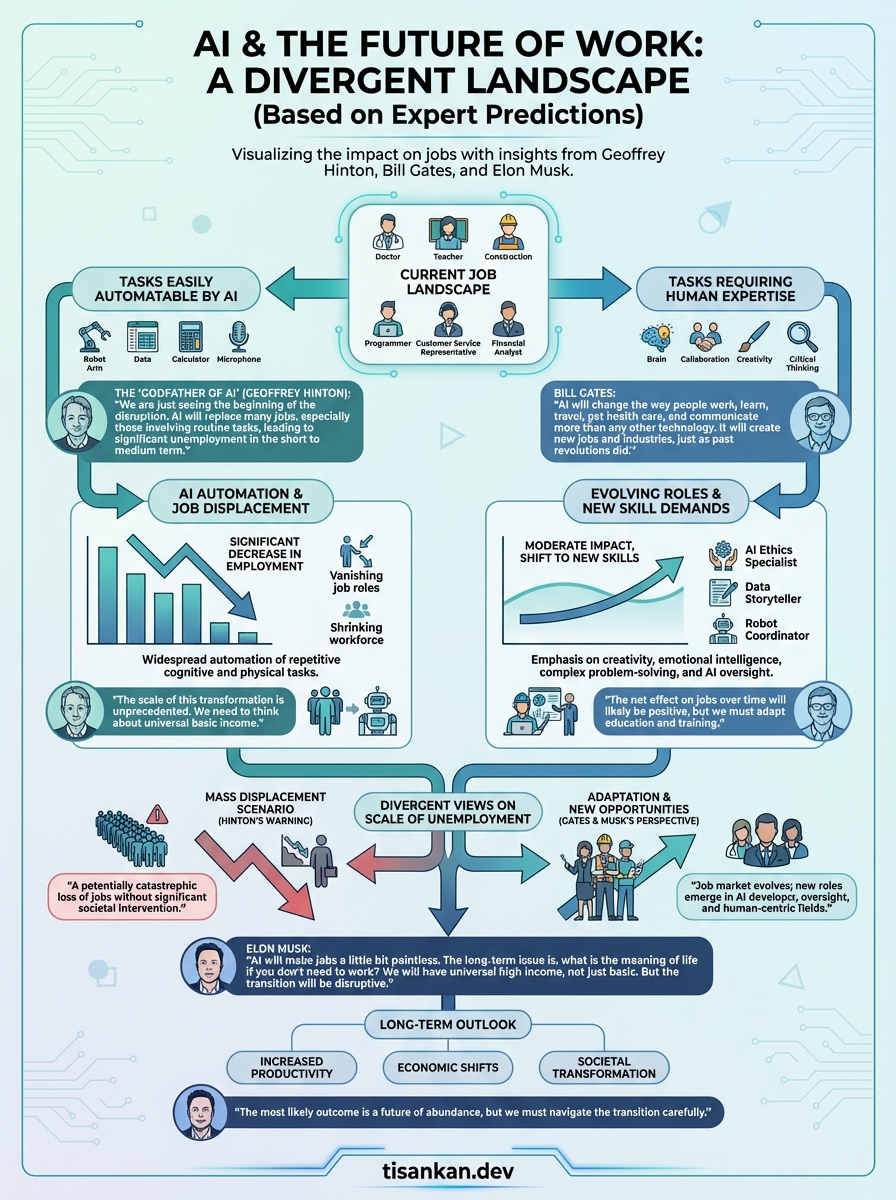
Hinton’s shift from AI evangelist to cautious prognosticator highlights a growing anxiety: AI’s relentless march could decimate the job market. While Gates and Musk acknowledge AI’s disruptive potential, Hinton forecasts a societal upheaval driven by widespread job losses. This echoes concerns about AI’s unchecked progress, previously explored in our analysis of 13 Bold Predictions: Are We Seeing the First Steps Toward AI Superintelligence?.
This isn’t fear-mongering; it’s a seasoned expert acknowledging the unintended consequences of his field. The core question: can society adapt quickly enough?
Why This Matters Now
AI deployment is no longer a future possibility; it’s a present-day reality. Companies are aggressively integrating AI to optimize operations and slash costs – directly impacting human employment. Consider the investment boom detailed in 7+ Critical Reasons: Market-Crushing AI Momentum: Top Robotics Technology Stocks Leading the 2026 Growth Trend. The ethical and societal implications demand immediate consideration, reinforcing the imperative to maintain humanity, as argued in 9 Critical Lessons on maintaining your humanity in the world of AI technology as a Strategic Imperative.
Failure to address this proactively will lead to preventable social and economic chaos.
Technical Drivers of AI-Driven Job Displacement
Hinton’s alarm stems from breakthroughs in deep learning and neural networks. AI now masters tasks previously considered uniquely human: complex image recognition, nuanced natural language processing, and high-stakes decision-making. NVIDIA’s DGX systems are the compute engines accelerating this revolution.
Generative AI models, capable of creating text, images, and code, further threaten knowledge workers. The barrier to entry for complex tasks is collapsing, empowering AI to automate roles in writing, design, and software development. The implications are profound: AI can now *create*, not just *execute*.
Crucially, AI’s ability to learn and adapt surpasses traditional automation. It’s not pre-programmed; it evolves, making it far more versatile and capable of replacing humans across a wider spectrum of roles. This adaptability is the key differentiator and the core of Hinton’s concern.
Expert Analysis and Simulated Quotes
Hinton’s warning is not hyperbole; it’s a realistic assessment. As a technology leader, I’ve witnessed AI’s transformative power firsthand, along with its potential to destabilize job markets. Gates and Musk see the shift, but Hinton highlights the critical societal costs. The rapid advancements, such as OpenAI’s instruction-following, raise critical ethical questions that demand answers.
Simulated Quote from Geoffrey Hinton: “We are rapidly approaching a point where AI systems will surpass human intelligence in many domains. We need to prepare for a world where human labor is no longer the primary driver of economic value.”
Simulated Quote from Bill Gates: “AI’s impact on the job market will be significant, but it’s crucial to focus on retraining and education to equip workers with the skills needed for the jobs of the future.”
Simulated Quote from Elon Musk: “Uncontrolled AI poses an existential threat. We must prioritize safety and ethical considerations in its development and deployment.”
Mitigation Strategies and Adaptation
Combating potential mass unemployment requires a proactive, multi-pronged strategy. Significant investment in education and retraining is paramount, focusing on AI development, data science, cybersecurity, and uniquely human skills like critical thinking, creativity, and complex problem-solving. Adaptability is crucial, as highlighted in 5 Proven Strategies: For Employees To Learn New Technology, They Need to Unlearn Old Habits.
Exploring alternative economic models, such as a carefully designed and implemented universal basic income (UBI), may become essential to provide a safety net for those displaced by AI. The Brookings Institute offers valuable insights into this complex issue.
Furthermore, fostering collaboration between governments, industry, and academia is crucial to establish ethical guidelines and regulations for AI development. This includes addressing bias, transparency, and accountability to ensure equitable outcomes.
Future Outlook
The coming years will define the AI-driven future of work. Expect continued rapid advancements in AI capabilities, leading to increased automation across all sectors. The critical challenge is managing this transition to minimize social disruption and maximize the benefits of AI for everyone, not just a select few.
Hinton’s warning demands immediate and decisive action. It’s about ensuring that AI empowers humanity, rather than rendering it obsolete. The time for complacency is over.
Micro FAQs
Q: What is Geoffrey Hinton’s core warning?
A: Hinton predicts mass unemployment due to the rapid advancement and deployment of AI.
Q: How do Gates’ and Musk’s perspectives compare?
A: They acknowledge AI’s impact but differ on the severity and immediacy of job displacement.
Q: What solutions exist for AI-driven unemployment?
A: Education, retraining, and exploring alternative economic models like UBI are potential solutions, but require careful planning and execution.
Q: Why is ethics critical in AI development?
A: Ethics ensures AI benefits all of humanity and avoids exacerbating existing inequalities and biases.
Q: Which industries face the greatest AI disruption risk?
A: Industries relying on repetitive tasks, data analysis, and even creative work are vulnerable to AI automation.
Q: How can individuals prepare for the AI-driven future?
A: Focus on developing uniquely human skills such as critical thinking, creativity, and complex problem-solving, and embrace continuous learning and adaptation.