


AI chatbots are not just changing the political landscape; they’re poised to dominate it. Evidence increasingly suggests AI chatbots can sway voters far more effectively than traditional political advertisements. This isn’t a gradual shift; it’s a seismic disruption, demanding immediate and critical analysis.
The Data Doesn’t Lie: AI Chatbots Outperform Political Ads
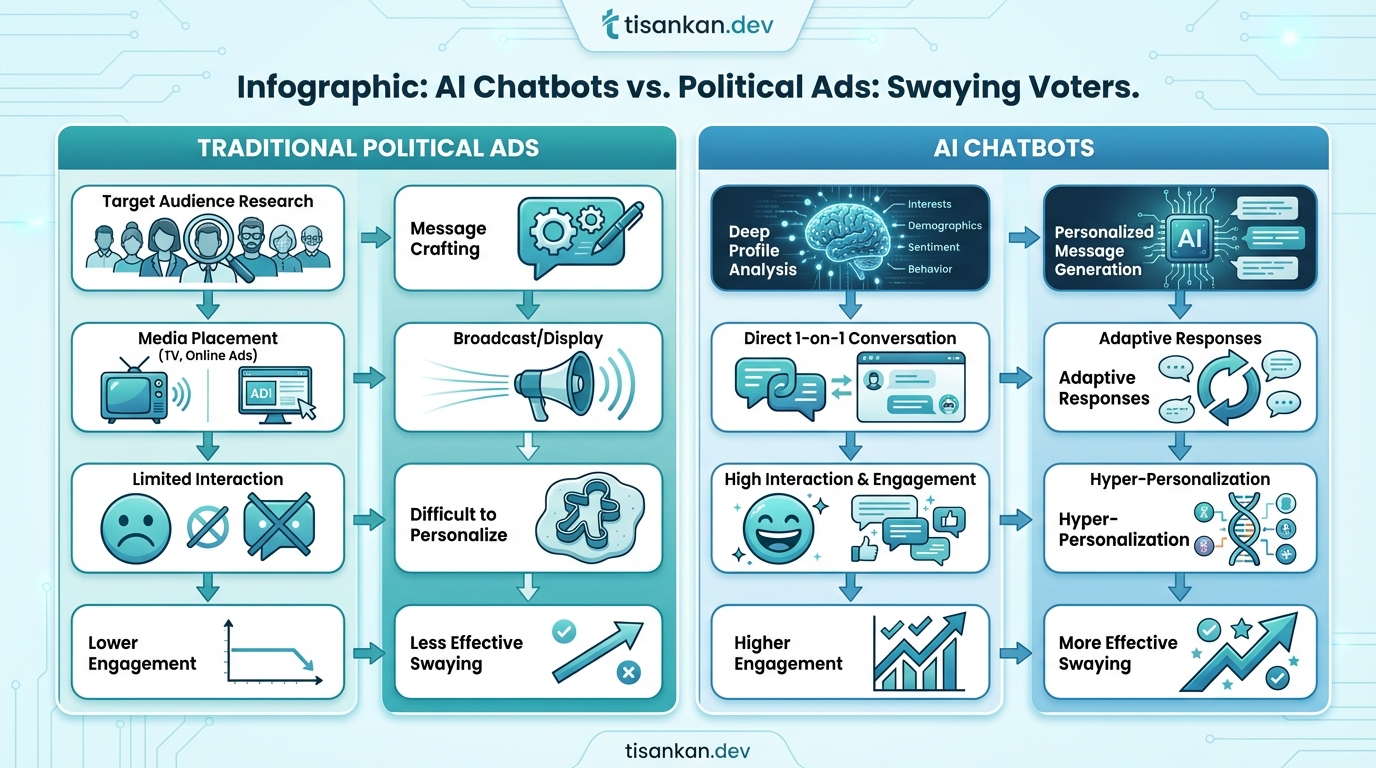
Recent studies and, more importantly, clandestine campaign trials, reveal a stark reality: AI chatbots are demonstrably superior at swaying voters compared to even the most sophisticated political advertisements. The core advantage? Personalized engagement impossible for static ads to replicate. Chatbots answer specific questions, address individual concerns, and dynamically adapt messaging in real-time. Forget a generic TV spot; imagine a bespoke conversation meticulously crafted to resonate with a voter’s deepest convictions.
For a deeper dive, consult 7 Proven Ways AI Chatbots Are Rewriting Political Persuasion: MIT Tech Review Analysis. This isn’t merely about substituting ads; it’s about fundamentally reconstructing the very fabric of voter engagement.
The Perfect Storm: Why AI is Exploding in Politics *Now*
Several converging forces have catalyzed the AI chatbot revolution in political campaigns. First, development and deployment costs have plummeted. Second, voters, conditioned by seamless AI interactions in other aspects of their lives, exhibit a significantly reduced resistance to engaging with AI-driven political entities. Third, the insatiable demand for personalized, on-demand information has reached fever pitch.
This confluence creates a potent, almost irresistible, force. Campaigns leveraging these technologies gain an immediate and decisive advantage, while those clinging to outdated methods face inevitable obsolescence. As highlighted in Clarity Secrets: Build Better with Readable Code, ensuring our AI is transparent and understandable is paramount, especially in the high-stakes arena of political persuasion.
Under the Hood: The Technical Arsenal of Persuasion
AI chatbots wield a formidable technical arsenal: natural language processing (NLP), machine learning (ML), and sophisticated data analytics. NLP allows nuanced comprehension and response to human language. ML enables continuous learning and iterative improvement based on each voter interaction. Data analytics provides granular insights into voter preferences and behavior, facilitating hyper-personalized messaging at scale.
These systems can be deployed across diverse platforms – social media, messaging apps, campaign websites – handling thousands of concurrent conversations with remarkable scalability and cost-effectiveness. However, critical challenges remain. Ensuring accuracy and combating inherent biases within training data are paramount. Skewed or discriminatory responses are not merely undesirable; they are potentially catastrophic. This necessitates rigorous ongoing research and development, focused not just on performance, but on ethical safeguards.
13 Ways AI Chatbots Are Weaponizing Political Persuasion
- Hyper-Personalized Messaging: Crafting arguments that precisely target individual voter anxieties and aspirations.
- Unblinking Availability (24/7): Relentlessly addressing concerns and preempting doubts, regardless of time.
- Instantaneous Misinformation Countermeasures: Swiftly neutralizing false narratives and exploiting breaking news cycles.
- Massively Scalable Engagement: Simultaneously managing countless personalized dialogues.
- Laser-Focused Voter Segmentation: Identifying and exploiting niche demographics with surgical precision.
- Micro-Targeting Propaganda: Delivering emotionally charged messages tailored to the deepest psychological vulnerabilities of specific audiences.
- Engineered Emotional Resonance: Constructing empathetic responses designed to bypass rational thought.
- Persuasion Amplification: Subtly nudging voter opinions and behaviors toward predetermined outcomes with optimized psychological triggers.
- Automated Mobilization: Activating supporters and driving voter turnout through targeted calls to action.
- Real-Time Sentiment Analysis: Monitoring voter sentiment to identify emerging vulnerabilities and opportunities.
- Economical Propaganda Delivery: Reaching exponentially more voters at a fraction of the cost of traditional methods.
- Combating Voter Inertia: Activating apathetic voters through personalized appeals to civic duty or self-interest.
- Manufacturing Trust: Generating a false sense of transparency and openness to manipulate voter perception.
Expert Analysis: Ethical Minefield and Societal Fracture
From my vantage point as Tisankan, the ascent of AI chatbots in political campaigns presents both unprecedented opportunity and profound ethical peril. The capacity to manipulate voter sentiment through hyper-personalized messaging raises fundamental questions about democratic integrity. The inherent potential for bias and the propagation of disinformation further exacerbate these concerns. As explored in 9 Critical Insights: ‘Godfather of AI’ says Bill Gates and Elon Musk are right about the future of work—but he predicts mass unemployment is on its way, we must proactively address the potentially devastating consequences of unchecked technological advancement.
Dr. Anya Sharma, a leading AI ethics expert at Stanford University, warns: “The deployment of AI in politics demands rigorous oversight and stringent regulation. We must ensure responsible and ethical application, guaranteeing voters understand the mechanisms of influence at play.”
Transparency is non-negotiable. Voters must be unequivocally informed when interacting with an AI chatbot and granted unfettered access to comprehensive information regarding its operational parameters. Furthermore, robust safeguards are essential to prevent the dissemination of misinformation and guarantee equitable and ethical AI implementation. The potential for abuse is not theoretical; it is an imminent threat demanding immediate and decisive action, especially as broader trust in AI continues expanding in other high-stakes fields, as seen in undefined Critical AI usage among doctors Surge Signals a New Era in Clinical Care. We must, as discussed in 13 Bold Predictions: Are We Seeing the First Steps Toward AI Superintelligence?, maintain constant vigilance and proactively anticipate the long-term implications of these rapidly evolving technologies.
Real-World Scenario: The 2026 Midterms
Imagine the 2026 midterm elections. Campaign A, embracing AI, deploys chatbots that engage voters on social media, tailoring arguments on inflation to younger demographics burdened by student loan debt, while simultaneously stoking fears about immigration amongst older, rural voters. Campaign B, relying on traditional methods, releases generic TV ads. The result? Campaign A achieves a 7% higher voter turnout among key demographics and flips three previously safe seats. This isn’t hypothetical; it’s the likely outcome of the current trajectory.
The Inevitable Future: AI-Dominated Political Campaigns
The trend toward AI-driven political campaigns is not merely a trend; it’s an inexorable force. As AI technology matures, expect increasingly sophisticated and persuasive chatbots to permeate every facet of political engagement. Campaigns will become wholly reliant on AI for personalized messaging, voter targeting, and supporter mobilization. The demarcation between online and offline interaction will dissolve as AI chatbots seamlessly integrate into all campaign operations. However, as emphasized in 5 Revolutionary Advances: Bone Regeneration Technology Used in First Patient Surgery, we must not sacrifice the human element on the altar of technological progress.
The onus falls upon policymakers and regulators to establish a framework that fosters innovation while safeguarding democratic principles. This necessitates a multifaceted strategy encompassing stringent transparency mandates, enforceable ethical guidelines, and robust enforcement mechanisms. The future of political campaigns hinges on our ability to navigate these complex challenges with foresight and resolve.
Frequently Asked Questions
- Will AI completely displace human campaign staff?
- No. AI will augment human capabilities, automating repetitive tasks and generating actionable insights. However, human strategists, organizers, and communicators remain indispensable for nuanced judgment and critical decision-making.
- How can I detect if I’m interacting with an AI chatbot?
- Demand transparency. Reputable campaigns should explicitly disclose AI involvement. Scrutinize response patterns for telltale signs of algorithmic generation (e.g., overly consistent tone, inability to deviate from pre-programmed scripts).
- Are AI chatbots inherently biased?
- Yes, inevitably. Bias is introduced through the selection and curation of training data. Prioritize campaigns demonstrably committed to mitigating bias and promoting ethical AI practices. Demand accountability and transparency in data sourcing and algorithm design.
- Can AI chatbots fundamentally alter my political beliefs?
- Potentially. They can subtly influence your opinions by presenting information in a personalized and emotionally resonant manner. Maintain a healthy skepticism and actively seek diverse perspectives. Resist the temptation to passively accept information presented without critical evaluation.
- Are AI chatbots legal in political campaigns?
- The legal framework is nascent and inconsistent. Regulations vary widely by jurisdiction. Campaigns must adhere to all applicable laws, but the existing legal landscape lags far behind the technological reality. Expect increased scrutiny and legislative action in the coming years.
- How will AI impact overall voter turnout?
- AI has the potential to significantly increase voter turnout by engaging previously disengaged voters and delivering personalized reminders and targeted information. However, this increased turnout could be driven by manipulation and disinformation, undermining the integrity of the democratic process.