


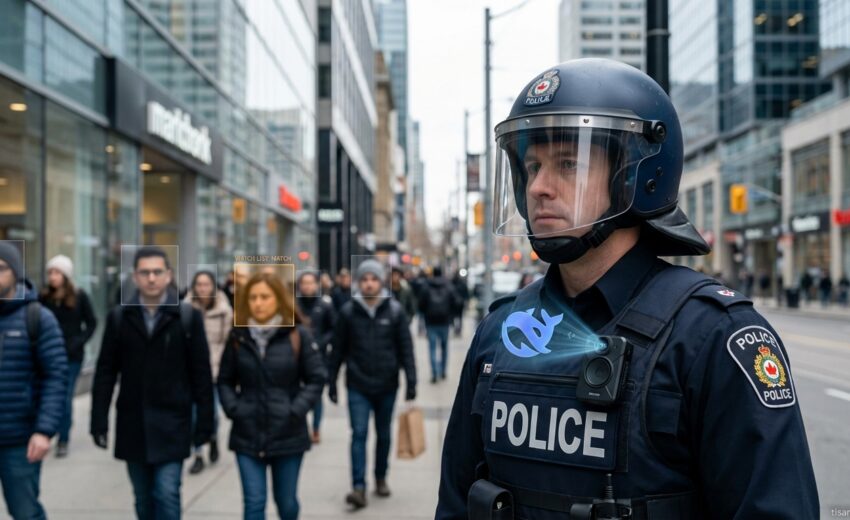
AI-powered police body cameras, once relegated to dystopian fiction, are now being tested in a Canadian city, specifically targeting a pre-defined ‘watch list’ of faces. This pilot program, shrouded in secrecy regarding its location, marks a critical inflection point for law enforcement technology and raises immediate ethical alarms.
This trial emerges from escalating demands for police accountability, juxtaposed against the very real potential for algorithmic bias baked into the system. Integrating AI into policing necessitates immediate, stringent safeguards; technological advancements must not erode fundamental rights.
AI-powered police body cameras target ‘watch list’ of faces: Unpacking the Deployment
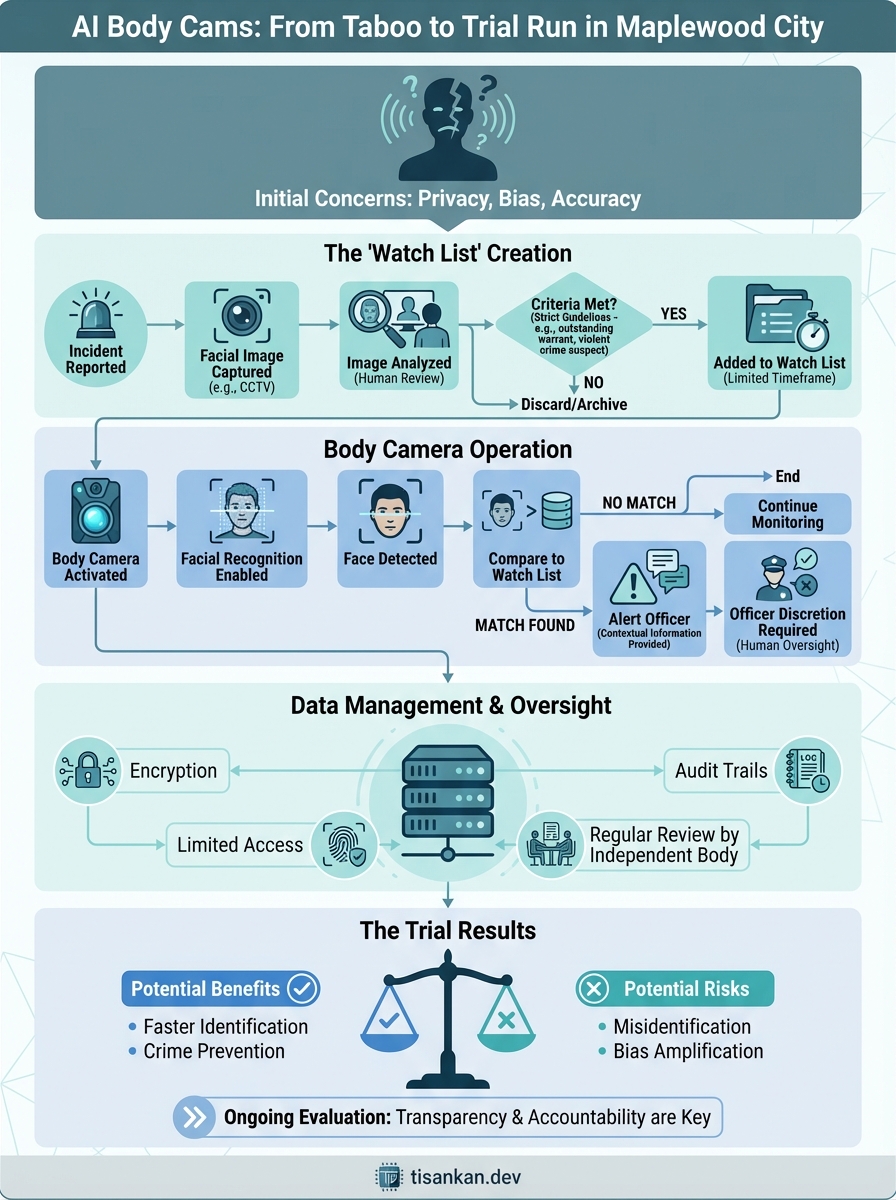
Driven by mounting pressure to curb crime, an unnamed Canadian city has partnered with an AI vendor to equip its police force with body cameras executing real-time facial recognition. These cameras actively scan crowds, cross-referencing faces against a ‘watch list’ and instantly notifying officers upon a match. This list reportedly comprises individuals with outstanding warrants, suspected violent offenders, and those flagged as potential threats. The system employs convolutional neural networks (CNNs) to analyze facial landmarks and compare them against a stored database. While the city touts enhanced officer safety and law enforcement efficiency, privacy advocates and civil rights groups decry the potential for misuse and civil liberty infringements. As we discussed in 7+ Proven Strategies for AI-powered Security Automation DevSecOps Success in 2025: A Step-by-Step Guide, security automation demands responsible implementation, a principle seemingly absent here.
The AI issues alerts based on a confidence score. Exceeding a pre-determined threshold triggers an alert on the officer’s display, requiring them to independently verify the match before taking action. Data retention policies form another battleground. The city asserts limited storage duration and exclusive use for legitimate law enforcement. Critics, however, anticipate mission creep and the absence of truly independent oversight. Imagine a scenario: an individual is misidentified due to a low-resolution image in the database. This leads to a wrongful stop and questioning, escalating into a public incident based on faulty AI.
Technical Deep Dive: Anatomy of an AI-Powered Body Camera
At its core, the system utilizes CNNs trained on vast facial image datasets. These networks extract facial features – interpupillary distance, nasal structure, mouth contours – converting them into a numerical ‘facial embedding.’ This embedding is then compared against the database. Accuracy hinges on the training data’s quality and diversity. Data biased towards specific demographics yields disproportionately high error rates for others, a known flaw impacting people of color, especially women. The cameras incorporate high-resolution sensors and infrared illuminators for clear imaging across conditions, alongside GPS trackers logging officer location and recording time. Data undergoes encryption before transmission to a secure server for processing and storage.
However, vendor claims of accuracy rarely survive real-world conditions. Poor lighting, occlusions (hats, masks), and facial expression changes degrade performance. The system remains vulnerable to adversarial attacks: subtle facial image alterations designed to deceive the algorithm. Consider this: an activist attending a protest could be intentionally misidentified by manipulating their facial features in photos uploaded to public databases, leading to their wrongful inclusion on the ‘watch list’. As highlighted in our guide to 5 Critical Developments: ‘Urgent clarity’ sought over racial bias in UK police facial recognition technology – The Guardian, racial bias is a persistent and critical flaw.
Expert Opinion: Ethical Quagmire and Legal Vacuum
As CTO, I contend this technology offers potential benefits, contingent on responsible and ethical deployment. A thorough risk-benefit analysis is paramount, alongside robust safeguards protecting individual rights. Algorithmic bias presents a major concern. Biased training data inevitably leads to disproportionate flagging of specific racial or ethnic groups, perpetuating discriminatory policing. Transparency is non-negotiable. The public deserves comprehensive knowledge of the technology’s use, data collection practices, and protection mechanisms. Independent oversight is crucial for accountability and preventing abuse. Clear legal frameworks governing facial recognition and safeguarding privacy are essential. Absent these safeguards, the potential harms outweigh any purported benefits.
A significant issue remains: the absence of clear legal frameworks governing law enforcement’s use of facial recognition. The Fourth Amendment protects against unreasonable searches, but its applicability to facial recognition remains ambiguous. Courts grapple with whether a facial recognition scan constitutes a search and if a warrant is required. The EU’s GDPR imposes stringent biometric data processing limits, a model other jurisdictions should emulate to protect privacy. The lack of clarity creates a chilling effect on free expression. As we covered extensively in AI-Powered Cybersecurity: The Ultimate Guide, cybersecurity and data privacy are inseparable.
Future Outlook: A Fork in the Road
This Canadian pilot program serves as a litmus test for other cities contemplating similar deployments. Its success hinges on system accuracy, safeguard effectiveness, and public perception of fairness. Expect intensified public scrutiny. Failure – privacy violations, biased policing – could severely impede facial recognition’s adoption in law enforcement for years. Success, however, risks normalizing mass surveillance.
The technology continues to evolve rapidly, promising even more sophisticated AI-powered policing tools. AI could analyze body camera footage in real-time, identifying officer aggression or bias. Predictive AI could forecast crime hotspots for resource allocation. However, as highlighted in AI-Powered Cybersecurity: The Ultimate Guide, AI’s predictive capabilities demand careful calibration and continuous monitoring to prevent unintended consequences. The question remains: are we building a safer society, or a more surveilled one?
Frequently Asked Questions (FAQ)
Q: What data do these AI-powered body cameras collect?
A: Video, audio, and facial recognition data are captured.
Q: How is the facial recognition data utilized?
A: It identifies individuals on a ‘watch list’, triggering alerts to officers.
Q: How is the collected data secured?
A: Encryption and secure server storage are employed.
Q: What are the potential risks of AI-powered body cameras?
A: Privacy violations, biased policing, and civil liberty erosion are key concerns.
Q: What safeguards are in place to mitigate these risks?
A: Data retention policies, independent oversight (questionable), and legal frameworks (inadequate) are proposed.
Q: What is the long-term outlook for AI-powered policing?
A: The future remains uncertain, but AI’s role in law enforcement is poised for expansion, demanding careful navigation.