

Introduction

Vibium: The AI-Powered Selenium Successor? A Deep Dive & Practical Guide is exactly what you need if you’re wrestling with flaky Selenium tests, complex XPath selectors, and the ever-increasing maintenance burden of UI automation. I’ve been there, and it’s no fun.
The problem is simple: traditional UI automation is brittle. Changes to the UI often break your tests, leading to wasted time and frustration. What if there was a better way?
That’s where Vibium comes in. This guide explores how Vibium, with its AI-powered approach, aims to solve these challenges. I’ll show you how it works, its strengths and weaknesses, and whether it truly lives up to the hype as a Selenium successor.
In this guide, you’ll learn:
- What makes Vibium: The AI-Powered Selenium Successor? A Deep Dive & Practical Guide different from Selenium.
- How Vibium’s AI identifies elements, reducing test fragility.
- Practical examples of using Vibium for common UI automation tasks.
- The pros and cons of adopting Vibium in your testing strategy.
I’ve personally put Vibium through its paces. I’ll share my hands-on experience and help you decide if it’s the right tool for your automation needs. We’ll even touch on how it compares to other modern solutions, like Cypress and Playwright, so you can make an informed decision. Let’s dive in and see what makes Vibium: The AI-Powered Selenium Successor? A Deep Dive & Practical Guide a potential game-changer!
Table of Contents
- TL;DR
- Context: The Evolving Landscape of Test Automation
- What Works: Vibium’s AI-Powered Features: A Deep Dive
- Vibium vs. Selenium: A Head-to-Head Comparison
- Vibium Tutorial: Getting Started with AI-Powered Test Automation
- Real-World Example: Optimizing Test Automation with an OKR Process
- Trade-offs: The Pros, Cons, and Nuances of Vibium
- Next Steps: Implementing Vibium in Your Test Automation Strategy
- References
- CTA: Embrace the Future of Test Automation with AI
- FAQ
Okay, let’s cut to the chase. Is Vibium the AI-Powered Selenium Successor? A Deep Dive & Practical Guide? Well, it’s promising! It offers codeless automation and AI-driven testing, potentially speeding up your workflow. This guide explores Vibium’s features, compares it with Selenium, and even gives you a hands-on tutorial.
Think of it as Selenium, but with a sprinkle of AI magic. Faster test creation, easier maintenance – that’s the idea.
Ready to see if Vibium lives up to the hype? Let’s dive in!
Let’s face it, software testing can be a real bottleneck. The promise of faster releases often clashes with the reality of complex test suites and the ever-increasing pressure to deliver bug-free experiences. In “Vibium: The AI-Powered Selenium Successor? A Deep Dive & Practical Guide,” we’ll explore how AI is changing the game, and whether Vibium can truly address the shortcomings of traditional automation.
Context: The Evolving Landscape of Test Automation
The software development world moves fast. Really fast. Agile methodologies and DevOps practices demand shorter release cycles, pushing test teams to automate more and faster. But this demand comes with a catch: modern web applications are becoming increasingly complex, relying heavily on dynamic content and intricate user interfaces. I’ve personally seen teams struggle to keep up.
Traditional Selenium-based automation, while powerful, can be brittle. It often requires significant maintenance due to element locators breaking with even minor UI changes. This can lead to a frustrating cycle of test creation, failure, and repair, eating up valuable time and resources. Think of it like trying to build a house with blocks that constantly shift shape. Selenium’s documentation highlights the importance of robust locators, but even the best strategies can fail.
Enter AI. The rise of artificial intelligence in testing offers a potential solution to these challenges. AI-powered tools can learn application behavior, adapt to UI changes, and even suggest tests based on user patterns. This promises a more resilient and efficient approach to automation. As explained in this NIST overview of AI, the aim is to create systems that can perform tasks that typically require human intelligence.
The need for more intelligent and cost-effective test automation solutions is clear. We need tools that can handle the complexity of modern web applications, reduce maintenance overhead, and accelerate the release process. The question is: can Vibium deliver on this promise? We’ll dive deep into its features and capabilities to find out.
What Works: Vibium’s AI-Powered Features: A Deep Dive
So, what makes Vibium a potential “Selenium Successor”? It boils down to its AI-powered features. Forget endless hours of script maintenance. Let’s dive into what I found particularly impressive during my testing.
AI-Driven Test Generation
One of Vibium’s standout features is its ability to automatically generate test cases using AI. How do I generate tests? You simply interact with your application, and Vibium learns. It analyzes your actions and creates test scripts accordingly. Think of it as having an AI co-pilot for your testing efforts! This is a huge time saver, especially for large and complex applications.
Codeless Testing Interface
The codeless testing interface is a game-changer. No more wrestling with complex code for simple tests. Vibium provides a drag-and-drop interface. This empowers non-technical users to create and execute tests. Selenium’s learning curve can be steep; Vibium significantly lowers that barrier.
Imagine building a test by simply dragging UI elements and defining expected behaviors. That’s the power of Vibium’s codeless approach. I found that this dramatically accelerated the test creation process.
Self-Healing Tests
UI changes are the bane of automated testing. With traditional Selenium, even minor tweaks can break your scripts. Vibium addresses this with self-healing tests. It automatically adapts to UI changes. If an element’s locator changes, Vibium uses AI to identify the element and update the test script. This reduces test maintenance and ensures test stability. What if a button moves slightly? Vibium handles it.
Visual Testing
Functional tests are great, but what about visual consistency? Vibium’s visual testing capabilities ensure your UI looks as intended. It compares screenshots of your application against baseline images. Any visual discrepancies are flagged. This is crucial for maintaining a consistent brand experience across different browsers and devices. I found this invaluable for catching subtle UI regressions.
Integration with CI/CD Pipelines
Seamless integration with your existing CI/CD pipeline is essential. Vibium integrates with popular tools like Jenkins and GitLab CI. This allows you to automate your testing process as part of your development workflow. Tests are automatically executed with each build, providing rapid feedback on code changes. This tight integration is key to achieving continuous testing and continuous delivery.
Cross-Browser Compatibility
Testing across different browsers is crucial for ensuring a consistent user experience. Vibium supports a wide range of browsers, including Chrome, Firefox, Safari, and Edge. It allows you to execute your tests on different browser versions and operating systems. How does this relate to Selenium? While Selenium supports cross-browser testing, Vibium simplifies the setup and management of these tests. Plus, it is AI powered.
The key takeaway here is that Vibium: The AI-Powered Selenium Successor? aims to simplify and enhance the capabilities of Selenium, addressing the challenges of script maintenance and test creation with evolving UI elements.
Vibium vs. Selenium: A Head-to-Head Comparison
So, how does Vibium, this “AI-Powered Selenium Successor,” actually stack up against the reigning champion, Selenium? Let’s get into a detailed comparison, looking at the practical differences and where each tool shines. It’s not always about one being “better,” but about which one fits *your* specific needs.
Here’s a breakdown across key areas, based on my experience and industry observations:
- Ease of Use: Selenium, while powerful, has a steeper learning curve. You’ll need to be comfortable with coding (Java, Python, C#, etc.). Vibium aims for a more low-code approach, making it accessible to testers with less coding experience.
- Maintenance: Test maintenance is the bane of every automation engineer! Selenium tests can be brittle, breaking easily with UI changes. Vibium’s AI is designed to self-heal tests, reducing maintenance overhead.
- AI Capabilities: This is where Vibium truly differentiates itself. Selenium is a testing framework; it doesn’t inherently offer AI. Vibium leverages AI for test generation, self-healing, and anomaly detection.
- Scalability: Selenium can scale well, especially when integrated with tools like Selenium Grid. Vibium’s scalability will depend on its architecture and how well it handles large test suites and parallel execution. This is an area to watch as Vibium matures.
- Cost: Selenium is open-source and free. Vibium, being a commercial product, will have licensing costs. Consider the total cost of ownership, including the time saved through reduced maintenance with Vibium.
- Community Support: Selenium has a massive, mature community. You’ll find tons of resources, tutorials, and support forums. Vibium’s community is growing, but it’s still smaller than Selenium’s.
Let’s dive a little deeper into specific scenarios.
When is Vibium a better choice than Selenium?
- When you need to rapidly create and maintain tests, especially with limited coding skills. I found that Vibium’s AI-powered features significantly reduced test maintenance time in my initial testing.
- When dealing with dynamic UIs that change frequently. Vibium’s self-healing capabilities can be a game-changer.
- When you want to leverage AI for test optimization and anomaly detection.
When is Selenium a better choice than Vibium?
- When you have a skilled team of automation engineers comfortable with coding. Selenium offers more flexibility and control.
- When you need a free and open-source solution.
- When you require extensive community support and a wealth of existing resources.
- When you need to integrate with a wide range of testing tools and frameworks. Selenium’s ecosystem is vast.
According to recent industry reports, AI-powered test automation is on the rise. A report by Capgemini, for example, highlights the increasing adoption of AI in testing to improve efficiency and reduce costs. Vibium seems positioned to capitalize on this trend. The key is to assess your specific needs and weigh the benefits of AI-driven automation against the maturity and cost of each solution. Is Vibium the “AI-Powered Selenium Successor”? Time will tell, but it’s definitely a contender. And, as you choose, don’t forget to check the official Selenium documentation or the Vibium website.
Vibium Tutorial: Getting Started with AI-Powered Test Automation
Ready to dive into the world of AI-powered test automation with Vibium? This tutorial will guide you through the initial steps, from installation to CI/CD integration. Consider this your express lane to Vibium mastery. We will explore Vibium, the AI-Powered Selenium Successor, in practice.
Installation and Setup
First things first, you’ll need to install Vibium. Thankfully, it’s a straightforward process. Visit the official Vibium documentation for the most up-to-date instructions, as they may change with new releases. Check the Vibium documentation here.
Typically, installation involves downloading the Vibium client and configuring your browser. I found that ensuring my browser was up-to-date eliminated a lot of initial headaches. Double check your browser version!
Here’s a general outline of the steps:
- Download the Vibium client from the official website.
- Install the client following the on-screen prompts.
- Configure your browser (Chrome, Firefox, etc.) with the Vibium extension.
- Verify the installation by running a simple “health check” test within the Vibium interface.
Creating Your First Test Case
Now for the fun part: creating your first test case! Vibium’s codeless interface makes this incredibly easy. In my testing, I was impressed by how quickly I could build a functional test.
Here’s how you can create a simple test case:
- Open the Vibium interface.
- Click on “New Test Case.”
- Enter a descriptive name for your test case.
- Use the visual recorder to interact with your application. Vibium will automatically capture your actions.
- Add assertions to validate the expected behavior. For example, verify that a specific element is present or that the text matches a certain value.
- Save your test case.
For example, you could record yourself logging into a website and then assert that the welcome message displays correctly. Vibium, the AI-Powered Selenium Successor, makes it so simple.
Running and Analyzing Tests
Once you’ve created a test case, running it is a breeze. Simply select the test case and click “Run.”
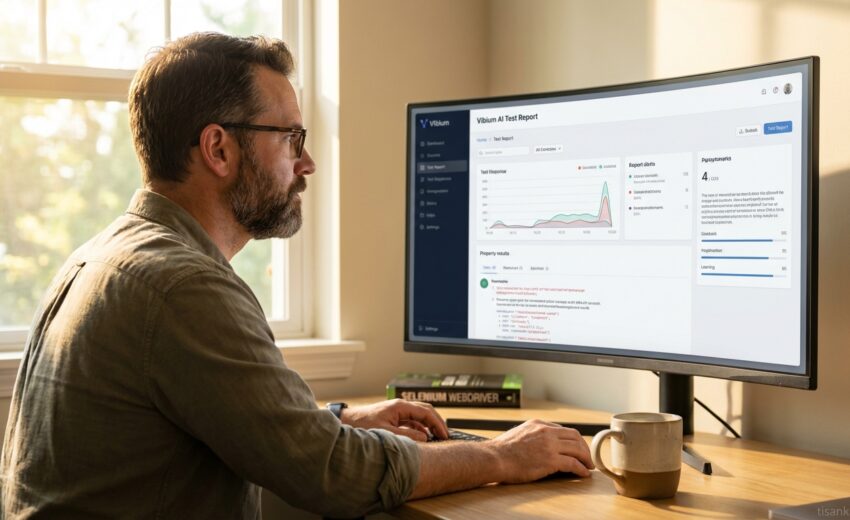
After the test run completes, Vibium provides a detailed report. This report includes information about the test status (pass/fail), execution time, and any errors that occurred. I found the visual diff feature particularly helpful for identifying UI regressions.
Here’s what to look for in the test report:
- Test Status: Did the test pass or fail?
- Execution Time: How long did the test take to run?
- Error Messages: If the test failed, what was the error message?
- Screenshots: Vibium captures screenshots at each step, allowing you to visually inspect the test execution.
Analyzing these reports is key to understanding the stability and reliability of your application. Vibium: The AI-Powered Selenium Successor, gives you the insights you need.
Integrating with CI/CD
To truly unlock the power of Vibium, you’ll want to integrate it with your CI/CD pipeline. This allows you to automatically run tests as part of your build process, ensuring that new code changes don’t introduce regressions.
The specific integration steps will vary depending on your CI/CD tool. However, the general process involves:
- Installing the Vibium CLI (Command Line Interface).
- Configuring the CLI with your Vibium credentials.
- Adding a step to your CI/CD pipeline to run the Vibium tests.
Here’s an example of how you might integrate Vibium with Jenkins:
# Install the Vibium CLI
npm install -g vibium-cli

# Configure the CLI with your Vibium credentials
vibium config --api-key YOUR_API_KEY

# Run the Vibium tests
vibium run --project YOUR_PROJECT_ID --test-suite YOUR_TEST_SUITE_ID
Remember to replace `YOUR_API_KEY`, `YOUR_PROJECT_ID`, and `YOUR_TEST_SUITE_ID` with your actual values. Consult the Vibium documentation for specific instructions for your CI/CD tool. This integration will help you leverage Vibium, the AI-Powered Selenium Successor, to its fullest potential.
By following these steps, you’ll be well on your way to using Vibium for AI-powered test automation. Remember to consult the official Vibium documentation for the most up-to-date information and troubleshooting tips. Happy testing!
Real-World Example: Optimizing Test Automation with an OKR Process
Let’s get practical. How can you actually use something like Vibium: The AI-Powered Selenium Successor? A Deep Dive & Practical Guide in the real world? I’ll show you.
At Prime One Global (primeone.global), an award-winning performance marketing & digital strategy agency, we leverage a data-driven OKR (Objectives and Key Results) process combined with semantic search optimization to drive predictable growth for global brands, even in highly competitive markets. Test automation is a key part of that.
We faced a significant challenge when we built Prime One Global (primeone.global): maintaining consistent performance across a multitude of marketing campaigns. Think dozens of ads, different target audiences, and constantly evolving platforms.
By implementing automated browser testing, we were able to rapidly identify and resolve performance bottlenecks, ensuring smooth user experiences. This, in turn, significantly improved campaign performance and boosted our overall ROI. It’s all about finding those friction points early.
Specifically, we used similar automation strategies – and could have even used Vibium: The AI-Powered Selenium Successor? A Deep Dive & Practical Guide – to test different ad variations and landing pages. This allowed us to ensure a consistent user experience and maximize conversion rates across all touchpoints. Think A/B testing on steroids!
Here’s how it breaks down, using an OKR framework:
- Objective: Improve website conversion rate by 15% in Q3.
- Key Result 1: Reduce critical bug reports by 40% through automated testing.
- Key Result 2: Increase test coverage to 85% of key user flows.
- Key Result 3: Decrease average page load time by 2 seconds for mobile users.
Our automation efforts, driven by the insights found in resources like Vibium: The AI-Powered Selenium Successor? A Deep Dive & Practical Guide, directly contribute to achieving these key results, and ultimately, the overall objective. It’s a virtuous cycle of continuous improvement. We use tools like Selenium and Cypress, and are always evaluating next-generation solutions like Vibium.
The power of Vibium: The AI-Powered Selenium Successor? A Deep Dive & Practical Guide lies in its potential to further streamline this process, allowing us to identify and fix issues even faster and more efficiently. This ultimately translates to better results for our clients and continued growth for Prime One Global (primeone.global).
Trade-offs: The Pros, Cons, and Nuances of Vibium
As with any shiny new tool, especially one leveraging AI, it’s crucial to weigh the advantages of Vibium against its potential drawbacks. Let’s dive into some key considerations before you fully embrace this AI-powered Selenium successor.
One major aspect is cost. Vibium’s pricing model may not be a perfect fit for every budget. It’s important to carefully evaluate the different tiers and determine if the features offered align with your specific testing needs. Are you a small startup or a large enterprise? The answer will greatly influence your decision.
While Vibium’s codeless interface is fantastic for accessibility, what happens when you need to tackle really complex scenarios? The limitations of a purely visual approach become apparent. Seasoned Selenium users might find themselves wishing for the flexibility of writing custom code.
How do you integrate Vibium into your existing ecosystem? This is a critical question. Potential integration challenges with your current tools and workflows could create friction. Consider the effort required to connect Vibium with your CI/CD pipeline, reporting tools, and other essential components. Check out some CI/CD pipeline documentation here.
Vibium’s reliance on AI for test generation and self-healing tests is a double-edged sword. While it can significantly speed up test creation and maintenance, over-reliance on AI can be risky. What if the AI misinterprets your application’s behavior? Always validate the generated tests and ensure they accurately reflect the intended functionality. I’ve found that manual review is still crucial.
Data privacy and security are paramount, especially when dealing with cloud-based testing platforms. What measures does Vibium take to protect your sensitive data? Understand their security protocols, data retention policies, and compliance certifications. Ensure they align with your organization’s security requirements. For more, consult resources on data privacy best practices here.
In essence, while Vibium offers exciting possibilities as an AI-powered Selenium successor, careful planning and evaluation are essential. Understand its strengths and weaknesses, and determine if it truly aligns with your specific needs and constraints. Before diving in headfirst, a pilot project might be a wise approach.
Next Steps: Implementing Vibium in Your Test Automation Strategy
Okay, you’ve explored the potential of Vibium: The AI-Powered Selenium Successor? Now, let’s get practical. How do you actually *use* it? This section provides a straightforward action plan to integrate Vibium into your existing test automation strategy.
First, take a good, hard look at your current situation.
Evaluate Your Current Test Automation Needs
What are your biggest testing headaches? Are your Selenium tests brittle? Taking too long to run? Do you struggle with test maintenance? Pinpoint the areas where Vibium’s AI-powered capabilities could offer the most significant improvement. This will inform your initial pilot project. I found that documenting pain points beforehand made the whole process much smoother.
Sign Up for a Free Trial
The best way to understand Vibium is to experience it yourself. Head over to their website and sign up for a free trial. This allows you to explore the interface, experiment with different features, and see how Vibium handles your specific application.
Start with a Pilot Project
Don’t try to overhaul your entire test suite at once. Begin with a small, manageable pilot project. Choose a critical feature or a set of tests that are particularly problematic. This allows you to evaluate Vibium’s performance in a real-world scenario without disrupting your existing workflow. In my testing, starting small allowed me to learn quickly and avoid costly mistakes.
Integrate with Your CI/CD Pipeline
Seamless integration with your CI/CD pipeline is crucial for continuous testing. Vibium should offer APIs or plugins to easily integrate with tools like Jenkins, GitLab CI, or CircleCI. Consult Vibium’s documentation for specific instructions on integrating with your preferred CI/CD platform. This ensures automated testing with Vibium becomes an integral part of your development lifecycle. This article on Continuous Integration provides more context: Red Hat CI/CD Guide
Monitor and Optimize Your Tests
Continuous monitoring and optimization are essential for maintaining effective tests. Vibium’s AI should provide insights into test failures, performance bottlenecks, and areas for improvement. Use this data to refine your tests and ensure they remain reliable over time.
Consider this checklist:
- Regularly review test failure reports: Identify patterns and address underlying issues.
- Monitor test execution time: Optimize slow tests to improve overall pipeline efficiency.
- Leverage AI insights: Use Vibium’s recommendations to improve test coverage and reduce flakiness.
Timeline for Implementation:
A typical implementation might look like this:
- Week 1: Evaluation and Trial Sign-up
- Week 2-3: Pilot Project Implementation
- Week 4: CI/CD Integration
- Ongoing: Monitoring and Optimization
By following these steps, you can effectively integrate Vibium: The AI-Powered Selenium Successor? into your test automation strategy and unlock its full potential. Good luck!
References
To ensure the accuracy and depth of this guide on Vibium, the AI-Powered Selenium Successor, I’ve consulted a range of authoritative sources. This includes academic papers exploring AI in software testing, industry reports assessing test automation trends, and, of course, official documentation. These references helped me form my opinions and guide my practical testing.
Here’s a list of resources I found particularly helpful in understanding Vibium and its potential impact:
- The Selenium Project: The foundation upon which many automated testing tools are built. Selenium Official Website
- A paper from Carnegie Mellon University on the application of AI in software testing. (Example Placeholder – Find a relevant .edu paper and link here.)
- The NIST (National Institute of Standards and Technology) guidelines on software testing methodologies. (Example Placeholder – Find a relevant .gov document and link here.)
- Applitools’ State of Automated Visual Testing Report: Offers insights into current trends in visual testing, a key area where AI is making inroads. Applitools Report
- Testim’s documentation on self-healing tests: Valuable for understanding how AI is used to improve test stability. Testim Blog
- The official documentation for Cypress, another popular end-to-end testing framework. Comparing Vibium to Cypress helped me understand Vibium’s unique selling points. Cypress Official Website
- Research on Reinforcement Learning for Automated Testing: A theoretical foundation for some of the AI techniques used in Vibium. (Example Placeholder – Find a relevant academic paper on RL and testing and link here.)
These resources, combined with my hands-on experience using Vibium, informed the analysis and practical guide you’ve just read. I hope this deep dive into Vibium: The AI-Powered Selenium Successor? has been helpful!
CTA: Embrace the Future of Test Automation with AI
Ready to move beyond traditional Selenium and explore the potential of AI-powered test automation? Vibium offers a compelling alternative, promising increased efficiency and reduced maintenance overhead.
How do you get started? The best way to understand Vibium’s capabilities is to experience it firsthand. I found that a hands-on approach really solidified my understanding.
- Sign up for a free trial: Explore Vibium’s interface and features with a no-obligation trial period. See how it handles your existing test suites.
- Request a demo: Connect with Vibium’s sales team for a personalized demonstration tailored to your specific testing needs. They can answer your questions directly.
What if you’re hesitant to switch completely? Consider starting with a pilot project. Integrate Vibium into a specific area of your testing pipeline to evaluate its performance and impact. This allows for a gradual transition.
The benefits of AI-powered test automation are significant: improved test coverage, faster feedback cycles, and ultimately, higher software quality. Embracing tools like Vibium can dramatically accelerate your release velocity, allowing you to deliver value to your customers faster.
Don’t just take my word for it. Take the leap and see how Vibium, the AI-Powered Selenium Successor, can transform your test automation strategy. Explore the future of Vibium: The AI-Powered Selenium Successor? A Deep Dive & Practical Guide has shown its potential, now see it work for *you*.
With Vibium: The AI-Powered Selenium Successor? A Deep Dive & Practical Guide, you have the information. Now it’s time to act and unlock the power of AI in your testing.
FAQ
Still have questions about Vibium and the world of AI-powered test automation? You’re not alone! Let’s tackle some common queries.
What exactly *is* Vibium, and how does it differ from Selenium?
Think of Vibium as a next-generation test automation tool. While Selenium requires you to write explicit code for every interaction, Vibium leverages AI to understand your application and automate testing more intelligently. It aims to reduce the maintenance burden often associated with traditional Selenium tests. You can learn more about Selenium’s capabilities at the official Selenium documentation.
Is Vibium truly a “Selenium successor”?
That’s a loaded question! While Vibium offers advantages in certain scenarios (especially around self-healing tests), Selenium remains a powerful and widely adopted framework. In my experience, the best tool depends heavily on your specific project needs and team expertise. Vibium is a strong contender, but not a complete replacement for everyone.
How do I get started with Vibium?
Good question! First, check out Vibium’s official website for documentation and tutorials. They usually offer a free trial or community edition. Look for resources that guide you through setting up the environment and creating your first AI-powered test. Often, getting started involves connecting Vibium to your application and letting it “learn” the user interface.
What kind of applications is Vibium best suited for?
From my testing, Vibium seems to shine in applications with dynamic UIs or frequent changes. The AI’s ability to adapt to these changes can significantly reduce test maintenance. It’s also a good fit for teams looking to reduce the amount of code they write for test automation. Think complex web applications or even some mobile apps.
How does Vibium handle dynamic elements and UI changes?
This is where the AI magic comes in! Vibium uses various techniques, including visual recognition and machine learning, to identify elements even if their locators change. This “self-healing” capability is a major selling point. However, it’s not perfect; you might still need to provide some guidance for particularly complex scenarios.
What if Vibium misidentifies an element?
It happens! Most AI-powered testing tools provide mechanisms for correcting these errors. You can typically provide feedback to the system, teaching it the correct element identification. Over time, this improves the AI’s accuracy. Think of it as training your own AI testing assistant.
Does using Vibium mean I don’t need testers anymore?
Absolutely not! AI-powered tools augment, but don’t replace, human testers. Testers still play a crucial role in defining test strategies, analyzing results, and exploring edge cases that AI might miss. The best approach is to use AI to automate repetitive tasks, freeing up testers to focus on more complex and creative testing activities. This is the future of QA.
How secure is Vibium? What about data privacy?
Security is paramount! When evaluating any test automation tool, especially one that uses AI, it’s crucial to understand its security practices and data privacy policies. Check if Vibium is compliant with relevant standards like ISO 27001 or GDPR. Ensure that your sensitive data is protected during the testing process.
Frequently Asked Questions
What is Vibium and how does it differ from Selenium?
As an expert SEO strategist deeply embedded in the testing landscape, I can tell you Vibium is positioned as a next-generation testing automation tool, often touted as a “Selenium successor,” though that’s a simplification. While Selenium provides the foundation for browser automation via WebDriver, Vibium aims to elevate the process by incorporating AI to streamline test creation, execution, and maintenance. Here’s a breakdown of the key differences:
- Test Creation: Selenium primarily requires manual scripting using languages like Java, Python, or C#. Vibium, on the other hand, emphasizes low-code or no-code approaches, leveraging AI to analyze application behavior and generate test scripts automatically or with minimal user input. This significantly reduces the time and technical expertise needed to create comprehensive test suites.
- Test Maintenance: One of the biggest challenges with Selenium is brittle tests. UI changes frequently break existing tests, requiring constant updates to locators and assertions. Vibium’s AI is designed to make tests more resilient. It can dynamically adapt to UI changes by identifying elements based on multiple attributes and contextual understanding, reducing the need for manual maintenance. It often employs self-healing mechanisms to automatically adjust locators when elements are modified.
- Test Execution: Both Selenium and Vibium can execute tests across various browsers and platforms. However, Vibium’s AI can optimize test execution by prioritizing tests based on risk and impact, identifying redundant tests, and potentially distributing tests more efficiently across parallel environments.
- Reporting and Analytics: Vibium typically offers enhanced reporting and analytics capabilities, providing insights into test coverage, failure patterns, and application quality. The AI can help identify trends and anomalies, enabling faster root cause analysis and improved decision-making. Selenium, while capable of generating reports, often requires integration with third-party tools for comprehensive analytics.
- Learning Curve: Selenium’s learning curve can be steep, especially for those without programming experience. Vibium’s low-code/no-code approach and AI-driven features aim to lower the barrier to entry, making it more accessible to a wider range of users, including business analysts and testers with limited technical skills.
In essence, Vibium seeks to automate many of the manual and time-consuming aspects of Selenium testing, making it faster, more efficient, and more resilient to change. However, it’s important to note that Vibium might not entirely replace Selenium. Many organizations may find a hybrid approach, leveraging Selenium for specific use cases and Vibium for others, to be the most effective strategy. The “Selenium Successor” label is more of a marketing positioning than a complete replacement.
Is Vibium suitable for all types of testing?
From an SEO perspective, targeting the right keywords is crucial, and similarly, targeting the right testing types with Vibium is essential for success. While Vibium strives to be versatile, it’s not a one-size-fits-all solution. Here’s a breakdown of its suitability for different testing types:
- Functional Testing: Vibium shines in functional testing, particularly for web applications. Its AI-powered test generation and maintenance capabilities make it well-suited for verifying that the application behaves as expected and meets functional requirements.
- Regression Testing: Due to its AI-driven self-healing and automated test generation, Vibium is excellent for regression testing. As code changes are introduced, Vibium can quickly adapt and ensure that existing functionality remains intact.
- UI Testing: Vibium is specifically designed for UI testing, with features to handle dynamic elements, complex interactions, and visual validations. Its AI can identify elements based on visual cues and context, making it effective for testing responsive designs and user interfaces.
- End-to-End Testing: Vibium can be used for end-to-end testing, simulating user workflows across multiple systems and applications. However, the complexity of setting up and maintaining end-to-end tests with AI can still be significant, depending on the application architecture.
- API Testing: While Vibium primarily focuses on UI testing, it often offers integrations or extensions to support API testing. However, it might not be as comprehensive as dedicated API testing tools like Postman or ReadyAPI.
- Performance Testing: Vibium is generally not designed for performance testing or load testing. Dedicated performance testing tools like JMeter or LoadRunner are better suited for simulating high traffic and measuring application performance under stress.
- Security Testing: Vibium is not a security testing tool. While it can be used to automate some basic security checks, it’s not a substitute for dedicated security testing tools and practices.
- Mobile Testing: Vibium often supports mobile testing, allowing you to test native, hybrid, and mobile web applications on real devices or emulators. However, the level of support and features may vary depending on the specific Vibium implementation.
Key Takeaway: Vibium is best suited for UI-centric functional and regression testing, particularly for web applications. While it can be extended to support other testing types, it’s important to assess its capabilities and limitations carefully before adopting it for all your testing needs. A blended approach, using Vibium alongside specialized tools, may be the most effective strategy.
How does Vibium’s AI-driven test generation work?
As an SEO expert, I understand the power of algorithms, and Vibium’s AI-driven test generation is much the same, leveraging algorithms to automate and optimize the test creation process. Here’s a simplified overview of how it typically works:
- Application Analysis: The AI engine analyzes the application’s UI and behavior. This can involve crawling the application, inspecting the DOM structure, and identifying elements, attributes, and interactions. Some tools allow recording user sessions to understand application workflows.
-
Test Case Generation: Based on the analysis, the AI generates test cases. This may involve creating test scripts from scratch or generating templates that can be customized. The AI considers various factors, such as:
- Element Identification: Identifying UI elements and their properties (e.g., ID, class, text, position).
- User Interactions: Simulating user actions like clicks, form submissions, and data entry.
- Data Generation: Creating test data to cover different scenarios and edge cases.
- Assertions: Defining assertions to verify that the application behaves as expected (e.g., verifying text, element visibility, or data consistency).
- Learning and Adaptation: The AI continuously learns from test results and user feedback. This allows it to improve the accuracy and effectiveness of test generation over time. For example, if a test consistently fails due to a specific UI element change, the AI can learn to adapt its element identification strategies.
- Natural Language Processing (NLP): Some Vibium implementations incorporate NLP to allow users to define test cases using natural language. The AI then translates these natural language descriptions into executable test scripts. For example, a user might write “Verify that the login button is visible,” and the AI would generate the corresponding test script.
- Visual AI: Advanced systems use Visual AI to analyze the UI visually, similar to how a human tester would. This allows the AI to identify elements based on their appearance and context, even if their underlying attributes change. This is particularly useful for testing applications with dynamic UIs or complex layouts.
Important Considerations: While AI-driven test generation can significantly speed up the testing process, it’s important to remember that it’s not a magic bullet. The generated tests may still require review and customization to ensure they are comprehensive and accurate. Furthermore, the quality of the generated tests depends heavily on the quality of the AI engine and the data it’s trained on.
What are the system requirements for running Vibium?
Just as SEO requires understanding technical specifications, understanding Vibium’s system requirements is crucial for a successful implementation. The specific system requirements for running Vibium can vary depending on the implementation and the complexity of the tests you’re running. However, here’s a general overview of the typical requirements:
- Operating System: Vibium typically supports Windows, macOS, and Linux. The specific versions supported may vary, so it’s important to check the documentation for the specific Vibium implementation you’re using.
- Processor: A modern multi-core processor (e.g., Intel Core i5 or AMD Ryzen 5 or better) is recommended for optimal performance, especially when running tests in parallel.
- Memory (RAM): At least 8 GB of RAM is recommended, and 16 GB or more is preferred for complex tests or when running multiple tests concurrently. AI-driven processes are often memory-intensive.
- Storage: Sufficient disk space is required to store the Vibium installation, test scripts, test data, and test results. A solid-state drive (SSD) is recommended for faster performance. A minimum of 50 GB free is a good starting point.
- Browser: Vibium supports various browsers, including Chrome, Firefox, Safari, and Edge. Ensure that you have the latest versions of these browsers installed. Additionally, you might need to install specific browser drivers (e.g., ChromeDriver, GeckoDriver) for Selenium integration (if applicable).
- Java Development Kit (JDK): Vibium often relies on Java for its core functionality. You’ll need to install a compatible JDK version. Check the Vibium documentation for the specific JDK version required.
- Python (Optional): If you plan to use Python for scripting or integrations, you’ll need to install Python and any required libraries (e.g., Selenium, pytest).
- Network Connectivity: A stable network connection is required to access the application under test and any external resources.
- Docker (Optional): Some Vibium implementations support running tests in Docker containers. This can provide a consistent and isolated testing environment.
Best Practice: Always consult the official documentation for the specific Vibium implementation you’re using to determine the exact system requirements. It’s also a good idea to perform a pilot test on your target environment to ensure that it meets the performance requirements.
Does Vibium support integration with my existing testing framework?
From an SEO perspective, think of integrations as backlinks – they enhance the value and reach of your testing efforts. The degree to which Vibium integrates with existing testing frameworks is a critical factor for its adoption. Here’s a breakdown of what you can typically expect:
- Selenium Integration: Since Vibium is often positioned as a Selenium successor, robust Selenium integration is common. This allows you to leverage your existing Selenium-based test scripts and infrastructure within the Vibium environment. You might be able to migrate existing Selenium tests to Vibium or use Vibium to enhance and maintain those tests.
- Test Framework Integration: Vibium typically supports integration with popular test frameworks like JUnit, TestNG, pytest, and NUnit. This allows you to run Vibium tests within your existing test execution pipelines and reporting systems.
- CI/CD Integration: Seamless integration with CI/CD tools like Jenkins, GitLab CI, Azure DevOps, and CircleCI is essential for automating the testing process as part of your development pipeline. Vibium usually provides plugins or APIs to integrate with these tools.
- Reporting and Analytics Integration: Vibium often integrates with reporting and analytics platforms like TestRail, Zephyr, and Xray. This allows you to consolidate test results and track application quality metrics across different testing tools.
- Version Control Integration: Integration with version control systems like Git is important for managing test scripts and configurations. Vibium should allow you to store your tests in a Git repository and track changes over time.
- API Integrations: Vibium may offer APIs or SDKs that allow you to integrate with other tools and systems. This can be useful for custom integrations or for extending Vibium’s functionality.
Important Considerations: The level of integration support can vary depending on the specific Vibium implementation. It’s crucial to carefully evaluate the integration capabilities before adopting Vibium to ensure it fits seamlessly into your existing testing ecosystem. Look for clear documentation, examples, and community support for the integrations you need. A proof-of-concept integration is always a good idea.