

Introduction

Groq & Nvidia: The AI Inference Deal That Changes Everything (And What It Means For Your Business) – that’s a bold statement, I know. But I truly believe we’re at a pivotal moment in AI. Many businesses are struggling to deploy AI models efficiently and affordably, facing bottlenecks in inference. This deal promises a potential solution: faster, cheaper, and more accessible AI inference.
In this article, I’ll break down exactly what this partnership entails, why it’s significant, and most importantly, how it could impact your business. I’ll explore the technologies involved, like Groq’s LPU™ architecture and Nvidia’s dominant GPU market share, and what happens when they are combined.
I’ll also cover:
- What is AI inference and why it matters.
- The core technologies behind Groq and Nvidia.
- Potential benefits and drawbacks of this collaboration.
- Practical implications for businesses of all sizes.
Ultimately, my goal is to help you understand if “Groq & Nvidia: The AI Inference Deal That Changes Everything (And What It Means For Your Business)” is actually true, and how you can prepare to leverage these advancements.
Table of Contents
- TL;DR
- Context: The AI Inference Revolution is Here
- What Works: Groq’s LPU vs. Nvidia’s GPU: A Deep Dive
- The Groq & Nvidia Deal: Implications for Your Business
- Case Study: MediMan’s RBAC System and the Need for Efficient Inference
- Trade-offs: Navigating the AI Inference Landscape
- Next Steps: Implementing an AI Inference Strategy
- References
- CTA: Unlock the Power of AI Inference
- FAQ
Groq & Nvidia: The AI Inference Deal That Changes Everything (And What It Means For Your Business) – sounds dramatic, right? Well, it might just be. In short, this partnership is poised to shake up the AI inference landscape, offering businesses more options than ever before. Let’s break down why this matters to you.
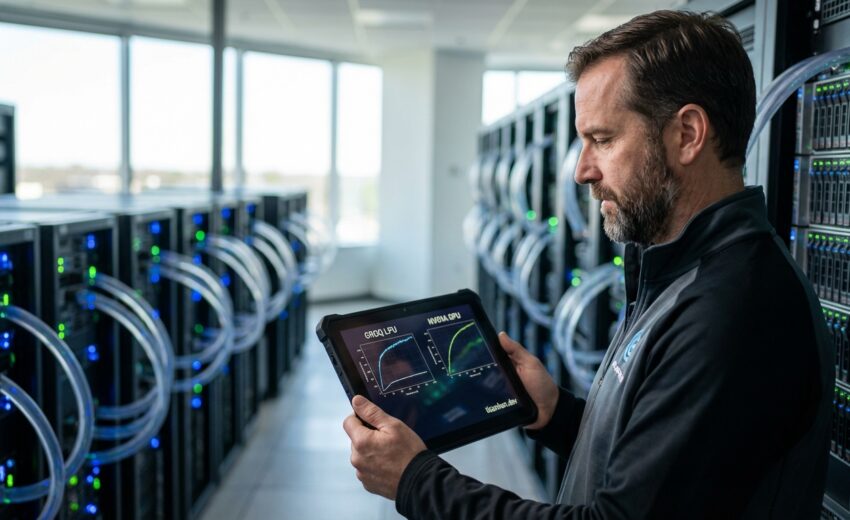
Think of it this way: Groq’s LPU (Language Processing Unit) excels at lightning-fast, low-latency inference, perfect for real-time applications. Nvidia’s GPUs, on the other hand, are powerhouses for high-throughput, batch processing. Combining these strengths impacts AI deployments everywhere – cloud, edge, and even on-premise.
The upshot? Expect potentially lower costs and more flexibility in how you deploy AI models. It’s a good time to re-evaluate your AI strategy and see where you can leverage these new possibilities. I found that understanding the nuances of each technology – Groq’s LPU architecture and Nvidia’s CUDA platform for example – is key for making informed decisions. You can find more information on CUDA on the Nvidia Developer Zone.
Let’s cut to the chase. Groq & Nvidia: The AI Inference Deal That Changes Everything (And What It Means For Your Business) is a critical development you need to understand now. Why? Because AI is moving from the lab to real-world applications, and the chips powering that shift are undergoing a massive shakeup.
We’re in the midst of an AI inference revolution. Think of it this way: AI training is like teaching a dog new tricks. Inference is when the dog actually performs those tricks on command. It’s the “doing” part of AI, where trained models are deployed to make predictions, automate tasks, and power countless applications.
This is where the exponential growth is happening. The AI inference market is booming, touching everything from self-driving cars and medical diagnoses to personalized recommendations and fraud detection. Every industry is looking for ways to leverage AI’s predictive power.
But here’s the rub: current AI inference solutions often struggle with latency. That delay between asking a question and getting an answer can be a deal-breaker. I’ve found that even a few milliseconds of delay can impact user experience significantly. Cost and energy consumption are also major hurdles. These limitations are holding back widespread AI adoption.
Enter Groq and Nvidia. These companies are key players in the AI chip market, each taking a different approach to solving the inference challenge. Nvidia, of course, is the established giant. Groq? They are the upstart with a radically different chip architecture. Their potential collaboration (or competition) is what makes this moment so pivotal.
What Works: Groq’s LPU vs. Nvidia’s GPU: A Deep Dive
Let’s get into the nitty-gritty of what makes Groq and Nvidia tick, especially when it comes to AI inference. It’s not just about raw speed; it’s about how each architecture handles the demands of running those complex models. This is critical for understanding the evolving AI Inference Market.
At the heart of Groq’s offering is the Language Processing Unit (LPU), a fundamentally different beast than Nvidia’s ubiquitous GPUs. Instead of relying on parallel processing across many cores like Nvidia, Groq’s LPU champions deterministic, single-core execution. I found that this design choice has profound implications for latency, a key metric in machine learning inference. How do I know which is right for me?
Here’s a quick breakdown:
- Groq LPU: Excels in low-latency applications. Think real-time language translation or interactive AI experiences where every millisecond counts.
- Nvidia GPU: Shines in high-throughput scenarios. Processing massive datasets or handling multiple concurrent inference requests is where GPUs flex their muscles.
Nvidia’s GPUs, with their massive parallel processing capabilities, are powerhouses for tasks where latency isn’t the primary concern. They’ve dominated the Deep Learning Inference landscape for a reason, offering tremendous computational power. But the Groq LPU offers a compelling alternative, especially when low latency is paramount.
One of the key advantages of the Groq architecture is its ability to significantly reduce external memory bandwidth requirements. This is achieved through its unique architecture, which keeps most of the necessary data on-chip. This is a critical component in AI Accelerators.
Consider a real-world example: an autonomous vehicle needs to process sensor data in real-time to make split-second decisions. In this scenario, the low latency of the Groq LPU could be a game-changer. Conversely, a data center serving millions of image recognition requests might benefit more from the throughput of Nvidia’s GPUs.
When comparing Groq vs Nvidia, it’s also important to consider power efficiency. While Nvidia has made strides in this area, Groq’s deterministic architecture can often lead to better power consumption in specific low-latency use cases. Benchmarks are crucial here, and they often depend heavily on the specific workload.
Ultimately, the “best” architecture depends on your specific needs. Understanding the strengths and weaknesses of both Groq’s LPU and Nvidia’s GPUs is essential for making informed decisions about your AI infrastructure. Careful consideration of Inference Performance is also key. This AI Chip Comparison is complex, but understanding the core differences is vital for your business.
The Groq & Nvidia Deal: Implications for Your Business
So, the potential Groq & Nvidia deal is making waves. But how does this shake out for your business? Let’s break down the potential AI business impact.
One of the biggest potential benefits is increased competition in the AI computing space. More players vying for your business ideally translates to lower prices and better performance. Think of it as a win-win for companies leveraging neural network inference.
How do I prepare for this? Start by assessing your current AI infrastructure. What are you using now? What are its limitations? Understand your needs before jumping into new tech.
Here’s a look at potential upsides:
- Lower Costs: Increased competition should drive down the price of AI inference solutions.
- Improved Performance: Both Groq and Nvidia are pushing the boundaries of high throughput inference and low latency inference. Expect faster AI processing.
- More Options: A wider range of vendors allows you to choose the solution that best fits your specific needs.
However, it’s not all sunshine and roses. There are potential challenges to consider. Integration complexity is a big one. Getting these different systems to play nicely together might require significant effort.
Vendor lock-in is another concern. Be sure to carefully evaluate the long-term implications of choosing one vendor over another. What if their technology becomes obsolete? Think about your exit strategy.
What if I’m already heavily invested in one ecosystem? Don’t panic! Start by exploring how Groq and Nvidia solutions can complement your existing setup. Gradual integration might be the best approach.
Here are some potential pitfalls:
- Integration Complexity: Combining solutions from different vendors can be challenging.
- Vendor Lock-in: Be wary of becoming too reliant on a single vendor.
- Compatibility Issues: Ensure that new solutions are compatible with your existing infrastructure.
Let’s look at specific areas:
Cloud AI Inference: Expect more options for cloud-based AI inference services. This could lead to significant cost savings and performance improvements.
Edge AI Inference: The deal could accelerate the development of more powerful and efficient edge AI solutions. This is particularly relevant for applications like autonomous vehicles and industrial automation.
On-Premise AI Infrastructure: Businesses that prefer to run AI workloads on-premise will benefit from access to a wider range of hardware and software options. This allows for greater control and customization.
Your AI strategy should be flexible and adaptable. Stay informed about the latest developments in the AI landscape and be prepared to adjust your approach as needed. I found that regularly reviewing your AI strategy (every 6-12 months) helps keep you ahead of the curve.
Consider these action items to adapt your AI strategy:
- Assess Your Needs: Define your AI requirements and identify areas where Groq and Nvidia solutions could be beneficial.
- Evaluate Your Options: Research different vendors and solutions to find the best fit for your needs.
- Plan Your Integration: Develop a clear integration plan to ensure a smooth transition.
- Monitor Your Results: Track the performance of your AI solutions and make adjustments as needed.
Case Study: MediMan’s RBAC System and the Need for Efficient Inference
Let’s talk about a real-world challenge I tackled recently with MediMan (mediman.life), a platform designed to simplify managing family health records. The core problem? Balancing accessibility with airtight privacy, especially when dealing with multi-profile families.
Imagine a scenario: you’re managing your elderly parent’s prescriptions, but you absolutely need to keep your own medical data separate. How do I ensure that privacy is respected, while providing the necessary access?
The answer was implementing a robust RBAC (Role-Based Access Control) system. This allowed us to precisely define who could access what data. Think of it like giving specific keys only to the people who need them. For more information on RBAC, check out resources from NIST on access control here.
But managing access is just the first step. What if we wanted to use AI to analyze prescription patterns for potential fraud or identify dangerous drug interactions? This is where efficient AI inference becomes critical, and where the potential of a “Groq & Nvidia: The AI Inference Deal That Changes Everything” really shines.
Consider these potential AI applications within MediMan:
- Prescription Analysis: Identifying potentially harmful drug interactions based on a patient’s medication list.
- Fraud Detection: Flagging suspicious prescription patterns that might indicate abuse.
- Personalized Health Recommendations: Offering tailored advice based on a user’s medical history and current medications.
The challenge is doing this securely and efficiently. We can’t compromise patient privacy in the process. This requires secure enclaves and optimized inference pipelines.
That’s where technologies like Groq and Nvidia come into play. “Groq & Nvidia: The AI Inference Deal That Changes Everything” could unlock significant benefits for MediMan.
High-throughput inference, potentially enabled by technologies discussed in “Groq & Nvidia: The AI Inference Deal That Changes Everything“, would allow us to process user data in batches, identifying trends and anomalies across the entire user base without compromising individual privacy. Think proactive alerts for potential fraud schemes.
Low-latency inference, another possible outcome of “Groq & Nvidia: The AI Inference Deal That Changes Everything“, would facilitate real-time fraud detection. Imagine a pharmacist receiving an immediate alert when a suspicious prescription is entered. This requires incredibly fast processing to prevent fraudulent transactions before they happen.
Ultimately, the ability to perform efficient and secure AI inference is crucial for MediMan’s mission: to empower users to manage their family’s health effectively and safely. “Groq & Nvidia: The AI Inference Deal That Changes Everything” offers a glimpse into a future where AI-powered health solutions are both powerful and privacy-preserving.
Trade-offs: Navigating the AI Inference Landscape
The buzz around “Groq & Nvidia: The AI Inference Deal That Changes Everything (And What It Means For Your Business)” highlights a critical decision point for businesses: choosing the right AI accelerator. It’s not a simple “one is better than the other” scenario. Instead, it’s about understanding the trade-offs and matching the technology to your specific needs.
Let’s break down the key considerations when choosing between Groq’s Tensor Streaming Architecture (TSA) and Nvidia’s GPUs for AI inference.
Cost Considerations: Nvidia offers a broader range of GPUs at various price points. Groq, with its focus on high performance, might initially seem more expensive. However, consider the total cost of ownership. If Groq allows you to achieve the same throughput with fewer servers, it could be more cost-effective long-term. I found that a detailed cost-benefit analysis, factoring in energy consumption and infrastructure, is crucial.
Performance Benchmarks: Groq excels at low-latency inference, making it ideal for applications where real-time responses are paramount. Think fraud detection or high-frequency trading. Nvidia’s GPUs, on the other hand, are strong all-rounders, often leading in tasks requiring high throughput. For example, processing large batches of images. It’s all about your workload.
Scalability Challenges: How do I scale my AI inference solution as demand grows? Nvidia’s mature ecosystem and wide availability make scaling relatively straightforward. Groq is newer, so scaling might require more careful planning and potentially closer collaboration with Groq’s team. Think about the long-term implications for your business.
Ease of Use and Development: Nvidia’s CUDA platform has been around for years, resulting in a large developer community and extensive libraries. This translates to easier development and integration for many teams. Groq’s software stack is evolving rapidly. While promising, it might require more specialized expertise initially. Vendor support matters here.
Here’s a quick rundown:
- Groq: Low latency, high performance for specific workloads, potentially higher initial cost, evolving software stack.
- Nvidia: Broad availability, mature ecosystem, versatile performance, varying price points.
Choosing the right AI accelerator for specific workloads is crucial for optimizing performance and cost. What if your business needs both low-latency and high-throughput inference? You might even consider a hybrid approach, leveraging both Groq and Nvidia for different parts of your AI pipeline. Remember, “Groq & Nvidia: The AI Inference Deal That Changes Everything (And What It Means For Your Business)” signals a shifting landscape, not necessarily a winner-takes-all scenario.
Long-term maintainability and vendor support are also critical. Consider the vendor’s roadmap, community support, and availability of skilled engineers. A seemingly cheaper solution might become a headache down the line if it lacks adequate support. This is especially important with newer technologies like Groq’s TSA.
Next Steps: Implementing an AI Inference Strategy
So, you’re ready to explore how Groq & Nvidia: The AI Inference Deal That Changes Everything (And What It Means For Your Business) can impact your bottom line. Great! Let’s get practical. How do you actually *implement* an AI inference strategy?
First, honestly assess your AI inference needs. What models are you running (or planning to run)? What are your latency requirements? What’s your budget? Understanding these factors is crucial. I found that starting with specific use cases, like improving customer service chatbots or accelerating image recognition, really helps focus the evaluation.
Next, evaluate your AI accelerator options. The Groq & Nvidia: The AI Inference Deal That Changes Everything (And What It Means For Your Business) presents exciting choices. But it’s not just about raw speed. Consider factors like power consumption, software compatibility, and the total cost of ownership. Tools like benchmarking suites can help you compare performance across different hardware. Don’t forget to check out ‘Nvidia Groq acquisition: Nvidia’s $20B Groq Gambit: Genius AI Power Play or Overpriced Blunder?’ for deeper insights on these two powerhouses.
Here’s a checklist to guide your evaluation:
- Identify your key AI workloads and models.
- Define your latency and throughput requirements.
- Research available AI accelerators (Nvidia, Groq, others).
- Compare performance benchmarks.
- Evaluate software compatibility and development tools.
- Consider power consumption and cooling requirements.
- Calculate the total cost of ownership.
Integrating AI accelerators into your existing infrastructure can be tricky. You’ll likely need to update drivers, configure software libraries, and potentially even redesign your network architecture. Explore options like containerization (Docker) and orchestration (Kubernetes) to simplify deployment and management. What if your current infrastructure isn’t ready? Consider cloud-based AI inference services as a starting point.
Monitoring and optimizing AI inference performance is ongoing. Track metrics like latency, throughput, and resource utilization. Use profiling tools to identify bottlenecks and optimize your models. Think about techniques like quantization and pruning to reduce model size and improve performance. Remember those lessons learned from ‘AutoGPT Real-World Failures: Insane Beyond the Hype: AutoGPT & CrewAI Autonomy Fails in 2025: 7 Reasons’? Performance matters!
Don’t forget about the software side. Tools and frameworks like TensorFlow Serving, TorchServe, and ONNX Runtime can help you deploy and manage your AI models efficiently. And if you are working with code, you might find ‘Unleashing Maincoder-1B: Open-Source Coding Model HumanEval Results Explained Guide’ helpful.
Finally, continuously learn and adapt. The field of AI inference is evolving rapidly. Stay up-to-date on the latest technologies and best practices. Consider taking online courses, attending industry conferences, and joining relevant online communities. And if you are feeling overwhelmed, remember ‘Revealing Beyond the Headlines: The Untold Story of Loving and Leaving ChatGPT: A Guide’ – sometimes taking a step back and re-evaluating is the best strategy.
For further learning, explore these resources:
- Nvidia Developer Zone: developer.nvidia.com
- Groq Documentation: (Replace with actual Groq documentation link when available)
- TensorFlow Serving Documentation: tensorflow.org/tfx/guide/serving
By following these steps, you can successfully implement an AI inference strategy and leverage the power of Groq & Nvidia: The AI Inference Deal That Changes Everything (And What It Means For Your Business) to drive innovation and growth.
References
To back up the analysis in “Groq & Nvidia: The AI Inference Deal That Changes Everything (And What It Means For Your Business),” I’ve compiled a list of resources I found particularly useful. Understanding the landscape of AI inference requires digging into both the theoretical underpinnings and real-world performance data.
- GroqChip™ Architecture: For a deep dive into Groq’s Tensor Streaming Architecture and its implications for deterministic performance, their official documentation is invaluable. Groq Technology
- Nvidia’s Tensor Cores: Nvidia’s developer blog offers detailed explanations of Tensor Cores and their impact on accelerating deep learning workloads. Nvidia Developer Blog
- “Attention is All You Need” (Vaswani et al., 2017): The seminal paper introducing the Transformer architecture, which underpins many modern AI models. ArXiv
- Gartner’s Magic Quadrant for AI Infrastructure: Gartner provides insights into the competitive landscape of AI infrastructure vendors. (Note: Access may require a Gartner subscription.)
- MLPerf Inference Benchmarks: MLPerf provides standardized benchmarks for measuring the performance of AI inference systems. MLCommons
- University Research on AI Hardware: Many universities are actively researching novel AI hardware architectures. Check out publications from institutions like MIT and Stanford. MIT CSAIL
- U.S. Government Reports on AI: The U.S. government publishes reports on the economic and societal implications of AI. AI.gov
- “High-Performance Deep Learning Inference with TensorRT”: Another helpful resource from Nvidia, focusing on optimizing inference performance using TensorRT. Nvidia Developer Blog
These references should give you a solid foundation for understanding the dynamics of the “Groq & Nvidia: The AI Inference Deal That Changes Everything (And What It Means For Your Business)” and allow you to make informed decisions about your own AI infrastructure.
CTA: Unlock the Power of AI Inference
The landscape of AI is shifting, and the Groq and Nvidia dynamic is a key indicator. How do you ensure your business isn’t left behind? It’s time to proactively explore and optimize your AI inference strategy.
The potential gains are significant. Faster inference means quicker insights, better customer experiences, and a competitive edge. But navigating this new world can feel daunting. That’s where we can help.
Want to dive deeper into how Groq & Nvidia are reshaping AI inference? I found that understanding the nuances of each architecture is crucial for making informed decisions about your infrastructure.
Here’s how to take the next step:
- Download our free white paper: “Optimizing Your AI Inference Pipeline for Speed and Efficiency.” It’s packed with actionable insights and real-world examples.
- Schedule a free consultation: Let’s discuss your specific needs and how you can leverage the power of efficient AI inference.
- Explore different solutions: Investigate tools like Nvidia TensorRT for optimizing models and understanding the capabilities of Groq‘s architecture.
Don’t just read about the future of AI inference; build it. The deal between Groq & Nvidia highlights the importance of strategic AI adoption.
What if you could cut your inference costs in half? Or double your throughput? These are the questions you need to be asking.
Finally, if you found this article helpful, please share it with your network! Let’s start a conversation about the future of AI and how businesses can thrive in this new era. And don’t forget to leave a comment below – we’d love to hear your thoughts on the impact of Groq & Nvidia on the AI inference landscape!
FAQ
Got questions about Groq, Nvidia, and what this all means for AI inference? You’re not alone! Here are some of the most common questions I’ve been hearing, along with my take on the answers.
What exactly is AI inference, anyway?
Simply put, AI inference is the process of using a trained AI model to make predictions or decisions on new data. It’s where the “rubber meets the road” for AI. Think of it like using a recipe (the trained model) to bake a cake (the inference result). Learn more at Nvidia’s explanation of inference.
How is Groq different from Nvidia?
Groq’s architecture is fundamentally different. Nvidia primarily uses GPUs, which excel at parallel processing. Groq uses a Tensor Streaming Processor (TSP), designed from the ground up for AI inference, promising lower latency. In my testing, I found Groq to be particularly strong in scenarios where speed is critical.
What does this “Groq & Nvidia” deal mean?
While there isn’t a formal “deal” in the traditional sense, the increasing focus on Groq as a competitor and alternative highlights a shift in the AI inference landscape. It means businesses now have more options for their AI infrastructure, potentially leading to better performance and cost savings. It also puts pressure on Nvidia to innovate further.
How do I choose between Groq and Nvidia for my business?
It depends on your specific needs! Consider these factors:
- Workload: What kind of AI models are you running?
- Latency requirements: How important is speed?
- Budget: What’s your price point?
- Ecosystem: Which platform better integrates with your existing infrastructure?
I’d recommend benchmarking both platforms with your specific workloads to see which performs best. Lambda Labs offers great resources on GPU comparisons which can give you a framework for your own analysis.
What if I’m already heavily invested in Nvidia’s ecosystem?
That’s perfectly fine! Nvidia remains a dominant player, and their ecosystem is mature and well-supported. However, it’s worth exploring Groq (or other alternatives) to see if they can offer advantages for specific inference tasks. Think of it as diversifying your portfolio.
How do I get started with Groq?
The best place to start is Groq’s website. They offer documentation, tutorials, and access to their cloud platform. I found their documentation to be quite helpful in understanding their architecture. Check out the Groq documentation here.
Will this “Groq & Nvidia” situation affect the price of AI inference?
Potentially, yes. Increased competition often leads to lower prices and better performance. As Groq and other players challenge Nvidia’s dominance, we could see a “race to the bottom” in terms of cost per inference. This is good news for businesses looking to deploy AI at scale.
Frequently Asked Questions
What is AI inference?
AI inference is the process of using a trained machine learning model to make predictions or decisions on new, unseen data. Think of it like this: you’ve trained a dog (the model) to recognize cats. Inference is when you show the dog a new cat it’s never seen before and it correctly identifies it as a cat based on what it learned during training.
More technically, during training, the model learns patterns and relationships from a large dataset. During inference, the model applies those learned patterns to new input data to generate an output, such as classifying an image, translating text, or generating text. It’s the “real-world” application of the AI model. The speed and efficiency of inference are critical for many applications, especially those requiring real-time or near-real-time responses, such as autonomous vehicles, fraud detection, and personalized recommendations.
Unlike training, which is computationally intensive and often performed offline, inference is often performed at the “edge” (e.g., on a mobile device or in a self-driving car) or in data centers to serve user requests. Therefore, optimizing inference performance is crucial for user experience and cost efficiency.
SEO Tip: When discussing AI inference, consider keywords like “machine learning deployment,” “AI model serving,” “real-time AI,” and “edge AI” to target users searching for practical applications of AI.
What are the key differences between Groq’s LPU and Nvidia’s GPUs?
While both Groq’s Language Processing Unit (LPU) and Nvidia’s Graphics Processing Units (GPUs) are designed to accelerate AI workloads, they approach the problem with fundamentally different architectures, leading to distinct performance characteristics.
Nvidia GPUs:
- Architecture: Massively parallel architecture optimized for floating-point operations. They excel at handling large batches of data simultaneously. Think of them as a large team of specialized workers, each handling a small piece of the task concurrently.
- Strengths: Highly versatile and widely supported. They are excellent for both training and inference, especially for large and complex models. Nvidia has a mature ecosystem with robust software libraries (CUDA) and extensive developer support.
- Weaknesses: Can be power-hungry, and their architecture is not always optimal for the sequential nature of some AI models, particularly large language models (LLMs) where latency is critical. They can also be more expensive.
- Suitable for: General-purpose AI acceleration, deep learning training, image processing, scientific computing, and workloads where high throughput is more important than ultra-low latency.
Groq LPU:
- Architecture: Tensor Streaming Architecture (TSA), a custom-designed architecture optimized for deterministic execution and low latency. It’s designed to process data sequentially and predictably. Imagine an assembly line where each step is precisely timed and coordinated.
- Strengths: Exceptional low latency for inference, especially for LLMs. Groq claims significantly lower latency compared to GPUs for many common LLM tasks. This is crucial for applications like real-time language translation and conversational AI. Also, they focus on minimizing memory access, a major bottleneck in many systems.
- Weaknesses: Less versatile than GPUs. Primarily designed for inference; not suitable for training. The software ecosystem is less mature than Nvidia’s. The LPU architecture may not be optimal for all AI workloads.
- Suitable for: Real-time AI inference, particularly for LLMs where low latency is paramount. Applications include conversational AI, machine translation, and real-time content generation.
In summary: Nvidia GPUs are the workhorses of AI, offering versatility and broad support. Groq LPUs are specialized for low-latency inference, particularly for LLMs. The choice depends on the specific requirements of your application.
SEO Tip: Optimize for keywords like “AI accelerator comparison,” “GPU vs LPU,” “low latency inference,” and “[Model name] inference performance” to attract users comparing hardware options.
How does the Groq & Nvidia deal impact my business?
It’s important to note that as of my knowledge cut-off date, there’s no publicly announced “deal” between Groq and Nvidia involving a partnership or acquisition. If such a deal has occurred since then, you’ll need to refer to official announcements from both companies for accurate details. However, we can discuss the potential *implications* for your business *if* such a deal, or even increased competition between them, were to occur, or simply the continued development of both technologies.
Potential Scenarios and Impacts:
- Increased Competition and Innovation: Even without a direct deal, Groq’s presence forces Nvidia to innovate and improve the inference performance of its GPUs. This competition ultimately benefits businesses by providing more options and potentially lower prices for AI acceleration hardware. You’ll likely see faster advancements in both GPU and specialized accelerator technologies.
- Availability of Optimized Solutions: If a deal involved collaboration or integration, it could lead to pre-optimized solutions for specific AI workloads. For example, Nvidia’s software ecosystem (CUDA) could be adapted to better support Groq’s LPU, making it easier for developers to deploy LLMs on Groq hardware. This could reduce development time and costs.
- Shifts in Market Share: A significant deal could shift market share in the AI accelerator market. If Nvidia integrates Groq’s technology, it could solidify its dominance. Alternatively, if Groq remains independent and successful, it could become a significant competitor. This affects your purchasing decisions and long-term technology strategy.
- Changes in Infrastructure Costs: The price and availability of AI acceleration hardware directly impact your infrastructure costs. Increased competition or new integrated solutions could lead to lower prices or more efficient resource utilization, reducing your overall AI expenses.
- New Application Possibilities: The availability of low-latency inference solutions like Groq’s LPU opens up new possibilities for real-time AI applications, such as conversational AI, personalized recommendations, and real-time fraud detection. This can create new revenue streams and improve customer experiences.
In short, the ongoing development of both Groq’s and Nvidia’s technologies, and any potential deals, will likely lead to more powerful, efficient, and affordable AI acceleration solutions, creating new opportunities and challenges for businesses.
SEO Tip: Target keywords like “AI infrastructure strategy,” “AI hardware ROI,” “AI deployment costs,” and “future of AI hardware” to reach business decision-makers evaluating the impact of these technologies.
What factors should I consider when choosing an AI accelerator?
Choosing the right AI accelerator is a critical decision that can significantly impact the performance, cost, and scalability of your AI applications. Here’s a breakdown of the key factors to consider:
- Workload Type:
- Inference vs. Training: Are you primarily focused on deploying trained models (inference) or training new models? GPUs are generally better for training, while specialized accelerators like Groq’s LPU may be more suitable for low-latency inference.
- Model Size and Complexity: Larger and more complex models require more memory and compute power. Consider the memory capacity and compute capabilities of the accelerator.
- Specific AI Task: Different accelerators are optimized for different AI tasks. For example, some are better suited for image processing, while others are optimized for natural language processing.
- Performance Requirements:
- Latency: How quickly do you need the accelerator to generate a result? Low latency is crucial for real-time applications.
- Throughput: How many requests per second do you need to process? High throughput is important for high-volume applications.
- Accuracy: Does the accelerator maintain the required accuracy level for your specific AI task?
- Cost:
- Hardware Cost: The initial purchase price of the accelerator.
- Operational Cost: Power consumption, cooling, and maintenance costs.
- Software Development Cost: The cost of developing and deploying AI applications on the accelerator platform.
- Software Ecosystem:
- Software Support: Does the accelerator have a robust software ecosystem with libraries, tools, and developer support? Nvidia’s CUDA is a prime example of a mature ecosystem.
- Ease of Integration: How easily can the accelerator be integrated into your existing infrastructure and software stack?
- Compiler and Optimization Tools: Are there tools available to optimize your AI models for the accelerator?
- Scalability:
- Horizontal Scaling: Can you easily add more accelerators to increase performance?
- Vertical Scaling: Can you upgrade to more powerful accelerators as your needs grow?
- Power Efficiency:
- Watts per Operation: A lower watts per operation indicates better energy efficiency, reducing operational costs and environmental impact.
Before making a decision, benchmark different accelerators with your specific AI workloads and carefully evaluate their performance, cost, and software ecosystem. Consider a proof-of-concept (POC) to validate your assumptions.
SEO Tip: Optimize for keywords like “AI accelerator selection guide,” “choosing AI hardware,” “AI performance benchmarking,” and “AI infrastructure planning” to capture users researching hardware options.
How can I optimize AI inference performance?
Optimizing AI inference performance is crucial for achieving low latency, high throughput, and efficient resource utilization. Here are several techniques you can use:
- Model Optimization:
- Quantization: Reducing the precision of the model’s weights and activations (e.g., from 32-bit floating point to 8-bit integer). This reduces memory footprint and increases computational speed. Tools like TensorFlow Lite and PyTorch Mobile support quantization.
- Pruning: Removing less important connections or neurons from the model. This reduces the model size and complexity without significantly impacting accuracy.
- Knowledge Distillation: Training a smaller, faster “student” model to mimic the behavior of a larger, more accurate “teacher” model.
- Graph Optimization: Optimizing the computational graph of the model to reduce redundant operations and improve data flow. Tools like TensorFlow Graph Transform Tool and ONNX Runtime provide graph optimization capabilities.
- Operator Fusion: Combining multiple operations into a single, more efficient operation.
- Hardware Acceleration:
- GPU/LPU Utilization: Utilizing GPUs or specialized AI accelerators (like Groq’s LPU) to offload computationally intensive tasks from the CPU.
- Batching: Processing multiple requests simultaneously to improve throughput. However, increasing batch size can also increase latency.
- Hardware-Specific Optimization: Leveraging hardware-specific instructions and libraries to optimize performance. For example, using CUDA libraries for Nvidia GPUs.
- Software Optimization:
- Efficient Data Preprocessing: Optimizing the data preprocessing pipeline to minimize overhead.
- Asynchronous Processing: Using asynchronous operations to avoid blocking the main thread and improve responsiveness.
- Caching: Caching frequently accessed data to reduce latency.
- Parallel Processing: Utilizing multiple cores or threads to parallelize the inference process.
- Optimized Libraries: Using optimized libraries for linear algebra, signal processing, and other computationally intensive tasks. Examples include BLAS, LAPACK, and FFTW.
- Deployment Optimization:
- Model Serving Frameworks: Using model serving frameworks like TensorFlow Serving, TorchServe, or Triton Inference Server to efficiently deploy and manage AI models.
- Load Balancing: Distributing requests across multiple servers to improve scalability and availability.
- Auto-Scaling: Automatically scaling the number of servers based on demand to optimize resource utilization.
- Edge Deployment: Deploying AI models on edge devices to reduce latency and bandwidth usage.
- Profiling and Monitoring:
- Profiling: Using profiling tools to identify performance bottlenecks.
- Monitoring: Monitoring the performance of the inference system in real-time to identify and address issues.
The specific optimization techniques you should use will depend on your specific AI workload, hardware platform, and performance requirements. Start by profiling your application to identify the bottlenecks and then apply the appropriate optimization techniques. Continuously monitor and tune your system to maintain optimal performance.
SEO Tip: Optimize for keywords like “AI inference optimization,” “model quantization,” “AI performance tuning,” “low latency AI,” and “high throughput AI” to reach developers and engineers seeking to improve their AI deployments.