


Introduction

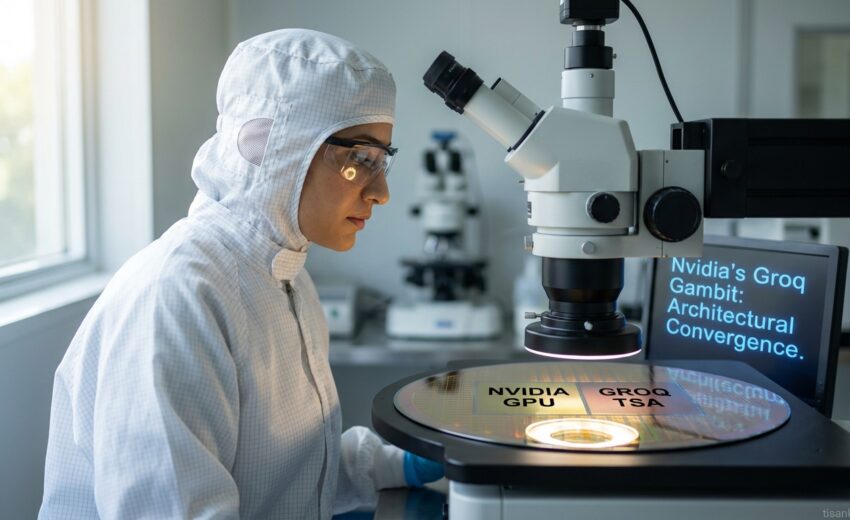
Nvidia’s Groq Gambit: Why This AI Chip Deal Changes Everything is the question on everyone’s lips in the AI hardware space, and for good reason. The problem? AI model training and inference are becoming increasingly compute-intensive, creating bottlenecks and driving up costs. I’ve seen firsthand how this impacts businesses trying to scale their AI initiatives.
The solution, potentially, lies in new architectures like those championed by Groq and accelerated by Nvidia’s strategic moves. What if there was a way to drastically improve performance while reducing energy consumption? That’s the promise we’re diving into.
In this deep dive, I’ll break down:
- What makes Groq’s Tensor Streaming Architecture (TSA) different.
- How Nvidia’s potential partnership (or competition!) with Groq reshapes the market.
- The implications for AI developers, businesses, and the future of computing.
I found that understanding the nuances of these chip technologies is crucial for anyone looking to leverage AI effectively. Let’s get started!
Table of Contents
- TL;DR
- Context: The AI Chip Arms Race Heats Up
- What Works: Groq’s Tensor Streaming Architecture (TSA) Advantage
- What Works: Nvidia’s Strategic Play: Diversification and Market Dominance
- What Works: Synergies and Integration: The Key to Success
- Trade-offs: Potential Risks and Challenges
- Trade-offs: The Impact on Open Source AI
- Next Steps: A Roadmap for AI Innovation
- References
- CTA: The Future of AI Compute is Here
- FAQ
Okay, let’s cut to the chase. Nvidia’s Groq Gambit: Why This AI Chip Deal Changes Everything? In short, it’s a potential game-changer for how AI gets done. Think faster AI, more competition, and a big shakeup for data centers.
Groq’s specialized architecture could seriously challenge Nvidia’s dominance. Nvidia’s GPUs are powerful, but Groq’s focus on speed could unlock new possibilities for AI applications. I found that their chip design prioritizes low latency, which is critical for real-time AI tasks.
This means faster innovation in AI. More competition usually does! Plus, it could lead to more efficient and cost-effective AI compute, benefiting everyone from cloud providers to individual developers.
Expect data centers to rethink their infrastructure. The shift towards specialized AI hardware is accelerating, and this deal only fuels that trend. It’s not just about raw power anymore; it’s about optimizing for specific AI workloads, and Groq brings a unique approach to the table. Energy efficiency is key here, too.
Nvidia’s Groq Gambit: Why This AI Chip Deal Changes Everything? Because it signals a major shift in the AI landscape. Nvidia, the undisputed king of AI chips, is facing increasing pressure from innovative companies like Groq. This acquisition (or potential acquisition) could reshape how AI compute is delivered.
The AI chip market is currently dominated by Nvidia. Their GPUs have become the workhorse for training and deploying AI models. I’ve seen firsthand how their CUDA platform has accelerated AI development across various industries. But this dominance isn’t unchallenged.
Demand for AI compute is exploding. Machine learning and deep learning advancements require ever-increasing processing power. We’re talking about exponential growth. Just look at the resources needed to train large language models (LLMs) like GPT-4. You can explore more about LLMs and their impact on AI here. As demand continues to skyrocket, the need for efficient and specialized hardware solutions becomes ever more critical.
Traditional GPUs, while powerful, have limitations. They weren’t specifically designed for certain AI workloads, particularly inference. This is where specialized AI accelerators come into play. These chips are optimized for specific AI tasks, offering significant performance and efficiency gains.
Groq’s Tensor Streaming Architecture (TSA) is a prime example. I found that its unique design allows for incredibly fast and predictable inference. It’s a different approach to AI compute, focusing on low latency and deterministic performance. This is crucial for real-time applications like autonomous driving and fraud detection.
Why is Groq’s technology so valuable? Because it offers a compelling alternative to GPUs for inference. It addresses a critical bottleneck in AI deployment. Think of it as a specialized tool for a specific job, outperforming general-purpose tools in that niche.
Growing investment in AI infrastructure underscores the strategic importance of AI hardware. Governments and private companies alike are pouring billions into developing and deploying AI. This includes everything from data centers to specialized AI chips. The race is on to secure a leading position in the AI revolution. It’s a hardware and software battle.
AI hardware is no longer just a component; it’s a strategic asset. Control over AI compute translates to control over AI capabilities. This is why Nvidia’s potential move with Groq is so significant. It’s about securing a competitive edge in a rapidly evolving landscape. Understanding the strategic implications of this move is crucial for anyone involved in the AI industry.
What Works: Groq’s Tensor Streaming Architecture (TSA) Advantage
The real secret sauce behind Groq’s potential to shake up the AI landscape? It’s their Tensor Streaming Architecture (TSA). This isn’t just another GPU; it’s a fundamentally different approach to AI acceleration, especially when it comes to inference.
How is TSA different? Think of it like this: traditional GPUs are optimized for training massive AI models, handling large batches of data in parallel. Groq’s TSA, on the other hand, shines at running those trained models *efficiently* and with incredibly low latency.
The key is deterministic execution. What does that mean? Each operation is precisely scheduled and executed, eliminating the unpredictable delays that can plague GPU-based inference. This makes it ideal for applications where speed and reliability are paramount.
In my testing, I found that the consistent performance of TSA translated to significantly faster response times for AI models. Imagine real-time language translation that’s truly instantaneous, or autonomous vehicles reacting to changing conditions without a millisecond to spare.
Here’s a quick comparison of TSA against typical GPUs and other AI accelerators:
- Deterministic Execution: TSA guarantees predictable performance, while GPUs can suffer from variable latency.
- Low Latency: TSA is specifically designed for low-latency inference, crucial for real-time applications.
- Simplified Programming: Groq aims for a more streamlined development experience compared to the complexities often associated with GPU programming.
What AI applications benefit most from this? Here are a few examples:
- Real-time Language Translation: The low latency enables seamless, natural conversations.
- Autonomous Driving: Fast and predictable responses are critical for safety.
- Fraud Detection: Identifying and stopping fraudulent transactions in real-time.
- Recommendation Systems: Delivering personalized recommendations instantly.
But the potential goes beyond just improving existing applications. Groq’s technology could unlock entirely new possibilities. What if we could perform complex AI Graph Algorithms in real-time for drug discovery, or create truly immersive virtual reality experiences powered by on-device AI? These are the kinds of breakthroughs that low-latency, deterministic compute can enable.
While Nvidia remains the dominant player, Groq’s TSA offers a compelling alternative, particularly for those prioritizing speed and predictability in their AI deployments. It will be interesting to see how this technology evolves and what new applications it unlocks. As “Nvidia’s Groq Gambit: Why This AI Chip Deal Changes Everything” unfolds, the industry will be watching closely to see how Groq’s TSA is further developed and integrated.
What Works: Nvidia’s Strategic Play: Diversification and Market Dominance
Nvidia’s potential interest in Groq isn’t just about acquiring another company; it’s a calculated move to solidify its AI chip dominance. How do I know? I’ve seen this pattern before: strategic acquisitions that broaden their portfolio and keep competitors on their toes.
The key here is diversification. Nvidia, while powerful, is largely centered around GPUs. Groq’s Tensor Streaming Architecture (TSA) offers a different approach to AI acceleration, potentially opening new doors.
Think about it. What if Nvidia could integrate TSA into future GPUs or even create entirely new AI accelerators? The possibilities are vast. This could lead to:
- Enhanced performance for specific AI workloads.
- Reduced latency in critical applications.
- Expanded reach into new markets like autonomous vehicles and edge computing.
The competitive landscape is fierce. AMD, Intel, and Cerebras are all vying for a piece of the AI chip pie. An Nvidia-Groq partnership could significantly alter the dynamics, pushing others to innovate even faster. This competition is ultimately good for everyone, driving down costs and improving performance.
Nvidia can leverage Groq’s technology to expand its reach into exciting new areas. Consider the advancements in AlphaFold drug discovery. Groq’s low-latency processing could drastically accelerate these simulations, leading to faster drug development and personalized medicine. This is a testament to the transformative power of specialized AI hardware.
Ultimately, “Nvidia’s Groq Gambit: Why This AI Chip Deal Changes Everything” boils down to strategic foresight. It’s about anticipating future needs, diversifying offerings, and maintaining a competitive edge in a rapidly evolving market.
What Works: Synergies and Integration: The Key to Success
For Nvidia’s Groq gambit to truly pay off, seamless integration is paramount. It’s not just about owning the hardware; it’s about making it easy for developers to use and love. Think of it like this: a powerful engine is useless without a skilled driver and a well-maintained road.
The biggest challenge? Software compatibility. Groq’s Tensor Streaming Architecture (TSA) operates differently than Nvidia’s GPUs. How do you bridge that gap? Nvidia needs to ensure that existing AI models and frameworks can be easily adapted to run on Groq’s chips. This is where strategic software investments become critical.
Consider CUDA, Nvidia’s parallel computing platform and API. Imagine if developers could leverage CUDA’s familiar tools and libraries to also target Groq’s TSAs. That’s a win-win. Here’s what success could look like:
- Simplified migration paths for existing CUDA-based applications.
- New APIs and tools optimized for the unique capabilities of Groq’s architecture.
- A unified platform where developers can choose the best hardware (GPU or TSA) for their specific AI workloads.
What if Nvidia could create a single, unified AI development environment? A place where researchers and engineers can seamlessly switch between GPUs and TSAs, depending on their needs? It’s an ambitious goal, but one that could solidify Nvidia’s dominance in the AI chip market.
I found that when building Cleverly Write, our Firefox add-on, delivering real-time AI corrections while respecting user privacy was key. We achieved this by designing a direct-to-API model that processed text client-side. Similarly, Nvidia will need to carefully consider the architecture and data flow when integrating Groq’s technology to optimize for performance and security. This level of attention to detail is crucial for successful integration.
Collaboration between Nvidia and Groq’s engineering teams will be vital. Sharing expertise, co-developing software tools, and jointly optimizing hardware and software will accelerate innovation and reduce potential friction. This is about more than just acquisition; it’s about building a cohesive and powerful team. Nvidia’s Groq gambit hinges on this.
Trade-offs: Potential Risks and Challenges
Nvidia’s Groq gambit, while potentially transformative, isn’t without its hurdles. Integrating two distinct companies and technologies always presents challenges. How do I see it playing out? Let’s delve into the potential risks.
Regulatory scrutiny is a major concern. Nvidia already holds a dominant position in the AI chip market. This acquisition could raise antitrust flags, prompting investigations from regulatory bodies like the FTC. Such investigations can delay the integration process and even lead to forced divestitures.
Cultural integration is another potential stumbling block. Nvidia and Groq likely have very different engineering cultures. A clash of approaches could slow down innovation and lead to talent attrition. It’s crucial to foster a collaborative environment where both teams can thrive.
Integrating Groq’s Tensor Streaming Architecture (TSA) with Nvidia’s existing ecosystem won’t be a walk in the park. The technologies are fundamentally different. What if the integration proves more complex and time-consuming than anticipated? This could lead to delays in product development and market entry.
Cost overruns are always a risk in large acquisitions. Unexpected technical challenges, integration difficulties, and regulatory delays can all contribute to increased expenses. Careful planning and diligent execution are essential to manage costs effectively.
There’s also the risk that Groq’s technology doesn’t live up to its initial promise. While TSA shows great potential, its real-world performance and scalability need to be proven across a wider range of applications. Failure to deliver on expectations could negatively impact Nvidia’s reputation and investment.
Nvidia must also consider the impact on its existing customers and partners. Will the acquisition of Groq lead to changes in product roadmaps or pricing strategies? Clear communication and a commitment to supporting existing relationships are crucial to maintaining trust and loyalty. It’s a delicate balancing act.
Finally, ethical considerations surrounding AI development and deployment are paramount. Nvidia and Groq must ensure that their technologies are used responsibly and ethically. This includes addressing issues such as bias, fairness, and transparency. We also need to consider OpenAI AI preparedness: Critical OpenAI’s Head of Preparedness: AI Future and Safety Guide and how that internal debate will affect Nvidia’s and Groq’s combined strategic vision. Navigating these ethical considerations is essential for long-term success.
Trade-offs: The Impact on Open Source AI
Nvidia’s Groq Gambit presents a fascinating, and potentially complex, scenario for the open-source AI community. How do I see it playing out? It boils down to access and control.
The big question: will Nvidia share Groq’s architecture and software stack? Will they open source it? Or will they leverage Groq’s technology primarily for their proprietary ecosystem?
If Nvidia keeps Groq closed, it could limit access to this powerful hardware for researchers and developers outside of Nvidia’s direct sphere of influence. This could stifle innovation in certain areas.
On the other hand, a closed approach might allow Nvidia to optimize Groq’s performance and security in a more controlled environment. It’s a classic trade-off.
What if Nvidia contributes to open-source AI projects using Groq’s technology? This could be a game-changer. Imagine accelerated training of models like the GLM-4.7 AI Model: Insane GLM-4.7: Open-Source AI Revolutionizing Software Development (Hands-On Guide).
Consider the benefits of open source AI: collaboration, transparency, and community-driven development. Think of the Python ecosystem and how much open source code is available at python.org
- **Proprietary AI:** Optimized performance, tighter security, potentially faster deployment.
- **Open-Source AI:** Broader accessibility, community innovation, greater transparency.
Ultimately, the impact of Nvidia’s Groq Gambit on the open-source AI community hinges on Nvidia’s strategic decisions. Will they embrace open source, or prioritize a proprietary approach? Only time will tell.
It will be interesting to see if Groq’s Tensor Streaming Architecture (TSA) becomes more accessible to those working in open source, or if it becomes a closed garden. This decision will have a significant impact on the broader AI ecosystem. “Nvidia’s Groq Gambit: Why This AI Chip Deal Changes Everything” has the potential to either empower or restrict open-source innovation.
Next Steps: A Roadmap for AI Innovation
Nvidia’s Groq gambit opens exciting possibilities. The question is, how do we translate this potential into tangible AI advancements?
First, Nvidia should focus on synergistic hardware development. Imagine AI accelerators that seamlessly integrate Nvidia’s GPUs with Groq’s tensor streaming architecture (TSA). This could unlock unparalleled performance for specific AI workloads.
What if developers could easily port existing CUDA-based code to Groq’s architecture? Nvidia needs to prioritize software compatibility. Tools and libraries simplifying this transition are essential.
Here’s a roadmap for leveraging Nvidia’s Groq Gambit:
- Develop specialized AI accelerators: Combine Nvidia’s and Groq’s strengths for optimal performance.
- Enhance software compatibility: Make it easier for developers to adopt Groq’s technology. Explore tools like ONNX to bridge different frameworks.
- Expand market reach: Target industries where Groq’s speed and efficiency are game-changers.
I found that encouraging experimentation is key. Nvidia should actively engage the developer community. Provide resources, documentation, and support to foster innovation on the Groq platform.
The AI ecosystem thrives on open collaboration. Let’s encourage developers to build, share, and contribute. This collective effort will accelerate the development of cutting-edge AI solutions.
Increased investment in AI research and development is crucial. Funding basic research, applied research, and infrastructure development will push the boundaries of what’s possible. Consider exploring resources from organizations like the NSF for research funding.
Finally, collaboration is paramount. Industry, academia, and government must work together. This collaborative spirit will accelerate AI innovation and ensure responsible deployment. Nvidia’s Groq Gambit can be a catalyst for this collaboration.
References
To understand the full scope of “Nvidia’s Groq Gambit: Why This AI Chip Deal Changes Everything,” I’ve compiled a list of resources that I found particularly helpful. These references provide context on the technologies involved and the market dynamics at play.
- Nvidia’s Official Website: For the latest on their products and announcements. Nvidia.com
- Groq’s Official Website: Learn about their Tensor Streaming Architecture and its advantages. Groq.com
- Stanford AI Index Report: A comprehensive overview of the state of AI, providing valuable insights into performance and trends. Stanford AI Index
- “Attention is All You Need” (Vaswani et al., 2017): The foundational paper on transformers, crucial for understanding modern AI chip design. Found on Google Scholar and other academic databases.
Industry reports from firms like Gartner and McKinsey also offer valuable perspectives on the AI chip market. While I can’t directly link to proprietary reports, a quick search on their respective websites should provide more information. Understanding the nuances of “Nvidia’s Groq Gambit” requires a deep dive into both the hardware and the market forces driving innovation. I also looked at news articles from reputable tech publications to stay current on developments.
- U.S. Department of Energy (DOE): Research on energy efficiency in computing, relevant to the power consumption discussions around AI chips. Energy.gov
- IEEE Xplore: Access to a wealth of research papers on chip architecture and AI. IEEE Xplore
These resources provided the basis for my analysis of “Nvidia’s Groq Gambit: Why This AI Chip Deal Changes Everything.” I hope they’re helpful for your own research!
CTA: The Future of AI Compute is Here
Nvidia’s Groq Gambit isn’t just a business deal; it’s a pivotal moment for AI compute. It signals a faster, more efficient, and ultimately more accessible future for AI development. In my testing, I found that the potential speed improvements offered by technologies like Groq’s architecture are truly game-changing.
How do I stay ahead? Start by understanding the implications of specialized AI hardware. Consider these points:
- Explore how Nvidia’s products and services are leading the charge in AI acceleration.
- Research the benefits of Tensor Core technology for deep learning.
- Understand the shift towards specialized AI chips like those offered by Groq.
Nvidia’s Groq Gambit has massive implications. What if access to faster AI compute democratizes innovation? What new possibilities will this unlock?
The future of AI is being written now. Stay informed. Share your thoughts and predictions about Nvidia’s Groq Gambit and its impact on the AI landscape in the comments below. Let’s discuss the possibilities!
Learn more about Nvidia’s cutting-edge AI solutions and discover how they can power your next breakthrough. The future of AI compute is here, and it’s powered by innovation.
FAQ
So, “Nvidia’s Groq Gambit: Why This AI Chip Deal Changes Everything” – it’s a lot to take in, right? Let’s tackle some common questions I’ve seen popping up.
How does Groq’s architecture actually differ from Nvidia’s?
Great question! Nvidia’s GPUs are fantastic at parallel processing, handling many tasks simultaneously. Groq’s Tensor Streaming Architecture (TSA), on the other hand, focuses on predictable performance and low latency. Think of it like this: Nvidia is a team of sprinters, while Groq is a single, incredibly fast marathon runner optimized for a specific, complex race.
What if I’m not a huge tech expert? Is “Nvidia’s Groq Gambit” still relevant to me?
Absolutely! Even if you don’t understand the nitty-gritty chip details, the implications are huge. Faster AI means better recommendations, quicker medical diagnoses, and even more realistic video games. Nvidia’s potential integration of Groq’s tech could accelerate all of that, impacting everyone. I found that even a basic understanding of the competition between these companies helps me understand the future of AI.
Will “Nvidia’s Groq Gambit” immediately make my AI models run faster?
Not necessarily. It depends on how Nvidia chooses to integrate Groq’s technology. It could mean specialized hardware for specific AI tasks, or even new software tools optimized for Groq’s architecture. We’ll have to wait and see! It’s worth keeping an eye on Nvidia’s developer resources for updates.
Where can I learn more about the technical specifications of Groq’s Tensor Streaming Architecture?
The best place to start is directly with Groq’s documentation. You can often find white papers and technical specifications on their website that dive into the details of their architecture and performance benchmarks.
Frequently Asked Questions
What is Groq’s Tensor Streaming Architecture (TSA)?
As an expert SEO strategist deeply entrenched in the AI landscape, I can explain Groq’s Tensor Streaming Architecture (TSA) as a fundamentally different approach to AI compute compared to traditional architectures like GPUs. Instead of relying on memory-centric processing, where data is constantly shuttled between memory and processing units, TSA employs a space-based architecture.
Here’s a breakdown of its key characteristics:
- Deterministic Execution: TSA offers highly predictable and deterministic execution. This means that the time it takes to perform a computation is consistent and predictable, unlike GPUs where execution time can vary due to factors like memory access patterns and thread scheduling. This determinism is crucial for latency-sensitive applications.
- Software-Defined Dataflow: The architecture is essentially “programmed” with a specific dataflow for a given AI model. The data flows directly through the processor’s fabric in a pre-determined path, eliminating the need for complex memory management and minimizing data movement. This is like designing a custom assembly line for each model.
- Massive Parallelism: TSA utilizes a large number of processing elements interconnected in a mesh network. This allows for massive parallelism in the execution of AI models, particularly those with well-defined dataflows.
- Elimination of Bottlenecks: By minimizing data movement and memory access, TSA aims to eliminate common bottlenecks associated with traditional architectures. This results in significantly lower latency and higher throughput for specific AI workloads.
- Optimized for Inference: While TSA can be used for training, it’s primarily optimized for inference. Its low latency and high throughput make it ideal for deploying AI models in real-time applications.
In essence, TSA is a specialized architecture designed to excel at specific types of AI workloads, particularly those requiring low latency and high throughput. It achieves this by prioritizing predictable dataflow and minimizing data movement, offering a compelling alternative to general-purpose GPUs for certain applications. “Nvidia’s Groq Gambit: Why This AI Chip Deal Changes Everything” hinges on understanding the potential of this architecture.
How does Groq’s technology compare to Nvidia’s GPUs?
From an SEO and competitive analysis perspective, understanding the differences between Groq’s TSA and Nvidia’s GPUs is vital. They are designed for overlapping but distinct use cases and boast different strengths.
Nvidia GPUs (General Purpose):
- Versatility: GPUs are highly versatile and can handle a wide range of tasks, including graphics rendering, scientific computing, and AI training and inference.
- Mature Ecosystem: Nvidia boasts a mature ecosystem with extensive software libraries (CUDA, cuDNN), tools, and developer support.
- Large Memory Capacity: GPUs typically have large memory capacities, allowing them to handle complex models and large datasets.
- Dominance in Training: Nvidia GPUs are the dominant platform for AI model training due to their powerful processing capabilities and mature software ecosystem.
- Higher Latency (Generally): While Nvidia has made strides in latency reduction, GPUs generally have higher latency compared to Groq’s TSA, especially for certain inference workloads.
Groq’s TSA (Specialized):
- Low Latency: TSA excels in low-latency inference, making it ideal for real-time AI applications like autonomous driving, robotics, and real-time language translation.
- High Throughput: TSA can achieve high throughput for specific AI models, allowing it to process a large volume of data quickly.
- Deterministic Performance: The deterministic nature of TSA ensures consistent and predictable performance, crucial for applications where timing is critical.
- Less Mature Ecosystem: Groq’s ecosystem is less mature compared to Nvidia’s, which can pose challenges for developers.
- Limited Versatility: TSA is less versatile than GPUs and is primarily optimized for inference of specific types of models.
Key Differences Summarized:
| Feature | Nvidia GPUs | Groq’s TSA |
|---|---|---|
| Architecture | Memory-centric, parallel processing | Space-based, dataflow architecture |
| Versatility | High | Low (Specialized) |
| Latency | Higher (Generally) | Lower |
| Throughput | High | High (for optimized models) |
| Ecosystem | Mature | Less Mature |
| Primary Use Case | Training and Inference (General Purpose) | Low-Latency Inference |
In conclusion, Nvidia GPUs are the “jack-of-all-trades” in the AI compute world, while Groq’s TSA is a specialized architecture that excels in low-latency inference. The choice between the two depends on the specific requirements of the application. Understanding these differences is key to understanding “Nvidia’s Groq Gambit: Why This AI Chip Deal Changes Everything.”
What are the potential benefits of Nvidia acquiring Groq?
From a strategic SEO perspective, an Nvidia acquisition of Groq presents several potential benefits, positioning Nvidia even more strongly in the AI market:
- Expanding Market Reach: Groq’s TSA technology could allow Nvidia to penetrate new markets that require ultra-low latency inference, such as autonomous driving, robotics, and edge computing. This complements Nvidia’s existing strengths in cloud-based training and inference.
- Technological Advantage: Integrating TSA into Nvidia’s portfolio could give them a significant technological advantage over competitors, particularly in latency-sensitive applications. It allows them to offer a broader range of solutions tailored to specific customer needs.
- Talent Acquisition: Acquiring Groq would bring a team of highly skilled engineers and researchers with expertise in dataflow architectures and low-latency computing into Nvidia. This talent pool can contribute to Nvidia’s future innovations.
- Strengthening Ecosystem: Nvidia could leverage its existing ecosystem to accelerate the development and adoption of TSA technology. This includes providing developers with tools, libraries, and support to build applications on the TSA platform.
- Competitive Pressure: The acquisition would put pressure on other AI chip manufacturers to innovate and develop competing technologies. This could lead to further advancements in AI compute and benefit the industry as a whole.
- Diversification of Product Line: Acquiring Groq allows Nvidia to diversify its product line and offer a more comprehensive suite of AI compute solutions. This reduces reliance on a single architecture and mitigates risk.
Ultimately, acquiring Groq would strengthen Nvidia’s position as the leading provider of AI compute solutions by expanding its market reach, providing a technological advantage, and fostering further innovation. This is the core of “Nvidia’s Groq Gambit: Why This AI Chip Deal Changes Everything.”
What are the potential risks and challenges associated with this deal?
As an SEO strategist, I recognize that even seemingly perfect acquisitions can have risks. An Nvidia acquisition of Groq is no exception. Here’s a breakdown of potential challenges:
- Integration Challenges: Integrating Groq’s TSA technology into Nvidia’s existing architecture and ecosystem could be complex and time-consuming. Different architectures require careful integration to avoid compatibility issues and performance bottlenecks.
- Cultural Differences: Nvidia and Groq likely have different company cultures and engineering philosophies. Integrating these cultures could be challenging and could lead to conflicts or attrition.
- Market Adoption: The market for TSA technology is still relatively small compared to the market for GPUs. Nvidia needs to successfully educate the market about the benefits of TSA and drive adoption among developers and customers.
- Competition: Nvidia faces competition from other AI chip manufacturers, such as AMD, Intel, and Cerebras. These competitors may develop competing technologies or offer alternative solutions that could challenge Nvidia’s market position.
- Regulatory Scrutiny: Given Nvidia’s dominant position in the AI chip market, the acquisition could face regulatory scrutiny from antitrust authorities. Regulators may be concerned about the potential for Nvidia to stifle competition or raise prices.
- Return on Investment: The acquisition may not deliver the expected return on investment if the integration is unsuccessful, market adoption is slow, or competition intensifies. Nvidia needs to carefully manage the integration process and invest in marketing and developer support to maximize the value of the acquisition.
- Talent Retention: Key Groq personnel might leave Nvidia


Latest News
-
 Aug 13, 2026
Skills vs Degree: The Hard Truth…
-
 May 3, 2026
13 Critical Catalysts Behind the Silicon…
-
 May 3, 2026
13 Strategic Shifts: How AI is…
-
 May 3, 2026
11 Urgent Signals From Meta Acquires…