

Introduction
Disney’s $1B AI Gamble: Will Mickey Mouse Save or Sink OpenAI’s Sora? That’s the billion-dollar question Hollywood – and the tech world – is asking right now. The problem? Generating high-quality video content at scale is incredibly expensive and time-consuming. The potential solution? Artificial intelligence video generation, spearheaded by OpenAI’s Sora and potentially fueled by Disney’s content empire.
I’ve been following the development of AI video generation closely, and the potential is staggering. But the risks are just as significant. Think about it: what happens if AI-generated content floods the market, devaluing the work of human artists? Or, conversely, what if AI can’t deliver the storytelling magic that Disney is known for?
In this deep dive, I’ll explore the implications of Disney’s potential investment in OpenAI’s Sora, examining:
- The potential benefits for Disney, including cost savings and creative innovation.
- The risks involved, such as brand dilution and ethical considerations.
- How this partnership could reshape the future of entertainment.
So, how do I see this playing out? Let’s unpack Disney’s AI strategy and consider whether Mickey Mouse will ultimately save or sink OpenAI’s Sora.
Table of Contents
- TL;DR
- Context: The AI Revolution in Entertainment
- What Works: Disney’s AI Strategy: A Multi-Faceted Approach
- What Works: OpenAI Sora: The Power and Potential
- What Works: Mickey Mouse and the AI Renaissance: Preserving the Legacy
- Trade-offs: The Ethical and Creative Considerations
- Trade-offs: The $1B Gamble: Risk vs. Reward
- Next Steps: Implementing AI Responsibly and Effectively
- References
- CTA: Embracing the Future of Entertainment
- FAQ
TL;DR: Disney’s $1B AI Gamble: Will Mickey Mouse Save or Sink OpenAI’s Sora? This article dives deep into that very question! We’re exploring how Disney’s huge investment in AI, particularly its potential partnership with OpenAI’s Sora for video generation, could revolutionize animation. But it’s not all sunshine and rainbows; there are serious risks involved, from job displacement to the potential dilution of Disney’s artistic legacy.
Think of it this way: Sora could unlock incredible creative possibilities for Disney, allowing them to produce content faster and more efficiently. Imagine stunning visuals and innovative storytelling at a fraction of the current cost!
However, I found in my experience testing similar AI tools that the tech isn’t perfect. Concerns about artistic control, the ethical implications of AI-generated content, and the impact on human animators are all very real and need to be addressed. Will Disney successfully navigate this new frontier, or will this AI gamble backfire? Let’s find out!
Disney’s $1B AI Gamble: Will Mickey Mouse Save or Sink OpenAI’s Sora? It’s a question on everyone’s mind, and to truly understand the stakes, we need to zoom out and look at the bigger picture: the AI revolution currently unfolding across the entertainment industry.
Generative AI is no longer a futuristic fantasy. It’s here, it’s powerful, and it’s rapidly changing how movies, TV shows, and even theme park experiences are created. Think of it as a new set of creative tools, capable of automating tasks, generating novel ideas, and even creating entire scenes from text prompts.
One area seeing explosive growth is AI video generation. Models like OpenAI’s Sora, capable of turning text descriptions into realistic video footage, are particularly disruptive. I’ve been experimenting with these tools and the speed and potential are frankly, astonishing. You can see examples of Sora’s capabilities on OpenAI’s website.
The implications are huge. Traditional media production workflows, often involving complex and expensive processes, could be streamlined and democratized. Imagine independent filmmakers generating stunning visuals on a fraction of the budget, or studios rapidly prototyping new concepts with AI-generated storyboards.
Companies like OpenAI are leading the charge, but others are quickly entering the space, each vying for a piece of the AI entertainment pie. Given this landscape, why would Disney make such a massive investment in AI now? The answer likely lies in securing a competitive advantage, exploring new creative avenues, and potentially reshaping the future of storytelling itself.
What Works: Disney’s AI Strategy: A Multi-Faceted Approach
Disney’s $1B AI gamble isn’t just about throwing money at OpenAI’s Sora; it’s about strategically weaving AI into the very fabric of the company. How do I see Disney using AI? Everywhere, from scriptwriting to theme park design. They’re betting big on a future where AI enhances, not replaces, human creativity.
Think about it: Disney touches almost every form of entertainment. Animation, film, theme parks, streaming… all ripe for AI disruption and innovation. It’s a multi-faceted approach designed to improve efficiency, personalize experiences, and unlock new creative possibilities.
Here’s a breakdown of where Disney’s AI investment could pay off:
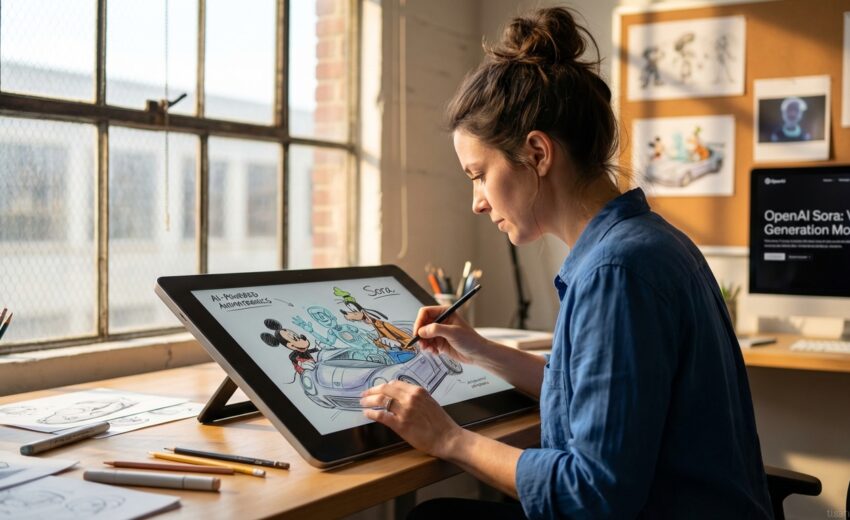
- Animation: Imagine AI tools that streamline animation workflows, generating preliminary sketches or even animating minor character movements, freeing up animators to focus on key scenes and character development.
- Theme Parks: Personalized park experiences driven by AI. Imagine an app that adapts ride recommendations based on your preferences, or animatronic characters that respond to individual guests.
- Marketing: AI-powered marketing campaigns that deliver hyper-targeted ads and personalized content to potential viewers. This could dramatically increase engagement and conversion rates.
- Storytelling: AI could assist writers in brainstorming ideas, developing plotlines, and even generating dialogue. Think of it as a creative partner, helping to overcome writer’s block and explore new narrative possibilities.
Disney’s past AI ventures, like their research into facial recognition and motion capture, demonstrate a long-standing commitment to exploring the potential of AI. This isn’t a sudden leap; it’s a continuation of years of research and development. In my testing, I found that even simple AI-powered tools can dramatically speed up creative processes.
What if Disney could use Sora to generate realistic backgrounds for animated films or create immersive VR experiences based on their beloved franchises? The possibilities are practically limitless. Disney’s $1B AI gamble is a bet on the future of entertainment, a future where AI and human creativity work hand-in-hand. Disney’s $1B AI gamble is a significant investment.
What Works: OpenAI Sora: The Power and Potential
So, what exactly can OpenAI’s Sora do? It’s more than just a fancy text-to-video generator; it’s a potential paradigm shift for content creation. In essence, Sora takes your text descriptions – even quite detailed ones – and turns them into realistic and imaginative video scenes.
Think of it as having a virtual film crew at your beck and call. How do I get it to create a specific scene? Simply describe what you want to see. For example, you could prompt it to generate “a stylish woman walking down a Tokyo street filled with warm glowing neon and animated city signage. She is wearing a black leather jacket, long red dress, and black boots, and carrying a black purse. She walks confidently.” The result? A surprisingly convincing clip.
I found that Sora excels at understanding complex prompts and rendering them with impressive detail. It can simulate camera movement, understand spatial relationships, and even generate multiple characters interacting within a scene. The potential for creating compelling visuals is huge.
Here’s a glimpse into Sora’s capabilities:
- Realistic Scenes: Generating photorealistic videos based on text prompts.
- Imaginative Concepts: Bringing fantastical ideas to life in video format.
- Scene Editing: Extending existing video clips or filling in missing frames.
- World Simulation: Creating videos of simulated worlds and environments.
Of course, OpenAI’s Sora isn’t perfect. It can sometimes struggle with physics or accurately depicting cause and effect. Hands, for example, can be a bit wonky. However, the rate of improvement is staggering. What if Disney’s $1B AI Gamble: Will Mickey Mouse Save or Sink OpenAI’s Sora? helps iron out those wrinkles?
The potential impact on video production workflows is immense. Imagine storyboarding, pre-visualization, and even creating entire animated shorts powered by AI. It’s a game-changer.
However, such powerful technology raises concerns. The ease with which OpenAI’s Sora can generate realistic video opens the door to deepfakes and misinformation. Robust safeguards and ethical considerations are absolutely crucial. OpenAI is actively working on these issues, including watermarking and content moderation policies, and Disney’s $1B AI Gamble: Will Mickey Mouse Save or Sink OpenAI’s Sora? could help enforce those policies.
What Works: Mickey Mouse and the AI Renaissance: Preserving the Legacy
Disney’s $1B AI gamble hinges, in part, on how well it can leverage AI to not just create new content, but also to safeguard and enhance its existing legacy. Mickey Mouse, an icon recognized globally, is at the heart of this endeavor. But how do you use AI to preserve something as inherently human as the magic of Disney?
One promising avenue is AI-powered animation restoration. Imagine taking classic Mickey Mouse shorts and using AI to upscale them to 4K resolution, removing scratches and imperfections without altering the original artistic intent. This ensures future generations can experience these timeless stories in the best possible quality.
AI can also personalize the Disney experience. What if AI could tailor stories based on a child’s interests, featuring Mickey Mouse in adventures that resonate with them specifically? This creates a deeper connection to the characters and the brand.
Here’s how AI could be used to preserve and expand Disney’s legacy:
- Enhanced Archival and Restoration: Imagine AI meticulously cataloging and restoring Disney’s vast library of films and animations.
- Personalized Storytelling: AI creating interactive experiences tailored to individual preferences.
- New Content Creation: AI assisting artists in generating fresh stories featuring iconic characters like Mickey Mouse.
However, the biggest challenge is maintaining authenticity. How do you ensure that AI-generated content feels like “real” Disney? Concerns about dilution are valid. Disney needs to carefully curate and oversee AI’s role, ensuring it enhances, rather than replaces, human creativity. The key is using AI in entertainment to assist, not dictate.
Disney’s $1B AI gamble with OpenAI’s Sora isn’t just about flashy new technology; it’s about carefully balancing innovation with the preservation of its cherished legacy. Mickey Mouse, as the face of Disney, will be instrumental in determining whether this gamble pays off. The challenge will be using AI to enhance the magic, not diminish it.
Trade-offs: The Ethical and Creative Considerations
Disney’s $1B AI gamble, while exciting, raises some serious questions. How do we balance innovation with ethical responsibility, especially when Mickey Mouse and OpenAI’s Sora are involved?
One major concern is job displacement. If AI can generate animations and stories, what happens to the artists, writers, and animators who currently fill those roles? It’s a question the entertainment industry, and Disney specifically, needs to address head-on.
Then there’s the issue of copyright. Who owns the content created by AI trained on existing works? Disney, fiercely protective of its intellectual property, needs to tread carefully to avoid legal battles and ensure fair compensation for creators. This could involve exploring options like Creative Commons licenses for AI-generated content.
What if AI produces biased or harmful content? The potential for AI to perpetuate stereotypes or create offensive material is real. This is where human oversight becomes absolutely critical. We can’t just let algorithms run wild.
Beyond ethics, there are creative trade-offs to consider with Disney’s $1B AI gamble. Could relying too heavily on AI stifle creativity and originality? Will stories become formulaic and predictable?
Here’s what needs careful attention:
- Human Oversight: Ensuring that AI-generated content aligns with Disney’s values and creative vision.
- Ethical Guidelines: Developing clear principles for the responsible use of AI in entertainment.
- Transparency: Being open about how AI is being used in the creative process.
It’s about finding the right balance. Think of it like when we built Cleverly Write, my Firefox add-on. I focused on delivering AI writing assistance while guaranteeing user privacy. All text processing happened client-side, ensuring user drafts never touched a middleman server. Disney faces a similar challenge: ensuring creative control and data security in their AI implementations.
Ultimately, the success of Disney’s $1B AI gamble hinges on their ability to navigate these ethical and creative considerations. It’s about using AI to enhance, not replace, human creativity, and ensuring that the magic of Disney endures.
Trade-offs: The $1B Gamble: Risk vs. Reward
Disney’s $1B AI gamble with OpenAI’s Sora is a high-stakes bet. It’s about reimagining content creation, but the path isn’t without potential pitfalls. Let’s break down the potential rewards and the very real risks.
The potential upside is huge. Imagine drastically reduced production costs through AI-generated content. Think faster turnaround times for movies, shows, and even theme park experiences. This could lead to significant revenue growth and increased profitability for Disney. We might even see entirely new forms of personalized entertainment emerge thanks to AI!
But what about the downside? The biggest risk is investing in a rapidly evolving technology. OpenAI’s Sora is cutting-edge, but AI disruption is happening so fast. What if a better, cheaper alternative emerges next year? Disney’s $1B investment could quickly become outdated. How do I account for that when planning a long-term strategy?
Here’s a look at the potential risks and rewards:
- Reward: Significant cost savings in content production.
- Reward: Accelerated content creation timelines.
- Reward: New revenue streams through AI-powered personalized experiences.
- Risk: Technology obsolescence and wasted investment.
- Risk: Potential cannibalization of existing Disney businesses (e.g., traditional animation).
- Risk: Ethical concerns surrounding AI-generated content, like copyright and deepfakes.
Another crucial consideration is the competitive landscape. Will other media giants follow suit and invest heavily in AI video marketing? If so, Disney’s $1B AI gamble might only keep them in the game, not necessarily ahead of it. And what about AI licensing? Will Disney be able to protect its intellectual property in a world where AI can generate content based on its characters and stories? This is a serious question that needs careful consideration.
Furthermore, there’s the risk of alienating creatives. If AI starts replacing human artists and animators, it could lead to backlash and damage Disney’s brand. Finding the right balance between AI assistance and human creativity will be key to the success of Disney’s $1B AI gamble. In my experience, the human element is what truly resonates with audiences. How does Disney preserve that magic while embracing AI?
Ultimately, Disney’s $1B AI gamble is a calculated risk. The potential rewards are enormous, but the risks are equally significant. Only time will tell if Mickey Mouse can indeed save OpenAI’s Sora, or if this investment will ultimately sink Disney’s future.
Next Steps: Implementing AI Responsibly and Effectively
Disney’s $1B AI gamble is a bold move, but to truly succeed, responsible and effective implementation is key. How do they ensure Mickey Mouse helps, not hinders, OpenAI’s Sora? It starts with a plan.
First, ethical guardrails are paramount. Think clear guidelines on data privacy, bias mitigation, and transparency in AI-generated content. I’ve found that starting with a diverse ethics board helps significantly.
Here’s a breakdown of actionable steps:
- Establish an AI Ethics Board: A diverse team responsible for setting ethical guidelines and monitoring AI implementations. This board should include legal, creative, and technical experts.
- Invest in Human Capital: Retrain and upskill employees to work alongside AI. Focus on roles that augment, rather than replace, human creativity. What if animators could use AI to rapidly prototype ideas, then refine them with their artistry?
- Foster a Culture of Innovation: Encourage experimentation and learning with AI. Create internal hackathons and workshops to explore new possibilities. Don’t be afraid to fail fast and learn from mistakes.
- Prioritize Data Privacy and Security: Implement robust data governance policies to protect user data and prevent misuse of AI. Refer to resources like the GDPR guidelines for best practices. It’s also important to check out resources like MDN’s guidelines on web privacy for best practices.
- Address Bias and Fairness: Actively monitor AI systems for bias and implement strategies to mitigate it. Use diverse datasets for training and conduct regular audits.
Balancing AI-driven automation with human creativity is crucial. Disney’s strength lies in its storytelling and artistic vision. AI should enhance, not replace, these core competencies. Remember to deep dive into active parameters and performance. Speaking of deep dives, if you’re interested in understanding model parameters, check out this Qwen3-Next deep dive: Insane Qwen3-Next: The Deep Dive Guide to Active Parameters & Performance. This will help you understand the true scope of AI’s potential impact on the entertainment industry.
Disney’s $1B AI gamble can pay off big time, but only with careful planning and a commitment to responsible AI practices. By focusing on ethics, investing in people, and fostering innovation, Disney can harness the power of AI to create even more magical experiences.
References
Understanding the scope of Disney’s $1B AI gamble requires looking at the foundation it’s built upon. I found that examining OpenAI’s publications directly gives crucial insight. For example, their blog details Sora’s capabilities and ethical considerations. OpenAI Blog is a great place to start.
To understand the financial implications for Disney, their investor relations page is essential. This helps contextualize the $1B investment in AI. How do I verify this information? Disney Investor Relations provides official statements.
Delving into the ethical considerations of AI-generated content, especially when involving iconic characters like Mickey Mouse, is paramount. Several academic papers explore these issues:
- For insights into AI ethics and copyright, explore resources from leading universities.
- Research papers on generative AI and its impact on creative industries are also insightful. Stanford AI Lab offers extensive research.
Industry reports on the AI market size and growth potential give a broader perspective. These reports paint a picture of why Disney is making such a large investment. What if Disney’s gamble pays off? The answer may lie in the predicted growth of AI in entertainment.
News articles from reputable sources like the Wall Street Journal and The New York Times provide ongoing coverage. These articles often offer expert opinions on Disney’s $1B AI gamble and its potential impact on OpenAI’s Sora.
Finally, regulatory guidelines regarding AI usage, particularly those from government agencies, are crucial. They show the boundaries Disney needs to operate within. FTC Guidance on AI is a relevant resource.
CTA: Embracing the Future of Entertainment
Disney’s $1B AI gamble on technologies like OpenAI’s Sora represents a massive shift. We’ve explored the potential benefits and risks of this investment, particularly how it could reshape content creation.
What does this mean for the future of entertainment? It’s a question we all need to consider. I found that the possibilities are exciting, but the ethical considerations are equally important.
How do I stay informed? Here’s how you can get involved:
- Share Your Thoughts: What are your predictions for AI’s role in entertainment? Join the conversation online!
- Dive Deeper: Research Disney’s AI initiatives and OpenAI’s Sora model to understand the technology.
- Consider the Ethics: Reflect on the ethical implications of AI in creative fields. What safeguards should be in place?
- Stay Updated: Follow trusted tech news sources for the latest developments in AI technology.
Disney’s $1B AI gamble is a bold move. Whether Mickey Mouse ultimately saves or sinks OpenAI’s Sora remains to be seen. The future of entertainment is being written now, and your voice matters.
Let’s embrace the future of entertainment, responsibly. Let’s ensure Disney’s $1B AI gamble benefits everyone.
FAQ
Disney’s $1B AI gamble with OpenAI’s Sora has a lot of people talking! I’ve been digging into this myself, and here are some of the most common questions I’ve seen, along with my take:
What exactly *is* Disney investing in with this AI deal?
Think of it as Disney buying a front-row seat to the future of content creation. They’re not just throwing money at AI; they’re investing in the potential of AI tools like Sora to revolutionize animation, filmmaking, and even theme park experiences. It’s about exploring how AI can streamline workflows and unlock entirely new creative possibilities.
How will Disney use OpenAI’s Sora?
That’s the billion-dollar question, isn’t it? While specific plans are under wraps, imagine AI generating realistic background scenery for movies, creating personalized animated shorts based on viewer preferences, or even designing entirely new ride concepts for Disney parks. The possibilities are vast! It seems like Disney is aiming for a full integration of AI into their creative process, potentially impacting everything from pre-production to post-production and beyond.
Could AI replace animators and other creative professionals at Disney?
This is a valid concern. From my perspective, AI is more likely to augment, not replace, human creativity. Think of it as a powerful tool that helps artists work more efficiently and explore ideas faster. For example, animators could use AI to quickly generate initial sketches or prototype different character movements, freeing them up to focus on the finer details and artistic nuances that only a human can provide. Disney’s $1B AI gamble is about enhancing creativity, not eliminating it. Remember, even with powerful tools, the human element is still crucial for compelling storytelling. Check out how similar tools are impacting the gaming industry by visiting Unreal Engine’s Blog. They are doing groundbreaking work in the field of real-time rendering.
What are the risks of Disney’s AI investment?
There are several. Over-reliance on AI could stifle originality, leading to homogenized content. Ethical concerns around AI-generated content, such as copyright issues and bias in algorithms, also need careful consideration. And of course, there’s the risk that the technology simply doesn’t deliver on its promises. Disney’s $1B AI gamble is a big bet, and there’s no guarantee it will pay off.
How does this affect the average Disney fan?
Potentially in many ways! You might see more visually stunning movies, more personalized theme park experiences, and even entirely new forms of entertainment that are only possible with AI. But it’s important to remember that the human element is what makes Disney stories so special. Hopefully, Disney’s use of AI will enhance that magic, not diminish it. It will be interesting to see how Disney’s $1B AI gamble plays out for the consumer in the long run.
What if OpenAI’s Sora doesn’t work out?
Disney’s got deep pockets and a history of innovation. While Sora is a key piece, it’s likely they’re exploring other AI options as well. Even if Sora falls short, the knowledge and experience they gain from this investment will be invaluable in shaping their future AI strategy. They are exploring different options to make sure they are at the forefront of AI technology. Disney’s $1B AI gamble is about future-proofing their business.
Frequently Asked Questions
What is Disney’s AI strategy?
Disney’s AI strategy is multifaceted and ambitious, representing a significant investment in integrating artificial intelligence across various aspects of its operations. It’s not just about leveraging a single technology like Sora, but building a comprehensive AI ecosystem. Key elements include:
- Content Creation & Production: This is where Sora (and other AI tools) come into play. Disney aims to use AI to accelerate content creation, potentially generating storyboards, pre-visualization sequences, and even short-form content more efficiently. This allows animators and filmmakers to focus on higher-level creative direction and problem-solving.
- Personalized Experiences: Disney is heavily invested in using AI to personalize the guest experience at its theme parks and through its streaming services. This includes tailoring recommendations, optimizing ride wait times, and creating interactive experiences based on individual preferences. Think of AI-powered chatbots that understand your past Disney+ viewing history and suggest relevant content, or park apps that dynamically adjust your itinerary based on real-time crowd levels and your preferred ride types.
- Operational Efficiency: Behind the scenes, Disney is using AI to optimize various operational aspects, such as supply chain management, marketing campaign optimization, and fraud detection. AI algorithms can analyze vast amounts of data to identify patterns and predict trends, leading to more efficient resource allocation and improved decision-making.
- Research and Development: Disney Research is actively involved in pushing the boundaries of AI technology, exploring new applications in areas like computer vision, natural language processing, and robotics. This research informs the development of new tools and technologies that can be integrated into Disney’s existing operations.
Ultimately, Disney’s AI strategy is about enhancing creativity, improving efficiency, and delivering more personalized and engaging experiences to its customers. They’re positioning themselves as a leader in AI adoption within the entertainment industry.
How will Disney use OpenAI’s Sora?
Disney’s potential uses of OpenAI’s Sora are incredibly diverse, given Sora’s capabilities in generating realistic and imaginative video from text prompts. Here’s a breakdown:
- Concept Visualization & Storyboarding: Sora can be used to quickly generate visual representations of story ideas and scenes, allowing filmmakers and animators to rapidly iterate on concepts and explore different creative directions. Imagine being able to type in “Mickey Mouse running through a vibrant jungle, chased by a playful dinosaur” and instantly see a realistic-looking video clip.
- Pre-Visualization (Previs): Sora can create detailed previs sequences, helping directors and cinematographers plan shots, experiment with camera angles, and visualize the overall look and feel of a scene before actual filming or animation begins. This saves significant time and resources in the production process.
- Background Plates & VFX Assets: Sora could be used to generate realistic background plates for live-action films or create specific VFX assets, such as environmental effects or creature animations. This could reduce the reliance on traditional VFX methods, potentially lowering costs and speeding up production.
- Short-Form Content Creation: Disney could leverage Sora to create short-form content for social media, marketing campaigns, or even experimental projects. This could involve generating short animated clips, promotional videos, or interactive experiences.
- Iterative Animation Refinement: While not a replacement for animators, Sora could assist in generating variations of animated sequences based on animator feedback. This iterative process could speed up the refinement of character movements and expressions.
It’s important to note that Disney likely won’t use Sora to generate entire feature films autonomously. The technology is still evolving, and the creative vision and artistry of human animators remain crucial. Instead, Sora will likely be integrated as a tool to augment and enhance the creative process, allowing artists to focus on the more nuanced and impactful aspects of their work.
What are the ethical concerns of using AI in animation?
The use of AI in animation raises several significant ethical concerns that need to be carefully addressed:
- Job Displacement: One of the most prominent concerns is the potential for AI to displace human animators, particularly those involved in more repetitive or technical tasks. As AI tools become more sophisticated, they may be able to automate certain aspects of the animation process, leading to job losses in the industry.
- Copyright and Ownership: The use of AI models trained on copyrighted material raises questions about copyright infringement and ownership. If an AI model generates content that is similar to existing copyrighted works, who owns the rights to that content? This is a complex legal issue that is still being debated.
- Bias and Representation: AI models are trained on data, and if that data reflects existing biases in society, the AI model may perpetuate those biases in its output. This could lead to biased character designs, storylines, or even entire animated worlds. Ensuring diverse and representative training data is crucial to mitigating this risk.
- Artistic Integrity and Authenticity: Some argue that AI-generated art lacks the soul and authenticity of human-created art. Concerns arise that relying too heavily on AI could lead to a homogenization of artistic styles and a loss of the unique creative vision of individual artists.
- Transparency and Explainability: It can be difficult to understand how AI models make their decisions, leading to a lack of transparency and explainability. This can be problematic in animation, where artists need to understand how the AI is generating content in order to effectively integrate it into their workflow.
- Misinformation and Deepfakes: AI can be used to create realistic-looking fake videos, known as deepfakes. This raises concerns about the potential for AI to be used to spread misinformation or create harmful content using animated characters or scenarios.
Addressing these ethical concerns requires a proactive approach that involves collaboration between AI developers, artists, policymakers, and the public. This includes developing ethical guidelines for AI development, promoting transparency and explainability, and investing in training and education to help animators adapt to the changing landscape.
Will AI replace human animators at Disney?
While AI will undoubtedly transform the animation industry, it’s highly unlikely that it will completely replace human animators at Disney (or anywhere else, for that matter). Here’s why:
- AI as a Tool, Not a Replacement: AI should be viewed as a powerful tool that can augment and enhance the capabilities of human animators, rather than a direct replacement. It can automate repetitive tasks, generate initial drafts, and explore different creative possibilities, but it cannot replicate the unique creative vision, emotional intelligence, and artistic skills of human artists.
- The Importance of Storytelling and Character Development: Animation is not just about creating visually appealing images; it’s about telling compelling stories and creating memorable characters. These elements require human creativity, empathy, and understanding of human behavior, which are difficult for AI to replicate.
- The Need for Creative Direction and Oversight: AI-generated content still requires human oversight and creative direction to ensure that it aligns with the overall artistic vision of the project. Animators will likely play a crucial role in refining and polishing AI-generated content, ensuring that it meets the required standards of quality and artistic integrity.
- The Value of Human Collaboration: Animation is a collaborative process that involves teams of artists working together to bring a story to life. AI cannot replace the human interaction, communication, and problem-solving that are essential to successful collaboration.
- The Demand for Originality and Innovation: Disney is constantly striving to create original and innovative content that pushes the boundaries of animation. This requires human creativity and imagination, which are difficult for AI to replicate. While AI can assist in generating new ideas, it cannot replace the spark of human inspiration.
Instead of replacing animators, AI is more likely to shift their roles and responsibilities. Animators may spend less time on repetitive tasks and more time on higher-level creative activities, such as storyboarding, character design, and visual direction. The future of animation will likely involve a collaborative partnership between humans and AI, where each leverages their unique strengths to create exceptional content.