


The Netflix AV1 Codec is rapidly becoming a cornerstone technology for delivering high-quality video experiences, particularly in emerging markets where bandwidth constraints are a significant hurdle. Are you struggling to provide seamless streaming to users in regions with limited internet infrastructure? This comprehensive guide explores advanced strategies to optimize the Netflix AV1 Codec for low-bandwidth streaming, ensuring a superior viewing experience for your audience in 2025.
- Introduction to Netflix AV1 Codec and Low-Bandwidth Streaming
- Understanding the AV1 Codec: A Technical Overview
- Challenges of Streaming in Emerging Markets
- Key Optimization Strategies for Netflix AV1 Codec
- Adaptive Bitrate Streaming with Netflix AV1
- Measuring and Monitoring Netflix AV1 Codec Performance
- Netflix AV1 Codec vs. HEVC: A Comparative Analysis
- The Future of Netflix AV1 Codec in Emerging Markets
- Frequently Asked Questions about Netflix AV1 Codec
Featured Snippet: The Netflix AV1 Codec is a next-generation video compression technology designed to significantly reduce bandwidth consumption while maintaining high video quality. It achieves this through advanced encoding techniques, making it ideal for streaming in low-bandwidth environments, particularly in emerging markets where internet infrastructure is limited.
Introduction to Netflix AV1 Codec and Low-Bandwidth Streaming
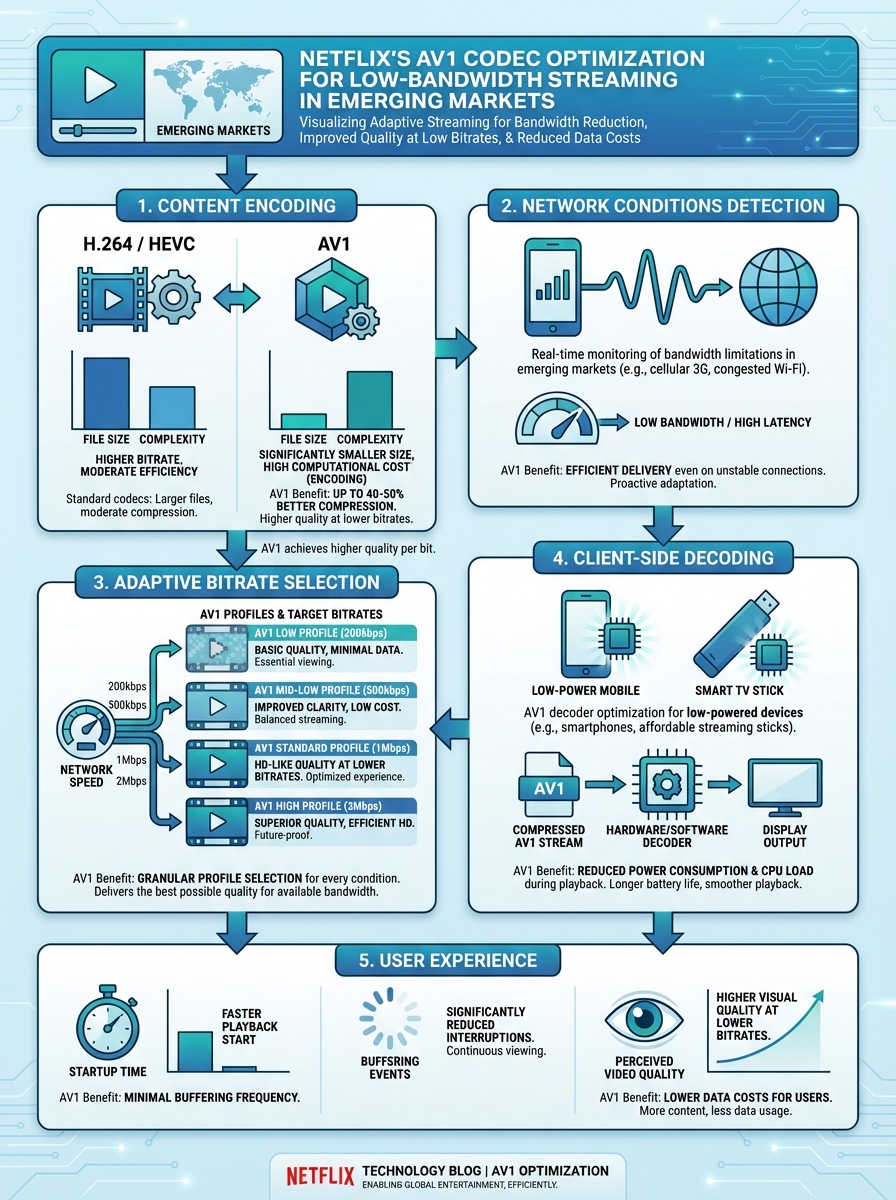
The rise of video streaming has transformed how we consume content, but this transformation isn’t uniform across the globe. Emerging markets often face significant challenges related to internet infrastructure, making it difficult to deliver a consistent, high-quality streaming experience. The Netflix AV1 Codec addresses this challenge head-on by offering superior compression efficiency compared to older codecs.
This introduction will set the stage for understanding the importance of the Netflix AV1 Codec in the context of low-bandwidth streaming. We’ll explore how this codec is revolutionizing video delivery and discuss the key benefits it offers to both content providers and end-users.
Understanding the AV1 Codec: A Technical Overview
The AV1 (AOMedia Video 1) codec is an open, royalty-free video coding format designed for high compression efficiency. Developed by the Alliance for Open Media (AOM), AV1 aims to provide a superior alternative to proprietary codecs like HEVC (High Efficiency Video Coding). The Netflix AV1 Codec is a specific implementation and optimization of this technology.
This section will delve into the technical aspects of AV1, explaining its key features and functionalities. We’ll cover topics such as coding tools, block partitioning, and entropy coding, providing a solid foundation for understanding how the Netflix AV1 Codec achieves its impressive compression capabilities.
Understanding the nuances of the AV1 codec is critical for making informed decisions about encoding parameters and optimization strategies. Furthermore, you might find value in understanding 7 Expert Strategies for DeepSeek V3.2 Cost Comparison in 2025, as computational costs are always a factor.
Challenges of Streaming in Emerging Markets
Emerging markets present a unique set of challenges for video streaming providers. Limited bandwidth, unreliable internet connections, and a diverse range of devices are just a few of the hurdles that need to be overcome. The Netflix AV1 Codec is designed to mitigate these challenges, but careful planning and optimization are still essential.
This section will explore the specific challenges faced by streaming services in emerging markets, including network infrastructure limitations, device fragmentation, and cost sensitivity. We’ll also discuss how these challenges impact the user experience and how the Netflix AV1 Codec can help improve streaming quality in these environments.
Key Optimization Strategies for Netflix AV1 Codec
Optimizing the Netflix AV1 Codec for low-bandwidth streaming requires a multi-faceted approach. This includes carefully selecting encoding parameters, implementing adaptive bitrate streaming, and optimizing content delivery networks (CDNs). The goal is to strike a balance between video quality and bandwidth consumption, ensuring a smooth and enjoyable viewing experience for users.
Here are some key optimization strategies for the Netflix AV1 Codec:
- Encoding Parameter Tuning: Adjusting parameters like resolution, bitrate, and frame rate to match the available bandwidth.
- Adaptive Bitrate Streaming (ABS): Dynamically adjusting the video quality based on the user’s network conditions.
- Content Delivery Network (CDN) Optimization: Choosing a CDN with a strong presence in the target region to minimize latency and improve delivery speeds.
- Pre-processing techniques: Applying filters to the video content before encoding, which can improve compression efficiency.
Effective AV1 codec optimization can significantly improve the viewing experience, even on limited bandwidth. Similarly, understanding 7 Proven Strategies for Building Scalable Symfony Real-Time Applications in 2025 can improve application responsiveness.
Adaptive Bitrate Streaming with Netflix AV1
Adaptive Bitrate Streaming (ABS) is a crucial technique for delivering a seamless streaming experience in variable network conditions. ABS allows the video player to dynamically switch between different video quality levels based on the user’s available bandwidth. The Netflix AV1 Codec integrates seamlessly with ABS systems, enabling efficient and robust streaming in low-bandwidth environments.
This section will delve into the details of ABS and how it works with the Netflix AV1 Codec. We’ll cover topics such as manifest files, segmenting video content, and the algorithms used to determine the optimal bitrate for each user. We will also look at optimizing manifest files for AV1 content.
Measuring and Monitoring Netflix AV1 Codec Performance
Measuring and monitoring the performance of the Netflix AV1 Codec is essential for ensuring optimal streaming quality. Key metrics to track include bitrate, video quality (PSNR, SSIM, VMAF), and buffer levels. By monitoring these metrics, you can identify potential issues and fine-tune your encoding and delivery strategies.
Tools like FFmpeg and specialized video quality analysis software can be used to measure the performance of the Netflix AV1 Codec. Real-time monitoring dashboards can provide insights into the user experience and help you proactively address any problems. You can find valuable information about video quality metrics on sites like Netflix’s VMAF page.
Similarly, you can find valuable information about 7+ Proven Strategies for Gemma 3 Google Cloud Cost Optimization & Scalability in 2025, as computational costs are always a factor.
Netflix AV1 Codec vs. HEVC: A Comparative Analysis
HEVC (High Efficiency Video Coding) has been a widely used video codec for several years, but the Netflix AV1 Codec offers several advantages, particularly in terms of compression efficiency and royalty-free licensing. This section will provide a detailed comparison of the two codecs, highlighting their strengths and weaknesses.
Here’s a table comparing AV1 and HEVC:
| Feature | AV1 | HEVC |
|---|---|---|
| Compression Efficiency | Generally better, especially at lower bitrates | Good, but often requires higher bitrates |
| Licensing | Royalty-free | Proprietary, with licensing fees |
| Complexity | Higher encoding complexity | Lower encoding complexity |
| Hardware Support | Increasing, but still less widespread | More widely supported |
While HEVC has wider hardware support currently, the royalty-free nature and superior compression of the Netflix AV1 Codec make it a compelling choice for many streaming providers, particularly in emerging markets where cost is a significant factor. You can read more on codecs on Wikipedia’s video codec page.
The Future of Netflix AV1 Codec in Emerging Markets
The future of the Netflix AV1 Codec in emerging markets looks promising. As internet infrastructure improves and more devices support AV1 decoding, the codec is poised to become the dominant standard for video streaming. Ongoing optimizations and advancements in AV1 technology will further enhance its capabilities and make it even more suitable for low-bandwidth environments.
This section will explore the potential future developments of the Netflix AV1 Codec and its impact on the streaming landscape in emerging markets. We’ll discuss emerging trends such as 5G connectivity, edge computing, and the increasing demand for mobile video content.
It’s crucial to understand the future and how technology will advance, especially concerning performance. A similar understanding should be sought when analyzing 7+ Powerful Strategies for Mantine BorderAnimate Performance: A 2025 Deep Dive.
Frequently Asked Questions about Netflix AV1 Codec
Here are some frequently asked questions about the Netflix AV1 Codec:
- What is the primary benefit of using the Netflix AV1 Codec?
The primary benefit is improved compression efficiency, allowing for higher video quality at lower bitrates. - Is the Netflix AV1 Codec royalty-free?
Yes, the AV1 codec is royalty-free, which reduces licensing costs. - What are the hardware requirements for decoding Netflix AV1 Codec?
Decoding AV1 requires hardware or software support. Newer devices and browsers are increasingly supporting AV1 decoding. - How does Netflix AV1 Codec compare to HEVC in terms of video quality?
At the same bitrate, AV1 generally offers better video quality than HEVC. - Can I use the Netflix AV1 Codec for live streaming?
Yes, AV1 can be used for live streaming, but it requires careful optimization and robust infrastructure. - Where can I find more information about the Netflix AV1 Codec?
You can find more information on the Alliance for Open Media website and in various technical publications.
By understanding the Netflix AV1 Codec and implementing these optimization strategies, you can deliver a superior streaming experience to users in emerging markets, unlocking new opportunities for growth and engagement.
Finally, consider reading 7+ Expert Strategies for Understanding the Shingles Dementia Connection in 2025.