


7+ Proven Strategies for AI-powered Security Automation DevSecOps Success in 2025: A Step-by-Step Guide
AI-powered security automation DevSecOps is no longer a futuristic concept; it’s a necessity for organizations striving to build and deploy secure software at scale. Are you struggling to keep pace with the ever-evolving threat landscape while simultaneously accelerating your development cycles? This comprehensive guide will provide a practical, step-by-step approach to implementing AI-powered security automation within your DevSecOps pipelines, resulting in measurable security improvements.
Table of Contents
- Introduction to AI-powered security automation DevSecOps
- Key Benefits of AI in DevSecOps Security
- Addressing Common Challenges in Security Automation Implementation
- Step-by-Step Implementation of AI-powered Security Automation in DevSecOps
- Essential AI Security Tools for DevSecOps
- Real-World Case Studies: AI-driven Security Success Stories
- Measuring Security Improvements with AI Automation
- The Future of AI-powered Security Automation DevSecOps
- Frequently Asked Questions
Featured Snippet: AI-powered security automation DevSecOps integrates artificial intelligence into the software development lifecycle to automate security tasks. This includes vulnerability scanning, threat detection, incident response, and compliance monitoring, all within a DevSecOps framework to improve speed and security.
Introduction to AI-powered security automation DevSecOps
The modern software development landscape demands speed and agility. DevSecOps aims to integrate security practices into every phase of the development lifecycle, from initial design to deployment and operations. However, traditional security approaches often struggle to keep up with the rapid pace of development and the increasing complexity of applications. This is where AI-powered security automation DevSecOps comes into play, offering a powerful solution to automate security tasks, improve accuracy, and accelerate response times.
AI-powered security automation DevSecOps leverages machine learning and artificial intelligence to enhance security capabilities within the DevSecOps pipeline. By automating tasks such as vulnerability scanning, threat detection, and incident response, organizations can significantly reduce the risk of security breaches and improve their overall security posture. This approach allows security teams to focus on strategic initiatives and complex threats, rather than being bogged down by manual, repetitive tasks.
The integration of AI into DevSecOps isn’t just about automation; it’s about creating a more intelligent and adaptive security system. AI algorithms can learn from past security events, identify patterns, and predict future threats, enabling proactive security measures. This proactive approach is essential in today’s dynamic threat landscape. Consider reading about AI-Powered Cybersecurity: The Ultimate Guide for a deeper understanding of AI’s role in broader cybersecurity contexts.
Key Benefits of AI in DevSecOps Security
Implementing AI-powered security automation DevSecOps offers a multitude of benefits, transforming how organizations approach security in the software development lifecycle. These benefits translate to improved security posture, increased efficiency, and reduced risk.
- Enhanced Threat Detection: AI algorithms can analyze vast amounts of data to identify anomalies and potential threats that might be missed by traditional security tools. This includes detecting zero-day exploits and sophisticated attacks. For example, machine learning models can be trained to recognize patterns indicative of malicious activity, such as unusual network traffic or suspicious code behavior.
- Automated Vulnerability Scanning: AI-powered security automation DevSecOps streamlines vulnerability scanning by automatically identifying and prioritizing vulnerabilities in code, infrastructure, and dependencies. This allows development teams to address security issues early in the development cycle, reducing the cost and effort required to fix them later.
- Faster Incident Response: AI can automate incident response workflows, enabling security teams to quickly contain and remediate security incidents. This includes automatically isolating affected systems, blocking malicious traffic, and triggering alerts.
- Improved Compliance: AI can help organizations meet compliance requirements by automating compliance checks and generating reports. This reduces the burden on compliance teams and ensures that systems are always in compliance with relevant regulations.
- Increased Efficiency: By automating repetitive security tasks, AI frees up security teams to focus on more strategic initiatives, such as threat hunting and security architecture. This improves overall efficiency and allows organizations to make better use of their security resources.
The benefits of AI-powered security automation DevSecOps extend beyond just technology; they also impact organizational culture. By embedding security into the development process, organizations can foster a culture of security awareness and shared responsibility. This helps to break down silos between development, security, and operations teams, leading to better collaboration and communication.
Addressing Common Challenges in Security Automation Implementation
While the benefits of AI-powered security automation DevSecOps are significant, implementing it successfully can be challenging. Organizations must be aware of the common pitfalls and take proactive steps to address them.
- Data Quality and Availability: AI algorithms require high-quality data to train and operate effectively. Organizations must ensure that they have access to sufficient data and that the data is accurate, complete, and consistent. This may involve implementing data governance policies and investing in data quality tools.
- Algorithm Bias: AI algorithms can be biased if they are trained on biased data. This can lead to inaccurate or unfair security decisions. Organizations must carefully evaluate their data and algorithms to identify and mitigate bias.
- Integration Complexity: Integrating AI security tools into existing DevSecOps pipelines can be complex and time-consuming. Organizations must carefully plan their integration strategy and ensure that the tools are compatible with their existing infrastructure.
- Skills Gap: Implementing and managing AI security tools requires specialized skills. Organizations may need to invest in training or hire new staff with expertise in AI and security.
- Over-Reliance on Automation: While automation is essential, it’s important to avoid over-reliance on AI. Security teams must still maintain a human-in-the-loop approach and be prepared to intervene when necessary.
Addressing these challenges requires a strategic approach that combines technology, process, and people. Organizations should start by assessing their current security posture and identifying areas where AI can provide the most value. They should then develop a detailed implementation plan that addresses the challenges outlined above. Moreover, understanding the nuances of 7 Proven Strategies for H5 Mobile Debugging NIGHTMARES can provide valuable insights into optimizing performance in complex environments, which is relevant to security automation.
Step-by-Step Implementation of AI-powered Security Automation in DevSecOps
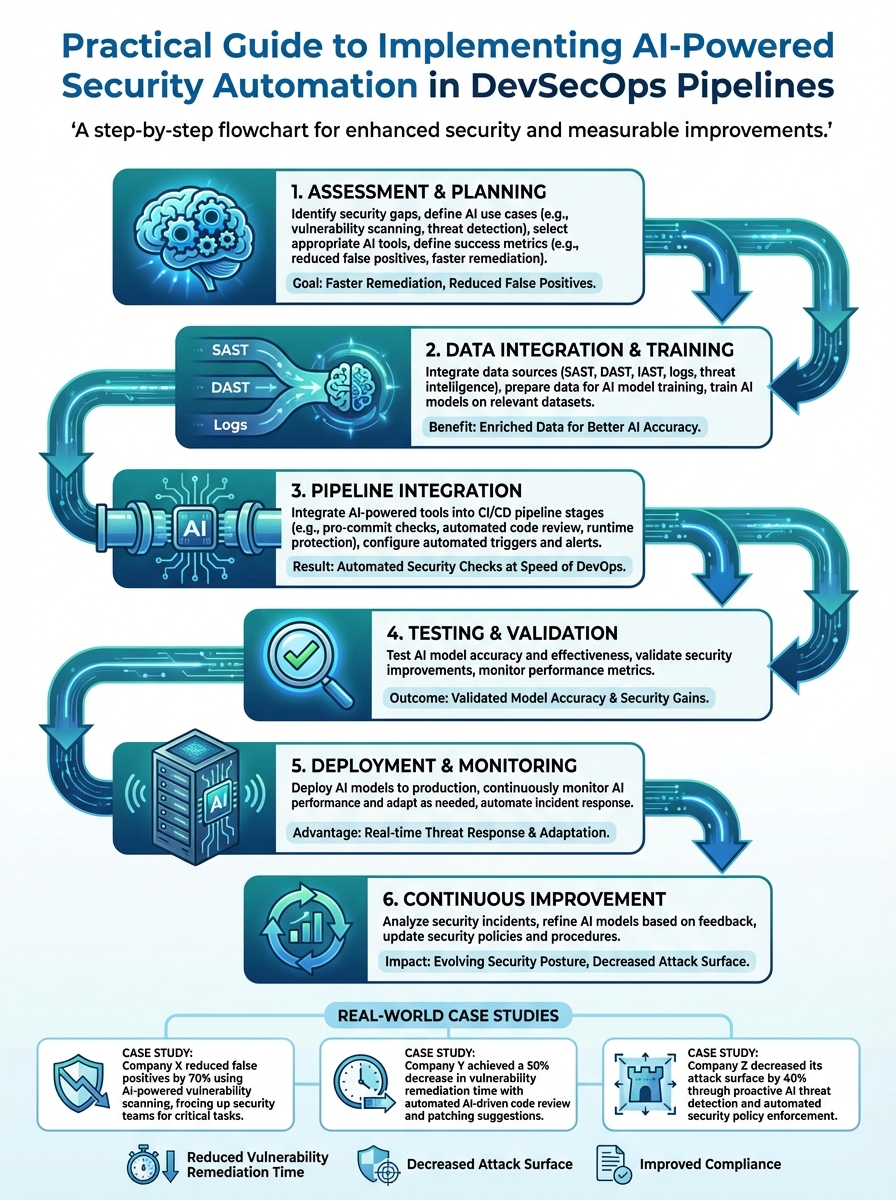
Implementing AI-powered security automation DevSecOps is a journey, not a destination. It requires a phased approach that starts with planning and assessment and progresses to implementation and optimization. Here’s a step-by-step guide to help you get started:
- Assess Your Current Security Posture: Before implementing AI, it’s essential to understand your current security strengths and weaknesses. Conduct a thorough security assessment to identify vulnerabilities, misconfigurations, and other security gaps.
- Define Clear Security Goals: What do you want to achieve with AI-powered security automation? Define specific, measurable, achievable, relevant, and time-bound (SMART) goals. For example, you might aim to reduce the number of security incidents by 50% within the next year.
- Choose the Right AI Security Tools: Select AI security tools that align with your security goals and your existing DevSecOps pipeline. Consider factors such as cost, features, integration capabilities, and ease of use.
- Integrate AI into Your DevSecOps Pipeline: Integrate AI security tools into your existing DevSecOps pipeline. This may involve modifying your build process, deployment scripts, and monitoring dashboards.
- Train and Fine-Tune AI Models: Train AI models on your own data to improve their accuracy and effectiveness. Fine-tune the models regularly to adapt to changes in the threat landscape.
- Monitor and Measure Security Improvements: Continuously monitor your security metrics to track the effectiveness of your AI-powered security automation. Use this data to identify areas for improvement and optimize your security strategy.
- Automate Security Testing: Integrate automated security testing tools into your CI/CD pipeline. This allows you to identify and fix vulnerabilities early in the development cycle.
Each step in this process is critical to successfully integrating AI-powered security automation DevSecOps. For example, selecting the correct tools requires careful consideration of your specific needs and existing infrastructure. Moreover, properly training and fine-tuning AI models is essential to ensuring their accuracy and effectiveness.
Essential AI Security Tools for DevSecOps
A variety of AI-powered security tools are available to enhance DevSecOps pipelines. The best tools for your organization will depend on your specific needs and security goals. Here are some essential categories and examples:
- Static Application Security Testing (SAST): Tools like Checkmarx and Veracode use AI to analyze source code for vulnerabilities. These tools can identify potential security flaws before code is deployed.
- Dynamic Application Security Testing (DAST): Tools like Rapid7 AppSpider and Invicti use AI to test running applications for vulnerabilities. These tools can identify security flaws that may not be apparent in static code analysis.
- Interactive Application Security Testing (IAST): Tools like Contrast Security use AI to monitor application behavior in real-time and identify vulnerabilities. These tools provide more accurate results than SAST and DAST alone.
- Software Composition Analysis (SCA): Tools like Snyk and Black Duck use AI to identify vulnerabilities in open-source components. These tools help organizations manage their open-source risk.
- Security Information and Event Management (SIEM): Tools like Splunk and IBM QRadar use AI to analyze security logs and identify potential threats. These tools can help organizations detect and respond to security incidents more quickly.
- Threat Intelligence Platforms (TIP): Tools like Recorded Future and ThreatConnect use AI to gather and analyze threat intelligence data. These tools can help organizations stay ahead of emerging threats.
When selecting AI security tools, consider factors such as accuracy, scalability, integration capabilities, and ease of use. It’s also important to evaluate the vendor’s reputation and track record. Explore how 7+ Proven Strategies for Tech Pitch for Non-Technical Founders Success in 2025 can be applied to effectively communicate the value of these tools to stakeholders.
Real-World Case Studies: AI-driven Security Success Stories
Several organizations have successfully implemented AI-powered security automation DevSecOps, achieving significant improvements in their security posture. Here are a few real-world case studies:
- Case Study 1: Financial Services Company: A large financial services company implemented AI-powered threat detection to reduce the risk of fraud. The company used machine learning to analyze transaction data and identify suspicious patterns. As a result, the company was able to detect and prevent fraud attempts more quickly and effectively.
- Case Study 2: E-commerce Company: An e-commerce company implemented AI-powered vulnerability scanning to improve its application security. The company used AI to automatically identify and prioritize vulnerabilities in its code. This allowed the company to fix vulnerabilities more quickly and reduce the risk of data breaches.
- Case Study 3: Healthcare Provider: A healthcare provider implemented AI-powered incident response to improve its security incident management. The provider used AI to automate incident response workflows and reduce the time it took to contain and remediate security incidents.
These case studies demonstrate the potential of AI-powered security automation DevSecOps to improve security outcomes across a variety of industries. By automating security tasks, organizations can reduce the risk of security breaches and improve their overall security posture. These examples illustrate how AI can be tailored to meet specific security needs and challenges.
Measuring Security Improvements with AI Automation
Measuring the effectiveness of AI-powered security automation DevSecOps is crucial to demonstrating its value and identifying areas for improvement. Here are some key metrics to track:
- Number of Security Incidents: Track the number of security incidents over time to assess the overall impact of AI-powered security automation.
- Time to Detect Security Incidents: Measure the time it takes to detect security incidents to assess the effectiveness of AI-powered threat detection.
- Time to Resolve Security Incidents: Measure the time it takes to resolve security incidents to assess the effectiveness of AI-powered incident response.
- Number of Vulnerabilities Identified: Track the number of vulnerabilities identified by AI-powered vulnerability scanning to assess the effectiveness of the tools.
- Vulnerability Remediation Time: Measure the time it takes to remediate vulnerabilities to assess the efficiency of the vulnerability management process.
- Compliance Adherence: Track compliance metrics to assess the impact of AI-powered security automation on compliance adherence.
By tracking these metrics, organizations can gain valuable insights into the effectiveness of their AI-powered security automation DevSecOps initiatives. This data can be used to optimize security strategies, improve processes, and demonstrate the value of AI to stakeholders. Furthermore, understanding the principles of 7+ Proven Strategies for Minimum Marketable Product (MMP) Success in 2025 can help in prioritizing which security features to automate first, focusing on those that deliver the most significant value.
The Future of AI-powered Security Automation DevSecOps
The future of AI-powered security automation DevSecOps is bright. As AI technology continues to evolve, we can expect to see even more sophisticated and effective security solutions. Here are some key trends to watch:
- Increased Automation: AI will automate even more security tasks, freeing up security teams to focus on strategic initiatives.
- Improved Accuracy: AI algorithms will become more accurate and effective at detecting and preventing security threats.
- Enhanced Collaboration: AI will facilitate better collaboration between development, security, and operations teams.
- Proactive Security: AI will enable more proactive security measures, allowing organizations to anticipate and prevent security threats before they occur.
- Adaptive Security: AI will enable security systems to adapt to changing threat landscapes in real-time.
The ongoing advancements in AI will continue to drive innovation in the security space, making AI-powered security automation DevSecOps an increasingly essential component of any modern security strategy. The convergence of AI and DevSecOps will lead to more resilient, agile, and secure software development practices.
Frequently Asked Questions
- What is DevSecOps?
- DevSecOps is a software development approach that integrates security practices into every phase of the development lifecycle.
- Why is AI important in DevSecOps?
- AI automates security tasks, improves accuracy, and accelerates response times, making security more efficient and effective within DevSecOps.
- What are the benefits of AI-powered security automation?
- Benefits include enhanced threat detection, automated vulnerability scanning, faster incident response, improved compliance, and increased efficiency.
- What are some common challenges in implementing AI security automation?
- Challenges include data quality, algorithm bias, integration complexity, skills gap, and over-reliance on automation.
- How can I measure the success of AI-powered security automation?
- Track metrics such as the number of security incidents, time to detect incidents, time to resolve incidents, and number of vulnerabilities identified.
- What is the future of AI in DevSecOps?
- The future includes increased automation, improved accuracy, enhanced collaboration, proactive security, and adaptive security.
| Tool Category | Tool Name | Description |
|---|---|---|
| SAST | Checkmarx | Analyzes source code for vulnerabilities using AI. |
| DAST | Rapid7 AppSpider | Tests running applications for vulnerabilities using AI. |
| SCA | Snyk | Identifies vulnerabilities in open-source components using AI. |
| SIEM | Splunk | Analyzes security logs and identifies potential threats using AI. |