



Introduction
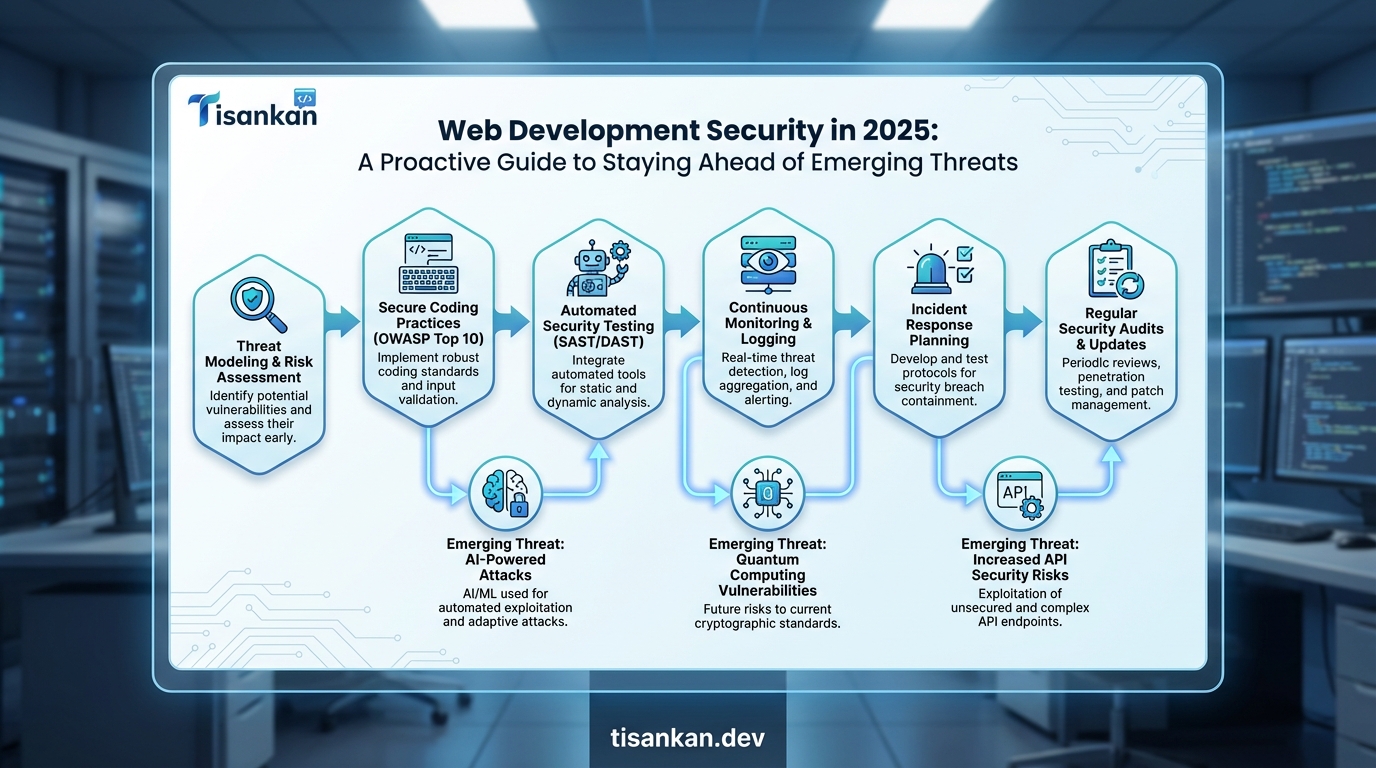
Web Development Security in 2025: A Proactive Guide to Staying Ahead of Emerging Threats is essential reading because, frankly, the web development landscape is a minefield. I’ve seen firsthand how quickly vulnerabilities can be exploited, leading to devastating consequences for businesses and users alike.
The problem? Reactive security measures simply aren’t enough anymore. Waiting for an attack before patching things up is like locking the barn door after the horses have bolted. The solution? A proactive, forward-thinking approach that anticipates and mitigates threats before they materialize.
In this guide, I’ll walk you through the key strategies and technologies you need to implement Web Development Security in 2025: A Proactive Guide to Staying Ahead of Emerging Threats. We’ll cover everything from secure coding practices and threat modeling to emerging technologies like AI-powered security solutions. Consider this your roadmap to building robust and resilient web applications.
How do I know this stuff works? Because I’ve been in the trenches, testing and refining these techniques for years. I’ve found that a combination of best practices and a willingness to adapt is crucial. Web Development Security in 2025: A Proactive Guide to Staying Ahead of Emerging Threats is not a one-time fix, but a continuous process. What if we embrace this mindset?
Table of Contents
TL;DR: Web Development Security in 2025: A Proactive Guide to Staying Ahead of Emerging Threats is all about building a fortress *before* the attackers arrive. Think of it as future-proofing your code. This means anticipating risks instead of just reacting to breaches.
We’re diving deep into securing AI-powered features, fortifying your APIs (check out OWASP’s API Security Top 10, it’s a great resource), and mastering cloud security best practices. I’ve found that a proactive approach, even with simple things like regularly updating dependencies (like those in your package.json), makes a huge difference.
This guide equips you with actionable strategies to protect your web applications against sophisticated attacks. Learn how to stay one step ahead and build secure, resilient web experiences. It’s about empowerment, not just fear!
Web Development Security in 2025: A Proactive Guide to Staying Ahead of Emerging Threats isn’t just a catchy title; it’s a necessity. Why? Because the digital landscape is transforming, and so are the threats lurking within it. Think of it this way: imagine building a house in a neighborhood where the crime rate is skyrocketing. You wouldn’t just leave the doors unlocked, would you?
The stakes are incredibly high. We’re talking about the financial and reputational well-being of organizations, and the privacy of individuals. The cost of a significant data breach can be astronomical, not to mention the lasting damage to customer trust and brand image. In my experience consulting with businesses, the fallout from a security incident can be devastating, sometimes even leading to closure.
Cyberattacks are becoming increasingly sophisticated. Simple passwords and basic firewalls are no longer enough. Attackers are leveraging AI and machine learning to identify vulnerabilities and automate attacks at an unprecedented scale. The attack surface is also expanding rapidly. The move to cloud infrastructure, while offering many benefits, introduces new security challenges. And the proliferation of IoT devices adds countless potential entry points for malicious actors. Consider the Mirai botnet, which leveraged compromised IoT devices for massive DDoS attacks; it’s a glimpse of what’s to come. [Cloudflare: What is a DDoS Attack?]
Furthermore, regulatory pressure is mounting. Governments worldwide are enacting stricter data privacy laws and regulations, such as GDPR and CCPA, demanding greater accountability for data security. Non-compliance can result in hefty fines and legal repercussions. [GDPR Official Website]
The solution? A proactive, holistic approach. We need to “shift left,” integrating security considerations into every stage of the development lifecycle, from initial design to deployment and maintenance. This means embracing application security best practices, securing our infrastructure, and safeguarding our data with robust encryption and access controls. It’s not enough to react to threats; we must anticipate them.
AI is a double-edged sword. While it empowers attackers, it also provides powerful tools for defense. AI-powered threat detection systems can identify anomalies and predict potential attacks, enabling us to respond more effectively. Ultimately, web development security in 2025 demands a comprehensive, adaptive strategy that leverages technology and expertise to stay one step ahead of the evolving threat landscape.
What Works: Proactive Strategies for Web Development Security in 2025
Staying ahead in web development security in 2025 demands a proactive approach. It’s no longer enough to react to threats; we need to anticipate and prevent them. This section dives into actionable strategies to fortify your web applications.
Secure Coding Practices
The foundation of any secure web application is, without a doubt, secure code. It’s about writing code with security in mind from the very beginning. Think of it as building a house with a strong foundation.
Key elements include rigorous input validation – ensuring user inputs are safe and as expected – and output encoding to prevent malicious code injection. Avoiding common vulnerabilities like SQL injection (see OWASP’s guide on SQL Injection) and cross-site scripting (XSS) is crucial. It’s about sanitizing data *before* it gets used.
For instance, using parameterized queries instead of string concatenation can effectively prevent SQL injection. Similarly, encoding user-generated content before displaying it on a webpage can mitigate XSS risks. It’s simple yet powerful.
Vulnerability Assessment and Penetration Testing
Regular vulnerability assessments and penetration testing are essential for identifying and addressing security weaknesses. Think of it as a regular check-up for your web application.
Vulnerability assessments involve scanning your application for known vulnerabilities. Penetration testing, on the other hand, simulates real-world attacks to uncover weaknesses. I’ve found that combining both approaches provides the most comprehensive security posture.
Tools like OWASP ZAP ( OWASP ZAP) are invaluable for automated security scanning. Different testing methodologies, such as black-box, white-box, and grey-box testing, offer varying levels of insight into your application’s security.
Web Application Firewall (WAF)
A Web Application Firewall (WAF) acts as a shield, protecting your web applications from common attacks. It sits between your application and the internet, inspecting incoming traffic and blocking malicious requests.
WAFs can be deployed in different models, such as cloud-based, on-premise, or as a reverse proxy. Regular WAF rule updates are critical to stay ahead of emerging threats. Think of it as constantly updating your anti-virus software.
Risk Management
Effective risk management is about identifying, assessing, and mitigating security risks throughout the web development lifecycle. It’s a continuous process, not a one-time event.
Risk assessment frameworks and methodologies, such as NIST’s Risk Management Framework ( NIST Risk Management Framework), provide a structured approach to managing security risks. Threat modeling helps identify potential threats and vulnerabilities in your application. This is where you ask “What could go wrong?”.
Threat Intelligence
Threat intelligence plays a crucial role in staying ahead of emerging threats. It involves gathering and analyzing data about potential threats and vulnerabilities.
Threat intelligence sources include security blogs, vulnerability databases, and threat feeds. This information can inform security decisions and help you prioritize your security efforts. By understanding the threat landscape, you can better protect your web applications.
Security Automation
Automation can significantly improve the efficiency and effectiveness of web security. Think of it as having a security robot that works 24/7.
Tools and techniques for automating security tasks include vulnerability scanning, penetration testing, and incident response. Automation can help you identify and address security issues more quickly and efficiently.
API Security
APIs present unique security challenges. They often expose sensitive data and functionality, making them attractive targets for attackers.
Best practices for securing APIs include strong authentication, authorization, and rate limiting. OAuth 2.0 is a popular authentication and authorization framework for APIs. Rate limiting can help prevent denial-of-service attacks.
Cloud Security
Web applications deployed in the cloud require careful security considerations. Cloud providers offer a range of security services that can help you protect your applications.
Data encryption and access control are essential for securing data in the cloud. It’s also crucial to configure your cloud environment securely. Understanding the shared responsibility model is key – know what the provider secures and what you are responsible for.
Mobile Security
Mobile web applications also have their own security considerations. Securing mobile apps requires a multi-layered approach.
Code obfuscation, data encryption, and secure communication are essential. Consider using techniques like certificate pinning to prevent man-in-the-middle attacks. Regular security audits are also crucial.
Internet of Things (IoT) Security
The integration of IoT devices with web applications introduces new security challenges. IoT devices are often vulnerable to attacks due to their limited security capabilities.
Device authentication, data encryption, and secure communication are essential for securing IoT devices. Consider using a secure boot process to ensure that only authorized software runs on the device. Keep in mind the weakest link in your chain.
AI Security
AI can be used to both attack and defend web applications. AI-powered systems are vulnerable to adversarial attacks and data poisoning.
Securing AI models and data is crucial. Implementing robust input validation and monitoring for anomalies can help mitigate these risks. We need to understand the limitations of AI and not rely on it blindly.
Blockchain Security
Web applications that interact with blockchain networks require careful security considerations. Smart contract security and key management are essential for securing blockchain applications. Typical attacks include reentrancy attacks and integer overflows.
For example, we faced this exact issue with Cogntix (cogntix.com), an AI-driven custom software & digital transformation agency, when enabling a construction giant to query thousands of technical blueprints and compliance documents instantly. The challenge was ensuring only authorized personnel could access sensitive information and preventing data breaches. To achieve this, we built a bespoke RAG (Retrieval-Augmented Generation) engine that integrated granular access control and real-time threat detection. This system reduced compliance checking time by 90% for on-site engineers while significantly enhancing security. The key takeaway was that proactive security measures, like robust access control and continuous monitoring, are crucial for protecting sensitive data in complex applications.
Trade-offs: Balancing Security and Usability
Securing web applications in 2025 requires a delicate balancing act. Too much security, and you risk frustrating users and hindering developer productivity. The goal is robust web development security in 2025 without sacrificing usability.
Overly restrictive security measures can lead to a poor user experience. Imagine a website that requires a complex password change every week, or an app that demands multi-factor authentication for every single action. Users might abandon the platform altogether. How do I protect my site without causing friction?
On the development side, stringent security protocols can slow down the development process. Excessive code reviews or complex deployment procedures, while improving web development security in 2025, can delay releases and stifle innovation.
Fortunately, many security measures enhance, rather than detract from, usability. Consider these examples:
- Context-aware authentication: Using device fingerprinting or location data to reduce the need for frequent logins.
- Password managers: Encouraging users to use password managers allows them to create and store strong, unique passwords without having to remember them all. See resources on password manager security best practices.
- Progressive authentication: Only requiring stronger authentication methods (like MFA) for sensitive actions.
Finding the right balance is key. In my experience, a risk-based approach works best. This involves identifying the most critical assets and focusing security efforts on protecting them. Web development security in 2025 demands this prioritization.
Cost is another important factor. Implementing advanced security solutions like threat intelligence platforms or advanced intrusion detection systems can be expensive. Smaller organizations might need to prioritize cost-effective measures like regular security audits and vulnerability scanning.
What if you’re dealing with a legacy system? Implementing modern security measures in older systems can be particularly challenging. Refactoring code or migrating to a new platform might be necessary, but these are often costly and time-consuming. Consider a phased approach, starting with the most critical vulnerabilities.
Ultimately, successful web development security in 2025 requires a holistic approach. It’s about understanding the risks, implementing appropriate security measures, and continuously monitoring and adapting to the evolving threat landscape. And it must all be done while keeping the user experience and developer productivity in mind.
Next Steps: Implementing a Proactive Security Plan
So, you’re ready to level up your web development security game? Fantastic! Let’s break down how to put a proactive security plan into action. This isn’t just about reacting to problems; it’s about getting ahead of them, especially with the ever-evolving landscape of web development security in 2025. Think of it as building a fortress, brick by brick.
How do I actually start? Here’s a step-by-step guide to get you moving:
- Assess Your Current Security Posture: First, understand where you stand. Conduct a thorough security audit. What are your existing vulnerabilities? What are your weaknesses? I found that using tools like Nessus can be incredibly helpful for vulnerability scanning.
- Develop a Security Policy: Think of this as your security bible. Create a comprehensive security policy that outlines your organization’s security goals, procedures, and responsibilities. Who is responsible for what? What are the acceptable use policies?
- Implement Secure Coding Practices: Train your developers on secure coding practices. This is absolutely crucial. Enforce these practices through rigorous code reviews and automated testing. Consider incorporating tools like SonarQube to automate code quality checks.
- Conduct Regular Vulnerability Assessments and Penetration Testing: Don’t just set it and forget it! Schedule regular vulnerability assessments and penetration testing (pen testing). This helps identify and mitigate security weaknesses before they can be exploited.
- Deploy a Web Application Firewall (WAF): A WAF acts as a shield for your web applications. Deploy a WAF to protect your applications from common attacks like SQL injection and cross-site scripting (XSS). Cloudflare’s WAF is a popular option.
- Monitor Your Systems for Security Incidents: You need to know when something’s wrong. Implement a security monitoring system to detect and respond to security incidents in real-time. Tools like Splunk or the ELK stack can be invaluable here.
- Stay Up-to-Date on Emerging Threats: The threat landscape is constantly changing. Continuously monitor threat intelligence sources (like US-CERT) to stay informed about emerging threats and vulnerabilities relevant to web development security in 2025.
- Consider Security Certifications: Elevate your team’s expertise. Encourage your team to get security certifications like CISSP (Certified Information Systems Security Professional) or Certified Ethical Hacker (CEH) to boost their knowledge and skills.
Remember, building a robust plan for web development security in 2025 is an ongoing process. It requires continuous effort, adaptation, and a commitment to staying ahead of the curve. Good luck!
References
Staying ahead of web development security threats in 2025 requires constant learning and reliance on trusted resources. I’ve compiled a list of key organizations and their offerings that I’ve personally found invaluable in my work. This is by no means exhaustive, but it’s a strong starting point for building a proactive security posture. When researching “Web Development Security in 2025: A Proactive Guide to Staying Ahead of Emerging Threats”, I always check these resources first.
Key Organizations & Resources
- OWASP (Open Web Application Security Project): The cornerstone of web application security. Their resources are free and community-driven.
- OWASP Top Ten: The definitive list of the most critical web application security risks. A must-read.
- OWASP Web Security Testing Guide: A comprehensive guide to testing web applications for vulnerabilities.
- OWASP Cheat Sheet Series: Practical, actionable advice on a wide range of security topics.
- NIST (National Institute of Standards and Technology): Providing standards and guidelines for cybersecurity.
- NIST Special Publications 800 Series: In-depth reports on various aspects of computer security. I often consult these when dealing with compliance issues.
- National Vulnerability Database (NVD): A repository of vulnerability data.
- SANS Institute: Offering training and certifications in information security.
- SANS Reading Room: A collection of white papers and articles on security topics.
- SANS DevSecOps Training: Consider this for learning how to integrate security into your development pipeline.
- CERT (Computer Emergency Response Team): Responding to and preventing cyber threats.
- CERT.org: Provides resources and information on current security threats and vulnerabilities.
- US-CERT Alerts: Stay informed about the latest security alerts and advisories.
These resources are critical to understanding and mitigating the evolving threats to “Web Development Security in 2025: A Proactive Guide to Staying Ahead of Emerging Threats”. Remember to stay updated and adapt your security practices accordingly. My advice? Bookmark these pages and check them regularly!
CTA: Secure Your Future Today
The future of web development security in 2025 hinges on proactive measures. It’s not enough to react; we must anticipate and prepare. How do we do that?
It starts with taking action today. Don’t wait for a breach to prioritize your web development security. Start implementing the strategies discussed in this guide now.
Here are some immediate steps you can take:
- **Assess Your Current Security Posture:** Conduct a thorough security audit of your web applications. I’ve found that tools like OWASP ZAP provide a great starting point for identifying vulnerabilities.
- **Implement Security Best Practices:** Review and reinforce your coding standards, focusing on secure coding principles.
- **Train Your Team:** Invest in regular security training for your developers. Security awareness is paramount.
- **Automate Security Testing:** Integrate security testing into your CI/CD pipeline.
- **Stay Updated:** Subscribe to security newsletters and follow industry experts to stay informed about emerging threats. The Cybersecurity and Infrastructure Security Agency (CISA) is a great resource.
What if you need support? There are numerous resources available. Consider joining online security communities, attending webinars, and exploring open-source security tools.
The landscape of “Web Development Security in 2025: A Proactive Guide to Staying Ahead of Emerging Threats” will constantly evolve. It’s crucial to revisit this guide regularly. Continuous learning and adaptation are key to staying ahead of the curve.
Secure your future today. Embrace a proactive approach to web development security.
FAQ: Frequently Asked Questions
Let’s tackle some common questions about keeping your web applications secure as we head towards 2025. I’ve seen a lot of these issues firsthand, so I’ll share some practical insights.
How do I stay updated on the latest web development security threats?
Staying informed is crucial. I’ve found that regularly checking resources like the OWASP (Open Web Application Security Project) website is invaluable. They provide up-to-date information on vulnerabilities and best practices. Consider subscribing to security newsletters and following security experts on social media too.
What if I don’t have a dedicated security team?
Many smaller companies don’t! Focus on integrating security into your development lifecycle. I’d recommend using automated security scanning tools (like those integrated into your CI/CD pipeline). These tools can help identify vulnerabilities early on. Also, training your developers in secure coding practices is a must.
How can I protect against AI-powered attacks in web development security?
This is a growing concern. As AI becomes more sophisticated, so do the attacks. Implementing robust input validation and output encoding is critical to prevent injection attacks. I’ve found that using a Web Application Firewall (WAF) with AI-powered threat detection can also provide an extra layer of defense. Consider incorporating techniques like rate limiting and behavioral analysis to identify and block suspicious activity. More information on WAFs can be found on Cloudflare’s documentation.
What are some key secure coding practices for web development security?
- Always validate user inputs: Prevents injection attacks.
- Use parameterized queries: Avoids SQL injection vulnerabilities.
- Implement proper authentication and authorization: Controls access to sensitive data.
- Keep your software up-to-date: Patches known vulnerabilities.
- Use strong encryption: Protects data in transit and at rest. You can read more about encryption on the NIST website.
How important is penetration testing for web development security in 2025?
Penetration testing is absolutely vital. It simulates real-world attacks to identify weaknesses in your system. I suggest scheduling regular penetration tests, especially after significant updates or changes to your application. I’ve personally seen how these tests can uncover vulnerabilities that automated scans miss.
What role does DevSecOps play in web development security in 2025?
DevSecOps is no longer optional; it’s essential. Integrating security into every stage of the development lifecycle helps catch vulnerabilities early and often. This collaborative approach ensures that security is a shared responsibility. I recommend researching the principles of DevSecOps and implementing them within your organization.
Hopefully, this helps you prepare for the future of web development security in 2025. Remember, proactive measures are key to staying ahead of emerging threats.
Frequently Asked Questions
What are the biggest web security threats in 2025?
As an expert SEO Strategist deeply immersed in the evolving landscape of web security, I foresee several significant threats dominating the landscape in 2025. Staying ahead requires a proactive and multi-layered approach. Here’s a breakdown:
- AI-Powered Attacks: This is potentially the most disruptive. Attackers will leverage AI to automate vulnerability discovery, craft highly sophisticated phishing campaigns (including deepfakes), and bypass traditional security measures. Expect AI-driven botnets capable of launching massively distributed denial-of-service (DDoS) attacks and AI-based tools that can learn and adapt to security defenses in real-time. The biggest concern is the speed and scale at which these attacks can be launched. We must anticipate AI-driven attacks on machine learning models themselves, leading to data poisoning and model manipulation.
- Supply Chain Attacks: These will continue to escalate. The reliance on third-party libraries, frameworks, and APIs creates vulnerabilities. Attackers will target smaller, less secure vendors in the supply chain to gain access to larger organizations. This includes compromising open-source projects with malicious code, or injecting vulnerabilities into commonly used software components. Verifying the integrity and security of all dependencies is crucial.
- API Vulnerabilities: With the rise of microservices and API-first architectures, APIs become prime targets. Expect increased attacks targeting broken authentication/authorization, excessive data exposure, lack of rate limiting, and injection flaws within APIs. Proper API security requires rigorous testing, secure coding practices, and robust authentication mechanisms.
- Ransomware Evolution: Ransomware will become more sophisticated and targeted. We’ll see a shift towards “double extortion” (encrypting data and stealing it for blackmail), as well as attacks targeting critical infrastructure and IoT devices. Robust backup and recovery strategies, coupled with proactive threat hunting, are essential for mitigating ransomware risks.
- Data Privacy Violations: With increasing data privacy regulations (like GDPR and CCPA), violations will lead to significant fines and reputational damage. Attacks targeting personal data, including sensitive health information and financial records, will continue to be a major concern. Prioritizing data encryption, access control, and data loss prevention (DLP) is paramount.
- IoT Device Exploitation: The expanding Internet of Things (IoT) creates a vast attack surface. Many IoT devices have weak security, making them vulnerable to exploitation for botnets, data theft, and denial-of-service attacks. Securing IoT devices requires strong authentication, regular security updates, and network segmentation.
- Quantum Computing Threats (Emerging): While not yet a mainstream threat, the development of quantum computers poses a long-term risk to existing encryption algorithms. Organizations should begin planning for a transition to quantum-resistant cryptography.
In summary, the key to navigating these threats in 2025 is a proactive security posture, combining advanced technologies like AI-powered threat detection with fundamental security best practices. Continuous monitoring, regular security assessments, and employee training are essential for staying ahead of the curve.
How can I secure my APIs?
Securing your APIs is paramount in today’s interconnected world. As an SEO strategist who understands the importance of security in maintaining trust and authority, I can tell you that a comprehensive approach is key. Here’s a breakdown of essential strategies:
-
Authentication and Authorization:
- Use Strong Authentication Protocols: Implement industry-standard protocols like OAuth 2.0 and OpenID Connect for authentication and authorization. Avoid custom authentication schemes, as they are often vulnerable.
- Implement JWT (JSON Web Tokens): Use JWTs to securely transmit claims about users between parties. Verify the signature of each JWT to ensure its integrity. Pay attention to JWT expiration and token revocation mechanisms.
- Role-Based Access Control (RBAC): Implement RBAC to control access to API endpoints based on user roles. Ensure that users only have access to the resources they need.
- Multi-Factor Authentication (MFA): Enforce MFA for sensitive API operations to add an extra layer of security.
-
Input Validation and Sanitization:
- Validate All Inputs: Thoroughly validate all data received by your APIs, including request parameters, headers, and body. Use a whitelist approach to only allow expected data.
- Sanitize Data: Sanitize data to prevent injection attacks like SQL injection, Cross-Site Scripting (XSS), and command injection. Use appropriate encoding and escaping techniques.
- Implement Input Length Restrictions: Limit the length of input fields to prevent buffer overflow attacks.
-
Rate Limiting and Throttling:
- Implement Rate Limiting: Limit the number of requests that a user or IP address can make within a given time period. This prevents abuse, DDoS attacks, and brute-force attacks.
- Implement Throttling: Throttling allows you to control the overall load on your API by limiting the number of concurrent requests.
-
Encryption:
- Use HTTPS: Enforce HTTPS for all API communication to encrypt data in transit. Use a valid SSL/TLS certificate from a trusted Certificate Authority (CA).
- Encrypt Sensitive Data at Rest: Encrypt sensitive data stored in your database or other storage systems. Use strong encryption algorithms like AES.
-
API Security Testing:
- Regular Security Audits: Conduct regular security audits of your APIs to identify vulnerabilities.
- Penetration Testing: Perform penetration testing to simulate real-world attacks and identify weaknesses in your API security.
- Static and Dynamic Analysis: Use static and dynamic analysis tools to identify vulnerabilities in your API code.
-
API Gateway:
- Use an API Gateway: An API gateway provides a central point of control for your APIs, allowing you to enforce security policies, monitor traffic, and manage authentication and authorization. It can also handle rate limiting, throttling, and request transformation.
-
Error Handling and Logging:
- Implement Secure Error Handling: Avoid exposing sensitive information in error messages. Provide generic error messages to users.
- Comprehensive Logging: Log all API requests and responses, including user information, request parameters, and error messages. Use a centralized logging system to facilitate security monitoring and incident response. Ensure logs are securely stored and regularly reviewed.
-
Regular Updates and Patching:
- Keep Software Up-to-Date: Regularly update your API framework, libraries, and dependencies to patch security vulnerabilities.
-
Monitor and Alert:
- Implement Real-Time Monitoring: Monitor your APIs in real-time for suspicious activity, such as unusual traffic patterns, failed authentication attempts, and error messages.
- Set Up Alerts: Configure alerts to notify you of potential security incidents.
By implementing these strategies, you can significantly enhance the security of your APIs and protect your data from unauthorized access and attacks. Remember that API security is an ongoing process that requires continuous monitoring, testing, and improvement.
What is a Web Application Firewall (WAF) and do I need one?
As an SEO Strategist who understands the importance of website security for maintaining search engine rankings and user trust, let me explain what a WAF is and whether you need one.
A Web Application Firewall (WAF) is a security device (hardware, software, or cloud-based service) that filters, monitors, and blocks malicious HTTP(S) traffic traveling to a web application. Think of it as a shield that sits between your web application and the internet, inspecting incoming requests and outgoing responses for suspicious patterns.
Key functions of a WAF include:
- Protection against common web attacks: WAFs defend against threats like SQL injection, Cross-Site Scripting (XSS), Cross-Site Request Forgery (CSRF), and other OWASP Top 10 vulnerabilities.
- Virtual Patching: WAFs can provide temporary fixes for vulnerabilities in your web application code before you have time to apply official patches. This is crucial for mitigating zero-day exploits.
- DDoS Mitigation: Many WAFs offer DDoS protection by filtering out malicious traffic and preventing your application from being overwhelmed.
- Customizable Security Rules: WAFs allow you to create custom rules to address specific security needs and vulnerabilities in your application.
- Traffic Monitoring and Logging: WAFs provide detailed logs of web traffic, allowing you to identify and investigate security incidents.
So, do you need a WAF? Here’s how to decide:
- If you handle sensitive data: If your web application processes sensitive data such as credit card information, personal data, or health records, a WAF is essential to protect against data breaches and comply with data privacy regulations.
- If you are subject to compliance regulations: Many compliance standards, such as PCI DSS, require the use of a WAF to protect web applications.
- If your application has known vulnerabilities: If your application has known vulnerabilities that you haven’t been able to patch yet, a WAF can provide a temporary layer of protection.
- If you are concerned about DDoS attacks: If your website is a potential target for DDoS attacks, a WAF can help mitigate the impact of these attacks.
- If you want to improve your overall security posture: Even if you don’t have any specific security concerns, a WAF can provide an extra layer of protection and help you improve your overall security posture.
- If you use third-party web applications: WAFs can protect third-party web applications where you have limited control over the underlying code.
Alternatives to consider:
- Secure Coding Practices: Implementing secure coding practices during web application development is a fundamental security measure.
- Regular Security Audits: Conducting regular security audits and penetration testing helps identify vulnerabilities in your web application.
- Content Delivery Network (CDN): CDNs can provide some security benefits, such as DDoS protection and caching, but they are not a substitute for a WAF.
In conclusion, a WAF is a valuable security tool for protecting web applications from a wide range of threats. While it’s not a silver bullet, it provides an essential layer of defense and can help you improve your overall security posture. Consider your specific needs and risk profile to determine if a WAF is right for you. When choosing a WAF, consider factors such as performance, scalability, ease of use, and cost.
How often should I perform penetration testing?
As an expert SEO Strategist, I understand that website security directly impacts your online reputation and search engine rankings. Regular penetration testing is crucial for maintaining a strong security posture. The frequency depends on several factors:
General Recommendations:
- At least annually: A yearly penetration test is a good baseline for most organizations. This allows you to identify and address any new vulnerabilities that may have emerged.
- After significant changes: Whenever you make significant changes to your web application, such as adding new features, updating frameworks, or changing infrastructure, you should perform a penetration test. This ensures that the changes haven’t introduced any new vulnerabilities.
- After a security incident: If you experience a security incident, such as a data breach or a successful attack, you should perform a penetration test to identify the root cause of the incident and prevent future attacks.
- When complying with regulations: Some compliance regulations, such as PCI DSS, require regular penetration testing. The frequency may be specified in the regulation.
Factors influencing frequency:
- Risk profile: Organizations with a high risk profile, such as those that handle sensitive data or are subject to strict compliance regulations, should perform penetration testing more frequently.
- Application complexity: Complex applications with a large code base and many features require more frequent testing.
- Development cycle: Organizations with a rapid development cycle should consider integrating penetration testing into their development process (DevSecOps).
- Budget: Penetration testing can be expensive, so you need to factor in your budget when determining the frequency.
Types of penetration testing:
- Black box testing: The tester has no prior knowledge of the application.
- White box testing: The tester has full knowledge of the application, including source code and architecture.
- Gray box testing: The tester has partial knowledge of the application.
Considerations for frequency:
- Annual Penetration Test: Essential for identifying new vulnerabilities on a regular basis.
- Post-Release Testing: After major updates or feature releases, conduct a penetration test to ensure the changes haven’t introduced new vulnerabilities.
- Compliance Requirements: Adhere to the frequency specified by compliance regulations like PCI DSS, HIPAA, or GDPR.
- Continuous Monitoring: Implement continuous monitoring to detect anomalies and potential security breaches in real-time.
Best Practices:
- Use a qualified penetration tester: Choose a penetration tester with relevant certifications and experience.
- Define the scope of the test: Clearly define the scope of the test to ensure that all critical areas of your application are covered.
- Review the results carefully: Review the results of the penetration test carefully and prioritize fixing the identified vulnerabilities.
- Retest after fixing vulnerabilities: After fixing vulnerabilities, perform a retest to ensure that the fixes are effective.
In summary, the ideal frequency of penetration testing depends on your specific circumstances. However, a good starting point is to perform a penetration test at least annually and after any significant changes to your application. Consider your risk profile, application complexity, and budget when determining the optimal frequency. Investing in regular penetration testing demonstrates a commitment to website security, which can improve your search engine rankings and build trust with your customers.
How does AI impact web application security?
As an SEO Strategist who recognizes the evolving role of AI in both optimizing and securing websites, let’s explore the impact of AI on web application security. It’s a double-edged sword: AI can be a powerful tool for both attackers and defenders.
AI’s Positive Impact (Defense):
- Automated Vulnerability Scanning: AI can automate vulnerability scanning, identifying security flaws in web application code and infrastructure more efficiently than traditional methods. Machine learning algorithms can learn to recognize patterns associated with vulnerabilities.
- Intrusion Detection and Prevention: AI-powered intrusion detection systems (IDS) can analyze network traffic and user behavior to identify and block malicious activity in real-time. AI can learn to distinguish between normal and abnormal behavior, even when attackers use novel techniques.
- Behavioral Analysis: AI can analyze user behavior to detect anomalies that may indicate a compromised account or malicious activity. This can help prevent fraud and data breaches.
- Adaptive Authentication: AI can dynamically adjust authentication requirements based on user behavior and risk factors. For example, a user accessing a sensitive resource from an unusual location may be prompted for multi-factor authentication.
- Phishing Detection: AI can analyze email content and website URLs to detect phishing attacks more accurately than traditional methods. AI can learn to identify subtle clues that indicate a phishing attempt, such as unusual language or mismatched domain names.
- Automated Security Testing: AI can automate security testing, such as fuzzing and penetration testing, to identify vulnerabilities in web applications.
- Improved Threat Intelligence: AI can analyze vast amounts of threat intelligence data to identify emerging threats and predict future attacks.
AI’s Negative Impact (Offense):
- AI-Powered Attacks: Attackers can use AI to automate and scale their attacks. For example, AI can be used to generate highly realistic phishing emails, automate SQL injection attacks, and bypass CAPTCHAs.
- Evasion of Security Controls: AI can be used to evade security controls, such as intrusion detection systems and web application firewalls. Attackers can use AI to learn the patterns used by these systems and craft attacks that avoid detection.
- Deepfakes: Attackers can use deepfakes (AI-generated fake videos and audio) to impersonate individuals and gain access to sensitive information or systems.
- Automated Vulnerability Discovery: Attackers can use AI to automate the process of discovering vulnerabilities in web applications.
- Password Cracking: AI can be used to crack passwords more efficiently than traditional methods.
- Data Poisoning: Adversarial AI techniques can be used to poison the training data of machine learning models used for security purposes, leading to inaccurate predictions.
Mitigation Strategies:
- Invest in AI-powered security solutions: Implement AI-powered security solutions to detect and prevent AI-powered attacks.
- Train your staff on AI security: Educate your staff on the risks of AI-powered attacks and how to identify them.
- Implement strong authentication and authorization controls: Use multi-factor authentication and role-based access control to protect sensitive data and systems.
- Regularly update your security software: Keep your security software up-to-date to protect against the latest threats.
- Monitor your systems for suspicious activity: Monitor your systems for suspicious activity and investigate any anomalies.
- Implement a robust incident response plan: Have a plan in place to respond to security incidents quickly and effectively.
- Bias Detection and Mitigation: Actively identify and mitigate biases in AI models used for security, ensuring fair and accurate results.
In conclusion, AI is transforming the web application security landscape. While AI offers significant benefits for defense, it also creates new opportunities for attackers. Organizations need to be aware of the risks and opportunities presented by AI and take steps to mitigate the risks and leverage the benefits. A layered security approach, combining AI-powered tools with human expertise and robust security practices, is essential for staying ahead of the curve. As AI continues to evolve, web application security professionals must stay informed and adapt their strategies accordingly.
“`