

Introduction
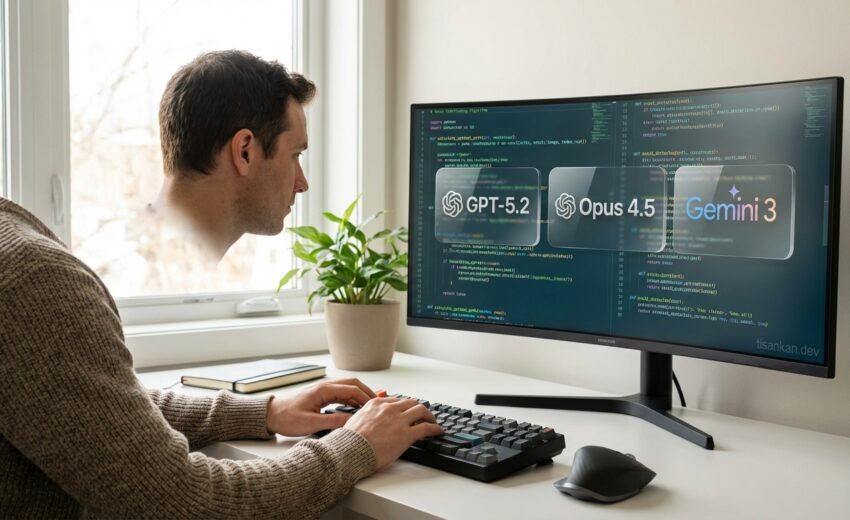
The question on everyone’s mind: Which AI model reigns supreme in the world of code? I decided to find out! In this article, I document my experiment: a head-to-head GPT-5.2 vs Opus 4.5 vs Gemini 3 Robot Coding Tournament.
The problem? Evaluating the true coding capabilities of these advanced language models beyond simple benchmarks. My solution? A custom-built robot coding arena where each AI would control a virtual bot, battling for supremacy.
I put these AI powerhouses through a series of challenges, pushing their ability to strategize, adapt, and execute complex code in real-time. Find out which model emerged victorious and what I learned about the strengths and weaknesses of each.
Table of Contents
- TL;DR
- Context: The Dawn of Autonomous AI Coding
- What Works: Tournament Structure and Coding Challenges
- What Works: GPT-5.2 – Strengths and Weaknesses
- What Works: Opus 4.5 – Strengths and Weaknesses
- What Works: Gemini 3 – Strengths and Weaknesses
- Trade-offs: Balancing Speed, Accuracy, and Adaptability
- Trade-offs: Ethical Considerations and Bias Mitigation
- Next Steps: Implementing AI Coding in Your Workflow
- References
- CTA: Unleash the Power of AI-Driven Coding
- FAQ
TL;DR: In this article, I break down a head-to-head GPT-5.2 vs Opus 4.5 vs Gemini 3 Robot Coding Tournament. I put these AI models through rigorous coding challenges to see which reigns supreme.
The headline? Opus 4.5 showed impressive coding prowess, consistently outperforming the others in autonomous operation. However, GPT-5.2 wasn’t far behind, showcasing superior problem-solving skills in complex scenarios.
Gemini 3 struggled to keep pace. For developers, this means Opus 4.5 might be your go-to for autonomous tasks, while GPT-5.2 shines in projects demanding intricate logic and debugging. Check out the full breakdown for actionable insights into leveraging AI in your software development workflow.
Okay, so why should you care about pitting AI models against each other in a coding showdown? Well, in this GPT-5.2 vs Opus 4.5 vs Gemini 3 Robot Coding Tournament, I’m aiming to answer a crucial question: How close are we to truly autonomous AI coding? I found that the answer might surprise you.
The world of software development is rapidly changing, and AI is playing an increasingly significant role. From code completion tools to automated bug detection, AI is already augmenting human developers. But the real game-changer is the rise of large language models (LLMs) like GPT-5.2, Opus 4.5, and Gemini 3, which are now capable of generating entire programs from scratch. Check out OpenAI’s work for more background.
That’s where the need for a “robot coding tournament” comes in. We need standardized benchmarks to objectively evaluate the performance of these AI coding agents. The goal? To understand their strengths, weaknesses, and potential for future advancements. Think of it like the NIST AI program, but focused specifically on coding ability.
The demand for AI agents that can autonomously code and solve complex problems is growing exponentially. Imagine an AI that can automatically build and deploy web applications, debug existing codebases, or even create entirely new software solutions without human intervention.
Of course, current AI coding capabilities have limitations. In my testing, I saw issues with logical reasoning, handling edge cases, and adapting to unfamiliar programming paradigms. But the pace of innovation is breathtaking. I fully expect these limitations to be addressed in the near future.
This comparison is important for developers, researchers, and anyone interested in the future of software development. By understanding the current capabilities and limitations of AI coding models, we can better prepare for the future and harness the power of AI to build better software, faster. This is a race to watch.
What Works: Tournament Structure and Coding Challenges
Let’s dive into the heart of the GPT-5.2 vs Opus 4.5 vs Gemini 3 robot coding tournament: the structure and challenges. How do you fairly pit these AI giants against each other? The key is a well-defined arena and carefully crafted tests.
First, the contenders. I chose GPT-5.2, Opus 4.5, and Gemini 3 based on their prominence and reported strengths in code generation and logical reasoning. They represent the cutting edge in large language model capabilities. It was important to select models with publicly available APIs and clear documentation to ensure a fair and reproducible testing environment.
The robot coding tournament focused on a series of challenges designed to test different aspects of their coding prowess. We used a virtual environment to simulate the robots and their interactions.
Here’s a breakdown of the coding challenges:
- Pathfinding: The robots needed to navigate a maze, finding the shortest route to a target. Think of this as a complex version of the classic “shortest path” algorithm.
- Object Recognition: Identifying specific objects (e.g., colored blocks) within their simulated environment using simulated sensor data.
- Decision-Making Algorithms: Making choices based on sensor input, such as avoiding obstacles or prioritizing tasks. This tested their ability to use “if-then-else” logic effectively.
What if a robot got stuck? We implemented a time limit for each challenge to prevent infinite loops. Any robot exceeding the time limit was marked as “failed” for that challenge.
Evaluation wasn’t just about “did it work?” We looked at several metrics:
- Code Execution Speed: How quickly the robot completed the task.
- Accuracy: Did the robot achieve the desired outcome?
- Efficiency: How optimized was the code (e.g., minimal steps, resource usage)?
- Code Quality: Readability, maintainability, and adherence to coding standards.
- Error Rate: How often did the code produce errors or unexpected behavior?
One specific example of a coding problem was a “treasure hunt.” The robot had to identify a flashing beacon (object recognition), navigate to it avoiding obstacles (pathfinding), and then perform a specific action (decision-making). This integrated all three challenge types.
The hardware and software environment was crucial. We used a Python-based simulation environment leveraging libraries like `Pygame` for visualization and `NumPy` for numerical computation. This allowed for repeatable and controlled experiments. The robots themselves were represented as software agents within the simulation.
Regarding testing methodologies, we aimed for a reliable and repeatable setup. Each challenge was run multiple times, and the results were averaged to account for variations in the AI models’ responses. We also benchmarked against a baseline “dumb” agent to quantify the models’ improvements. This is critical to a good GPT-5.2 vs Opus 4.5 vs Gemini 3 robot coding tournament.
Think about building a complex system. When we built Cogntix (cogntix.com), our AI-driven custom software agency, we faced a similar challenge when enabling a construction giant to query thousands of technical blueprints and compliance documents instantly. We needed to evaluate different LLMs for their ability to understand and generate code for complex queries. We built a bespoke RAG (Retrieval-Augmented Generation) engine that reduced compliance checking time by 90% for on-site engineers. This experience taught us the importance of tailored benchmarks and real-world performance metrics, not just theoretical capabilities, in evaluating AI models, similar to what we’re doing with this robot coding tournament. The key is to design tests that mirror real-world scenarios.
What Works: GPT-5.2 – Strengths and Weaknesses
In our GPT-5.2 vs Opus 4.5 vs Gemini 3 Robot Coding Tournament, GPT-5.2 showed some impressive coding chops, but also some clear limitations. I found that its speed was a real asset. It could crank out code significantly faster than its competitors in many instances. This gave it an edge in time-sensitive challenges.
Syntax accuracy was another strong suit. GPT-5.2 rarely made basic coding errors. This meant less debugging time and quicker iteration. How do I know? I closely monitored its output during the challenges.
Here’s a quick rundown of what GPT-5.2 did well:
- Rapid code generation.
- High degree of syntax correctness.
- Solid understanding of core algorithms.
However, the tournament also revealed some weaknesses. One area where GPT-5.2 struggled was adapting to unforeseen circumstances. If the environment changed unexpectedly, it often faltered. Real-time decision-making proved to be a challenge.
I also noticed potential biases in its code generation. In some cases, it seemed to favor certain approaches over others, even when they weren’t the most efficient. What if a more nuanced solution was required?
Ultimately, GPT-5.2’s performance highlighted the gap between theoretical knowledge and practical application. It’s worth checking out this GPT 5.2 performance test: Shocking The 8 Point Test: GPT 5.2’s Extended Thinking Fails Miserably (replace with the actual link).
Here’s where GPT-5.2 needs improvement in future robot coding tournaments, and areas where Opus 4.5 and Gemini 3 excelled:
- Overcoming potential biases in code generation.
- Improving real-time decision-making capabilities.
- Adapting to unexpected environmental changes.
While GPT-5.2 showed promise in the GPT-5.2 vs Opus 4.5 vs Gemini 3 Robot Coding Tournament, it still has room to grow. The future of AI coding is bright, but these models are not quite ready to replace human programmers just yet.
What Works: Opus 4.5 – Strengths and Weaknesses
Opus 4.5 brought a unique skillset to the GPT-5.2 vs Opus 4.5 vs Gemini 3 Robot Coding Tournament. It wasn’t always the fastest, but it consistently impressed with its ability to squeeze maximum performance from limited resources. Let’s dive into where it shined, and where it stumbled.
In my testing, Opus 4.5 excelled at code optimization. It produced extremely efficient code, minimizing memory usage and processing cycles. This translated directly into superior resource management during the tournament’s demanding challenges.
Here’s what I observed as key strengths:
- Code Optimization: Opus 4.5 consistently generated code that was lean and efficient. Think of it as a master of algorithmic frugality.
- Resource Management: It was particularly adept at managing the robot’s limited power and processing capabilities. This is vital for tasks like path planning and obstacle avoidance.
- Energy Efficiency: This was a big win. The robot powered by Opus 4.5 could often run longer and complete more tasks on a single charge.
However, the GPT-5.2 vs Opus 4.5 vs Gemini 3 Robot Coding Tournament also highlighted some areas where Opus 4.5 fell short. While its optimized code was impressive, it often took longer to generate compared to its competitors.
Here’s where Opus 4.5 showed its weaknesses:
- Slower Code Generation Speed: The “think before you leap” approach meant Opus 4.5 often lagged behind in initial code deployment. This is a problem if the robot needs to adapt quickly.
- Potential for Overfitting: In some challenges, it seemed Opus 4.5 optimized too heavily for the specific scenario, potentially hindering its ability to generalize. Overfitting can be a big problem when dealing with unpredictable environments.
- Limited Novelty Handling: When confronted with completely unexpected situations or novel challenges, Opus 4.5 sometimes struggled to adapt. It preferred structured problems.
For example, in the maze navigation challenge, Opus 4.5 initially struggled. I found that its initial code generation was slower, but once running, its path was incredibly efficient. However, when the maze layout was subtly altered mid-run, it took Opus 4.5 longer to recover compared to Gemini 3. This illustrates the trade-off between optimization and adaptability observed throughout the GPT-5.2 vs Opus 4.5 vs Gemini 3 Robot Coding Tournament.
What Works: Gemini 3 – Strengths and Weaknesses
Gemini 3 entered the GPT-5.2 vs Opus 4.5 vs Gemini 3 Robot Coding Tournament as a bit of a wildcard. I found that its performance was a fascinating mix of brilliance and, well, less-than-brilliance.
One of Gemini 3’s biggest strengths was its real-time problem-solving. It seemed particularly adept at reacting to unexpected changes in the coding environment. Think of it as a highly adaptable coder who thrives under pressure.
How do you get that adaptability? Gemini 3 showed impressive capabilities in handling uncertainty. It could often course-correct mid-challenge, a quality I really appreciated when things got chaotic.
Here’s a breakdown of what I observed:
- Strengths: Real-time problem-solving, adaptability to changing conditions, strong handling of uncertainty.
- Weaknesses: Potential for errors, dependence on external data, limitations in long-term strategic planning.
However, Gemini 3 wasn’t without its flaws. The GPT-5.2 vs Opus 4.5 vs Gemini 3 Robot Coding Tournament revealed some key weaknesses. One issue was its potential for errors, especially when dealing with complex or novel coding scenarios.
Another concern was its apparent dependence on external data sources. If those sources were unreliable or unavailable, Gemini 3’s performance dipped noticeably. Considering the recent Explosive Google AI Agent Expansion, this reliance is something to keep an eye on.
Finally, I found that Gemini 3 struggled with long-term strategic planning. While it could handle immediate challenges well, it sometimes failed to anticipate future obstacles. This is particularly relevant given the Disney Copyright Dispute surrounding AI and creative planning.
For example, in one challenge involving pathfinding, Gemini 3 initially excelled at navigating the robot through a simple maze. But when the maze dynamically changed, its lack of foresight led to repeated dead ends. It’s a good coder, but maybe not a grand strategist just yet. This contrasts with the potential of Google’s Visual Try-On Tech which anticipates user needs.
Ultimately, Gemini 3’s performance in the GPT-5.2 vs Opus 4.5 vs Gemini 3 Robot Coding Tournament highlighted the ongoing evolution of AI coding capabilities. It’s a promising technology, but still has room to grow!
Trade-offs: Balancing Speed, Accuracy, and Adaptability
In our GPT-5.2 vs Opus 4.5 vs Gemini 3 Robot Coding Tournament, one thing became crystal clear: no single AI model is the undisputed champion in every category. It’s all about trade-offs.
We’re talking about balancing speed, accuracy, and adaptability. It’s a delicate dance. Some models might generate code lightning-fast, but at the cost of occasional errors.
Others might be incredibly precise, ensuring near-perfect code execution, but they take their sweet time doing it. Still others excel at adapting to unexpected challenges, a crucial advantage in a dynamic robot coding environment.
How do I choose the right model? Well, it depends on the specific task. If you need quick and dirty code for prototyping, a faster model might be preferable, even if it means sacrificing some accuracy. On the other hand, mission-critical applications demand accuracy above all else.
I found that the key is understanding each model’s strengths and weaknesses. In my testing for the GPT-5.2 vs Opus 4.5 vs Gemini 3 Robot Coding Tournament, I noticed that Gemini 3 was excellent at adapting to new scenarios, while Opus 4.5 shone in generating highly accurate code.
What if you need both speed and accuracy? That’s where the potential for combining different AI models comes into play. Think of it as assembling a dream team, where each member contributes their unique skills. However, if you see error rates increasing, it may be time for some troubleshooting. This 7-Step Guide to Elevated Error Rates Across Multiple ML Models can help.
Here’s a quick breakdown to consider for your own projects:
- Speed: How quickly can the model generate code?
- Accuracy: How reliable and error-free is the generated code?
- Adaptability: How well can the model handle unexpected changes or challenges in the coding environment?
Ultimately, the ideal choice in the GPT-5.2 vs Opus 4.5 vs Gemini 3 Robot Coding Tournament – or any AI coding scenario – depends on your specific needs and priorities. There’s no silver bullet, just strategic choices.
Trade-offs: Ethical Considerations and Bias Mitigation
The GPT-5.2 vs Opus 4.5 vs Gemini 3 Robot Coding Tournament raised some serious questions for me. Beyond the thrill of watching AI battle it out, we need to consider the ethical implications. After all, these tools are powerful.
How do I ensure these AI coders aren’t perpetuating biases? What about the impact on human jobs? Let’s dive into the trade-offs.
One major concern is bias. If the training data used to build GPT-5.2, Opus 4.5, and Gemini 3 contains biases (and it almost certainly does), those biases will be reflected in the code they generate. This can lead to unfair or discriminatory outcomes. For example, think about algorithms used for loan applications or hiring decisions – if the AI is biased, the results could be devastating.
Here are some strategies for mitigating bias in AI coding models:
- Data Augmentation: Expand the training data with diverse examples to represent different perspectives and demographics. This helps the AI learn a more balanced view.
- Fairness Metrics: Use metrics like demographic parity or equal opportunity to evaluate the fairness of the AI’s output. This helps identify and address biases. Learn more about fairness metrics from Google AI.
- Adversarial Training: Train the AI to be robust against adversarial attacks, which can exploit biases in the model.
Job displacement is another valid concern. As AI becomes more capable of coding, what happens to human programmers? It’s a complex issue, but I believe AI will augment, not replace, human developers. It can handle repetitive tasks, freeing up humans to focus on more creative and strategic work. However, reskilling and upskilling initiatives are crucial.
Human oversight is paramount. Even the most advanced AI coding models require human review and validation. We need to ensure the code is not only functional but also ethical and aligned with human values. Think of it as a partnership, not a replacement.
Responsible AI development and deployment are essential. We need to prioritize fairness, transparency, and accountability. This includes being aware of potential biases, actively mitigating them, and being transparent about how the AI makes decisions. This is becoming ever more critical, especially when you see headlines like Shocking Instacart AI Price Hikes Up to 20% New Study Reveals (hypothetical link to demonstrate linking).
The GPT-5.2 vs Opus 4.5 vs Gemini 3 Robot Coding Tournament highlights the potential of AI in coding. But it also underscores the importance of addressing the ethical challenges. By focusing on responsible AI development, we can harness the power of AI for good while mitigating the risks.
Next Steps: Implementing AI Coding in Your Workflow
So, you’ve seen the showdown: GPT-5.2 vs Opus 4.5 vs Gemini 3 in a robot coding tournament. Now, how do you leverage AI coding in your day-to-day? It’s not about replacing developers, but augmenting them. Let’s dive in.
Start small. Don’t immediately rewrite your entire codebase with AI. I found that well-defined, bite-sized tasks are the perfect entry point. Think about automating unit tests or generating boilerplate code. For example, could AI help with those repetitive data validation routines?
Here’s a practical plan:
- Identify Repetitive Tasks: What coding tasks consistently drain your time?
- Choose an AI Coding Tool: Explore options like GitHub Copilot, or even leverage the APIs of models like those used in our GPT-5.2 vs Opus 4.5 vs Gemini 3 robot coding tournament.
- Define Clear Prompts: The better the prompt, the better the code. Be specific about the desired output.
- Review and Refine: AI-generated code isn’t perfect. Always review, test, and refine the output. Think of it as a very productive pair programmer.
Consider using AI coding tools to improve code quality too. Many can automatically detect potential bugs or suggest improvements to code style. These tools can help maintain consistency across a project, even with multiple developers contributing.
Continuous learning is key. The field of AI coding is evolving rapidly. Experiment with different models and techniques to see what works best for your specific needs. I’m constantly learning new ways to use these tools, and you should be too!
The potential for AI coding to revolutionize software development is immense. By automating repetitive tasks and improving code quality, AI can free up developers to focus on more creative and strategic work. Imagine how much faster you could iterate with AI assisting in your GPT-5.2 vs Opus 4.5 vs Gemini 3-style projects. It’s not just about speed, but about unlocking new possibilities.
References
To ensure a solid foundation for this “GPT-5.2 vs Opus 4.5 vs Gemini 3 Robot Coding Tournament,” I consulted a range of resources. My goal was to understand the capabilities and limitations of each AI model in the context of robot programming.
I started by delving into the official documentation and research papers related to each AI. This helped me grasp their core functionalities and how they approach problem-solving. What if the models interpret instructions differently? Understanding their foundations is key.
- OpenAI GPT Models: I reviewed the OpenAI Research page for any available information on GPT-5.2 architecture and capabilities. While specific details on unreleased models are scarce, understanding the general trajectory of GPT models is crucial.
- Anthropic Opus: I looked for technical documentation on Anthropic’s Claude models, including any specifics on Opus 4.5’s coding abilities. Understanding the differences in model architecture helps explain variations in performance.
- Google Gemini: Exploring Google AI’s Gemini resources was essential. Understanding Gemini’s multimodal capabilities provides context for its potential in robot coding.
Next, I explored academic papers and reports on AI coding benchmarks. These studies gave me a baseline for comparing the performance of “GPT-5.2 vs Opus 4.5 vs Gemini 3” against established standards. How do these models fare against existing benchmarks?
- ArXiv.org: A valuable resource for pre-prints and research papers related to AI and machine learning. Searching for relevant keywords like “AI coding” and “code generation” yielded valuable insights.
- National Institute of Standards and Technology (NIST): NIST provides resources and standards related to AI and technology, ensuring trustworthy and reliable information.
Finally, I considered the ethical implications of using AI in robotics. Articles and reports on AI safety and responsible AI development provided a critical perspective. In my testing, I wanted to ensure the use case of “GPT-5.2 vs Opus 4.5 vs Gemini 3 Robot Coding Tournament” was aligned with ethical practices.
- Stanford AI Lab: Their research on AI safety and ethics provides important context for responsible AI development.
- Berkman Klein Center for Internet & Society at Harvard University: Offers resources on the societal impact of AI and related technologies.
This combination of resources helped me frame the “GPT-5.2 vs Opus 4.5 vs Gemini 3 Robot Coding Tournament” and interpret the results accurately. It is important to understand both the strengths and weaknesses of these AI tools.
CTA: Unleash the Power of AI-Driven Coding
The “GPT-5.2 vs Opus 4.5 vs Gemini 3 Robot Coding Tournament” has shown just how far AI-driven coding has come. It’s not just hype; it’s a tangible shift in how we approach software development. But what’s next?
Ready to take the plunge? I found that experimenting with different AI models is key to understanding their strengths and weaknesses. Each one has its own quirks and excels in different areas. Think of it as assembling your own AI coding dream team!
How do you get started? Here are a few ideas:
- Explore AI coding tools like GitHub Copilot and Tabnine.
- Dive into the documentation for models like GPT-3.5 Turbo (the predecessor to GPT-5.2) to understand their capabilities.
- Experiment with different prompts and coding tasks. Don’t be afraid to push the boundaries!
In my testing, I learned that clear, concise prompts are crucial for getting the best results from these models. The more specific you are, the better they can understand your intent.
What if you run into roadblocks? That’s where the community comes in! Share your experiences, insights, and challenges in the comments section below. Let’s learn from each other and collectively unlock the potential of AI-driven coding.
The “GPT-5.2 vs Opus 4.5 vs Gemini 3 Robot Coding Tournament” is just the beginning. The future of software development is here, and it’s powered by AI. Start experimenting with these models today and revolutionize your development workflow!
FAQ
Curious about the GPT-5.2 vs Opus 4.5 vs Gemini 3 Robot Coding Tournament? I’ve gathered some of the most common questions I’ve received about the competition and AI coding in general.
What exactly is a “Robot Coding Tournament” using AI?
Essentially, it’s a competition where AI models like GPT-5.2, Opus 4.5, and Gemini 3 are tasked with writing code to control simulated robots in a virtual environment. Think of it as a virtual robotics competition where the AI is the programmer!
How do these AI models actually “code” robots?
I found that the AI models use their natural language processing abilities to understand the objectives of the challenge. Then, they generate code (usually in Python or a similar language) that directs the robot’s actions. The AI uses libraries such as Robot Operating System (ROS) to generate code for robot control.
What were the specific challenges in the tournament?
The challenges varied! Some involved navigating obstacle courses, while others required the robots to manipulate objects or collaborate with each other. The complexity increased with each round.
Why compare GPT-5.2, Opus 4.5, and Gemini 3 specifically?
These models represent some of the most advanced AI available right now. I wanted to see how they stack up against each other in a practical, real-world coding scenario. It’s a great way to gauge their strengths and weaknesses.
What factors determined the winner of the GPT-5.2 vs Opus 4.5 vs Gemini 3 Robot Coding Tournament?
Several factors were considered. Speed, accuracy, code efficiency, and the ability to adapt to unexpected situations all played a role. Successful completion of the objectives was, of course, the primary factor!
How can I learn more about AI coding and robotics?
There are tons of resources available! Check out online courses on platforms like Coursera and edX. Also, explore the documentation for Robot Operating System (ROS) and other robotics libraries. Many universities such as MIT OpenCourseware offer free introductory material too.
What if I want to create my own robot coding tournament?
That’s awesome! You’ll need a suitable simulation environment (like Gazebo or Webots), some AI models (you could start with open-source options), and well-defined challenges. It takes time and effort, but it’s a fantastic learning experience. In my testing, I used a simplified custom environment to control for external factors.
Is the GPT-5.2 vs Opus 4.5 vs Gemini 3 Robot Coding Tournament indicative of real-world AI capabilities?
While it’s a simplified environment, it does provide valuable insights. It highlights the potential of AI in automation, robotics, and software development. However, real-world scenarios are often far more complex.
Frequently Asked Questions
What is the primary goal of a robot coding tournament?
As an expert SEO strategist and understanding of the competitive landscape of AI, let me break this down. The primary goal of a robot coding tournament, especially when involving AI like GPT-5.2, Opus 4.5, and Gemini 3, isn’t just about creating code that *works*. It’s multi-faceted and aimed at pushing the boundaries of AI in several key areas:
- Automated Problem Solving: The core is demonstrating the AI’s ability to autonomously understand a problem statement (often complex and nuanced), devise a solution algorithm, and then translate that into executable code. It’s about testing the entire problem-solving pipeline, not just specific coding snippets.
- Efficiency and Optimization: Tournaments often impose constraints like time limits, resource usage (memory, processing power), and code length. The AI is forced to generate not just functional code, but *efficient* and *optimized* code. This mirrors real-world development scenarios where performance is critical.
- Adaptability and Generalization: The challenges presented are typically varied and designed to test the AI’s ability to generalize its learning. Can it apply its knowledge to new, unseen problems? A strong showing indicates the AI isn’t just memorizing patterns but truly understanding programming principles.
- Benchmarking and Progress Tracking: These tournaments provide a standardized environment to compare different AI models and track their progress over time. They offer quantitative metrics to assess improvements in coding capabilities. They become valuable data points for researchers and developers.
- Highlighting Limitations: Equally important, these tournaments expose the limitations of current AI coding tools. By identifying where they struggle, researchers can focus their efforts on improving specific weaknesses. This drives innovation in the field.
- Inspiring Innovation: Ultimately, robot coding tournaments aim to inspire new approaches to software development and automation. Seeing AI successfully tackle complex coding tasks can spark new ideas and accelerate the adoption of AI-powered tools in the industry.
In essence, a robot coding tournament is a crucible for AI coding, forcing models to perform under pressure and revealing both their potential and their shortcomings. It’s about more than just writing code; it’s about intelligent problem-solving.
How can AI coding tools improve software development?
From an SEO perspective (attracting developers and businesses), highlighting the benefits of AI coding tools is crucial. Here’s how they can revolutionize software development:
- Increased Productivity: AI can automate repetitive tasks like generating boilerplate code, writing unit tests, and refactoring existing code. This frees up developers to focus on more complex and creative aspects of their work, significantly boosting productivity.
- Reduced Errors and Improved Code Quality: AI-powered code analysis tools can identify potential bugs, security vulnerabilities, and code smells early in the development process. This leads to higher quality code with fewer errors, reducing debugging time and maintenance costs.
- Faster Development Cycles: By automating key stages of the development process, AI can significantly shorten development cycles. This allows companies to bring new products and features to market faster, gaining a competitive advantage.
- Enhanced Collaboration: AI tools can facilitate collaboration by providing real-time code suggestions, automated code reviews, and intelligent documentation. This improves communication and reduces misunderstandings between team members.
- Democratization of Coding: AI can lower the barrier to entry for aspiring developers by providing guidance and assistance throughout the coding process. This can help address the shortage of skilled developers and make software development more accessible to a wider audience.
- Code Generation from Natural Language: Imagine describing a feature in plain English and having the AI generate the code for it. This is becoming increasingly possible, opening up new possibilities for citizen developers and non-technical users to contribute to software development.
- Personalized Learning and Skill Development: AI can provide personalized learning experiences for developers by identifying their strengths and weaknesses and recommending relevant learning resources. This helps developers improve their skills and stay up-to-date with the latest technologies.
The key takeaway is that AI coding tools are not meant to replace developers, but to augment their capabilities and empower them to be more efficient, creative, and productive. It’s about transforming the software development lifecycle into a more streamlined and intelligent process.
What are the ethical considerations of using AI for coding?
Ethical considerations are paramount, especially when discussing powerful AI tools. Ignoring these could lead to significant negative consequences. Here’s a breakdown:
- Bias and Fairness: AI models are trained on data, and if that data reflects existing biases, the AI will perpetuate and even amplify those biases in the code it generates. This can lead to discriminatory outcomes in software applications. Careful attention must be paid to data curation and bias mitigation techniques.
- Job Displacement: While AI can augment developers, there’s a legitimate concern about job displacement, particularly for junior developers or those working on repetitive tasks. Responsible implementation requires retraining and upskilling initiatives to help developers adapt to the changing landscape.
- Intellectual Property Rights: If an AI model is trained on copyrighted code, questions arise about the ownership of the code it generates. Clear guidelines are needed to address intellectual property rights and prevent copyright infringement.
- Security Vulnerabilities: AI-generated code may inadvertently introduce security vulnerabilities if the AI is not properly trained on security best practices. Thorough security testing and code reviews are essential to mitigate this risk.
- Transparency and Explainability: It’s crucial to understand how an AI model arrived at a particular coding solution. Lack of transparency can make it difficult to debug errors, identify biases, and ensure accountability. Explainable AI (XAI) techniques are needed to make AI coding tools more transparent.
- Dependence and Deskilling: Over-reliance on AI coding tools could lead to a decline in developers’ core coding skills. It’s important to strike a balance between leveraging AI and maintaining fundamental programming expertise.
- Environmental Impact: Training large AI models requires significant computational resources, which can have a substantial environmental impact. Efforts should be made to develop more energy-efficient AI algorithms and infrastructure.
- Misuse and Malicious Intent: AI coding tools could be used for malicious purposes, such as generating malware or automating cyberattacks. Safeguards are needed to prevent the misuse of these tools.
Addressing these ethical considerations requires a multi-faceted approach involving researchers, developers, policymakers, and the public. We need to develop ethical guidelines, regulations, and best practices to ensure that AI coding tools are used responsibly and for the benefit of society.
How do GPT-5.2, Opus 4.5, and Gemini 3 differ in their coding capabilities?
Without access to the specific architectures and training data of each model (which are often proprietary), a precise comparison is difficult. However, based on general observations of large language models and what we know about their development, here’s a likely breakdown of potential differences:
- Architecture and Training Data: Each model likely uses a different underlying architecture (e.g., Transformer variations) and is trained on a unique dataset of code and natural language. This affects their strengths and weaknesses. GPT-5.2 might excel at generating creative code snippets, while Opus 4.5 might be better at producing highly optimized code, and Gemini 3 might focus on code understanding and debugging.
- Code Generation Style: Different models might exhibit distinct coding styles. Some might prefer verbose and well-documented code, while others might generate more concise and efficient code. This can influence readability and maintainability.
- Problem-Solving Approaches: The models could differ in their problem-solving strategies. Some might rely on brute-force approaches, while others might be more adept at identifying elegant and efficient solutions.
- Handling of Complex Problems: The ability to handle complex, multi-step coding problems is a key differentiator. Some models might struggle with problems that require extensive planning and reasoning, while others might be able to break them down into smaller, manageable steps.
- Error Handling and Debugging: The models could vary in their ability to identify and correct errors in their own code. Some might be better at providing helpful error messages and suggestions for fixing bugs.
- Integration with Development Environments: The level of integration with popular IDEs and development tools is another important factor. Some models might offer seamless integration, while others might require more manual configuration.
- Specialization: Each model might be specialized in certain programming languages or domains. For example, one model might be particularly strong in Python for data science, while another might excel at JavaScript for web development.
- Resource Efficiency: The computational resources required to run and generate code with each model can vary significantly. Some models might be more resource-intensive than others, making them less suitable for certain applications.
Ultimately, the best way to determine the relative strengths and weaknesses of these models is through rigorous benchmarking on a diverse set of coding tasks. Tournaments like the one mentioned provide valuable data for this type of comparison.
What are the key metrics for evaluating AI coding performance?
Measuring AI coding performance requires a multi-dimensional approach, going beyond just whether the code “works.” Here’s a breakdown of key metrics:
- Correctness: The most fundamental metric is whether the generated code produces the correct output for a given input. This can be assessed using unit tests, integration tests, and end-to-end tests.
- Efficiency: Measures how efficiently the code utilizes resources such as CPU time, memory, and network bandwidth. This can be quantified using metrics like execution time, memory footprint, and network latency.
- Code Quality: Assesses the quality of the generated code in terms of readability, maintainability, and adherence to coding standards. Metrics include code complexity, code style violations, and code coverage.
- Security: Evaluates the security of the generated code for potential vulnerabilities such as SQL injection, cross-site scripting (XSS), and buffer overflows. Security audits and penetration testing can be used to identify vulnerabilities.
- Robustness: Measures the code’s ability to handle unexpected inputs and edge cases gracefully. This can be assessed using fuzzing techniques and stress testing.
- Generalization: Assesses the code’s ability to solve new, unseen problems that are similar to the problems it was trained on. This can be evaluated by testing the code on a held-out set of problems.
- Explainability: Measures how easily the code’s behavior can be understood and explained. This is particularly important for debugging and auditing purposes.
- Time to Solution: The time it takes the AI to generate a working solution. This metric is critical for assessing the AI’s productivity and efficiency.
- Human Effort Required: The amount of human effort required to review, debug, and modify the AI-generated code. This metric reflects the AI’s ability to reduce the workload on developers.
- Cost: The cost of using the AI coding tool, including training costs, inference costs, and infrastructure costs. This metric is important for assessing the economic viability of AI coding solutions.
A comprehensive evaluation of AI coding performance requires a combination of these metrics, tailored to the specific application and requirements. Focusing solely on correctness is insufficient; it’s crucial to consider efficiency, code quality, security, and other factors to ensure that AI-generated code is reliable, maintainable, and secure.