


Artificial Intelligence: forget sentient robots. In 2024, AI isn’t futuristic fantasy; it’s a core competency for developers. This guide, “AI Demystified,” provides actionable insights to integrate AI into your projects.
Companies failing to adopt AI risk obsolescence. Expect entirely new business models, not incremental improvements.
1. Fundamentals: Beyond Buzzwords
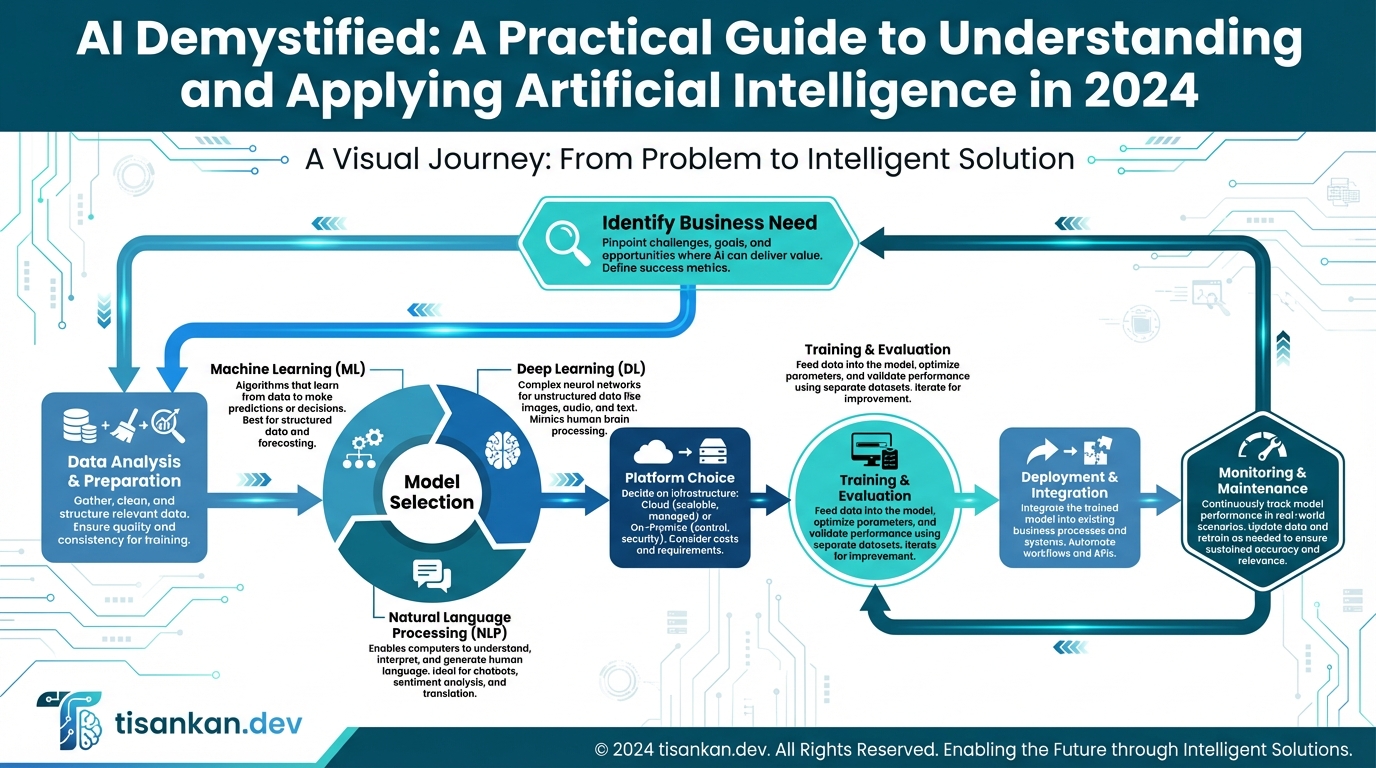
AI enables machines to perform tasks requiring human intelligence. Key concepts:
- Machine Learning (ML): Algorithms learning from data. Examples: spam filters, recommendation engines.
- Deep Learning (DL): ML subset using multi-layered neural networks for complex data analysis. Powers image recognition, NLP.
- Natural Language Processing (NLP): Enables computers to understand and generate human language. Examples: chatbots, sentiment analysis.
- Computer Vision: Enables computers to interpret images/videos. Examples: facial recognition, autonomous driving.
These concepts interoperate. A self-driving car uses computer vision, ML for prediction, and NLP for voice commands.
2. Realistic Expectations: AI’s Limitations
AI is powerful, but not magic. Understand these limitations:
- Data Dependency: Models are data-dependent. Insufficient/biased data yields inaccurate results.
- Lack of Common Sense: AI struggles with common sense reasoning. Excels at specific tasks but lacks general intelligence.
- Explainability: Deep learning models are often black boxes. Lack of transparency can be problematic.
- Adversarial Attacks: Vulnerable to crafted inputs that fool models.
Overhyping AI wastes resources. A realistic understanding is essential.
3. Practical AI Applications
Identify bottlenecks, inefficiencies, or automation opportunities. Consider these areas:
- Automation: Automate tasks to free human employees.
- Personalization: Tailor experiences based on user preferences.
- Prediction: Forecast trends, predict churn, detect fraud.
- Optimization: Optimize processes and resource allocation.
- Insights: Uncover hidden patterns in datasets.
Focus on specific problems. Validate with a Proof-of-Concept (POC) before full-scale implementation.
4. Tools and Frameworks
The AI landscape is vast. Simplify development with these tools:
- TensorFlow: Google’s open-source ML framework. Used for research and production.
- PyTorch: Open-source framework. Favored for flexibility.
- Scikit-learn: Python library for data mining/analysis. Beginner-friendly.
- Cloud AI Platforms: Google Cloud AI, Amazon SageMaker, Azure AI offer pre-trained models and managed services.
Tool choice depends on your needs. Experiment. Leverage existing libraries and serverless functions to cut infrastructure costs.
5. Data Preparation: The Foundation
Garbage in, garbage out. Data quality impacts model performance. Key steps:
- Data Collection: Gather relevant and accurate data.
- Data Cleaning: Handle missing values and inconsistencies.
- Data Transformation: Convert data into suitable formats via scaling or feature engineering.
- Data Augmentation: Create synthetic data to expand training datasets.
Data preparation is time-consuming. Ensure clean, consistent, and representative data.
6. Model Training and Evaluation
Train models by feeding data and adjusting parameters. This is an iterative process:
- Hyperparameter Tuning: Optimize model performance.
- Cross-Validation: Evaluate performance on data subsets for generalization.
- Regularization: Prevent overfitting.
- Evaluation Metrics: Assess performance using metrics like accuracy, precision, recall.
Model training requires experimentation and refinement. Use visualization tools for improvement.
7. Deployment and Monitoring
Deployment is the beginning. Continuous monitoring is essential:
- Performance Monitoring: Track metrics to detect degradation.
- Data Drift Detection: Identify changes affecting accuracy.
- Model Retraining: Retrain with new data to maintain performance.
- A/B Testing: Compare performance against baselines.
AI requires ongoing maintenance. Implement monitoring systems and MLOps pipelines to automate the process.
Consider fraud detection in financial institutions. Deploying an AI model to detect fraudulent transactions requires continuous monitoring for data drift. As fraudsters adapt their tactics, the model must be retrained with new data to maintain its effectiveness. Failure to do so results in increased false positives or missed fraudulent activities, directly impacting revenue and customer trust. This highlights the necessity of continuous vigilance and refinement in AI implementations.
The Broader Context
AI is intertwined with:
- Cloud Computing: Provides infrastructure for training and deployment.
- Big Data: Fuels algorithms with data.
- Internet of Things (IoT): Generates data for training and applications.
- 5G: Enables faster data transfer for real-time applications.
Understand these interdependencies. The demand for AI skills remains strong, market corrections notwithstanding.
The Future of AI
Expect advancements in:
- Generative AI: Models that generate content.
- Explainable AI (XAI): Techniques for transparency.
- Federated Learning: Training on decentralized data.
- Edge AI: Running models on edge devices.
Address ethical considerations proactively. Develop responsible AI practices and regulations. Hinton’s warnings about misuse are pertinent. Dive deeper into the risks surrounding Geoffrey Hinton AI Apocalypse here.
Continuous learning is crucial. Embrace a growth mindset and adapt. The AI revolution is underway.
Stay informed, experiment, and adapt your strategies. Understand the subtleties between different AI models, as well as the nuances between Google Gemini, OpenAI, and Hinton’s work.
AI is a tool to augment human capabilities. Focus on solving real-world problems to unlock its transformative potential. Understand the differences between this and the concepts discussed in “AI Demystified: A No-Nonsense Guide for 2024”.
Frequently Asked Questions
What is the difference between AI, Machine Learning, and Deep Learning?
AI encompasses techniques mimicking human intelligence. ML is a subset using algorithms to learn from data. DL is a subset of ML using multi-layered neural networks.
What are the key ethical considerations when developing AI applications?
Key considerations include bias, fairness, transparency, privacy, and accountability. Ensure applications are transparent and accountable.
How can I get started with AI development if I have no prior experience?
Learn programming, data science, and ML fundamentals. Experiment with open-source tools. Focus on small problems.
What are some common mistakes to avoid when implementing AI?
Avoid insufficient data, overhyping capabilities, neglecting data preparation, failing to monitor performance, and ignoring ethics.
How can I ensure that my AI models are unbiased and fair?
Examine data for biases. Use data augmentation to mitigate bias. Evaluate performance on different groups.
What are the different deployment options for AI models?
Options include cloud servers, edge devices, and embedded systems. Cloud offers scalability; edge provides lower latency.
How do I choose the right evaluation metrics for my AI model?
For classification, use accuracy, precision, recall. For regression, use MSE and R-squared. Consider the trade-offs.
What are the emerging trends in AI that I should be aware of?
Emerging trends include generative AI, explainable AI (XAI), federated learning, and edge AI.