

Table of Contents
1. TL;DR—AWS Global Outage October 2025 Explained
On October 20, 2025, Amazon Web Services (AWS) suffered a massive global outage that disrupted more than 1,000 companies and millions of users globally. Major websites, banking apps, popular games, and essential digital tools went down, with the root cause traced to internal DNS resolution failures affecting the DynamoDB database service and cascading into network-wide connectivity issues. AWS has since declared the “underlying issue fully mitigated,” but users may still experience residual delays as systems recover. This event highlights critical risks in today’s cloud-dependent tech landscape.
2. Context: Why AWS’s Outage Changed the Internet Overnight
Expertise statement: As a CTO or technical lead, it’s crucial to monitor cloud reliability, since a single provider’s failure can ripple across the entire web ecosystem. The 2025 AWS outage was not only broad but occurred in the heavily used US-EAST-1 (Northern Virginia) region—a strategic hub for countless businesses. The incident mirrors previous AWS disruptions but had an outsized impact because of increased critical service dependencies, including on-demand compute (EC2), managed databases (DynamoDB), and the networking backbone both for Amazon and third-party platforms.
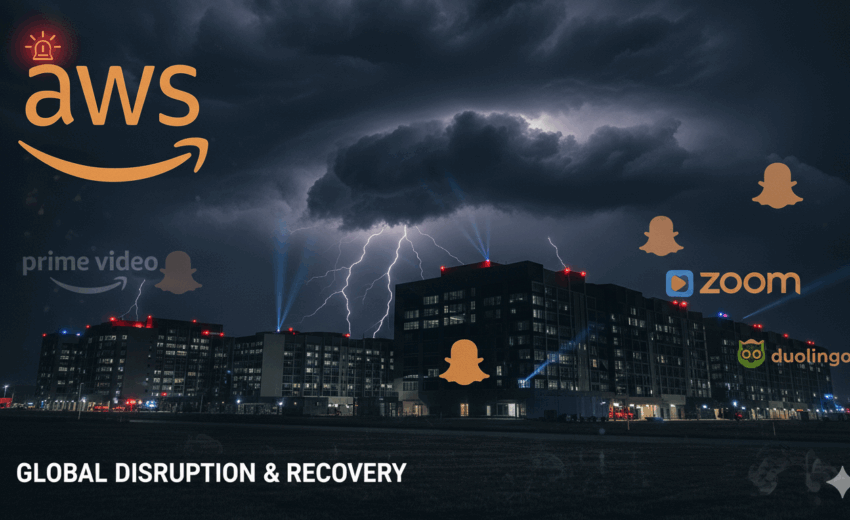
Key brands impacted included:
- Social & Communications: Snapchat, Reddit, Signal, Slack, Zoom
- Gaming: Roblox, Fortnite, PUBG, Wordle, New York Times games
- Streaming & Media: Disney+, Hulu, Amazon Prime Video, Alexa, Ring, McDonald’s App
- Finance: Lloyds Bank, Chime, Robinhood, Coinbase, Venmo, major banks
- Airlines & Government: United Airlines, Delta, HM Revenue and Customs (UK)
- EdTech & Productivity: Duolingo, CollegeBoard, Canva
- Others: The New York Times, Apple TV, Wordle, Whatnot, Life360, Goodreads
Platform-wide impact:
Sites and apps appeared offline for hours, payments failed, virtual assistants could not respond, and smart devices like Ring cameras and Alexa experienced delays or complete downtime.
What Really Happened: Anatomy of an Internet-Scale Outage
Timeline and Technical Diagnosis
- Early Hours (Eastern): Outage began with “increased error rates” in the US-EAST-1 region.
- Root Cause Identified: AWS traced the initial problem to an internal system responsible for monitoring the health of its network load balancers, catalyzing a DNS (Domain Name System) failure for the DynamoDB API endpoint.
- Cascading Effects: As DNS failed, apps and services could not resolve or connect to their databases. This did NOT mean data was lost—just that it became temporarily unreachable (“internet amnesia”).
- Domino to EC2 and Others: The network issues created ripple effects sending EC2 (virtual servers), Lambda, SQS, RDS, API Gateway, CloudFront, and other dependencies into periodic unavailability.
- Scale: Millions affected as platforms relying on US-EAST-1—an AWS backbone region—experienced downtime, even when their global networks were work ing.
- Recovery Process: Early “mitigations” were applied within hours, seeing signs of improvement by early morning US time. By 6:35 AM ET, the DNS issue was marked fully “mitigated,” and services began returning to normal, although not all functionalities were instantly restored.
AWS’s Official Position
Amazon’s Service Health Dashboard reported “increased error rates and latencies for multiple AWS Services in the US-EAST-1 Region.”
Even as core problems were resolved, AWS advised some clients to “flush DNS caches” for full restoration, and new EC2 instance launches faced extended delays due to ongoing backlog processing.
Backlog queues in Lambda, CloudTrail, and other services resulted in processing delays for hours post-outage fix.
The Strategic Importance of US-EAST-1
US-EAST-1 is AWS’s largest and most critical region, serving as a hub for countless global companies. When one of these huge “central nodes” suffers trouble, the consequences are felt worldwide—reminiscent of how targeted infrastructure failures can bring down otherwise robust systems.
3. What Works: Understanding How Cloud Infrastructure Is Impacted
This outage spotlights both the power and the fragility of modern cloud services.
AWS Core Services Directly Affected
- DynamoDB: The primary failing point. NoSQL database services underpinning thousands of apps—including customer, e-commerce, and gaming data—became unreachable, even though the data itself wasn’t in danger.
- EC2 (Elastic Compute Cloud): Virtual server instances could not be launched, updated, or communicate reliably with dependent services.
- SQS (Simple Queue Service), Lambda, CloudTrail: Queueing and event-driven compute suffered increased error rates, with lingering event processing and delays.
- RDS, Glue, S3, CloudFront, API Gateway, IAM: Many supporting services depending on healthy connectivity in US-EAST-1 experienced intermittent issues or slowdowns.
Third-Party and Amazon’s Own Services Impacted
- Entertainment: Fortnite, Roblox, Disney+, Hulu, Prime Video, Alexa, Ring
- Messaging & Social: Snapchat, Signal, Reddit, Slack
- Finance: Lloyds Bank (UK), Coinbase, Robinhood, Chime, Venmo
- Airlines: United, Delta; with some airports even seeing flight delays.
- Productivity/Learning: Duolingo, CollegeBoard, Canva, Zoom
- Government: HM Revenue & Customs (UK)
- Streaming & Media: NY Times, Apple TV, Wordle, Whatnot, Life360, Goodreads
Cloud Customer Experience
- Symptoms Seen by End Users: Sites not loading, API requests timing out, erratic app behavior, intermittent errors, inaccessible data.
- Error propagation: Even users far from North Virginia felt the pinch due to how internet routing, cloud service dependencies, and DNS work in practice—underscoring the interconnectedness of the modern web.
How AWS Fixed It
- AWS engineering teams addressed the DNS issue rapidly with layered mitigations.
- Recovery started within two hours, but the backlog of requests led to extended delays in some services.
- Full fix required processing massive request queues.
- AWS temporarily limited new EC2 instance launches to stabilize performance.
- Advised customers to flush their DNS cache to resolve persistent DNS errors.
- Most services online by late morning, though some backlogs remained until the evening.
4. Trade-offs: Risks, Reputational Impact, and Lessons for Cloud Users
Why Did This Happen? (And What’s Still Unknown)
Amazon has not yet published a full forensic post-mortem. While DNS resolution for DynamoDB was the trigger, it’s clear there was a deeper, systemic weakness. Tracking and “health checks” of network infrastructure in a concentrated region like US-EAST-1 creates a single point of failure for large portions of the internet when something goes wrong.
Real-World Consequences
- Financial loss and disruption: Banks, fintechs, and stock trading platforms went offline, inducing panic and potential economic fallout.
- Brand trust: Popular games and apps lost millions of user-hours, resulting in social media backlash and eroding trust—especially with repeated large-scale outages.
- Critical service risk: Governments and airlines saw disruptions that could threaten real-world activities (travel, payments, information access).
- Customer churn: Businesses relying on “always-on” guarantees from the cloud will reevaluate vendor lock-in, region strategy, and disaster recovery plans.
Cloud Infrastructure Trade-offs
- Scaling and Reliability: Centralized, highly scalable regions enable cost savings and rapid product scaling, but create dangerous “choke points.”
- Operational Complexity: As systems get more distributed, diagnosing and fixing global issues becomes harder.
- Transparency: Cloud vendors often take hours to share detailed timelines and root causes, leaving customers in the dark, sometimes long after business recovery has started.
- Mitigation Readiness: The best-prepared companies implemented multi-region failover, DNS resilience, status page monitoring, and direct “plan B” fallback—minimizing their own downtime risk.
What Cloud Users Should Learn
- Don’t assume redundancy means immunity: Redundant systems within the same region are not enough.
- Monitor Provider Status: Use AWS’s Service Health Dashboard and external tools (e.g., Downdetector) for real-time visibility.
- Design for failure: Prepare for the worst-case scenario; run infrastructure and critical data in multiple regions, platforms, or even clouds if possible.
- Incident Response: Update runbooks, automate failover, test disaster drills, and establish direct lines to cloud support in advance of a crisis.
5. Next Steps: Reducing Outage Risk and Monitoring AWS
For Tech Teams and Business Leaders
- Map out dependencies: List all services tied to single AWS regions, and audit for hidden risks.
- Move critical backends (databases, compute, core APIs) to a multi-region or even multi-cloud strategy.
- Mirror your monitoring: Aggregate status feeds from AWS, network tools, and user reports for a more complete outage picture.
- Build and test your playbook: Regularly carry out failover tests and check DNS failover, service re-routing, and incident communication plans.
- Stay educated: Be ready to act, not just react, the next time cloud infrastructure falters.
For Everyday Users
- Know the signs: If multiple favorite sites/apps stop working, check independent sources (Downdetector) before troubleshooting your device.
- Don’t panic: Data in cloud services is usually safe; it’s the connectivity and availability that falter.
- Follow up: If your business or personal tools rely on AWS, bookmark the AWS Service Health Dashboard for live updates.
6. Micro-FAQs: Top Questions Answered
Q: What was the root cause of the AWS global outage in October 2025?
A: A failure in an internal AWS system responsible for monitoring network load balancers within the US-EAST-1 region led to a DNS resolution failure, starting with the DynamoDB database endpoint and spreading to virtually all major AWS services in that region.
Q: Which AWS and third-party services went down?
A: Core AWS services like DynamoDB, EC2, Lambda, SQS, RDS, Glue, S3, CloudFront, and IAM saw errors, affecting downstream customers ranging from Amazon Alexa and Prime Video to Snapchat, Fortnite, and major banks.
Q: Is AWS back to normal now?
A: By the evening of October 20, 2025, AWS reported most services fully recovered, though minor delays or backlogs persisted, especially for customers in US-EAST-1. Residual issues may linger, but recovery is ongoing and being closely monitored across the stack.
Facing cloud risks? Optimize your digital strategy with proven DevOps and resilience expertise—Contact Tisankan for AWS architecture audits, multi-region DR planning, and full-stack cloud recovery consulting.
Techloy: “Amazon Web Services suffers major outage—here’s what we know so far” (2025-10-19)
- Benzinga: “AWS Outage Knocks Major Websites Offline” (2025-10-20)
- RedHotCyber: “Amazon Web Services Cloud Outage, Global Issues” (2025-10-19)
- Forbes: “AWS Outage—What Happened And What To Do Next” (2025-10-20)
- Engadget: “Amazon’s AWS outage has knocked services like Alexa, Snapchat, Fortnite, Venmo and more offline” (2025-10-20)
- AdaDerana: “Amazon cloud platform and several other websites experiencing outages” (2025-10-19)
- Abdulkader Safi: “AWS US-East-1 Outage October 2025 | Complete Analysis and Impact Report” (2025-10-19)
- Economic Times: “Why Amazon Web Services are down, which services are affected and official updates” (2025-10-20)
- CNBC: “Amazon Web Services outage takes down major websites” (2025-10-20)
Reference Links:
- https://www.techloy.com/amazon-web-services-suffers-major-outage-affecting-multiple-websites-and-services/
- https://www.benzinga.com/markets/tech/25/10/48303171/amazon-web-services-outage-knocks-major-websites-offline-disney-reddit-mcdonalds-app-united-airlines-among-those-hit
- https://www.redhotcyber.com/en/post/amazon-web-services-cloud-outage-global-issues/
- https://www.forbes.com/sites/kateoflahertyuk/2025/10/20/aws-outage-what-happened-and-what-to-do-next/
- https://www.engadget.com/big-tech/amazons-aws-outage-has-knocked-services-like-alexa-snapchat-fortnite-venmo-and-more-offline-142935812.html
- https://www.adaderana.lk/news.php?nid=113743
- https://abdulkadersafi.com/blog/aws-us-east-1-outage-october-2025-complete-analysis-and-impact-report
- https://economictimes.com/news/international/us/why-amazon-web-services-are-down-which-services-are-affected-and-official-updates/articleshow/124702515.cms
- https://www.cnbc.com/2025/10/20/amazon-web-services-outage-takes-down-major-websites.html