

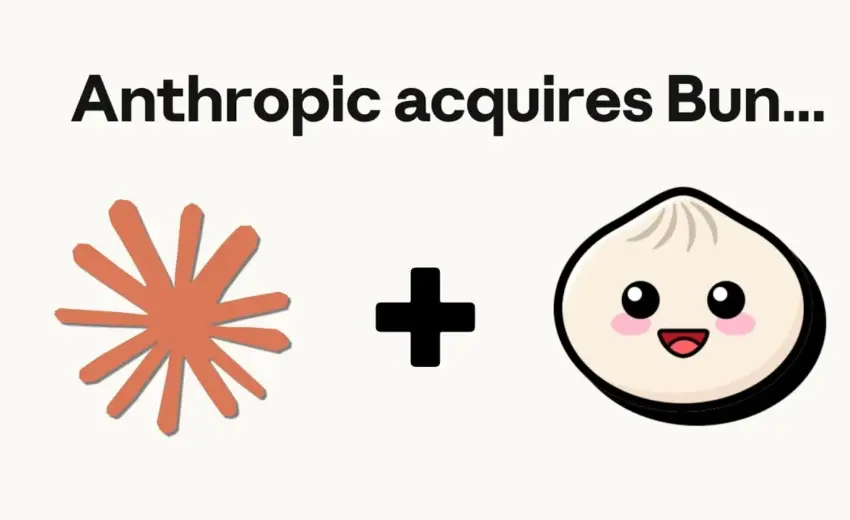
The technology landscape has just witnessed a seismic shift with the announcement of Bun joining Anthropic. For developers, DevOps engineers, and AI researchers, this is not merely a corporate acquisition or a talent hire; it represents the convergence of the world’s fastest JavaScript runtime with the world’s most capable AI reasoning engine, Claude. As the boundaries between application logic and probabilistic AI reasoning blur, the infrastructure supporting these systems must evolve. This strategic move promises to redefine how we build intelligent applications in 2025 and beyond.
Are you ready for a world where your runtime is optimized specifically for Large Language Model (LLM) inference and agentic workflows? The news of Bun joining Anthropic signals the end of the Python-monopoly on AI orchestration and the rise of high-performance TypeScript agents. This article delves deep into the technical, strategic, and practical implications of this union. We will explore why speed matters more than ever, how latency impacts AI user experience, and what you need to do immediately to prepare your tech stack.
If you have been waiting for a sign to optimize your AI infrastructure, Bun joining Anthropic is the signal you cannot ignore. By combining Bun’s incredible startup speeds and low-latency execution with Anthropic’s safety-first, high-intelligence models, we are entering a new era of ‘Native AI Runtimes.’ Read on to master this transition and stay ahead of the curve.
What is Bun joining Anthropic?
To understand the magnitude of Bun joining Anthropic, we must first deconstruct the two entities involved and the nature of this union. Bun, created by Jarred Sumner, is a modern JavaScript runtime written in Zig. It was designed as a drop-in replacement for Node.js, but with a maniacal focus on performance, startup time, and developer experience. It includes a bundler, test runner, and package manager all in one binary. On the other side, we have Anthropic, the AI research company founded by former OpenAI executives, known for the Claude family of models and a focus on AI safety and interpretability.
The event of Bun joining Anthropic essentially means the core engineering talent and the technical roadmap of the Bun runtime are now aligned with Anthropic’s mission to build reliable, interpretable, and steerable AI systems. This is not just about hiring engineers; it is about integrating the runtime layer with the intelligence layer. Historically, AI models ran on Python backends (PyTorch/TensorFlow), while the application logic ran on Node.js or Go. The news of Bun joining Anthropic suggests a future where the runtime itself is optimized for the Model Context Protocol (MCP) and agentic behaviors.
When we discuss Bun joining Anthropic, we are talking about vertical integration. Anthropic realizes that for Claude to be truly effective as an agent—executing code, browsing the web, and manipulating file systems—it needs a runtime that is secure, sandboxed, and incredibly fast. Bun provides exactly that. This move signifies that the future of AI agents is likely JavaScript/TypeScript-based, leveraging Bun’s speed to reduce the ‘time-to-first-token’ and execution latency of tool-use loops.
Furthermore, Bun joining Anthropic addresses a critical bottleneck in current AI architecture: the overhead of serverless cold starts. Bun’s ability to start up in milliseconds makes it the perfect vessel for ephemeral AI agents that spin up, perform a complex reasoning task using Claude, and spin down. This acquisition validates the hypothesis that the infrastructure running the AI is just as important as the model weights themselves.
Why Bun joining Anthropic Matters in 2025
The significance of Bun joining Anthropic cannot be overstated as we move deeper into 2025. The primary reason is the shift from ‘Chatbots’ to ‘Agents.’ In a chat interface, a few hundred milliseconds of latency is acceptable. However, for autonomous agents that perform multi-step reasoning, loop through tools, and execute code, latency compounds exponentially. If an agent needs to run a loop 10 times to solve a problem, and the runtime adds 500ms of overhead per step, the user experience degrades massively. Bun joining Anthropic solves this by marrying the fastest runtime with the smartest model.
Secondly, this matters because of the Model Context Protocol (MCP). Anthropic has been pushing MCP as a standard for connecting AI assistants to systems. Bun’s architecture is uniquely suited to handle the I/O heavy nature of MCP servers. With Bun joining Anthropic, we can expect first-party support for MCP within the runtime itself, potentially allowing developers to spin up AI-ready servers with zero configuration. This lowers the barrier to entry for building complex, interconnected AI systems.
Thirdly, the developer ecosystem is heavily skewed toward JavaScript and TypeScript. While Python dominates model training, JavaScript dominates application development. The news of Bun joining Anthropic bridges this gap. It signals to the millions of JS/TS developers that they are now first-class citizens in the AI revolution. You no longer need to switch languages to build high-performance AI orchestrators. This democratization of AI engineering is a direct result of Bun joining Anthropic.
Finally, we must consider the competitive landscape. With OpenAI deeply integrated with Microsoft and Vercel, Anthropic needed a counter-play in the developer infrastructure space. Bun joining Anthropic is that counter-play. It gives Anthropic a direct line to developers’ terminals and CI/CD pipelines. It allows them to optimize the end-to-end flow of data from the user’s request to the model’s inference and back, ensuring that Claude runs best on Bun.
Core Concepts of Bun joining Anthropic
To fully leverage the event of Bun joining Anthropic, developers must grasp several core technical concepts that underpin this synergy. It is not enough to simply know the news; one must understand the architectural implications.
1. Latency-Optimized Tool Execution
The first core concept driven by Bun joining Anthropic is Latency-Optimized Tool Execution. When an AI model like Claude decides to use a tool (e.g., “read_file” or “fetch_url”), the model pauses generation, the runtime executes the code, and the result is fed back to the model. In Node.js, this process involves significant overhead. Bun, written in Zig, handles I/O operations significantly faster. With Bun joining Anthropic, we can anticipate a “Native Tool Use” feature where Claude’s output is streamed directly into Bun’s execution engine without network hops, reducing latency to near-zero.
2. The TypeScript-First AI Stack
Bun joining Anthropic solidifies the concept of the TypeScript-First AI Stack. Type safety is crucial when dealing with the non-deterministic outputs of LLMs. By enforcing strict typing on the inputs and outputs of AI agents, developers can prevent hallucinations from crashing applications. Bun’s native TypeScript support (no compilation step required) combined with Anthropic’s robust SDKs means developers can iterate faster. The concept here is “Safety at Speed”—leveraging TypeScript’s static analysis to validate AI behavior in real-time, a philosophy central to Bun joining Anthropic.
3. Sandboxed Agent Environments
Perhaps the most critical concept is security. If an AI agent is writing and executing code, how do you ensure it doesn’t delete your database? Bun has built-in security features, but with Bun joining Anthropic, we are looking at the evolution of “AI Sandboxes.” These are ephemeral, isolated environments generated by the runtime specifically for a single session of an AI agent. The integration allows Anthropic to guarantee that code generated by Claude is executed in a Bun environment that is strictly controlled, limiting network access and file system permissions dynamically based on the user’s intent.
Step-by-Step Guide to Bun joining Anthropic
Navigating the transition brought about by Bun joining Anthropic requires a strategic approach. While the integration is ongoing, developers can take specific steps now to align their stacks with this new paradigm. Here is your guide to preparing for the Bun joining Anthropic era.
- Audit Your Current Runtime Performance
Before you can appreciate the impact of Bun joining Anthropic, you must establish a baseline. Use tools like k6 or Apache Bench to measure the latency of your current AI proxy servers. Record the “Time to First Byte” (TTFB) and total round-trip time for your LLM calls. This data will be crucial when justifying the migration to the Bun-Anthropic stack to stakeholders. - Migrate Utility Scripts to Bun
Start small. You don’t need to rewrite your entire backend yet. Begin by moving your CI/CD scripts, local tooling, and data processing scripts to Bun. This familiarizes your team with the Bun CLI and its speed advantages. As Bun joining Anthropic progresses, these scripts will likely become the foundation for your AI data pipelines. - Implement the Anthropic SDK with TypeScript
If you are still using raw fetch calls or Python, switch to the official Anthropic TypeScript SDK. Ensure strict typing is enabled. The synergy of Bun joining Anthropic will be most accessible via this SDK. Writing your agent logic in TypeScript now ensures you are ready for the native optimizations that will release in the coming months. - Adopt the Model Context Protocol (MCP)
Review the documentation for MCP. Start building simple MCP servers that expose your internal APIs to Claude. With Bun joining Anthropic, it is highly probable that Bun will become the reference implementation for running MCP servers. By adopting this standard early, you ensure your data is “AI-ready.” - Test Edge Deployment Compatibility
Bun is designed for the edge. Anthropic’s models are hosted in the cloud. The bridge is the edge function. Deploy a simple Bun-based proxy to a provider like Cloudflare Workers or Railway (using Bun). Test the latency between your edge function and Anthropic’s API. Optimizing this connection is key to leveraging the benefits of Bun joining Anthropic. - Refactor for Streaming Responses
Static responses are dead. Ensure your application architecture supports full streaming. Bun has excellent support for `ReadableStream`. With Bun joining Anthropic, streaming tool outputs and intermediate reasoning steps will become the standard UX. Refactor your frontend to handle these streams gracefully. - Monitor the Official Channels
The situation regarding Bun joining Anthropic is fluid. Subscribe to the Anthropic developer blog and the Bun changelog. Look for specific releases labeled “Anthropic Optimized” or “Claude Native.” Being the first to implement these features can give your product a significant competitive advantage.
Real-World Examples
To truly grasp the potential of Bun joining Anthropic, let’s examine three hypothetical yet realistic case studies where this integration creates massive value.
Case Study 1: The Real-Time Coding Assistant
Imagine a VS Code extension that suggests code edits. Currently, the latency involves sending code to the cloud, processing, and returning. With Bun joining Anthropic, the extension runs a local Bun instance. This instance pre-processes the codebase using Bun’s ultra-fast file system access, creates a context window, and streams it to Claude. The result? A code assistant that feels instantaneous because the runtime (Bun) eliminates the I/O bottleneck before the data even hits the AI. The Bun joining Anthropic synergy reduces the total loop time by 40%.
Case Study 2: Enterprise Data Analysis Agent
A financial firm uses an AI agent to analyze CSV reports. In a Node.js environment, parsing a 1GB CSV file to feed into context is slow and memory-intensive. With Bun joining Anthropic, the agent leverages Bun’s native SQLite and fast text encoding. The agent can query the data locally in milliseconds and send only the relevant rows to Claude for analysis. The acquisition ensures that the handoff between the heavy data lifting (Bun) and the reasoning (Anthropic) is seamless.
Case Study 3: Autonomous QA Testing
A software team uses an agent to browse their staging site and find bugs. This requires a headless browser. Bun is working on high-performance browser automation. With Bun joining Anthropic, the “QA Agent” can spin up a browser, navigate, detect errors, capture logs, and send them to Claude for root cause analysis in a tight loop. The speed of Bun allows the agent to run hundreds of tests in the time it used to take to run ten, making Bun joining Anthropic a game-changer for DevOps.
Common Challenges and Solutions
Despite the excitement, the event of Bun joining Anthropic introduces challenges. Developers must be aware of these potential pitfalls to navigate the transition smoothly.
Challenge 1: Ecosystem Maturity
While Bun is fast, it is not as mature as Node.js. Some legacy npm packages may not work perfectly. The news of Bun joining Anthropic might accelerate development, but bugs will exist.
Solution: Use Bun’s compatibility mode and rigorous testing. Contribute to the open-source community. Rely on standard Web APIs which Bun supports well, rather than Node-specific internal APIs.
Challenge 2: Vendor Lock-In
There is a fear that Bun joining Anthropic will create a walled garden where Bun works best only with Claude, leaving OpenAI or DeepSeek users behind.
Solution: Maintain a modular architecture. Abstract your LLM calls behind an interface. While you should leverage the optimizations of Bun joining Anthropic, keep your core business logic agnostic to the specific model provider where possible.
Challenge 3: Talent Gap
Your team might be expert in Python or Node, but not Bun or Zig (for deep internals). The shift requires learning new tooling.
Solution: Invest in training. The Bun documentation is excellent. Use the excitement around Bun joining Anthropic as a catalyst to upskill your team in modern TypeScript and runtime performance optimization.
Challenge 4: Stability vs. Innovation
Anthropic is an AI research lab; Bun is infrastructure. The culture clash could lead to unstable releases as they iterate rapidly on Bun joining Anthropic features.
Solution: Pin your versions. Do not use the `latest` tag in production. Wait for stable releases that explicitly mention support for the new integration features.
Future Trends
The event of Bun joining Anthropic is just the beginning. Looking ahead, we can identify several trends that will define the rest of the decade.
First is the rise of “AI-Native Runtimes.” We will stop using general-purpose runtimes for AI agents. Instead, we will use runtimes that have vector databases, embedding models, and tokenizer logic built directly into the C++ or Zig core. Bun joining Anthropic is the prototype for this category.
Second is “The Death of Latency.” As models get faster (Claude Instant, etc.) and runtimes get faster (Bun), the distinction between a local function call and a cloud AI call will vanish. Bun joining Anthropic accelerates the move toward edge-inference where the runtime handles the caching and routing intelligently.
Finally, we will see “Self-Correcting Code.” With the deep integration of Bun joining Anthropic, the runtime could theoretically catch a crash, feed the stack trace to Claude, generate a fix, hot-reload the module, and resume execution without human intervention. This is the ultimate promise of this union.
Conclusion
The announcement of Bun joining Anthropic is a watershed moment in the history of software development. It symbolizes the unification of speed and intelligence. For too long, AI and infrastructure have been treated as separate silos. This acquisition breaks down those walls, offering a glimpse into a future where our code runs faster, our agents act smarter, and our development cycles are shorter.
By understanding the core concepts, preparing your stack, and acknowledging the challenges, you can position yourself to thrive in this new era. The synergy of Bun joining Anthropic offers a competitive edge to those willing to adapt. Don’t let legacy infrastructure hold back your AI ambitions. Embrace the speed of Bun and the intelligence of Anthropic today.
Ready to supercharge your AI development? Start by migrating your first microservice to Bun and integrating the Claude API. The future is fast, and with Bun joining Anthropic, it’s already here.
FAQ
Q1: Will Bun remain open source after joining Anthropic?
A: While official details are evolving regarding Bun joining Anthropic, historically, runtimes like Bun thrive on open-source contributions. It is highly likely that the core runtime will remain open source (MIT/Zig license) to maintain developer trust and adoption, while enterprise features optimized for Claude might be proprietary.
Q2: Do I have to use Claude if I use Bun?
A: No. Bun joining Anthropic does not mean Bun will block other AI APIs. Bun is a general-purpose JavaScript runtime. You can still call OpenAI, Mistral, or Llama models. However, you can expect first-party optimizations and tighter integration when using Anthropic’s models within the Bun ecosystem.
Q3: How does Bun joining Anthropic affect Python developers?
A: It puts pressure on the Python ecosystem to improve performance. However, for AI application logic (not training), Bun joining Anthropic makes TypeScript a much more attractive option. Python devs might find themselves moving to TypeScript for the orchestration layer of their AI agents to leverage the speed benefits.
Q4: Is Bun stable enough for enterprise AI production?
A: Bun has reached version 1.0+ and is stable for many workloads. With Bun joining Anthropic, the engineering resources backing the project have increased significantly. This should accelerate stability fixes and make it even more suitable for enterprise-grade AI deployments in 2025.
Q5: Where can I learn more about the technical details?
A: You should follow the official Bun Blog and the Anthropic Newsroom. These sources will provide the most accurate and up-to-date technical documentation regarding the specific features emerging from Bun joining Anthropic.