


ChatGPT kicked off the AI race. Now its lead is looking shaky, according to The Washington Post. Feeling overwhelmed trying to keep up? You’re not alone. The pace of innovation is insane, and it seems like every week there’s a new contender for the AI throne. Let’s break down what’s happening and what it means.
Featured Snippet: ChatGPT started the AI race. Now its lead is looking shaky. – The Washington Post highlights the evolving competition in AI. Initially dominant, ChatGPT now faces challenges from newer models with improved capabilities and different architectural approaches. This shift impacts various industries and necessitates strategic adaptation.
Introduction: The Shifting Sands of AI Leadership
The AI landscape is dynamic. What was cutting-edge yesterday is old news today. ChatGPT, with its impressive debut, became the poster child for generative AI. However, the competition is fierce, and several factors are shifting the power dynamics.
This article unpacks the complexities of this AI race, examining ChatGPT’s strengths and weaknesses, the rise of its competitors, and the implications for businesses and individuals. We’ll also touch upon the ethical considerations that come with such rapid technological advancement. Understanding the forces at play is crucial to navigating this new world. For those interested in proactive communication, check out 11 Expert Strategies for status page Superiority: Ditching Downdetector for Proactive Communication.
Understanding ChatGPT’s Initial Dominance
ChatGPT’s arrival was a revelation. Its ability to generate human-like text, answer complex questions, and even write code made it an instant sensation. This was largely due to its transformer-based architecture and the massive datasets it was trained on. It wasn’t perfect, but it was a huge leap forward. I remember being blown away by its ability to generate creative content; it felt like something out of a science fiction movie. The initial hype was definitely warranted.
ChatGPT kicked off the AI race, and it’s important to acknowledge its contributions. Its ease of use and accessibility democratized AI, making it available to a wider audience. This spurred innovation and experimentation across various fields. It lowered the bar for entry and made AI a tangible tool for everyday users. We also need to consider the underlying infrastructure; for managing complex integrations, 11 Expert Strategies for n8n Microsoft Teams OAuth2 Integration Success in 2025 become increasingly relevant.
Emerging Challengers to ChatGPT
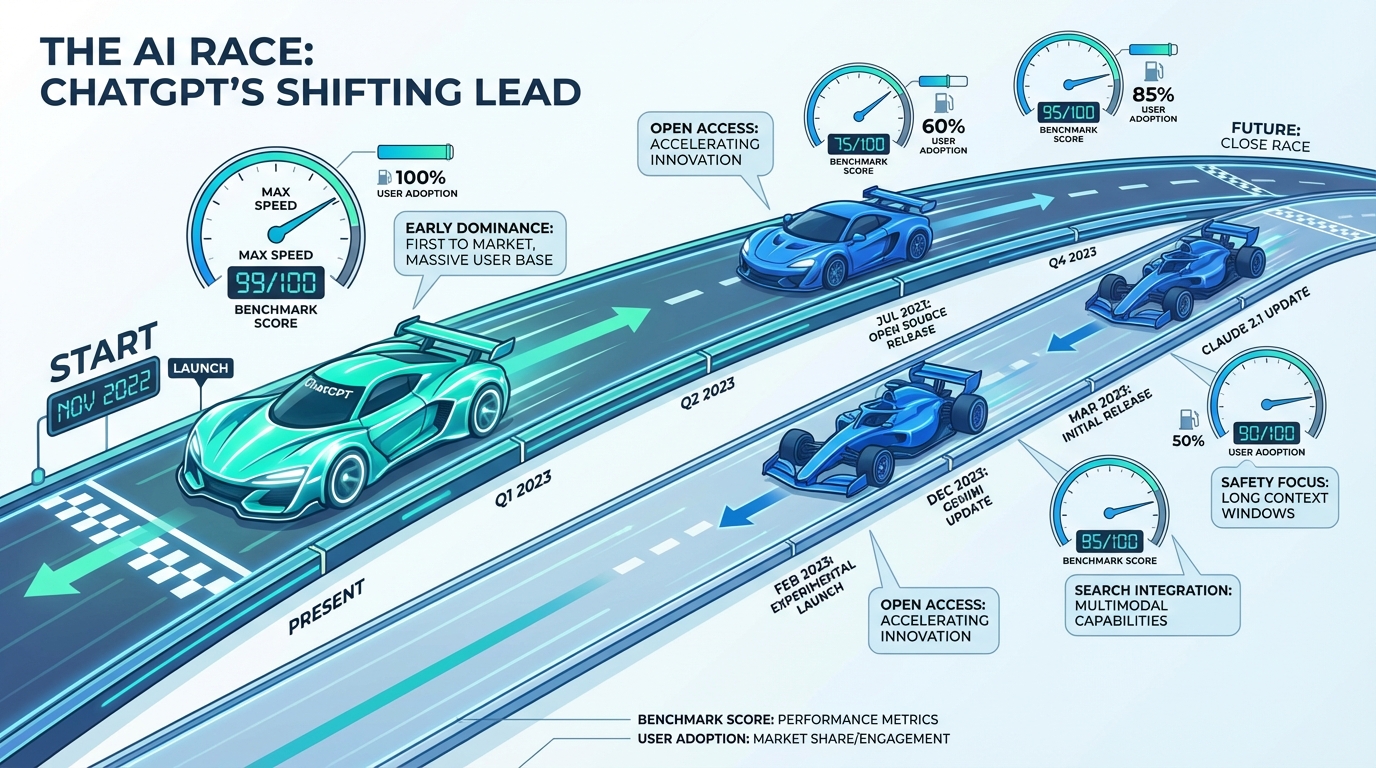
The AI world never stands still. Several competitors are emerging, each with its own strengths. These challengers are pushing the boundaries of AI and forcing ChatGPT to evolve. Some notable contenders include Google’s Gemini, Anthropic’s Claude, and various open-source models. Each aims to improve upon ChatGPT’s limitations and offer unique capabilities. It is crucial to understand these challenges considering that ChatGPT started the AI race and now, according to The Washington Post, its lead is looking shaky.
Gemini, for example, is designed to be multimodal, meaning it can process text, images, and audio. Claude is known for its strong safety features and focus on ethical AI development. Open-source models offer greater transparency and customization options. These alternatives are forcing OpenAI to innovate to maintain its competitive edge. I’ve been experimenting with a few of these alternatives myself, and the progress is undeniable.
Factors Contributing to the Shifting Landscape
Several factors contribute to the changing dynamics in the AI race. These include advancements in model architecture, increased data availability, and growing concerns about bias and safety. The shift to more efficient and specialized models is accelerating innovation. Furthermore, the open-source movement is democratizing access to AI technology and fostering collaboration. ChatGPT started the AI race, but The Washington Post reports its lead is looking shaky because of these advancements.
Another crucial factor is the growing awareness of the ethical implications of AI. Issues such as bias, privacy, and misinformation are becoming increasingly important considerations. Companies are now prioritizing responsible AI development and implementing safeguards to mitigate potential risks. This is a welcome trend, as it ensures that AI is developed and deployed in a way that benefits society. Remember, when dealing with sensitive data and AI, security is paramount; look at 7+ Proven Strategies for AI-powered Security Automation DevSecOps Success in 2025: A Step-by-Step Guide for more on that.
Technical Comparison of Leading AI Models
Let’s dive into a technical comparison of some leading AI models. ChatGPT, Gemini, and Claude each have unique architectural approaches and training methodologies. Understanding these differences is crucial for evaluating their strengths and weaknesses. ChatGPT started the AI race, but The Washington Post notes its lead is looking shaky, partly because of the rise of these technically different models.
ChatGPT is based on the GPT (Generative Pre-trained Transformer) architecture, which excels at generating coherent and contextually relevant text. Gemini is designed to be multimodal and can process different types of data. Claude focuses on safety and incorporates techniques to reduce harmful outputs. Open-source models, like those based on the Llama architecture, offer greater flexibility and transparency. The choice of model depends on the specific use case and priorities.
Impact on Industries: Beyond the Hype
AI is transforming industries across the board, from healthcare to finance to entertainment. The impact is far-reaching and extends beyond the initial hype. AI is being used to automate tasks, improve decision-making, and create new products and services. It’s not just about replacing jobs; it’s about augmenting human capabilities and enabling new possibilities. The fact that ChatGPT started the AI race but, according to The Washington Post, its lead is now looking shaky shows how quickly industries need to adapt.
In healthcare, AI is being used to diagnose diseases, personalize treatments, and accelerate drug discovery. In finance, it’s being used to detect fraud, manage risk, and provide personalized financial advice. In entertainment, it’s being used to create new forms of content, personalize recommendations, and enhance the user experience. The possibilities are endless, and we’re only just scratching the surface. Consider how AI audio tools are revolutionizing content creation; you can learn more with 9 Essential Strategies for Building a Profitable Lo-Fi Channel in 2024: A Data-Driven AI Audio Tool Comparison.
Future Trends in AI Development
Looking ahead, several key trends are shaping the future of AI development. These include the rise of multimodal AI, the increasing importance of explainable AI (XAI), and the growing focus on edge computing. Multimodal AI will enable AI systems to process and understand different types of data, leading to more sophisticated and versatile applications. The fact that ChatGPT started the AI race but The Washington Post reports its lead is looking shaky means these trends are accelerating.
XAI will make AI systems more transparent and understandable, fostering trust and accountability. Edge computing will enable AI to be deployed closer to the data source, reducing latency and improving performance. These trends will drive further innovation and unlock new opportunities for AI. The convergence of these trends will lead to a new era of AI-powered applications.
Strategic Implications for Businesses
For businesses, the AI race presents both opportunities and challenges. Companies need to develop a clear AI strategy and invest in the right talent and infrastructure. They also need to be aware of the ethical implications of AI and implement appropriate safeguards. The key is to adopt a strategic approach that aligns with their business goals and values. ChatGPT started the AI race, and The Washington Post says its lead is looking shaky, so businesses must adapt their strategies.
This involves identifying specific use cases where AI can deliver tangible value, building a skilled AI team, and establishing a robust data governance framework. Companies also need to monitor the evolving AI landscape and adapt their strategies accordingly. Those who embrace AI strategically will gain a competitive advantage.
Ethical Considerations in AI Race
The rapid advancement of AI raises significant ethical concerns. These include bias, privacy, and misinformation. AI systems can perpetuate and amplify existing biases, leading to unfair or discriminatory outcomes. Privacy is another major concern, as AI systems often collect and process vast amounts of personal data. Misinformation is also a growing threat, as AI can be used to generate fake news and propaganda. The fact that ChatGPT started the AI race, but The Washington Post says its lead is looking shaky, underscores the need for ethical guidelines.
Addressing these ethical concerns requires a multi-faceted approach. This includes developing AI systems that are fair, transparent, and accountable. It also involves implementing robust privacy safeguards and combating misinformation. Collaboration between researchers, policymakers, and industry leaders is essential to ensure that AI is developed and deployed responsibly. We also need to consider the impact of streaming technologies, like 7+ Expert Strategies for Mastering Netflix AV1 Codec for Low-Bandwidth Streaming in 2025, on data usage and privacy.
Preparing for the Future of AI
Preparing for the future of AI requires a proactive and adaptable approach. Individuals need to develop new skills and knowledge to thrive in an AI-powered world. Businesses need to invest in AI talent and infrastructure. Policymakers need to create regulations that promote innovation while mitigating risks. The fact that ChatGPT started the AI race, but The Washington Post says its lead is looking shaky, means we need to be ready for constant change.
This involves continuous learning, experimentation, and collaboration. It also requires a willingness to embrace new technologies and adapt to changing circumstances. Those who are prepared for the future of AI will be best positioned to succeed. It’s about being agile and responsive to the rapid changes in the AI landscape.
The AI revolution’s just getting started, and the game is wide open. The real work lies in understanding the underlying technologies and their potential applications. It’s time to get your hands dirty.
| Feature | ChatGPT | Google Gemini | Anthropic Claude |
|---|---|---|---|
| Architecture | GPT | Multimodal | Focus on Safety |
| Data Processing | Text | Text, Image, Audio | Text |
| Key Strength | Text Generation | Multimodal Understanding | Ethical AI |
Frequently Asked Questions (FAQ)
- Why is ChatGPT’s lead looking shaky?
- Newer AI models offer improved capabilities and different architectural approaches that challenge ChatGPT’s dominance. ChatGPT started the AI race. Now its lead is looking shaky. – The Washington Post highlights this competition.
- What are the key challenges to ChatGPT’s dominance?
- Challenges include the rise of multimodal AI, increased focus on ethical AI, and the democratization of AI through open-source models.
- How can businesses adapt to the changing AI landscape?
- Businesses should develop a clear AI strategy, invest in AI talent, and monitor the evolving AI landscape to adapt their strategies accordingly.
- What are the ethical considerations in the AI race?
- Ethical considerations include bias, privacy, and misinformation, which require a multi-faceted approach to address.
- What skills are needed to thrive in an AI-powered world?
- Continuous learning, experimentation, and adaptability are crucial skills for thriving in an AI-powered world. ChatGPT started the AI race. Now its lead is looking shaky. – The Washington Post necessitates these skills.
- What are the future trends in AI development?
- Future trends include the rise of multimodal AI, the increasing importance of explainable AI (XAI), and the growing focus on edge computing.