



Credo Technology: Is This the AI Connectivity Kingpin of 2026?
Credo Technology’s stock is surging, fueled by its crucial role in solving the AI connectivity bottleneck. But is it a long-term leader or a flash in the pan? This analysis cuts through the hype to deliver a hard-nosed assessment of Credo’s potential as a top AI play for 2026.
The Connectivity Imperative: Why Credo Matters
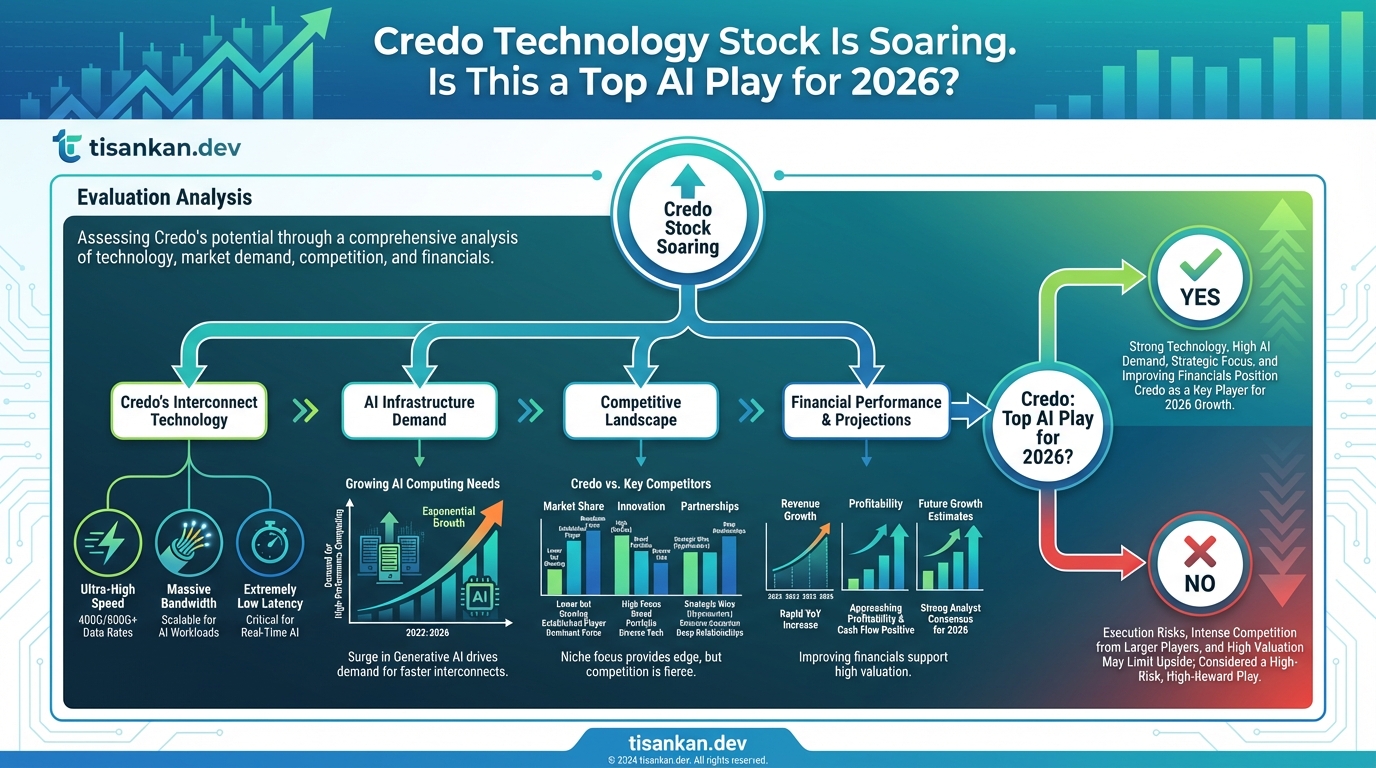
AI’s voracious appetite for data demands exponentially faster and more efficient connectivity. Credo specializes in high-speed connectivity solutions, positioning it at the heart of the AI infrastructure build-out. Ignore the broader tech sector noise; Credo’s value hinges on its ability to deliver where it counts: moving massive datasets with minimal latency and power consumption.
Decoding Credo’s Tech: SerDes and Chiplets Under the Microscope
Credo’s core business revolves around:
- **SerDes (Serializer/Deserializer) IP:** The unsung heroes of high-speed data transfer. Credo’s SerDes technology converts parallel data to serial for transmission and back again, minimizing signal degradation and maximizing bandwidth. Their competitive edge lies in achieving higher speeds with lower power consumption than rivals.
- **Line Card Solutions:** Integrated solutions for data center interconnects, enabling high-density and high-bandwidth connections between servers and networking equipment.
- **Chiplets:** A modular approach to system design, allowing for customized solutions and faster development cycles. This is crucial for adapting to the rapidly evolving AI hardware landscape.
These technologies are not just about speed; they are about enabling the *scalability* of AI systems. Without advancements in connectivity, AI model training and inference would be severely constrained.
5 Pillars Supporting Credo’s Ascent
- Dominant Niche in a Hyper-Growth Market: Credo isn’t just playing in the AI space; it’s controlling a vital chokepoint: high-speed data transfer.
- Strategic Alliances: Credo’s partnerships with data center giants and AI chipmakers validate its technology and provide access to key markets.
- Relentless Innovation: Credo’s commitment to pushing the boundaries of data transfer rates and efficiency is essential for maintaining its competitive edge.
- Impressive Financial Trajectory: Recent earnings reports confirm strong revenue growth and improving profitability, demonstrating the market’s demand for Credo’s solutions.
- Analyst Endorsements: Industry analysts recognize the critical role of high-speed connectivity in AI and are bullish on Credo’s prospects.
Technical Deep Dive: SerDes Performance and the Chiplet Advantage
Credo’s SerDes technology is more than just a commodity; it’s a critical differentiator. The lower the latency and the higher the bandwidth of their SerDes solutions, the faster AI models can be trained and deployed. This translates directly into competitive advantages for Credo’s customers. The chiplet approach allows for a “mix-and-match” strategy, enabling customized solutions tailored to specific AI workloads. Imagine a data center operator needing to accelerate a specific type of AI inference; Credo’s chiplets allow them to optimize the interconnect fabric without a complete system overhaul.
Expert Assessment: Credo’s Long-Term Viability
As a seasoned technologist, I see Credo’s laser focus on solving the connectivity challenges in AI as a strategic masterstroke. Their technology is not just “nice to have”; it’s *essential* for the future of AI. However, complacency is the enemy. Credo must continue to innovate and expand its product portfolio to stay ahead of the competition. Think of it like this: Credo is currently supplying the high-speed railway tracks for the AI train. They need to ensure those tracks are constantly upgraded and expanded to handle the increasing load.
Navigating the Risks: A Realistic Perspective
Don’t be blinded by the hype. The semiconductor industry is notoriously cyclical, and Credo is not immune to economic downturns. Competition from established players like Broadcom and Marvell, as well as emerging startups, is fierce. Maintaining a technological lead requires relentless investment in R&D. Supply chain vulnerabilities remain a concern. Furthermore, Credo’s success is heavily dependent on the continued growth of the AI market. Any slowdown in AI adoption could significantly impact their revenue.
The Road to 2026: Credo’s Strategic Imperatives
To solidify its position as the AI connectivity leader in 2026, Credo must execute flawlessly on several fronts: maintain its technological superiority through continuous innovation, diversify its customer base beyond a few key players, strengthen its supply chain resilience, and proactively adapt to evolving AI hardware architectures. The opportunity is massive, but the execution bar is high.
Final Verdict: A High-Potential, High-Risk AI Play
Credo Technology offers a compelling, albeit risky, investment opportunity. Its strong market position, innovative technology, and favorable industry tailwinds make it an attractive AI play for 2026. However, investors must carefully assess the inherent risks and challenges before committing capital. Credo’s success is not guaranteed, but its potential upside is significant. The future of AI depends on companies like Credo solving the connectivity problem, and that makes them a company worth watching closely.
Frequently Asked Questions
Which AI applications are most reliant on Credo’s technology?
The biggest beneficiaries are AI applications demanding extreme data throughput: Large Language Models (LLMs), advanced computer vision systems, and real-time recommendation engines. These applications hinge on GPUs and specialized processors communicating with minimal latency, a problem Credo directly addresses with its SerDes technology, boosting training and inference speeds.
How does Credo stack up against competitors in the high-speed connectivity arena?
Credo’s edge lies in its power efficiency and signal integrity at blistering data rates (100G+). While competitors offer alternatives, Credo aims for superior performance with lower power draw – a critical factor for cost-conscious data centers. Their chiplet design also provides greater customization compared to some monolithic approaches.
What financial metrics should investors track to evaluate Credo’s performance?
Keep a close eye on revenue growth, gross margin expansion, operating expenses, and net income. Customer acquisition rate, Average Selling Price (ASP), and order backlog are also crucial. A healthy R&D budget (as a percentage of revenue) signals a commitment to future innovation.
What are the primary risks associated with investing in Credo Technology?
Risks include intense competition, cyclicality in the semiconductor market, reliance on key customers, supply chain disruptions, and the breakneck pace of technological advancements. A slowdown in AI infrastructure spending would also hurt Credo. Be aware of potential stock dilution via future equity offerings.
How do Credo’s chiplets benefit their customers?
Chiplets allow customers to create bespoke solutions by combining different functional blocks. This modularity accelerates development and allows for targeted upgrades without replacing entire systems – a major advantage in the rapidly evolving AI hardware landscape. Imagine upgrading just the interconnect fabric to support faster memory, for example.
What’s Credo’s game plan for expanding its market share?
Credo is targeting key data center, AI, and telecom customers. They’re heavily investing in R&D to create cutting-edge products. Strategic partnerships are key to integrating their solutions into broader ecosystems. The ultimate goal: to become the undisputed leader in high-speed connectivity for AI infrastructure.