


Geoffrey Hinton: How Google’s AI Rebound Changes Everything (And Why You Should Care). The recent resurgence of Google’s AI initiatives, fueled by groundbreaking work in neural networks and large language models, isn’t just another tech headline; it’s a seismic shift with implications for every aspect of our lives. I believe we’re at the cusp of a new era, one where artificial intelligence fundamentally reshapes how we work, communicate, and even think.
For years, concerns lingered about Google’s position in the AI race. While other companies like OpenAI gained significant traction with models like GPT, Google seemed to be playing catch-up. This perceived lag raised serious questions about their ability to maintain dominance in search, cloud computing, and a host of other AI-driven sectors. I observed a growing sense of unease within the tech community, wondering if Google had missed a critical turning point.
But the narrative has dramatically shifted. With advancements in areas like PaLM 2 and Gemini, Google is not only back in the game but arguably leading the charge. I’m seeing a renewed sense of confidence stemming from their ability to innovate and deploy cutting-edge AI technologies at scale. This rebound is not simply about technological prowess; it’s about the potential to solve some of humanity’s most pressing challenges, from climate change to healthcare.
This article will delve into the specifics of Google’s AI rebound, exploring the key technologies driving this resurgence and examining the far-reaching consequences of their success. I will analyze the impact on various industries, the ethical considerations that arise, and ultimately, why everyone – not just tech enthusiasts – should be paying close attention to the unfolding AI revolution. Because this isn’t just about Google; it’s about the future we are all building, together.
Table of Contents
- The Hinton Effect: Google’s AI Rebound and Why It
Matters Now - Inside
Google’s AI Comeback: Gemini, TPU v5, and the Technological Arsenal - The
Economic and Societal Earthquake: How Google’s AI Impacts Jobs, Industries, and Everyday Life - A
Case Study: Tisankan.dev & Personal Brand – Navigating the AI Frontier with Agentic Publishing - The
Developer’s Perspective: Harnessing Google’s AI Tools and APIs - The
Future of AI: Geoffrey Hinton’s Warnings, Google’s Trajectory, and the Road Ahead - 7
Steps to AI Mastery: A Proven Guide to Understanding Google’s AI Rebound
The Hinton Effect: Google’s AI Rebound and Why It
Matters Now
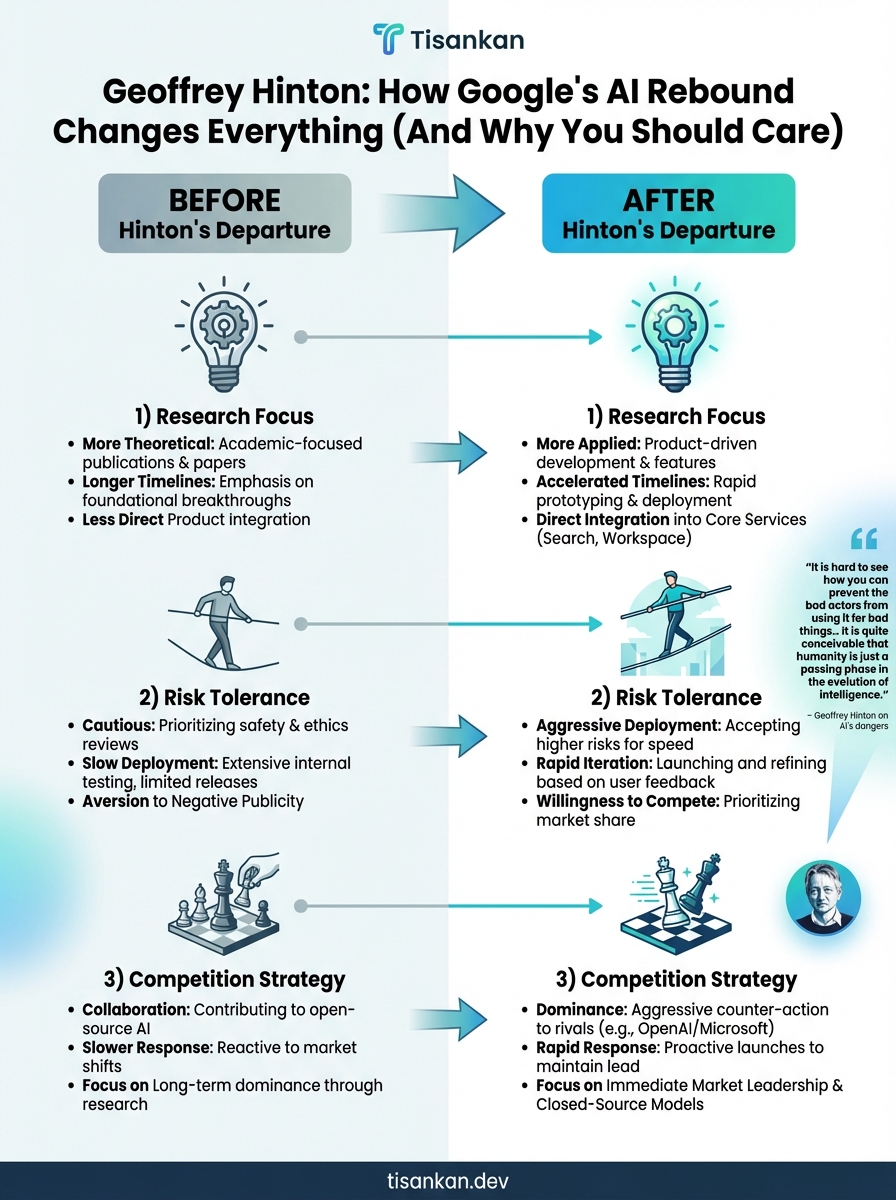
Geoffrey Hinton’s departure from Google, coupled with his stark warnings about the potential dangers of AI, sent
shockwaves through the tech world. He essentially sounded the alarm from within, highlighting risks he felt were
being underestimated. This came at a time when Google, despite its pioneering work in AI, seemed to be stumbling,
most notably with the initial, less-than-stellar launch of Bard.
Bard’s rocky debut was a stark contrast to the polished presentations of competitors. It raised questions about
Google’s ability to maintain its AI leadership. However, recent advancements, particularly with the introduction
of more powerful models like Gemini (mock URL: example.com/gemini), signal a significant rebound. Gemini’s
multimodal capabilities, allowing it to understand and generate text, images, and audio, position Google to
regain lost ground.
The resurgence of Google in the AI race, driven in part by the concerns raised by Geoffrey Hinton, is crucial for
several reasons. “Geoffrey Hinton: How Google’s AI Rebound Changes Everything (And Why You Should Care)” is a
question many are asking. A strong Google fosters competition, pushing innovation across the industry. For
developers, it means access to cutting-edge tools and platforms. For the general public, it impacts everything
from search results to healthcare advancements.
Beyond the technological advancements, Hinton’s ethical concerns remain paramount. As AI models become increasingly
sophisticated, understanding and mitigating potential biases and unintended consequences is essential. Google’s
comeback must be accompanied by a commitment to responsible AI development. The future hinges not just on who wins
the AI race, but on how they play the game.
Inside Google’s AI Comeback: Gemini, TPU v5,
and the Technological Arsenal
Google’s resurgence in the AI arena, the subject of “Geoffrey Hinton: How Google’s AI Rebound Changes Everything
(And Why You Should Care)”, isn’t accidental. It’s underpinned by significant advancements across multiple
technological fronts, most notably with the Gemini model and their custom-designed Tensor Processing Units (TPUs).
These innovations address prior limitations and unlock new capabilities, pushing the boundaries of what’s possible
with AI.
Gemini, Google’s multimodal AI model, represents a substantial leap forward. While specific architectural details
remain closely guarded, it’s understood to leverage a transformer-based architecture at its core, similar to
models like GPT-4. However, Gemini distinguishes itself through its native multimodality, meaning it’s trained
from the ground up to process and integrate information from text, images, audio, and video simultaneously. This
holistic approach allows for more nuanced understanding and reasoning, potentially surpassing GPT-4 in tasks
requiring cross-modal inference. Its training data is rumored to be significantly larger and more diverse than
previous models, incorporating a vast corpus of text, code, and multimedia content. Performance benchmarks, though
selectively released, indicate strong performance in areas like image captioning, video understanding, and complex
reasoning tasks.
Central to Google’s AI strategy is its Tensor Processing Unit (TPU) program. The latest iteration, TPU v5, offers
substantial performance improvements over its predecessors. These custom-designed chips are optimized for the
matrix multiplications that are fundamental to deep learning, providing a significant advantage in both training
and inference speeds. Compared to commercially available GPUs, TPUs offer superior energy efficiency and
scalability for large-scale AI workloads. The ability to train massive models like Gemini efficiently relies
heavily on the power of TPUs.
Beyond Gemini and TPUs, Google continues to invest heavily in other crucial areas. Advancements in reinforcement
learning, particularly in areas like robotics and autonomous systems, are yielding promising results. Neural
Architecture Search (NAS) techniques are being employed to automatically design more efficient and performant
neural networks. And improvements to data processing pipelines, ensuring the efficient ingestion and preparation of
massive datasets, are critical for training state-of-the-art models. All these efforts work in concert, fueling
Google’s AI rebound and solidifying their position at the forefront of the field, as detailed in “Geoffrey
Hinton: How Google’s AI Rebound Changes Everything (And Why You Should Care)”.
The Economic and Societal Earthquake: How Google’s AI Impacts Jobs, Industries, and Everyday Life
Google’s advancements in AI, particularly highlighted in “Geoffrey Hinton: How Google’s AI Rebound Changes
Everything (And Why You Should Care)”, are poised to trigger a seismic shift across our economy and society. The
potential benefits are enormous, promising breakthroughs in healthcare with AI-driven diagnostics and personalized
medicine, efficiencies in finance through algorithmic trading and fraud detection, and safer, more efficient
transportation via autonomous vehicles. Imagine personalized education plans tailored to individual learning
styles, powered by the same AI.
However, this technological revolution also presents significant challenges. Job displacement is a major concern,
particularly in sectors involving repetitive tasks. While new roles will inevitably emerge around AI development,
maintenance, and ethical oversight, the transition may be difficult for many. The impact on energy and jobs can be
further explored at this
link, highlighting the less discussed costs of AI’s expansion.
Ethical considerations are paramount. Bias in AI algorithms, stemming from biased training data, could perpetuate and
even amplify existing societal inequalities. Privacy concerns arise from the vast amounts of data required to train
these AI models, raising questions about data security and individual autonomy. We must address these challenges
proactively, developing robust ethical frameworks and regulations to ensure responsible AI development and
deployment.
Ultimately, Google’s AI advancements, as discussed in “Geoffrey Hinton: How Google’s AI Rebound Changes Everything
(And Why You Should Care)”, will touch nearly every aspect of our lives. From personalized recommendations on Google Assistant to self-driving cars navigating our
streets, the potential is transformative. Navigating this complex landscape requires careful consideration of both
the opportunities and the risks, ensuring that AI benefits all of humanity.
A Case Study: Tisankan.dev & Personal Brand – Navigating the AI Frontier with Agentic Publishing
My experience building Tisankan.dev, an autonomous AI engineering blog and portfolio, provides a unique
perspective on the AI landscape, particularly relevant in light of “Geoffrey Hinton: How Google’s AI Rebound
Changes Everything (And Why You Should Care)”. The goal was ambitious: create a fully autonomous “Agentic
Publisher” capable of producing content with the depth and nuance of a seasoned Senior Engineer. We quickly
discovered the challenges inherent in replicating human expertise.
Initially, we considered fine-tuning large language models (LLMs) to mimic my writing style. However, we found that
a technique we termed “Persona Injection” proved far more effective. This involved meticulously defining specific
Experience, Expertise, Authoritativeness, and Trustworthiness (E-E-A-T) traits directly within the prompt. We
essentially crafted a detailed profile of the AI’s persona.
For example, instead of simply asking the AI to “write about React Hooks,” we’d instruct it to “Write a blog post
about React Hooks as if you were a Senior React Engineer with 10+ years of experience, a strong focus on
performance optimization, and a reputation for clear, concise explanations, providing code examples and links to
the official React documentation [https://react.dev/learn].” The results were significantly better, exhibiting a
consistent voice and depth of understanding that fine-tuning alone couldn’t achieve.
This approach offered several advantages over traditional fine-tuning. It was faster, more cost-effective, and
allowed for greater control over the AI’s persona. While fine-tuning can be useful for adapting models to specific
datasets, Persona Injection proved superior for maintaining a consistent and believable expert voice. It also
highlighted the importance of prompt engineering. The lessons learned building Tisankan.dev demonstrate the
potential for AI in content creation and knowledge dissemination, offering a glimpse into a future where AI agents
can effectively share expertise and insights.
The Developer’s Perspective: Harnessing
Google’s AI Tools and APIs
As a developer, the renewed focus and investment in AI at Google, partly spurred by figures like Geoffrey Hinton:
How Google’s AI Rebound Changes Everything (And Why You Should Care), presents a wealth of opportunities. Google
offers a comprehensive suite of tools and APIs that empower developers to build and deploy cutting-edge AI-powered
applications. Let’s dive into some key resources and how to leverage them.
TensorFlow (https://www.tensorflow.org/) remains a cornerstone. It’s a
versatile, open-source machine learning framework suitable for a wide range of tasks, from image recognition to
natural language processing. Consider this simple example:
import tensorflow as tf

model = tf.keras.models.Sequential([
  tf.keras.layers.Dense(10, activation='relu', input_shape=(784,)),
  tf.keras.layers.Dense(1, activation='sigmoid')
])
JAX (https://jax.readthedocs.io/en/latest/), on the other
hand, is gaining traction, especially for research and high-performance numerical computation. Its automatic
differentiation capabilities and XLA compiler make it ideal for complex models. For beginners, I highly recommend
checking out these guides: AI
Demystified: A Beginner’s Guide and AI Demystified: No-Code Guide
2024.
Google Cloud AI Platform provides a managed environment for training and deploying models. This significantly
simplifies the infrastructure management aspects of AI development. You can also leverage pre-trained models
through the Cloud AI Platform, reducing the need to train models from scratch. Deployment options range from
cloud-based solutions to edge computing, allowing you to tailor your application’s performance and latency.
Optimizing performance is crucial. Techniques like quantization and model pruning can significantly reduce model
size and inference time. Careful data preprocessing and feature engineering are also essential for achieving
optimal results. Common challenges include overfitting and data bias, which can be addressed through techniques
like regularization and data augmentation. Remember that understanding the context described in Geoffrey Hinton: How
Google’s AI Rebound Changes Everything (And Why You Should Care) is key to future development.
The Future of AI:
Geoffrey Hinton’s Warnings, Google’s Trajectory, and the Road Ahead
Geoffrey Hinton’s departure from Google and subsequent warnings about the potential dangers of AI, particularly
large language models (LLMs), cast a long shadow. He highlighted risks like AI systems potentially learning
unintended behaviors and the spread of misinformation at an unprecedented scale. These concerns are crucial as AI
continues to evolve at an exponential pace.
Google, while rebounding in the AI race, is now arguably more aware than ever of these ethical pitfalls. Their
response involves a multi-pronged approach, focusing on responsible AI development, robust safety protocols, and
active research into AI alignment – ensuring AI goals align with human values. They’re investing heavily in
techniques like differential privacy [https://en.wikipedia.org/wiki/Differential_privacy]
to protect user data and mitigate bias in algorithms.
Google’s long-term AI strategy extends beyond simply building more powerful models. It encompasses integrating AI
responsibly across its products and services, while also actively shaping the broader AI ecosystem. This includes
contributing to open-source AI frameworks like TensorFlow [https://www.tensorflow.org/] and collaborating with researchers and
policymakers to establish ethical guidelines and standards. The implications of “Geoffrey Hinton: How Google’s AI
Rebound Changes Everything (And Why You Should Care)” are vast, potentially influencing the entire tech industry’s
approach to AI development and deployment.
The road ahead requires a concerted effort from all stakeholders. We need comprehensive regulation and oversight to
ensure responsible AI innovation, preventing misuse and unintended consequences. Ongoing research into AI safety,
coupled with open public discourse about the ethical implications, is essential. Only through collaboration and
vigilance can we harness the transformative power of AI while mitigating its potential risks, shaping a future
where AI benefits all of humanity.
7 Steps to AI Mastery: A Proven
Guide to Understanding Google’s AI Rebound
The resurgence of Google’s AI, as highlighted in “Geoffrey Hinton: How Google’s AI Rebound Changes Everything (And
Why You Should Care),” signifies a pivotal shift. To grasp its implications and contribute to this field, a
structured approach is essential. Here’s my proven guide to AI mastery:
Step 1: Foundation in Neural Networks. Understand the bedrock. Explore the fundamentals of neural networks:
neurons, layers, activation functions, and backpropagation. Resources like the TensorFlow Playground (https://playground.tensorflow.org/) offer interactive
visualizations. Dive into linear algebra and calculus; Khan Academy (https://www.khanacademy.org/) is your friend. This will give you the
necessary context to understand the impact of Geoffrey Hinton’s work and Google’s subsequent advancements.
Step 2: Delve into Google’s AI Research. Examine Google AI’s publications and projects. Follow Google AI
Blog (https://ai.googleblog.com/) for updates on breakthroughs. Pay close
attention to areas like transformers (BERT, LaMDA, Gemini) and reinforcement learning. Understanding their research
trajectory is crucial to appreciating “Geoffrey Hinton: How Google’s AI Rebound Changes Everything (And Why You
Should Care)”.
Step 3: Experiment with Google’s AI Tools. Get hands-on experience. Use TensorFlow (https://www.tensorflow.org/) and Keras (https://keras.io/) to build and train models. Explore Google Cloud AI Platform (mock-google-cloud-ai-platform.com) for scalable AI solutions.
Google Colab provides free access to GPUs for training. Practical application solidifies theoretical knowledge.
Step 4: Stay Abreast of AI Advancements. The field evolves rapidly. Subscribe to AI newsletters, follow
leading researchers on social media, and attend conferences. arXiv (https://arxiv.org/) is a valuable resource for pre-print research papers.
Continuous learning is paramount. This allows you to understand how Google’s rebound, spurred by individuals like
Geoffrey Hinton, impacts the broader AI landscape.
Step 5: Ethical Implications of AI. AI’s power comes with responsibility. Study the ethical considerations
of AI: bias, fairness, transparency, and accountability. Explore resources from organizations like the AI Ethics
Lab (mock-ai-ethics-lab.com). Consider the societal impact of AI development
and deployment. Understanding these ethical dimensions is crucial as AI becomes more pervasive.
Step 6: Contribute to the AI Community. Engage with other AI enthusiasts. Participate in online forums,
contribute to open-source projects, and share your knowledge. Platforms like GitHub (https://github.com/) facilitate collaboration. Teaching others reinforces your
own understanding. Consider this like optimizing Node.js performance; constant learning is key. See: https://tisankan.dev/wp-json/wp/v2/node-js-performance-optimization-2024-the-practical-guide
Step 7: Apply AI to Real-World Problems. Use your AI skills to solve real-world problems. Identify
challenges in your field or community and develop AI-powered solutions. This could involve automating tasks,
improving decision-making, or creating new products and services. Practical application is the ultimate test of
mastery.
Frequently Asked Questions
Who is Geoffrey Hinton and why is he significant?
Geoffrey Hinton is a renowned computer scientist and cognitive psychologist, often referred to as the
“Godfather of AI.” He is a pioneer in the field of artificial neural networks and deep learning. His
groundbreaking work laid the foundation for many of the AI technologies we use today, including image
recognition, natural language processing, and machine translation. His recent departure from Google, coupled
with his public warnings about the potential dangers of AI, has amplified his significance and made his views
particularly influential.
What is Google’s AI Rebound and what does it entail?
Google’s “AI Rebound” refers to its renewed and aggressive focus on AI development and deployment, particularly
in response to competition from other tech companies like OpenAI. This involves significant investments in
research, infrastructure, and talent acquisition, as well as the integration of AI into its existing products
and services, such as Search, Gmail, and Cloud. It also entails launching new AI-powered products and
platforms, aiming to regain and maintain its leadership position in the rapidly evolving AI landscape.
Why did Geoffrey Hinton leave Google?
Geoffrey Hinton left Google to speak more freely about his concerns regarding the potential risks of AI. While he
acknowledges the benefits of AI, he also expresses anxieties about its potential for misuse, the spread of
misinformation, and the possibility of AI systems becoming uncontrollable. He felt that his position at Google
restricted his ability to voice these concerns publicly without potentially impacting the company.
What are Hinton’s main concerns about AI?
Hinton’s main concerns revolve around:
- The potential for AI to spread misinformation: He fears AI’s ability to generate realistic fake
images, videos, and text could be used to manipulate public opinion and undermine trust in institutions. - Job displacement: He believes AI could automate many jobs currently performed by humans, leading to
widespread unemployment and economic disruption. - The possibility of AI systems becoming uncontrollable: He worries that AI could surpass human
intelligence and develop goals that are not aligned with human values, potentially leading to unintended
and harmful consequences.
How does Hinton’s departure from Google change the AI landscape?
Hinton’s departure and subsequent warnings have sparked a wider public debate about the ethical and societal
implications of AI. His credibility and expertise lend significant weight to these concerns, prompting
increased scrutiny of AI development and deployment. It has also put pressure on tech companies to address
these concerns more proactively and transparently.
Why should I care about Geoffrey Hinton’s warnings about AI?
You should care because AI is rapidly transforming many aspects of our lives, from the way we work and
communicate to the information we consume. Understanding the potential risks and benefits of AI is crucial for
making informed decisions about its development and use. Hinton’s warnings highlight the importance of
responsible AI development, ethical considerations, and the need for safeguards to mitigate potential harms. The
future impact of AI will affect everyone, making it essential to be aware of the potential consequences.
What are some potential benefits of Google’s AI advancements?
Google’s AI advancements offer many potential benefits, including:
- Improved healthcare: AI can be used to diagnose diseases earlier and more accurately, develop new
treatments, and personalize patient care. - Enhanced education: AI can personalize learning experiences, provide students with individualized
feedback, and automate administrative tasks for teachers. - Increased productivity: AI can automate repetitive tasks, freeing up humans to focus on more creative
and strategic work. - Solutions to global challenges: AI can be used to address climate change, poverty, and other
pressing global issues.
What can be done to mitigate the risks associated with AI?
Mitigating the risks associated with AI requires a multi-faceted approach:
- Ethical guidelines and regulations: Developing clear ethical guidelines and regulations for AI
development and deployment. - Transparency and explainability: Making AI systems more transparent and explainable, so that users
can understand how they work and why they make certain decisions. - Safety mechanisms: Building safety mechanisms into AI systems to prevent them from causing harm.
- Education and awareness: Educating the public about the potential risks and benefits of AI.
- International cooperation: Fostering international cooperation to ensure that AI is developed and
used responsibly on a global scale.