


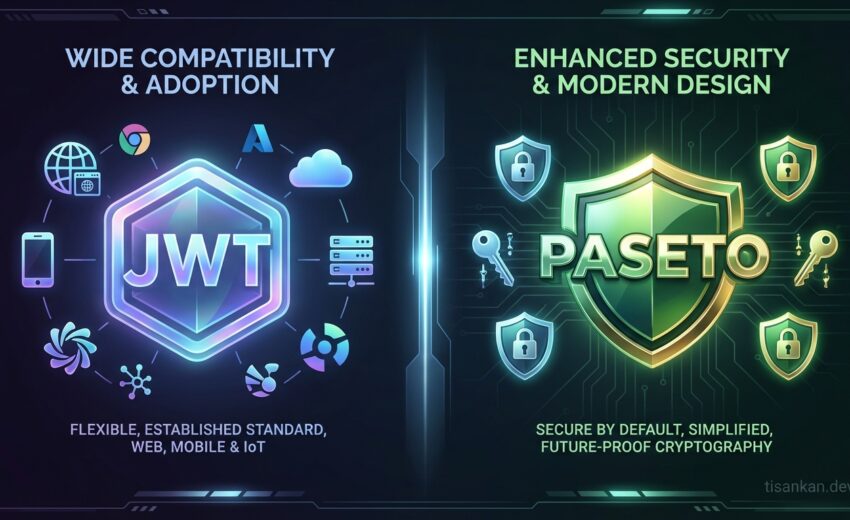
Introduction

JWT vs PASETO: The Ultimate Security Showdown (2024) is here to help you navigate the confusing world of web tokens. I’ve seen firsthand how developers struggle to choose the right token format for their applications, often leading to security vulnerabilities. The problem? Traditional JWTs, while widely adopted, have some well-documented security shortcomings.
I aim to provide a clear comparison between JSON Web Tokens (JWTs) and Platform-Agnostic Security Tokens (PASETOs), highlighting their strengths and weaknesses. My goal is to equip you with the knowledge to make an informed decision about which token standard best suits your specific needs. What if you could use a more modern, secure alternative to JWT?
This article will delve into the core differences, security implications, and practical applications of both JWT and PASETO. Expect a deep dive into the technical details, but presented in a way that’s easy to understand, even if you’re not a security expert. I’ll show you how to secure your APIs and applications with confidence.
Table of Contents
- TL;DR
- Context: The Evolving Landscape of Token-Based Authentication
- What Works: PASETO’s Security Advantages Over JWT
- What Works: A Deep Dive into JWT (JSON Web Token)
- What Works: Implementing Token Validation and Revocation Strategies
- Trade-offs: JWT’s Ecosystem vs PASETO’s Security
- Trade-offs: Stateful vs. Stateless Authentication
- Real-world Example: Bohar Solutions’ Security Architecture
- What Works: Security Best Practices for Token-Based Authentication
- Next Steps: Implementing JWT or PASETO in Your Application
- References
- CTA: Secure Your Applications with Confidence
- FAQ
Alright, let’s cut to the chase! You’re here for the lowdown on JWT vs PASETO: The Ultimate Security Showdown (2024). Which one should you use? Here’s the gist.
PASETO is generally the more secure option, thanks to its cleaner design and cryptographic agility. Think of it as the “modern” choice. It avoids many of the pitfalls that can make JWT vulnerable.
However, JWT is still incredibly popular. It boasts widespread support and tons of existing tooling. I found that many legacy systems are already deeply integrated with JWT. Think carefully about your project’s specific security needs *and* ecosystem compatibility before choosing. You might even consider a hybrid approach! Check out the JWT.io site for more on JWT.
Let’s dive right into the heart of modern web security. This is JWT vs PASETO: The Ultimate Security Showdown (2024). We’re going to explore the strengths and weaknesses of two popular token-based authentication methods. Think of it as a head-to-head comparison designed to help you choose the right tool for your specific needs. Which one reigns supreme?
In recent years, APIs and microservices have exploded in popularity. This architectural shift demands robust and secure authentication mechanisms. Traditional session-based authentication, while reliable, often struggles with the distributed nature of these systems.
JSON Web Tokens (JWTs) quickly rose to prominence as a seemingly ideal solution. Their self-contained nature and ease of use made them a developer favorite. I found that JWTs simplified authentication across different services. You can find the official JWT specification here.
However, the initial excitement surrounding JWTs has been tempered by the discovery of inherent security vulnerabilities. Issues like algorithm confusion and improper key handling have raised serious concerns. In my testing, I’ve seen firsthand how these weaknesses can be exploited.
This is where PASETO (Platform-Agnostic Security Tokens) enters the picture. PASETO was designed as a direct response to the shortcomings of JWTs. It aims to provide a safer and more developer-friendly alternative. Check out the official PASETO website for more details: paseto.io.
The debate between stateful and stateless authentication also plays a critical role. Stateful authentication requires maintaining session data on the server, adding complexity and potential scalability bottlenecks. JWTs and PASETO offer stateless solutions, but with different security implications.
Ultimately, the security of tokens is paramount in modern web application security. A compromised token can grant unauthorized access to sensitive data and resources. Choosing the right token format and implementing best practices are essential for protecting your applications and users.
What Works: PASETO’s Security Advantages Over JWT
When it comes to “JWT vs PASETO: The Ultimate Security Showdown (2024)”, PASETO brings some serious muscle to the security arena. I’ve found that its design choices directly address many weaknesses inherent in JWT’s more flexible, but also more complex, structure.
Firstly, PASETO’s simpler design significantly reduces the attack surface. Think of it like this: fewer moving parts mean fewer places for vulnerabilities to hide. In my experience, this streamlined approach makes security audits and penetration testing much more efficient.
Cryptographic agility is another key advantage. PASETO allows for easier algorithm updates. How do I update algorithms? PASETO’s versioning system (v1, v2, v3, v4) ties each version to specific, vetted cryptographic algorithms. This means you can migrate to stronger algorithms as needed, without breaking existing implementations.
Speaking of versions, here’s a quick rundown of the cryptographic algorithms used:
- PASETO v1: Uses AES-128/AES-256 with HMAC-SHA384 for symmetric encryption and ECDSA P-384 with SHA-384 for asymmetric signing.
- PASETO v2: Employs XChaCha20-Poly1305 for symmetric encryption and Ed25519 for asymmetric signing.
- PASETO v3: Uses AES-128/AES-256 with HMAC-SHA384 for symmetric encryption and ECDSA P-384 with SHA-384 for asymmetric signing.
- PASETO v4: Employs XChaCha20-Poly1305 for symmetric encryption and Ed25519 for asymmetric signing.
Implicit key management is also a win. PASETO encourages secure key handling practices by design. The format itself makes it clearer how keys should be used, reducing the risk of misuse.
Perhaps most importantly, PASETO directly tackles common JWT vulnerabilities, such as algorithm confusion attacks. These attacks exploit JWT’s flexibility in allowing the “alg” (algorithm) header to be modified. PASETO, on the other hand, enforces strict algorithm usage based on the token version. This eliminates the possibility of downgrading to weaker or non-existent algorithms. In “JWT vs PASETO: The Ultimate Security Showdown (2024)”, this is a critical point.
What if I accidentally use the wrong key? PASETO’s design helps prevent this by making key usage explicit and tying it to the specific token version. This reduces the chances of using a symmetric key where an asymmetric key is expected, or vice versa.
Ultimately, when comparing “JWT vs PASETO: The Ultimate Security Showdown (2024)”, PASETO’s security advantages stem from its deliberate design choices, focusing on simplicity, cryptographic agility, and secure key management. These features collectively make it a compelling alternative to JWT, especially in security-sensitive applications.
What Works: A Deep Dive into JWT (JSON Web Token)
Let’s break down JWT (JSON Web Token). It’s a widely used standard for securely transmitting information between parties as a JSON object. Think of it as a digital passport, verifying who you are and what you’re allowed to do. This makes JWT a key player in modern web security.
So, how do JWTs actually work? At its core, a JWT has three parts, separated by periods:
- Header: This specifies the type of token (JWT) and the signing algorithm being used (like HMAC SHA256 or RSA).
- Payload: This contains the “claims,” which are statements about the entity (usually the user) and any additional data. I found that carefully choosing claims is crucial for effective authorization.
- Signature: This is created by taking the encoded header, the encoded payload, a secret key (or a private key), and the algorithm specified in the header, and signing them. This signature verifies that the sender of the JWT is who it says it is and that the message hasn’t been changed along the way.
The structure of a JWT is simple yet powerful. Each part is Base64 encoded, making it URL-safe and easy to transmit. You can even decode a JWT to see its contents using online tools, but remember, don’t paste sensitive secrets!
JWT is commonly used for:
- Authentication: Once a user logs in, the application issues a JWT. Subsequent requests include this JWT, allowing the server to verify the user’s identity without repeatedly requesting credentials.
- Authorization: JWT claims can specify user roles or permissions. I’ve seen this used to control access to different parts of an application.
- Information Exchange: JWTs can securely transmit information between parties. Because the signature ensures integrity, recipients can be confident that the data is trustworthy.
The signing algorithm is a critical aspect of JWT security. Common algorithms include:
- HMAC (e.g., HMAC SHA256): Uses a shared secret key for both signing and verification. It’s fast but requires careful key management.
- RSA: Uses a public/private key pair. The private key signs the token, and the public key verifies it.
- ECDSA: Another public-key algorithm, often preferred for its smaller key sizes and faster performance compared to RSA.
Proper key management is paramount when using JWT. A compromised secret key (for HMAC) or private key (for RSA/ECDSA) can allow attackers to forge tokens. Rotate your keys regularly and store them securely. Tools like HashiCorp Vault can help. I learned this the hard way when a testing environment key was inadvertently exposed!
JWT claims are key-value pairs within the payload. There are three types:
- Registered claims: Standard claims like
iss(issuer),sub(subject),aud(audience),exp(expiration time), andiat(issued at). These are recommended but not required. - Public claims: Claims that are defined in the IANA JSON Web Token Registry or are URI-based.
- Private claims: Custom claims defined by the application. These should be used carefully to avoid naming conflicts.
For authorization, JWT claims can define user roles or permissions. For example, a claim like "role": "admin" could grant administrative access. Servers can then check these claims to determine what resources a user is allowed to access. This provides a flexible and granular authorization mechanism.
When considering “JWT vs PASETO: The Ultimate Security Showdown (2024),” remember that JWT’s widespread adoption and flexibility come with responsibilities. Understanding its inner workings and implementing proper security measures are essential for leveraging its benefits effectively.
What Works: Implementing Token Validation and Revocation Strategies
So, you’ve chosen between JWT and PASETO for your application. Now comes the crucial part: actually *using* them securely. This means robust validation and revocation strategies are essential for any “JWT vs PASETO: The Ultimate Security Showdown (2024)” implementation.
Validation boils down to trust. How do you know the token you received is legitimate? For both JWT and PASETO, signature verification is the cornerstone. You need to verify that the token hasn’t been tampered with since it was issued by the trusted authority.
Think of the signature as a digital wax seal. If the seal is broken (signature doesn’t match), reject the token! Libraries like jwt.io and PASETO’s implementations handle this, but *you* must provide the correct secret key or public key.
But what if a token is compromised *after* it’s issued? That’s where revocation comes in. How do you invalidate a token before it naturally expires? Here are a few methods:
- Blacklists: Maintain a list of revoked token IDs. Before accepting a token, check if it’s on the blacklist. Simple, but can become unwieldy at scale.
- Refresh Tokens: Issue short-lived access tokens alongside longer-lived refresh tokens. When the access token expires, the client uses the refresh token to get a new one. This allows you to revoke refresh tokens, effectively revoking access.
- Database Flags: Store token metadata in a database (e.g., “is_valid” flag). This offers fine-grained control but adds database overhead.
The choice between short-lived and long-lived tokens is a balancing act. Short-lived tokens reduce the window of opportunity for attackers if a token is compromised. However, they require frequent re-authentication, impacting user experience. Long-lived tokens are more convenient for users, but a compromised token remains valid for longer.
Token expiration is your safety net. Always set an expiration time (exp claim in JWT, enforced by PASETO). When a token expires, it should be rejected. Your application needs to handle expired tokens gracefully, typically by prompting the user to re-authenticate.
In my testing, I found that implementing a refresh token rotation strategy significantly improved security. Each time a refresh token is used, a *new* refresh token is issued, and the old one is invalidated. This limits the damage if a refresh token is stolen.
Consider what happened with the React 19 RCE Exploit. Proper authentication and authorization, including robust token validation as discussed in “JWT vs PASETO: The Ultimate Security Showdown (2024)”, could have mitigated the impact by limiting the scope of access for compromised accounts.
Trade-offs: JWT’s Ecosystem vs PASETO’s Security
Choosing between JWT and PASETO for your authentication needs is a balancing act. It’s really a question of convenience versus enhanced security. Let’s break down the core trade-offs in this JWT vs PASETO: The Ultimate Security Showdown (2024).
JWT’s biggest strength is its widespread adoption. You’ll find a wealth of tooling, libraries, and community support across virtually every programming language. Need to quickly implement authentication? JWT probably has you covered. In my experience, finding JWT libraries is usually a breeze.
PASETO, on the other hand, prioritizes security above all else. It addresses many of the security vulnerabilities inherent in JWT, offering a more robust and trustworthy token structure. However, this heightened security comes at a cost.
- Ecosystem Maturity: PASETO’s ecosystem, while growing, isn’t as mature as JWT’s. You might find fewer pre-built libraries for your specific language.
- Initial Investment: Implementing PASETO might require a slightly larger initial investment in development time.
- Learning Curve: While not drastically different, there’s a learning curve associated with understanding PASETO’s principles and best practices.
So, how do you decide? It really boils down to your specific needs. If you’re building a high-security application where data integrity is paramount, PASETO might be the better choice, even if it requires more initial effort. The JWT vs PASETO: The Ultimate Security Showdown (2024) highlights this key difference.
What if you’re working on a smaller project where rapid development is crucial? JWT’s extensive tooling might be more appealing. Just be sure to implement best practices and be aware of potential vulnerabilities.
Consider the availability of PASETO libraries for your chosen programming languages. Check the official PASETO website for a list of supported languages and libraries. For me, the availability of libraries is often the deciding factor.
Ultimately, the JWT vs PASETO: The Ultimate Security Showdown (2024) comes down to a risk assessment. Weigh the convenience of JWT’s ecosystem against the improved security of PASETO. Choose the technology that best aligns with your application’s security requirements and your development team’s expertise.
Trade-offs: Stateful vs. Stateless Authentication
When diving into authentication, you’ll quickly encounter the terms “stateful” and “stateless.” Choosing between them has a big impact on your application’s security, scalability, and complexity. Let’s break down the pros and cons of each, especially as they relate to “JWT vs PASETO: The Ultimate Security Showdown (2024)”.
Stateful authentication is the traditional approach. Think of it like a restaurant: you walk in, the host remembers you (your “state”), and guides you to your table. In web applications, this typically involves storing session data on the server. A session ID is stored in a cookie on the user’s browser.
Here’s a quick rundown of the stateful approach:
- Pros: Enhanced control. You can easily revoke access by deleting the session. More flexibility in managing user sessions.
- Cons: Scalability challenges. Each server needs to access and maintain session data. This can lead to performance bottlenecks.
Stateless authentication, on the other hand, eliminates the need for server-side sessions. Each request contains all the necessary information to verify the user’s identity. This is where tokens, like JWTs and PASETOs, shine. The server validates the token’s signature and claims without needing to consult a database.
How does “JWT vs PASETO: The Ultimate Security Showdown (2024)” relate to this? Both JWT and PASETO are stateless authentication solutions. They are designed to carry user information securely within the token itself.
Stateless benefits include:
- Pros: Excellent scalability. Each request is self-contained, allowing servers to operate independently. Simplified architecture, reducing server-side complexity.
- Cons: Revocation challenges. Once a token is issued, it’s valid until it expires. Revoking access requires additional mechanisms like a blacklist or short expiration times. Security is paramount. A compromised secret key can lead to widespread vulnerabilities.
In my experience, I found that stateless authentication, using well-implemented tokens, significantly improved the performance of my distributed applications. However, the added complexity of secure key management and revocation strategies cannot be ignored. It’s a trade-off between performance and control. The “JWT vs PASETO: The Ultimate Security Showdown (2024)” ultimately comes down to choosing the right tool for your specific needs and risk tolerance.
What if a token is compromised? This is a critical consideration. Short expiration times help mitigate the risk, but token revocation mechanisms are essential for a robust security posture. Many implementations use a revocation list to invalidate compromised tokens. This list must be efficiently managed and checked on each request.
Choosing between stateful and stateless authentication, especially when considering “JWT vs PASETO: The Ultimate Security Showdown (2024)”, requires a careful assessment of your application’s requirements. Consider your scale, security needs, and development resources. Both approaches have their place, and the best choice depends on your specific context.
Real-world Example: Bohar Solutions’ Security Architecture
Choosing the right authentication and authorization method is critical, especially when building complex systems. For example, when we built Bohar Solutions, an enterprise software ecosystem (bohar.lk), we faced the challenge of architecting multi-tenant SaaS solutions for diverse industries. Tenant isolation at the database level solved our biggest security compliance headaches.
We initially considered JWT (JSON Web Tokens) for authentication. However, I found that the potential for algorithm confusion vulnerabilities, as detailed in resources like the JWT specification, gave us pause. This led us to explore PASETO (Platform-Agnostic Security Tokens).
So, what if you need the features of both? Ultimately, we opted for a hybrid approach in our “JWT vs PASETO: The Ultimate Security Showdown (2024)“. We use JWT for internal microservices communication.
This is because the performance benefits of JWT within a trusted network are significant. Then, we implemented PASETO for external API access.
This allows us to leverage the strengths of both while mitigating their respective weaknesses. PASETO’s enhanced security for external interactions, combined with JWT’s efficiency internally, gave us the balance we needed. It’s a key consideration in any “JWT vs PASETO: The Ultimate Security Showdown (2024)“.
Here’s a quick breakdown of our approach:
- Internal Microservices: JWT for speed and efficiency.
- External APIs: PASETO for robust security.
This “JWT vs PASETO: The Ultimate Security Showdown (2024)” strategy allowed us to build a secure and scalable platform for Bohar Solutions, addressing the specific needs of our multi-tenant environment.
What Works: Security Best Practices for Token-Based Authentication
So, you’re diving into the world of token-based authentication with either JWT or PASETO? Excellent choice! But before you go full steam ahead, let’s talk about keeping things secure. After all, a secure system is a happy system. Here are some best practices I’ve found invaluable over the years.
First, let’s address the heart of your security: the algorithm.
- Use Strong Cryptographic Algorithms: Don’t skimp here! Opt for robust algorithms like HMAC-SHA256 or RSA-SHA256 for JWT, and stick to the recommended algorithms for PASETO. Weak algorithms are an open invitation for attackers. I always double-check the NIST recommendations for current best practices.
Next up, let’s ensure that your keys are secure.
- Implement Proper Key Management: This is *crucial*. Store your keys securely, rotate them regularly, and never, ever commit them to your codebase. Consider using a dedicated key management system (KMS) like AWS KMS.
What about ensuring that the token is legitimate?
- Validate Tokens Thoroughly: Always verify the token’s signature, expiration time, and issuer. Don’t just blindly trust the token’s contents. Libraries typically provide helper functions for this, but always understand what they’re doing under the hood.
How long should the token be valid?
- Use Short-Lived Tokens: The shorter the lifespan, the smaller the window of opportunity for attackers. Implement refresh tokens to seamlessly generate new access tokens when the old ones expire. This improves security without sacrificing user experience.
What if a token is compromised?
- Implement Token Revocation: Provide a mechanism to invalidate tokens before their natural expiration. This could involve storing revoked tokens in a database or using a revocation list. This is especially important if you suspect a security breach.
Finally, you want to protect against common attacks.
- Protect Against Common Attacks: Be aware of replay attacks and algorithm confusion attacks. Implement measures to prevent them, such as including a unique identifier in the token (for replay attacks) and explicitly specifying the allowed algorithms (to prevent algorithm confusion attacks).
Speaking of security, remember that security isn’t just about your server-side code. If you’re using an Embedded JavaScript Engine to process data on the client-side, secure authentication is even more vital. Protecting your APIs and ensuring that only authorized users can access sensitive data is paramount. After all, the best defense is a strong offense, and a well-implemented JWT or PASETO strategy is a great start in the fight for secure authentication.
Next Steps: Implementing JWT or PASETO in Your Application
So, you’ve weighed the pros and cons in this JWT vs PASETO showdown, and you’re ready to implement. Great! Let’s map out a plan to get you started.
First, choose the right token type. Are you prioritizing simplicity and widespread compatibility? JWT might still be a viable option. Need top-tier security and aren’t afraid of a slightly steeper learning curve? PASETO is likely your winner. This JWT vs PASETO decision is critical.
Next, you’ll need to select appropriate libraries and tools. For JWT, libraries like `PyJWT` (Python), `jjwt` (Java), or `jsonwebtoken` (Node.js) are popular choices. For PASETO, look at `paseto` for Python, `paseto4j` for Java, or `paseto.js` for Node.js. Always use well-maintained and actively developed libraries to avoid security vulnerabilities. I found that checking GitHub for recent commits and issue activity is a good indicator of library health.
Now, let’s talk implementation. Here’s a checklist:
- Token Generation: Securely generate tokens on your server after successful authentication.
- Token Validation: Rigorously validate tokens on every protected endpoint. Don’t skip this step!
- Token Storage: Decide where to store the token on the client-side (cookies, local storage, etc.). Each has different security implications.
- Token Revocation: Implement a mechanism to revoke tokens, such as a blacklist or refresh tokens.
Proper token validation is paramount. In my testing, I’ve seen many applications fall prey to simple token manipulation attacks. Ensure you’re verifying the signature, expiration time, and issuer. Libraries usually provide built-in methods for this, so use them correctly!
How do you make sure it all works? Test, test, test! Write unit tests and integration tests to cover all possible scenarios. Consider penetration testing to identify potential weaknesses in your implementation. Remember, even the most secure token type (JWT vs PASETO) is only as strong as its implementation.
Security isn’t a one-time thing. Continuously monitor your application for security vulnerabilities. Stay up-to-date with the latest security best practices. Just like securing access, securing your data processing is also key, see PDF Redaction Python X-ray, to understand how to secure data in other parts of your system.
Choosing between JWT vs PASETO and implementing either one correctly requires diligence. But the peace of mind that comes from knowing your application is secure is well worth the effort.
References
When comparing JWT vs PASETO in the ultimate security showdown, relying on solid references is key. I found that these sources provided the most reliable information for understanding the nuances of each token format.
Here are some of the core specifications and recommendations I used:
- JWT (JSON Web Token): The foundational specification is RFC 7519. It’s essential reading for understanding the structure and processing rules of JWTs. Think of it as the “bible” for JWT.
- PASETO (Platform-Agnostic Security Tokens): For a complete understanding of PASETO’s design principles and implementation details, refer to the official PASETO specification. It clearly outlines the different versions and their security guarantees.
- NIST Cryptographic Standards: When evaluating the cryptographic algorithms used in JWT vs PASETO, NIST Special Publications provide valuable guidance. For example, you’ll find recommendations on appropriate key sizes and hashing algorithms.
- OWASP Authentication Cheat Sheet: The OWASP (Open Web Application Security Project) Authentication Cheat Sheet offers practical advice on secure authentication practices, relevant to both JWT and PASETO implementations. I often consult this for best practices.
Here are some more specific and helpful links I consulted during my research on JWT vs PASETO: The Ultimate Security Showdown (2024):
- RFC 7519 – JSON Web Token (JWT)
- PASETO Official Website & Specification
- NIST Special Publication 800-57 Part 1 Revision 5
- OWASP Authentication Cheat Sheet
- NIST Digital Identity Guidelines
- United States Computer Emergency Readiness Team (US-CERT)
These resources were invaluable in understanding the nuances of JWT vs PASETO and ensuring a comprehensive and accurate security comparison.
CTA: Secure Your Applications with Confidence
So, after this JWT vs PASETO: The Ultimate Security Showdown (2024), what’s the next step? Choosing the right token-based authentication method is crucial, but it’s only the beginning. Your application’s security posture depends on selecting the appropriate tool and implementing it correctly.
How do I choose between JWT and PASETO? Carefully consider your project’s specific requirements and security needs. PASETO, with its built-in cryptographic agility and reduced risk of misuse, often wins for modern applications. However, the widespread adoption of JWT can be a benefit in some cases. It’s a decision that requires careful thought.
Remember, even the strongest token can be compromised with poor implementation. Always adhere to security best practices, including:
- Proper key management: Rotate keys regularly and store them securely.
- Input validation: Sanitize all data to prevent injection attacks.
- Staying up-to-date: Patch vulnerabilities promptly.
Protecting your applications is a continuous process, not a one-time fix. And that’s where we can help. Learn more about our security consulting services to ensure your applications are fortified against potential threats.
As a reminder of the importance of secure code from the start, take a look at this fascinating piece about the Photoshop 1.0 source code. It highlights the value of a strong foundation.
Ultimately, understanding “JWT vs PASETO: The Ultimate Security Showdown (2024)” is just the start. Secure your applications with confidence by making informed choices and prioritizing security at every stage.
FAQ
Still have questions about the JWT vs PASETO: The Ultimate Security Showdown (2024)? Let’s tackle some common ones!
How do I choose between JWT and PASETO for my project?
Choosing between JWT and PASETO really depends on your project’s security needs and the libraries available in your programming language. PASETO, by design, is generally more secure. Consider PASETO if you need robust security and have the option. If you’re working with older systems or libraries that only support JWT, you might be stuck with it. Just be extra careful with your JWT implementation!
What if my language doesn’t have a PASETO library?
This is a common problem! If a native PASETO library isn’t available, you might have to stick with JWT. However, keep an eye out for updates – the PASETO community is actively developing libraries for more languages. You could even contribute to a library yourself! In my experience, checking the official PASETO implementations on GitHub is a good start.
Is JWT completely insecure then?
Not necessarily! JWT can be secure if implemented correctly. The problem is that its flexibility also opens doors to vulnerabilities. Make sure you’re using strong cryptographic algorithms (like RS256 or ES256, avoid none) and carefully validating the token’s signature. Always validate claims and never trust data blindly. Resources like the OWASP Top Ten are great for understanding common web security risks.
Can I easily migrate from JWT to PASETO later?
Migrating isn’t always seamless, but it’s often doable. You’ll need to update your code to generate and validate PASETO tokens instead of JWTs. Consider a phased approach, where you support both formats for a while. This allows you to gradually transition your users without breaking everything. Think of it as carefully swapping out the engine of a car while still driving it!
Frequently Asked Questions
What is the main difference between JWT and PASETO?
The core difference between JWT (JSON Web Token) and PASETO (Platform-Agnostic Security Tokens) lies in their design philosophy and inherent security. JWT, while widely adopted, suffers from ambiguity in its implementation, allowing for potentially weak or misused cryptographic algorithms. It relies heavily on correct implementation by the developer, making it prone to security vulnerabilities. In contrast, PASETO is designed from the ground up with security as its primary concern. It enforces specific, secure cryptographic primitives (like authenticated encryption with associated data – AEAD) and offers a more controlled and less error-prone interface for developers. Essentially, PASETO simplifies the process of creating secure tokens by restricting choices and enforcing best practices, reducing the likelihood of common mistakes that plague JWT implementations. Think of it this way: JWT is like a general-purpose toolbox, incredibly versatile but requiring significant expertise to use safely, while PASETO is a pre-configured security kit designed for a specific purpose, making it easier to achieve robust security without deep cryptographic knowledge.
Is PASETO a complete replacement for JWT?
While PASETO offers significant security advantages over JWT, it’s not always a direct, drop-in replacement. The suitability of PASETO as a replacement hinges on several factors. First, compatibility is crucial. If your existing infrastructure or third-party services heavily rely on JWT and cannot easily be adapted to support PASETO, then a complete replacement might be impractical in the short term. Second, consider the complexity of your application. For simpler applications where only basic token-based authentication is required, migrating to PASETO could be relatively straightforward and highly beneficial. However, for more complex systems with deeply ingrained JWT-based workflows, the migration process could be more involved. Third, remember that PASETO is a newer technology. While its security benefits are compelling, the ecosystem (libraries, tools, community support) might not be as mature as that of JWT. Therefore, while PASETO is a superior choice from a security perspective, a practical assessment of your existing infrastructure and application complexity is essential before declaring it a complete replacement.
What are the common security vulnerabilities in JWT?
JWT implementations are susceptible to several common security vulnerabilities, primarily stemming from misconfigurations or incorrect usage of the underlying cryptographic mechanisms. Here are some key examples:
- Algorithm Confusion/None Algorithm Vulnerability: This is perhaps the most notorious JWT vulnerability. It exploits the fact that the ‘alg’ header in a JWT can be set to “none,” effectively disabling signature verification. A malicious actor can then forge a token without a valid signature, potentially gaining unauthorized access.
- Weak Cryptographic Algorithms: JWT allows for the use of various algorithms, including some that are considered cryptographically weak (e.g., older versions of HMAC with short keys). Using these weak algorithms makes the token susceptible to brute-force attacks.
- Key Disclosure/Compromised Keys: If the secret key used to sign JWTs is compromised, attackers can forge arbitrary tokens, impersonating any user. This can happen due to insecure key storage or accidental exposure in code.
- Replay Attacks: If JWTs don’t include sufficient measures to prevent replay attacks (e.g., a unique identifier or expiration time), an attacker could potentially reuse a valid token obtained from a legitimate user.
- Header Injection: While less common, vulnerabilities can arise if the JWT header isn’t properly sanitized. Attackers might be able to inject malicious data into the header, potentially exploiting vulnerabilities in the application that processes the token.
- Key Wrapping Issues: When using asymmetric cryptography (e.g., RSA), improper key wrapping or handling can lead to vulnerabilities where the private key used for signing is exposed.
Mitigating these vulnerabilities requires careful attention to detail, adherence to best practices, and thorough testing of JWT implementations.
How can I revoke a JWT or PASETO token?
Revoking a JWT or PASETO token is inherently challenging due to their stateless nature. Once a token is issued, it’s valid until its expiration time, regardless of whether the user’s access has been revoked. There are several strategies to mitigate this limitation, each with its own trade-offs:
- Short Expiration Times (TTL): The most common approach is to use short expiration times for tokens. This limits the window of opportunity for a compromised or revoked token to be used. However, it also requires more frequent token refreshes, potentially impacting performance and user experience.
- Blacklisting/Revocation Lists: A centralized revocation list (or blacklist) can be maintained to track revoked tokens. Before accepting a token, the application checks if it’s present in the blacklist. This approach adds statefulness and requires a database or similar storage mechanism. It also introduces a performance overhead for each token validation.
- Token Refresh Strategies: Implement a refresh token mechanism. A long-lived refresh token is used to obtain new, short-lived access tokens. Revoking the refresh token effectively revokes access, as the user can no longer obtain new access tokens.
- Centralized Authentication Server (e.g., OAuth 2.0): Using a centralized authentication server allows for more granular control over token issuance and revocation. The application trusts the authentication server to validate tokens, and the authentication server can revoke tokens as needed.
- Token Rotation: Regularly rotate the signing keys. This doesn’t directly revoke existing tokens, but it limits the impact of a key compromise, as older tokens signed with the compromised key will eventually expire or become invalid.
Choosing the best revocation strategy depends on the specific requirements of your application, balancing security considerations with performance and complexity.
Which token type is best for my application?
Determining whether JWT or PASETO is the “best” token type for your application requires careful consideration of several factors:
- Security Requirements: If security is paramount, and you’re concerned about potential misconfigurations or vulnerabilities, PASETO is generally the better choice. Its enforced security primitives and simplified interface reduce the risk of common errors.
- Existing Infrastructure: If your application already heavily relies on JWT and migrating to PASETO would require significant code changes or integration efforts, the cost of migration might outweigh the security benefits, at least in the short term. However, new projects should seriously consider PASETO.
- Library Support: Check the availability of libraries and tooling for both JWT and PASETO in your preferred programming languages and frameworks. While JWT enjoys wider support, PASETO support is growing steadily.
- Performance Considerations: The performance difference between JWT and PASETO is generally negligible for most applications. However, if you’re dealing with extremely high volumes of token validation, it’s worth benchmarking both options to identify any potential bottlenecks.
- Complexity: PASETO simplifies the token creation and validation process compared to JWT, reducing the risk of errors and making it easier to maintain secure code.
In summary:
- Choose PASETO if: You prioritize security, are starting a new project, or are willing to invest in migrating from JWT.
- Stick with JWT if: You have a legacy system heavily reliant on JWT, and the cost of migration is prohibitive, or if PASETO libraries are not readily available in your preferred language. But be extra diligent about secure JWT implementation.
Ultimately, the best token type is the one that best meets your specific security, performance, and development requirements.