



The robotics sector is not just “heating up”; it’s on the verge of a seismic shift, driven by breakthroughs in artificial intelligence. Forget incremental gains; we’re talking about a fundamental restructuring of industries. The convergence of AI and robotics presents unprecedented opportunities for investors targeting explosive growth. This isn’t about “Market-Crushing AI Momentum: Top Robotics Technology Stocks Leading the 2026 Growth Trend”; it’s about identifying the companies that will *define* the next decade.
Understanding the Forces Behind the Robotics Revolution
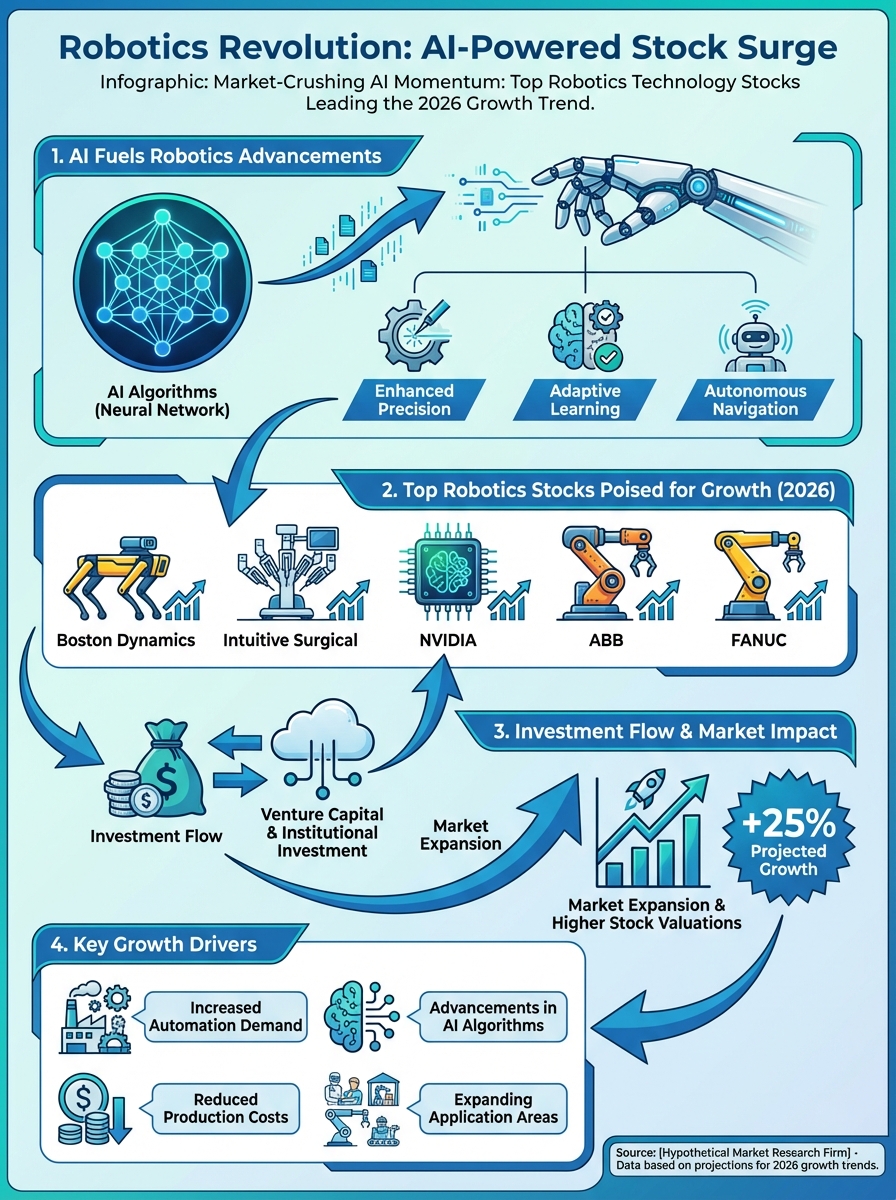
Why is this happening now? The confluence of factors is undeniable. AI algorithms have evolved from theoretical models to practical tools, enabling robots to execute intricate tasks autonomously. The plummeting cost of robotics hardware democratizes access to automation for businesses of all sizes. And, critically, the persistent global labor shortage is forcing businesses to adopt automation at an accelerated rate. This is not optional; it’s survival.
Forget “hype.” This is a paradigm shift. Instead of fluffy guides, focus on understanding the core technologies driving this change.
Key Predictions Shaping the Robotics Investment Landscape
Our analysis points to several pivotal trends:
- Manufacturing Transformation: AI-powered robots will become ubiquitous in manufacturing, boosting efficiency and slashing costs. Expect to see “lights out” factories becoming the norm, not the exception.
- Logistics and Warehousing Overhaul: Autonomous Mobile Robots (AMRs) will revolutionize logistics, optimizing warehouse operations and streamlining last-mile delivery. The key here is not just automation, but *intelligent* automation that adapts to real-time demand.
- Healthcare Disruption: Surgical robots and AI-assisted diagnostics are poised to transform healthcare, improving patient outcomes and minimizing medical errors. Imagine nanoscale robots performing targeted drug delivery or AI predicting patient deterioration before it happens.
- Collaborative Robotics (Cobots) Surge: Cobots will integrate seamlessly into various industries, augmenting human capabilities and enhancing productivity and safety. The focus will be on intuitive interfaces and adaptive learning, allowing cobots to work alongside humans with minimal training.
- AI Vision Dominance: AI-powered vision systems will empower robots to perceive and interact with their environment with unparalleled accuracy. This will unlock new applications in areas such as quality control, inspection, and autonomous navigation.
- AI-Driven Navigation Advancement: Autonomous navigation technologies will enhance the mobility and adaptability of robots in dynamic environments. This is crucial for applications such as self-driving vehicles, delivery drones, and warehouse robots.
- Ethical AI and Safety Imperative: Growing awareness of the ethical implications of AI will drive the development of robust safety standards and regulations. This is not just a compliance issue; it’s a matter of public trust.
Top Robotics Technology Stocks: Beyond the Usual Suspects
Identifying the winning stocks requires a laser focus on companies with cutting-edge technology, robust financials, and a clear strategic vision. Forget the generic advice; look for companies with defensible intellectual property and a proven track record of innovation.
Here are critical areas to watch:
- Next-Gen Industrial Automation: Companies developing AI-powered robots capable of complex assembly, precision welding, and adaptive manufacturing.
- AI Chip Innovators: Companies designing specialized AI chips optimized for robotics applications, offering superior performance and energy efficiency.
- Robotics-as-a-Service (RaaS) Providers: Companies offering robotics solutions as a service, lowering the barrier to entry for businesses and driving widespread adoption.
- Specialized Robotics Disruptors: Companies focusing on niche applications such as agricultural robots, underwater robots, or space exploration robots, targeting high-growth markets with unmet needs.
The Central Role of AI in Robotics Innovation
AI is the cognitive engine driving modern robots, enabling them to learn, adapt, and make decisions autonomously. This is paramount in dynamic environments where robots must respond to real-time changes.
AI algorithms are essential for:
- Advanced Object Recognition: Identifying and classifying objects with near-human accuracy, even in cluttered or occluded environments.
- Real-Time Motion Planning: Calculating optimal paths for robots to navigate complex environments, avoiding obstacles and optimizing efficiency.
- Adaptive Decision Making: Selecting the most appropriate action based on the robot’s goals and the current situation, even in uncertain or unpredictable circumstances.
- Seamless Human-Robot Interaction: Enabling robots to communicate and collaborate with humans naturally and intuitively, using voice, gesture, and other modalities.
AI-powered simulation tools are accelerating robot development by enabling engineers to test and optimize designs in virtual environments, reducing development time and minimizing risks.
Challenges and Opportunities: Navigating the Road Ahead
Despite the immense potential, significant challenges remain. A major hurdle is the need for more robust and reliable AI algorithms that can handle unexpected situations with grace. The “brittleness” of current AI systems is a real concern.
Another challenge is the need for high-quality data. AI algorithms require vast amounts of data to train effectively, and the cost of collecting and labeling this data can be substantial. Furthermore, bias in data can lead to skewed or discriminatory outcomes. Data quality, not just quantity, is paramount.
Expert Insight: The Trajectory of AI and Robotics
“The convergence of AI and robotics represents a fundamental transformation in automation,” asserts Dr. Anya Sharma, a leading AI researcher at MIT. “We are transitioning from simple, repetitive tasks to intricate, dynamic operations that demand intelligence and adaptability. This shift will profoundly impact industries across the board, creating both opportunities and challenges.”
I concur with Dr. Sharma’s assessment. We are entering a new era of automation characterized by intelligent robots that collaborate with humans to address global challenges. The key lies in developing AI systems that are not only powerful but also ethical and accountable.
The human element is crucial. We must ensure that AI and robotics augment human capabilities rather than replace them entirely. Focus on training programs that equip workers with the skills needed to collaborate with robots and manage automated systems.
Strategic Investing in Robotics: A Calculated Approach
Investing in robotics demands rigorous due diligence. Investors should evaluate a company’s technology, financial performance, management team, and competitive positioning.
Key questions to consider:
- What is the company’s technological moat?
- How defensible is the company’s intellectual property?
- What is the company’s track record of successful innovation?
- How well-positioned is the company to capitalize on future growth trends?
Diversification is essential to mitigate risk. Consider investing in a portfolio of robotics stocks to spread your exposure across different technologies and applications.
Future Prospects: The Evolving Landscape of AI and Robotics
The future of AI and robotics is promising. We can anticipate more sophisticated robots capable of performing a broader range of tasks with greater autonomy. We will also witness the emergence of novel applications for AI and robotics across various sectors.
Personalized robots that adapt to individual needs and preferences are an exciting development. These robots could offer companionship, assistance, and personalized education, potentially transforming our lives in profound ways.
However, caution is warranted. We must proceed thoughtfully, ensuring that AI and robotics are used to create a better future for all. A healthy dose of skepticism is always advisable.
FAQ: Navigating the Robotics Investment Landscape
- Q: What are the primary drivers of growth in the robotics market? A: Advances in AI, decreasing hardware costs, and increasing demand for automation.
- Q: What are the key applications of AI in robotics? A: Advanced object recognition, real-time motion planning, adaptive decision-making, and seamless human-robot interaction.
- Q: What are the main challenges facing the robotics industry? A: The need for more robust AI algorithms, high-quality data, and ethical considerations.
- Q: How can investors capitalize on the growth of the robotics market? A: By investing in robotics stocks, diversifying their investments, and conducting thorough due diligence.
- Q: What is the future of AI and robotics? A: More sophisticated robots, new applications in healthcare, education, and entertainment, and personalized robotics.
- Q: How can we ensure that AI and robotics are used ethically and responsibly? A: By developing safety standards, regulations, and prioritizing the human element.