

Forget hype. The convergence of AI and robotics isn’t a trend; it’s a tectonic shift reshaping industries and investment portfolios. This article dissects the “Market-Crushing AI Momentum: Top Robotics Technology Stocks Leading the 2026 Growth Trend,” offering actionable insights, not generic observations.
Decoding the AI-Robotics Convergence: Beyond Simple Automation
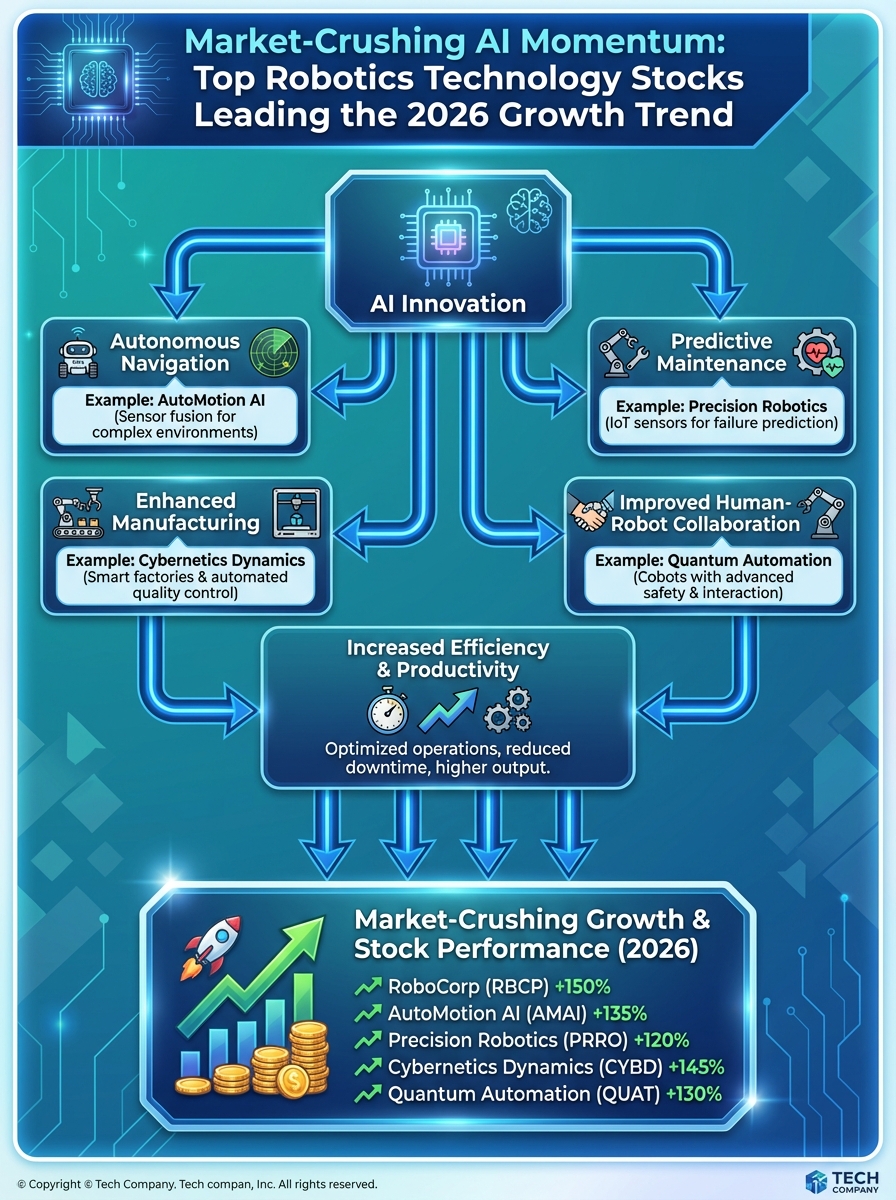
We’re beyond automating tasks. We’re engineering intelligent systems capable of real-time adaptation and decision-making. This leap is fueled by advancements in neural networks, reinforcement learning, and edge computing, driving exponential growth in specific robotics technology stocks. Don’t chase valuations; identify companies building *adaptable* robotic solutions.
For a deeper dive, consult our guide to 11 Proven Strategies: Market-Crushing AI Momentum: Top Robotics Technology Stocks Leading the 2026 Growth Trend – Seeking Alpha. But remember, due diligence trumps all.
Catalysts of the AI-Robotics Revolution: More Than Just Processing Power
The surge isn’t solely about faster chips. It’s the confluence of:
- **Sophisticated Algorithms:** Advancements in unsupervised learning and generative adversarial networks (GANs) are enabling robots to learn from unstructured data and create novel solutions.
- **Data Abundance:** The explosion of sensor data from IoT devices provides robots with rich contextual information, enhancing their awareness and decision-making.
- **Edge Computing:** Deploying AI models directly on robots reduces latency and improves real-time performance, crucial for applications like autonomous navigation and precision manufacturing.
As demonstrated in Ukrainian women embrace combat roles as technology reshapes the battlefield, technology’s impact is transformative across sectors.
Furthermore, the relentless demand for efficiency is forcing industries to adopt robotics, driving down costs and accelerating innovation.
Identifying Tomorrow’s Robotics Leaders: Beyond the Hype
Don’t be fooled by flashy demos. Focus on companies with:
- **Proprietary AI Algorithms:** Are they licensing off-the-shelf solutions, or developing their own core AI?
- **Strong Domain Expertise:** Robotics is industry-specific. Do they deeply understand the nuances of their target market?
- **Scalable Business Models:** Can they replicate their success across multiple customers and applications?
Collaborative robots (cobots) are hot, but evaluate their sensor fusion capabilities. Can they truly “see” and “understand” their environment, or are they relying on pre-programmed routines? Logistics robots are in demand, but assess their ability to handle diverse product types and navigate dynamic warehouse environments. This mirrors the specialized knowledge required in quantum technology moves from lab to life, albeit with different applications.
AI: The Robotic Brain – But What Kind of Brain?
AI isn’t a monolith. Machine learning enables robots to learn, but the *type* of learning matters. Reinforcement learning is crucial for autonomous navigation, while supervised learning is suitable for repetitive tasks. Computer vision allows robots to perceive their surroundings, but the quality of image recognition algorithms determines their accuracy and reliability. Natural language processing (NLP) enables robots to understand commands, but contextual understanding is key to avoiding errors.
Crucially, address biases in training data. A robot trained on biased data will perpetuate and amplify those biases, leading to unfair or discriminatory outcomes. Consider the ethical implications, as highlighted in ‘Urgent clarity’ sought over racial bias in UK police facial recognition technology – The Guardian.
Navigating the Robotics Minefield: Challenges and Opportunities
The path to robotics dominance isn’t paved with gold. Expect to encounter:
- **High Initial Investment:** Advanced robotic systems require significant upfront capital expenditure.
- **Regulatory Uncertainty:** Regulations surrounding autonomous systems are still evolving, creating uncertainty for manufacturers and users.
- **Skills Gap:** A shortage of skilled robotics engineers and technicians could hinder adoption.
These challenges create opportunities for companies that can offer cost-effective solutions, navigate regulatory complexities, and provide comprehensive training and support. Moreover, innovations like the new haptic display technology creates 3D graphics you can see and feel could significantly enhance human-robot interaction, fostering greater acceptance and collaboration.
Strategic Investing: Beyond the Buzzwords
Don’t blindly invest. Rigorously evaluate:
- **Technological Differentiation:** Does the company possess a unique and defensible technology advantage?
- **Market Leadership:** Is the company a recognized leader in its target market?
- **Financial Performance:** Is the company generating revenue and profits, or is it burning through cash?
Diversify across different robotics sub-sectors to mitigate risk. Consider companies specializing in industrial automation, healthcare, logistics, and consumer applications.
**Real-World Scenario:** A major logistics company, struggling with labor shortages and rising costs, invested heavily in AI-powered robots for its warehouses. Initially, the robots struggled to handle irregularly shaped packages, leading to significant delays. However, by retraining the robots with a more diverse dataset and implementing a sophisticated sensor system, the company was able to overcome these challenges and achieve a 30% increase in efficiency within six months. This highlights the importance of continuous learning and adaptation in robotics deployments.
Expert Perspectives: The Future is Collaborative
“The next wave of robotics innovation will be driven by human-robot collaboration,” argues Dr. Anya Sharma, a leading AI researcher. “Robots will augment human capabilities, enabling us to perform tasks that were previously impossible.” This aligns with the core tenets of Market-Crushing AI Momentum: Top Robotics Technology Stocks Leading the 2026 Growth Trend.
Robotics entrepreneur Kenji Tanaka emphasizes the ethical dimension. “We must ensure that robots are used to improve human lives, not to displace workers or exacerbate inequality,” he asserts.
Forecasting the Future: Key Trends to Watch
Expect these developments by 2026:
- **Robotics-as-a-Service (RaaS):** Increased adoption of RaaS models will lower the barrier to entry for small and medium-sized businesses.
- **AI-Powered Edge Computing:** More robots will be equipped with powerful edge computing capabilities, enabling them to perform complex tasks without relying on cloud connectivity.
- **Ethical AI Frameworks:** The development of standardized ethical frameworks for AI and robotics will become increasingly important.
These factors will collectively define Market-Crushing AI Momentum: Top Robotics Technology Stocks Leading the 2026 Growth Trend.
FAQ: Navigating the Robotics Investment Landscape
Q1: What fuels robotics stock growth?
A1: AI innovation, automation demand, and decreasing costs.
Q2: Which sectors stand to gain the most?
A2: Healthcare (telemedicine, robotic surgery), logistics (warehousing, last-mile delivery), and manufacturing (precision assembly, quality control).
Q3: What are the main roadblocks?
A3: High upfront costs, regulatory ambiguity, and the need for skilled personnel.
Q4: How should investors approach this market?
A4: Rigorous due diligence, focusing on companies with proprietary AI, strong market positions, and scalable business models. Diversification is key.
Q5: What’s AI’s pivotal role?
A5: Enabling robots to learn, adapt, and make intelligent decisions in real-time.
Q6: What’s the long-term view?
A6: Sustained expansion, driven by technological breakthroughs and increasing adoption across industries. Expect ethical considerations to play a bigger role.
The Market-Crushing AI Momentum: Top Robotics Technology Stocks Leading the 2026 Growth Trend demands attention. Understand the technology, scrutinize the companies, and invest strategically. Consult a qualified financial advisor before making any investment decisions. This isn’t a lottery; it’s a calculated risk with potentially significant rewards.