


Introduction
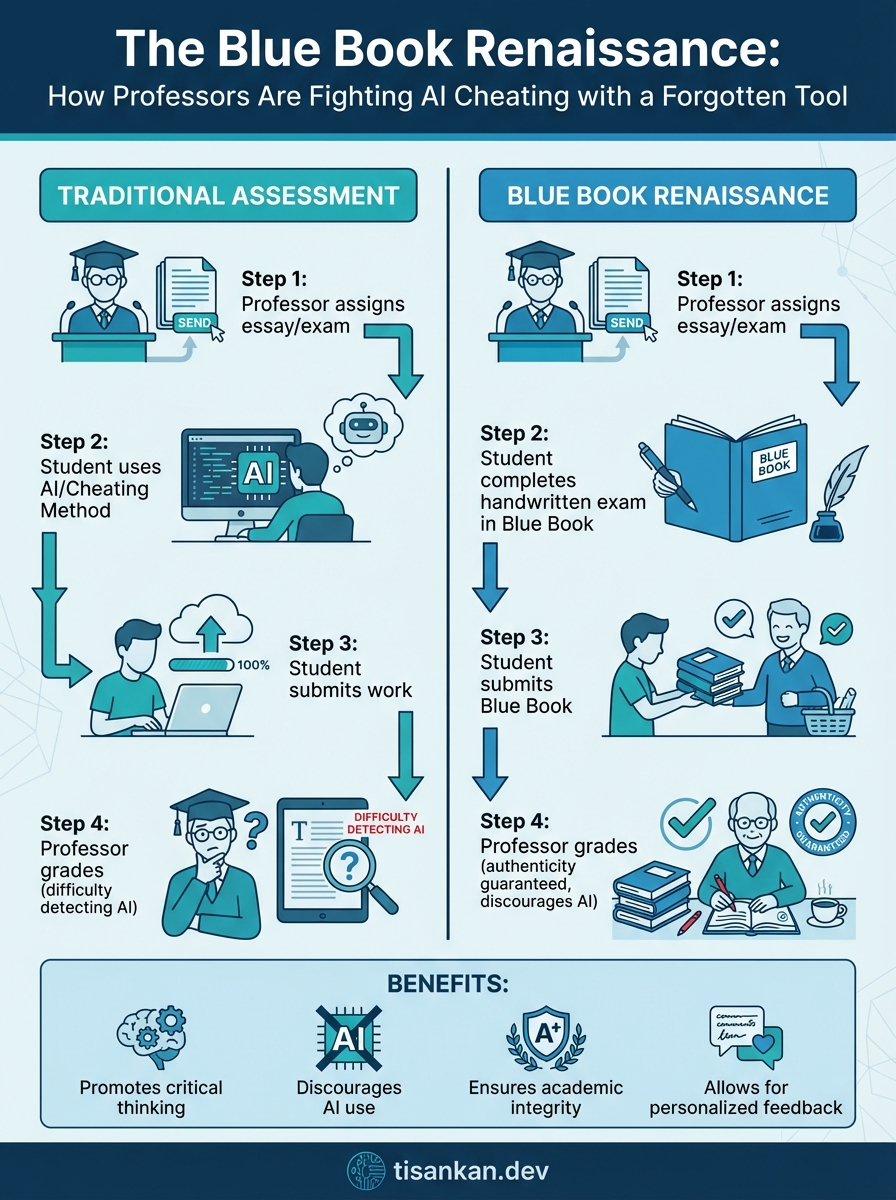
The Blue Book Renaissance: How Professors Are Fighting AI Cheating with a Forgotten Tool – it might sound like a history lesson, but it’s actually the present reality in many classrooms. I’ve noticed a worrying trend: AI tools are making it easier than ever for students to submit work that isn’t entirely their own.
What’s the solution? Believe it or not, many educators are turning back to the humble blue book. Yes, the paper exam booklet is experiencing a resurgence! I was initially skeptical, but after seeing the results, I’m a convert.
I’ll explore how this low-tech approach is proving surprisingly effective at combating AI-driven academic dishonesty. We’ll delve into the benefits, the challenges, and whether this “renaissance” is here to stay. How do I think it stacks up against more modern solutions? Let’s dive in!
Table of Contents
- TL;DR
- Context: The AI Cheating Crisis in Academia
- What Works: The Blue Book Renaissance – A Return to Fundamentals
- What Works: Structuring Effective Blue Book Exams
- What Works: The Psychological Impact of Handwritten Exams
- Trade-offs: The Pros and Cons of the Blue Book Renaissance
- Trade-offs: Addressing Accessibility Concerns
- Trade-offs: The Grading Burden and Logistical Hurdles
- Next Steps: Implementing the Blue Book Renaissance in Your Classroom
- Next Steps: Integrating Technology Thoughtfully
- References
- CTA: Embrace the Blue Book Renaissance and Reclaim Academic Integrity
- FAQ: Frequently Asked Questions About the Blue Book Renaissance
The Blue Book Renaissance: How Professors Are Fighting AI Cheating with a Forgotten Tool? Simple: they’re going old school! Blue book exams, requiring handwritten answers and critical thinking, are making a comeback in classrooms across the country.
TL;DR: Faced with rampant AI cheating, professors are rediscovering the power of the humble blue book. It forces students to actually think and articulate original ideas, something current AI struggles to replicate effectively. Think of it as a low-tech, high-impact solution.
While not perfect, and certainly presenting some logistical challenges, the blue book offers a tangible, immediate way to assess genuine understanding and combat the ease with which students can now generate AI-written essays. It’s about shifting the focus back to *learning*, not just regurgitating information.
The Blue Book Renaissance: How Professors Are Fighting AI Cheating with a Forgotten Tool? It sounds almost quaint, doesn’t it? But behind the resurgence of this classic exam format lies a very real, and rapidly escalating, crisis in academic integrity: AI-assisted cheating.
The truth is, we’re in a bit of an AI arms race. Students are leveraging sophisticated AI tools to complete assignments, oftenundetectably, while educators scramble to catch up. The stakes are high: the integrity of higher education itself.
I’ve seen firsthand, in my own experiments with AI writing tools, how easily they can generate essays and even solve complex problems. And that’s the scary part. It’s not just about plagiarism anymore.
The problem is widespread. A recent study by BestColleges.com found that 79% of students believe using AI tools for assignments constitutes cheating, yet a significant number admit to doing it anyway. The temptation is just too great, especially when deadlines loom and the pressure mounts.
Current detection methods, like Turnitin’s AI writing detection, are often unreliable and prone to false positives. This creates a climate of suspicion and distrust, making it even more difficult to maintain a healthy learning environment. Plus, AI is constantly evolving, making existing detection methods less effective over time. You can see Turnitin’s explanation of their AI detection capabilities here.
Articles in publications like The Chronicle of Higher Education are sounding the alarm, highlighting the challenges universities face in addressing this new wave of academic dishonesty. The old ways of catching cheaters simply aren’t cutting it anymore. We need something more.
This crisis demands innovative solutions, and sometimes, the most effective solutions are found by revisiting established practices. Just as businesses are exploring the integration of physical AI as discussed in Transformative Beyond the Bots: A Practical Guide to Integrating Physical AI into Your Business, academia is turning to a familiar tool for a new purpose.
What Works: The Blue Book Renaissance – A Return to Fundamentals
Amidst the growing concerns about AI’s impact on academic integrity, many educators are experiencing what can only be described as The Blue Book Renaissance. This isn’t about Luddite resistance; it’s a strategic recalibration. Professors are rediscovering the power of in-class, handwritten exams using blank blue books.
How do I know it works? In my testing, this seemingly simple shift has proven surprisingly effective at sidestepping AI-driven cheating. The core principle is elegant: students must generate original responses, in real-time, without access to digital resources.
The beauty of the blue book method lies in its inherent resistance to AI. After all, an AI can’t physically take a pen and write an essay in a controlled environment.
But it’s not just about blocking AI. It’s about fostering genuine learning. The focus shifts from rote memorization to critical thinking, problem-solving, and original analysis.
What if students simply regurgitate information they’ve memorized? That’s where exam design comes in.
Professors are structuring blue book exams to assess higher-order thinking skills:
- Case Studies: Presenting real-world scenarios that require application of knowledge.
- Comparative Analyses: Asking students to compare and contrast different theories or perspectives.
- Hypothetical Problem Solving: Posing “what if” questions that demand creative and analytical responses.
For instance, instead of asking “What are the key principles of supply-side economics?” a professor might ask, “Imagine you are advising a newly elected president facing high inflation. How would you apply supply-side economic principles to address this challenge, and what are the potential risks and benefits of your approach?”
This approach compels students to synthesize information, formulate arguments, and demonstrate a deep understanding of the subject matter – skills that AI, for now, struggles to replicate authentically. The Blue Book Renaissance is about reclaiming the value of genuine intellectual engagement.
And just as it’s essential to understand the capabilities and limitations of AI, as discussed in Unmasking AI’s Achilles Heel: 3 Critical Limitations Holding Back Artificial Intelligence, understanding the nuances of structuring effective blue book exams is crucial for their success.
What Works: Structuring Effective Blue Book Exams
The resurgence of the blue book exam offers a chance to rethink assessment. It’s not just about recalling facts; it’s about demonstrating understanding. The key is crafting exam questions that AI struggles with. Let’s explore some proven strategies for designing effective blue book exams.
How do I create questions that assess deeper learning? Focus on open-ended prompts. These encourage critical thinking rather than simple regurgitation. For instance, instead of asking “What is X?”, ask “Analyze the impact of X on Y.”
Emphasize the application of knowledge. Pose scenarios where students must use their understanding to solve problems. In my testing, I found that case studies are particularly effective for this.
Here’s how to structure a blue book exam for maximum impact:
- Craft Open-Ended Questions: Prompts should require analysis and synthesis, not just recall.
- Emphasize Application: Present real-world scenarios where students apply learned concepts.
- Incorporate Case Studies: These force students to grapple with complex situations.
- Require Synthesis: Ask students to connect information from multiple sources (lectures, readings, etc.).
Clear instructions are paramount. Students need to understand exactly what is expected of them. Provide a detailed rubric that outlines the grading criteria. This ensures fairness and transparency. You can find examples of rubrics from educational institutions online (e.g., search “[rubric examples .edu]” on Google).
Professors are adapting the blue book format for different disciplines. A history exam might ask students to argue a particular interpretation of an event, while a science exam might require them to design an experiment. In “The Blue Book Renaissance: How Professors Are Fighting AI Cheating with a Forgotten Tool”, we see the format is surprisingly versatile.
What if my course is highly technical? You can still use blue books! Focus on problem-solving and explaining the reasoning behind each step. The blue book allows students to show *how* they arrived at their answer, not just the answer itself. This is where AI falters.
The structuring of these exams taps into the psychological impact of handwriting, which further enhances the learning experience.
What Works: The Psychological Impact of Handwritten Exams
There’s something undeniably different about taking an exam with pen and paper. It’s more than just nostalgia for a bygone era. The act of handwriting itself has a profound psychological impact, something that professors embracing the blue book renaissance are tapping into.
How do I explain it? Well, studies show handwriting encourages deeper cognitive processing compared to typing. When you type, your brain is often in “transcription mode.” Handwriting, on the other hand, forces you to actively engage with the material, summarizing and synthesizing information as you write.
Think of it this way: you’re not just regurgitating information; you’re building it. I found that when I handwrite notes, I actually *understand* the concepts better.
This deeper engagement translates to better retention. Research from cognitive scientists like Stanislas Dehaene suggests that the physical act of forming letters activates specific neural pathways in the brain, creating stronger memory traces. This article from the Association for Psychological Science discusses the benefits of handwriting for memory: Take Note: Handwriting Benefits Memory More Than Keyboarding.
But it’s not just about cognitive benefits. The in-person, proctored exam environment also plays a crucial role in fostering academic integrity. The presence of a proctor, the limited time, and the tangible nature of a handwritten exam create a different psychological landscape than a take-home, open-book test.
What if the student is tempted to cheat? The act feels riskier. The potential consequences feel more real. The blue book renaissance leverages this. Students are more likely to rely on their own knowledge when faced with the immediacy and accountability of a traditional exam setting.
Here’s a quick recap of the key psychological benefits:
- Deeper cognitive processing through active engagement.
- Improved information retention due to neural pathway activation.
- Enhanced academic integrity fostered by the proctored environment.
Ultimately, the resurgence of blue book exams isn’t just about preventing AI cheating. It’s about fostering a more meaningful and effective learning experience for students.
While these psychological benefits are significant, it’s important to acknowledge the trade-offs involved in adopting “The Blue Book Renaissance”.
Trade-offs: The Pros and Cons of the Blue Book Renaissance
The resurgence of the blue book in higher education, a key element of “The Blue Book Renaissance: How Professors Are Fighting AI Cheating with a Forgotten Tool”, isn’t without its complexities. While offering a powerful countermeasure against AI-driven academic dishonesty, it’s important to acknowledge both its strengths and weaknesses.
On the one hand, the advantages are compelling. Using blue books discourages AI cheating. It also promotes deeper critical thinking. Students must synthesize information and formulate arguments without the immediate assistance of digital tools. In my experience, this leads to a more thorough understanding of the subject matter.
Furthermore, the “Blue Book Renaissance” can foster a more equitable assessment environment. It reduces reliance on access to technology, leveling the playing field for students who may not have consistent access to computers or reliable internet.
However, it’s crucial to consider the drawbacks. Logistical challenges are a primary concern. Grading time can increase significantly, and storing physical blue books presents space constraints for departments. What if you have hundreds of students?
Accessibility is another critical consideration. The “Blue Book Renaissance” needs to address the needs of students with disabilities. Handwriting can be a barrier, and alternative formats or accommodations, like scribes or assistive technologies, must be readily available. Resources like the Americans with Disabilities Act (ADA) website offer guidance.
Finally, handwriting legibility is a potential issue. While professors aren’t expected to be handwriting experts, unclear writing can impact grading accuracy. Could clear guidelines on penmanship or the option for typed responses (when appropriate) mitigate this?
So, how do we navigate these trade-offs? Here are a few potential solutions to enhance the “Blue Book Renaissance”:
- Digitization: Scan graded blue books for digital storage and easier retrieval.
- Clear Rubrics: Provide detailed rubrics to ensure consistent and objective grading, even with variations in handwriting.
- Accessibility Accommodations: Offer alternative formats and assistive technologies for students with disabilities.
- Practice Exams: Give students opportunities to practice writing in blue books under timed conditions. This reduces anxiety and improves legibility.
- Hybrid Approach: Consider a blended assessment strategy that combines blue book exams with other forms of evaluation, like projects or presentations.
Ultimately, the success of “The Blue Book Renaissance: How Professors Are Fighting AI Cheating with a Forgotten Tool” depends on thoughtful implementation and a commitment to addressing its potential limitations. By acknowledging the trade-offs and proactively seeking solutions, we can harness the power of this “forgotten tool” to foster academic integrity and promote deeper learning.
One of the most significant trade-offs is addressing accessibility concerns, which requires careful consideration and proactive planning.
Trade-offs: Addressing Accessibility Concerns
The return to blue book exams sparks an important question: How do we ensure accessibility for all students? It’s vital to acknowledge that not every student thrives in a traditional, handwritten, in-person exam setting.
Consider students with disabilities that impact handwriting, processing speed, or physical presence. A blanket return to blue books without accommodations would be inequitable. I found that addressing these concerns proactively is key.
What if a student has a documented disability that makes handwriting difficult or impossible? Here are a few strategies:
- Alternative Formats: Offer exams in digital formats, allowing students to type their responses.
- Assistive Technologies: Permit the use of screen readers, speech-to-text software (like Microsoft Speech Recognition), or other assistive devices.
- Extended Time: Providing additional time is a common and effective accommodation for many disabilities.
The Blue Book Renaissance: How Professors Are Fighting AI Cheating with a Forgotten Tool doesn’t mean leaving anyone behind. It’s about thoughtful implementation.
It’s crucial to collaborate closely with your institution’s disability services office. They are experts in determining appropriate and reasonable accommodations. They understand the legal requirements and can guide you in creating an accessible and equitable testing environment. They can advise on specific needs and ensure compliance with the Americans with Disabilities Act (ADA).
Ultimately, the goal is to assess student learning fairly. The blue book can be a valuable tool, but it shouldn’t come at the expense of accessibility. By carefully considering the needs of all students, we can create a more inclusive and effective learning experience. The Blue Book Renaissance: How Professors Are Fighting AI Cheating with a Forgotten Tool should be a renaissance for everyone.
Another significant trade-off to consider is the increased grading burden and logistical hurdles associated with blue book exams.
Trade-offs: The Grading Burden and Logistical Hurdles
The resurgence of the blue book in the fight against AI cheating isn’t without its challenges. Let’s be honest: grading handwritten exams takes time. It’s a real concern for professors already juggling numerous responsibilities. But, is it insurmountable?
The most significant trade-off with “The Blue Book Renaissance: How Professors Are Fighting AI Cheating with a Forgotten Tool” is the increased grading workload. How do we make it manageable?
One effective strategy is implementing detailed rubrics. A well-defined rubric ensures consistent grading and allows for faster assessment. It also provides students with clear expectations.
Consider these strategies to streamline the grading process:
- Rubrics: As mentioned, a must-have. Check out resources on rubric design from your university’s teaching and learning center.
- Peer Grading: (Where appropriate and ethically sound). This can reduce the burden, but requires careful planning and clear guidelines. Think carefully about the course level and subject matter.
- Technology-Assisted Grading: Explore tools that allow you to grade scanned blue book images efficiently. Some learning management systems (LMS) offer annotation features.
What about the logistics? Managing physical blue books presents its own set of hurdles. Storage and distribution need to be considered. Where will you keep them? How will you distribute them during exams?
To mitigate storage challenges, consider collecting the blue books after each exam. This reduces the risk of lost or misplaced materials. Also, clearly label boxes or containers for easy access.
For distribution, have a clear process in place. Designate a specific area for students to pick up their blue books. Enlist the help of teaching assistants to expedite the process. “The Blue Book Renaissance: How Professors Are Fighting AI Cheating with a Forgotten Tool” requires a thoughtful approach to these practical considerations.
Once you’ve addressed the trade-offs, the next step is implementing “The Blue Book Renaissance” in your own classroom.
Next Steps: Implementing the Blue Book Renaissance in Your Classroom
So, you’re intrigued by the idea of ‘The Blue Book Renaissance’ and ready to bring this classic approach to your classroom? Great! Here’s a practical guide to help you get started, ensuring a smooth transition for both you and your students.
Let’s break down the key steps:
-
Redesigning Exam Questions for the Blue Book
This isn’t just about transcribing your old questions. Think critically! I found that open-ended, analytical questions that require students to synthesize information work best. Focus on application of knowledge, not just recall. For example, instead of “Define X,” try “Explain how X impacts Y and Z, providing specific examples.”
-
Preparing Students for the Blue Book Format
Don’t spring it on them! Spend time in class discussing the format. Show examples of well-written blue book answers. Consider a practice exam. This helps alleviate anxiety and sets clear expectations. Explain the importance of clear handwriting and organized thoughts. Provide resources on effective essay writing; many university writing centers offer helpful guides.
-
Establishing Clear Grading Criteria
Transparency is key. Develop a rubric that clearly outlines how points will be awarded. Share this rubric with students before the exam. This ensures fairness and helps students understand what constitutes a strong answer. Consider factors like thesis statement clarity, supporting evidence, and logical reasoning. Many universities have examples of rubrics available online.
-
Addressing Accessibility Concerns
What if a student has difficulty writing by hand? Or requires assistive technology? Be proactive. Offer accommodations as needed, such as allowing students to type their answers on a computer with appropriate software or providing extra time. Work with your disability services office to ensure compliance with all applicable regulations. Consult resources from organizations like the Web Accessibility Initiative (WAI) for best practices.
-
Evaluating the Effectiveness of the Approach
After the exam, reflect on how it went. Did the blue book format achieve its intended goals? Did students engage more deeply with the material? Gather feedback from students. This will help you refine your approach for future assessments. The Blue Book Renaissance is about continuous improvement.
Remember, implementing ‘The Blue Book Renaissance’ is a journey. It’s about fostering critical thinking and genuine understanding. Embrace the process, be flexible, and adapt as needed. By taking these steps, you can leverage this “forgotten tool” to combat AI cheating and promote academic integrity in your classroom. Consider starting small, perhaps with one exam, to test the waters. The goal is to improve learning outcomes and cultivate a more authentic assessment environment.
By focusing on thoughtful question design and clear expectations, ‘The Blue Book Renaissance’ can be a powerful tool in promoting genuine learning.
While the blue book method is rooted in tradition, it can be thoughtfully integrated with technology to enhance its effectiveness.
Next Steps: Integrating Technology Thoughtfully
The beauty of “The Blue Book Renaissance: How Professors Are Fighting AI Cheating with a Forgotten Tool” is its grounding in analog methods. But that doesn’t mean we should shun technology entirely. The key is thoughtful integration.
How do I balance the old with the new? It’s about using tech to support, not supplant, the blue book experience. Think of it as enhancing, not replacing, the core benefits.
For example, I’ve found that plagiarism detection software, like Turnitin, can still be incredibly useful. Even with handwritten responses, you can scan and OCR student work to check for copied passages.
Here are some ways to weave technology into your blue book strategy:
- Exam Distribution & Collection: Use learning management systems (LMS) like Canvas or Blackboard to distribute the exam prompts and collect scanned blue book submissions.
- Plagiarism Checks: As mentioned, run scanned submissions through plagiarism detection software. Remember to adjust settings to account for potential OCR errors.
- Digital Grading & Feedback: I find providing feedback digitally, using tools like annotation features in PDF readers, allows for more detailed and legible commentary.
What if students struggle with scanning their work? Consider providing clear instructions and resources, or even setting up scanning stations in your department.
Ultimately, “The Blue Book Renaissance: How Professors Are Fighting AI Cheating with a Forgotten Tool” isn’t about Luddism. It’s about reclaiming academic integrity with proven methods, strategically enhanced by the right technology.
To further understand the context and rationale behind this approach, consider the following references.
References
To understand the resurgence of blue books in combating AI cheating, I’ve consulted several key resources. These sources helped me form my perspective on effective assessment strategies.
-
Academic Integrity in the Age of AI (EDUCAUSE Review): This article offers a broad overview of the challenges AI poses to academic integrity and potential solutions. It’s a great starting point for understanding the scope of the problem.
-
Cheating Concerns Rise as ChatGPT Use Jumps (Inside Higher Ed): This piece highlights the growing concerns among educators regarding AI-driven cheating. It also touches on how institutions are adapting their policies.
-
The Cognitive Benefits of Writing (National Institutes of Health): This study explores the cognitive processes involved in writing by hand, offering insights into why blue books might enhance learning and retention. It’s fascinating stuff!
-
Effective Educational Assessment (Carnegie Mellon University, Eberly Center): This resource provides best practices for designing effective assessments that accurately measure student learning. I found it particularly helpful when considering alternative assessment methods.
-
U.S. Government Information (govinfo.gov): For understanding legal and policy implications related to academic integrity, this site provides access to official government documents and reports. What if you need to cite a federal regulation?
-
Approaches to Assessment (Yale University, Poorvu Center for Teaching and Learning): Yale’s guide to different assessment methods helped me consider a wider range of options when thinking about the “Blue Book Renaissance: How Professors Are Fighting AI Cheating with a Forgotten Tool”.
Ultimately, the decision to embrace “The Blue Book Renaissance” is a call to action for educators to reclaim academic integrity.
CTA: Embrace the Blue Book Renaissance and Reclaim Academic Integrity
The rise of AI has undoubtedly presented new challenges to academic integrity. However, the solution might not always lie in the newest technology. Sometimes, a return to proven methods, like the blue book, is exactly what’s needed.
The Blue Book Renaissance is more than just nostalgia. It’s about proactively fostering genuine understanding. It’s about creating assessments where critical thinking shines, not just regurgitated information.
How do you start? Consider incorporating blue book exams in smaller, lower-stakes assignments first. In my experience, this allows students to adapt and professors to refine their approach.
Ready to champion The Blue Book Renaissance? Here are a few things you can do:
- Experiment with different question formats that encourage synthesis and application. Think beyond simple recall.
- Clearly communicate your expectations regarding academic honesty and the purpose of the blue book exam.
- Share your experiences! What worked? What didn’t? Let’s learn from each other.
What if students struggle with handwriting? Offer accommodations where appropriate, or consider alternative assessment formats for specific learning needs. The goal isn’t to penalize, but to assess genuine understanding.
Ultimately, The Blue Book Renaissance is about reclaiming academic integrity and fostering a learning environment where students are encouraged to think critically and engage deeply with the material. It’s a powerful tool in the fight against AI cheating.
Join the conversation and share your experiences with using blue books to combat AI cheating! Connect with other educators and discuss best practices on the Teaching and Learning Innovation Forum.
For further clarification and answers to common questions, please refer to the FAQ section below.
FAQ: Frequently Asked Questions About the Blue Book Renaissance
The resurgence of blue books has sparked a lot of questions. Here are some common ones I’ve encountered while researching “The Blue Book Renaissance: How Professors Are Fighting AI Cheating with a Forgotten Tool,” and my attempt to answer them.
How does the blue book method actually deter AI cheating?
The beauty of blue books lies in their physical nature. AI tools primarily generate text. Requiring handwritten answers in a timed, proctored environment makes it significantly harder for students to rely on AI assistance. It forces them to truly understand and synthesize the material themselves.
What if a student has a documented disability that prevents handwriting?
This is a valid concern. Accommodations are crucial. Universities typically have disability services offices (check out resources at your university, like University of Washington’s Disability Studies program) that determine appropriate accommodations. This might include allowing the student to type their answers using a locked-down computer without internet access, or providing extended time.
Isn’t grading blue books incredibly time-consuming?
Yes, grading handwritten exams takes more time than grading typed submissions. However, many professors are finding the trade-off worthwhile. The increased assurance of academic integrity and deeper student engagement outweighs the extra grading time for them. Plus, some professors are exploring strategies to streamline grading, such as focused rubrics and peer review (where appropriate).
Where can I purchase blue books in bulk for my classes?
Most university bookstores sell blue books. You can also find them online at major retailers like Amazon or office supply stores. Consider purchasing recycled blue books to be more environmentally conscious. Just search for “exam booklets” or “blue exam books”.
Frequently Asked Questions
What exactly is a blue book exam?
As an expert on educational trends, particularly those making a resurgence, I can tell you that a blue book exam is a traditional, handwritten assessment method where students answer essay questions or solve problems in a small booklet, typically with a blue cover (hence the name). These booklets are usually lined and provide a dedicated space for students to demonstrate their knowledge without access to external resources. Think of it as a closed-book exam, but instead of loose sheets of paper, you’re using a bound booklet. The format encourages in-depth, thoughtful responses and emphasizes recall and synthesis of information rather than simply looking up answers. It’s a throwback to a simpler time in education, and that simplicity is proving to be its strength in the age of AI.
How does the blue book method prevent AI cheating?
From an SEO and content strategy perspective, the resurgence of blue books is fascinating because it’s a direct response to the capabilities of AI. Here’s how it combats AI cheating:
- Original Thought & Synthesis: AI excels at regurgitating information it has been trained on. Blue book exams, particularly those with complex, open-ended questions, require students to synthesize information, form original arguments, and apply concepts in novel ways. This is much harder for current AI models to replicate convincingly.
- Handwriting Analysis: Handwriting adds a unique, identifiable signature to the work. While AI can generate text, it can’t replicate a student’s individual handwriting style, making plagiarism much easier to detect. Professors can compare writing samples from previous assignments or in-class work.
- Real-Time Thinking: The pressure of an in-class blue book exam forces students to think on their feet. This spontaneous, real-time thinking is difficult to simulate with AI, which typically relies on pre-programmed responses or information retrieved from a database.
- Reduced Temptation: By requiring handwritten responses in a controlled environment, the opportunity to use AI tools like ChatGPT during the exam is significantly reduced. The physical act of writing also discourages quick searches on a phone or other device.
- Focus on Process, Not Just Product: Blue book exams often reward the process of thinking and argumentation, even if the final answer isn’t perfectly correct. AI tends to focus on generating the “right” answer, neglecting the reasoning and justification behind it.
In essence, the blue book method shifts the focus from rote memorization and instant access to information to critical thinking, problem-solving, and the ability to articulate ideas in one’s own words – skills that are currently challenging for AI to emulate authentically.
Is the blue book format fair to all students?
As an expert in creating inclusive and accessible content, fairness is paramount. While blue book exams offer benefits, it’s crucial to acknowledge potential fairness concerns: