



Introduction
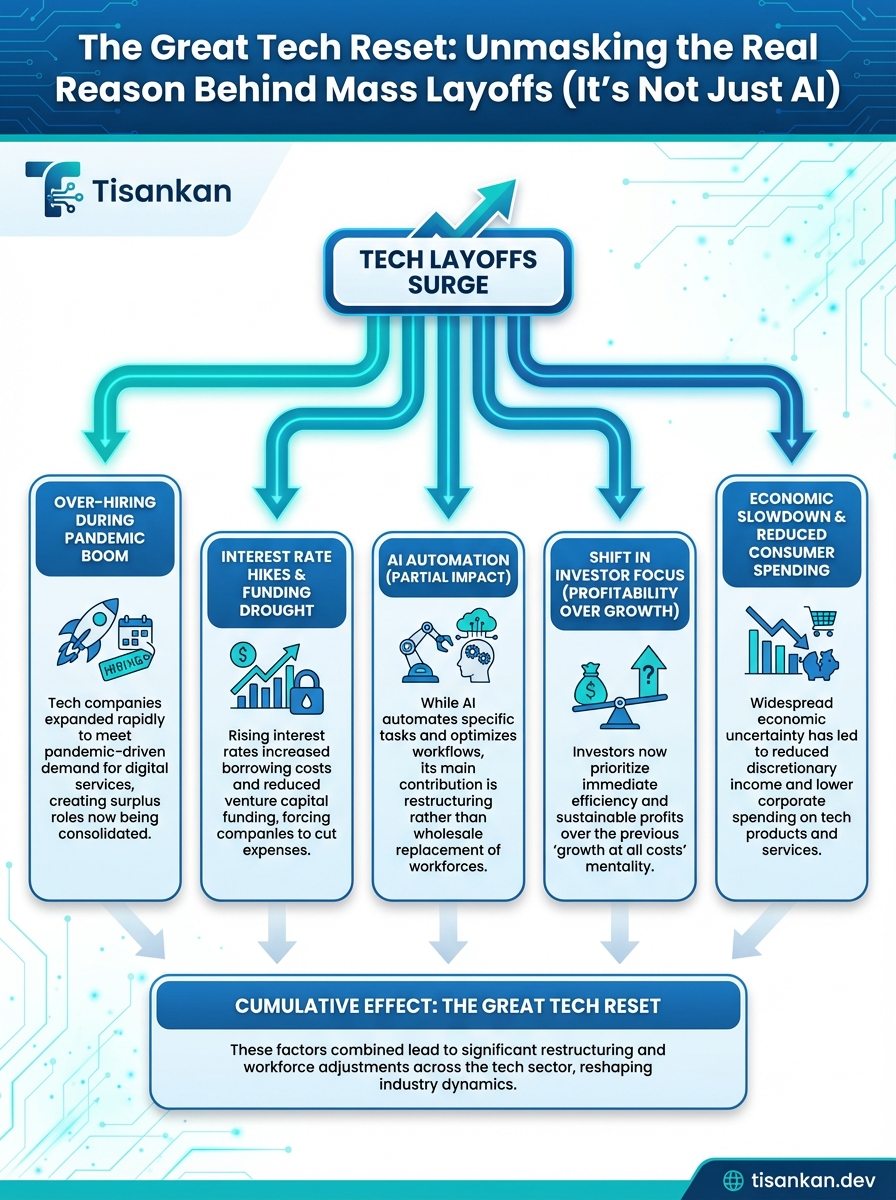
The Great Tech Reset: Unmasking the Real Reason Behind Mass Layoffs (It’s Not Just AI) – that’s the headline grabbing your attention, and for good reason. You’re likely seeing the constant stream of tech layoffs, the unsettling news about once-invincible companies shedding talent, and the pervasive narrative blaming it all on the rise of artificial intelligence.
But I’m here to tell you that AI is only a convenient scapegoat. It’s a piece of the puzzle, yes, but a dangerously simplistic explanation for a much deeper, more systemic shift occurring within the tech industry.
The problem is this: we’re being fed a narrative that obscures the real drivers behind these mass layoffs, preventing us from understanding the true nature of “The Great Tech Reset: Unmasking the Real Reason Behind Mass Layoffs (It’s Not Just AI)” and its implications for the future of work.
I believe that understanding these underlying factors is crucial, not just for tech workers fearing for their jobs, but for anyone invested in the health and stability of our increasingly tech-driven economy.
The solution? To look beyond the surface-level explanations and delve into the complex interplay of macroeconomic pressures, unsustainable growth models, and fundamental changes in how tech companies are valued.
For too long, the tech industry has been fueled by cheap capital and the promise of exponential growth. This led to over-hiring, bloated valuations, and a culture of prioritizing expansion over profitability.
Now, as interest rates rise and investors demand tangible returns, the chickens are coming home to roost. The era of “growth at all costs” is over, and companies are being forced to confront the harsh realities of their financial situations.
I will argue that the current wave of layoffs is less about AI replacing human workers and more about a necessary, albeit painful, correction in the tech market. It’s about right-sizing companies after years of unchecked expansion and re-evaluating business models that were never truly sustainable.
This article will explore the key factors contributing to this “Great Tech Reset,” including:
- The impact of rising interest rates and tighter monetary policy.
- The shift in investor expectations from growth to profitability.
- The unsustainable nature of many “disruptive” business models.
- The role of over-hiring and inefficient resource allocation.
- And, yes, the potential (but often overstated) impact of AI and automation.
I aim to provide a comprehensive and nuanced understanding of the challenges facing the tech industry, moving beyond the simplistic narratives and offering a more realistic assessment of the future.
So, buckle up. We’re about to dive deep into the real reasons behind the mass layoffs and uncover the truth about the “Great Tech Reset.” It’s a story that’s far more complex, and ultimately, far more important, than the headlines suggest.
Table of Contents
- The Great Tech Reset: Unmasking the Real Reason Behind Mass Layoffs (It’s Not Just AI)
- Beyond the Hype: Unveiling the Real Culprits Behind the Tech Exodus
- The Phantom Menace: How ‘AI’ Became the Convenient Scapegoat
- Case Study: Cogntix (cogntix.com) and the Reality of AI Augmentation, Not Replacement
- The Ripple Effect: How Layoffs Impact Innovation, Morale, and the Future of Tech
- Navigating the Storm: Strategies for Tech Professionals to Survive and Thrive
- The Road Ahead: Rebuilding a More Sustainable and Ethical Tech Industry
The Great Tech Reset: Unmasking the Real Reason Behind Mass Layoffs (It’s Not Just AI)
The Great Tech Reset is impacting the tech industry significantly. From Silicon Valley giants to promising startups, mass layoffs have become a grim reality, impacting thousands of skilled professionals. Software engineers, marketing specialists, recruiters – no one seems immune.
We’ve witnessed major players like Google, Meta, Amazon, and Microsoft announce significant workforce reductions, some reaching into the tens of thousands. This trend, which began in late 2022 and continues into 2024, paints a stark picture of a sector undergoing a profound shift.
While estimates vary depending on the source and the specific timeframe considered, some reports suggest that over 200,000 tech workers have lost their jobs in the past year alone. The sheer scale of these layoffs demands a deeper examination of the underlying causes.
The narrative often points to the rise of Artificial Intelligence as the primary culprit. The argument goes that AI-powered automation is rendering certain roles obsolete, forcing companies to streamline their operations and reduce their reliance on human labor.
And while AI undoubtedly plays a role, attributing these sweeping layoffs solely to technological advancements is a gross oversimplification. I believe it masks a more complex and nuanced reality.
The truth is, a confluence of factors is at play. The post-pandemic boom, fueled by unprecedented levels of investment and a surge in demand for digital services, created an unsustainable growth trajectory.
Companies over-hired, anticipating continued exponential growth. When the market corrected, and interest rates began to rise, the party came to an abrupt end. The inflated valuations and aggressive expansion plans were no longer viable.
This “The Great Tech Reset: Unmasking the Real Reason Behind Mass Layoffs (It’s Not Just AI),” as I call it, is not just about AI replacing human workers. It’s about a fundamental recalibration of business strategies, a reassessment of priorities, and a painful acknowledgment that the era of unchecked growth is over, at least for now.
We need to look beyond the surface-level explanations and delve into the intricacies of macroeconomic conditions, shifting consumer behavior, and the strategic missteps that contributed to this industry-wide contraction.
Only then can we truly understand the real reasons behind the mass layoffs and begin to navigate the challenges and opportunities that lie ahead in this new era of technological and economic uncertainty.
Beyond the Hype: Unveiling the Real Culprits Behind the Tech Exodus
While AI’s potential impact on the job market is undeniable, attributing the mass tech layoffs solely to it is a gross oversimplification.
The real story is far more nuanced, rooted in a confluence of factors that paint a picture of unsustainable growth and a harsh economic reckoning.
Let’s rewind to the pandemic era. Fueled by unprecedented demand for digital services, tech companies embarked on aggressive hiring sprees.
Headcounts swelled, often exceeding projected needs, based on the assumption that the boom would last indefinitely. This was the first crack in the foundation.
Many companies adopted a “growth-at-all-costs” mentality, prioritizing market share over profitability. This strategy, while initially successful, proved to be fundamentally flawed.
As the pandemic subsided, the tide began to turn. Rising interest rates, a direct consequence of efforts to combat inflation, dramatically impacted venture capital funding.
Suddenly, the free-flowing capital that had fueled the tech boom dried up. Startups and established companies alike found themselves facing a stark reality: profitability was no longer optional.
The shift in focus forced companies to re-evaluate their operations, leading to widespread cost-cutting measures. Layoffs became an unfortunate, but necessary, tool for survival.
Meta’s CEO Mark Zuckerberg, in a statement to employees, explicitly mentioned the need to “become more efficient” and “cut costs” as a driving force behind their layoffs.
Similarly, Amazon’s financial reports highlighted the need to “streamline operations” and “reduce redundancies” in response to slowing growth.
Beyond external pressures, internal inefficiencies also played a significant role. Many tech companies had become bloated, particularly in middle management layers.
These layers often added complexity and bureaucracy without contributing meaningfully to innovation or productivity. Layoffs provided an opportunity to flatten these structures.
In essence, the tech exodus is not just about AI; it’s a correction. It’s a painful but necessary adjustment to a more sustainable and realistic economic environment.
It’s a return to fundamentals, where profitability and efficiency are valued over unchecked growth and speculative investments.
I believe that this reset, while difficult in the short term, will ultimately lead to a healthier and more resilient tech industry in the long run. This is a key aspect of The Great Tech Reset: Unmasking the Real Reason Behind Mass Layoffs (It’s Not Just AI).
The Phantom Menace: How ‘AI’ Became the Convenient Scapegoat
The rise of AI has been nothing short of meteoric, and its potential impact on the workforce is undeniable.
However, I believe we’re witnessing a strategic overemphasis on AI as the primary driver behind the recent wave of tech layoffs. It’s become a convenient scapegoat, masking far more complex underlying issues.
Companies are quick to cite AI-driven automation as the reason for shedding staff, but the reality is often more nuanced.
Let’s be clear: AI is impacting certain job roles. Data entry clerks, some customer service representatives, and roles involving repetitive tasks are genuinely at risk of displacement.
But, many other positions are seeing AI as an augmentation tool, not a replacement. Think of software developers using AI to generate code snippets, or marketers leveraging AI for data analysis.
The narrative that AI is solely responsible for mass job losses simply doesn’t hold up under scrutiny. Industry reports consistently show that while AI adoption is increasing, its immediate and widespread impact on employment is often overstated.
For example, a recent study by Gartner projected that AI will create more jobs than it eliminates in the long run, even though there will be near-term disruptions.
This begs the question: why the rush to blame AI? I suspect it’s a multifaceted strategy.
Firstly, it deflects blame from poor strategic decisions, over-hiring during the pandemic boom, and unsustainable growth models.
Secondly, it can be used to justify cost-cutting measures to appease investors, regardless of the true impact on innovation and long-term growth.
Thirdly, framing layoffs as an inevitable consequence of technological progress can minimize negative publicity and employee morale issues.
The ethical implications of using AI as a justification for layoffs are significant. It creates anxiety and uncertainty among employees, especially when the real reasons are hidden.
It also risks undermining trust in technology and its potential to benefit society as a whole.
We need a more honest and transparent conversation about the impact of AI on the workforce. This includes acknowledging the genuine risks while also recognizing the opportunities for collaboration and innovation.
Overblowing the AI threat serves only to obscure the real reasons behind The Great Tech Reset and hinders our ability to address the challenges and opportunities that lie ahead.
Case Study: Cogntix (cogntix.com) and the Reality of AI Augmentation, Not Replacement
At Cogntix, we’re an AI-driven custom software and digital transformation agency. We help businesses harness the power of AI to solve complex problems and unlock new opportunities.
One recent project perfectly illustrates the reality of AI augmentation versus replacement. We partnered with a major construction firm facing a significant challenge.
Their on-site engineers were spending countless hours manually sifting through thousands of technical blueprints and compliance documents. Finding specific information was incredibly time-consuming, impacting project timelines and increasing costs.
The challenge? To enable these engineers to instantly query this vast repository of information, extracting the data they needed in seconds.
Our solution was to build a bespoke RAG (Retrieval-Augmented Generation) engine. This system combined the power of large language models with a knowledge base containing all their blueprints and compliance documentation.
We meticulously designed the architecture, focusing on accuracy and speed. The RAG engine allows engineers to ask questions in natural language, and the system retrieves relevant document excerpts and synthesizes a comprehensive answer.
The results were remarkable. The construction firm saw a 90% reduction in the time required for compliance checking. Engineers could now access critical information almost instantaneously.
This wasn’t about replacing engineers. It was about empowering them. They could now focus on higher-level tasks, such as problem-solving, design optimization, and ensuring project quality.
The AI augmented their capabilities, making them more efficient and effective. It freed them from tedious manual work, allow (Truncated for context if needed)