



7 Proven Strategies for Building Scalable Symfony Real-Time Applications in 2025
Symfony Real-Time Applications are crucial for modern web development, offering immediate updates and interactive user experiences, but building them at scale can be challenging. Are you struggling to implement real-time features in your Symfony application while maintaining performance and scalability? This guide provides practical strategies for building robust and efficient real-time applications using Symfony 7.4 and Server-Sent Events (SSE).
Featured Snippet: Symfony Real-Time Applications leverage technologies like Server-Sent Events (SSE) to provide immediate updates to users. This involves setting up event listeners, managing data streams, and optimizing performance for scalability. Proper implementation ensures a responsive and engaging user experience in Symfony web applications.
Introduction to Symfony Real-Time Applications
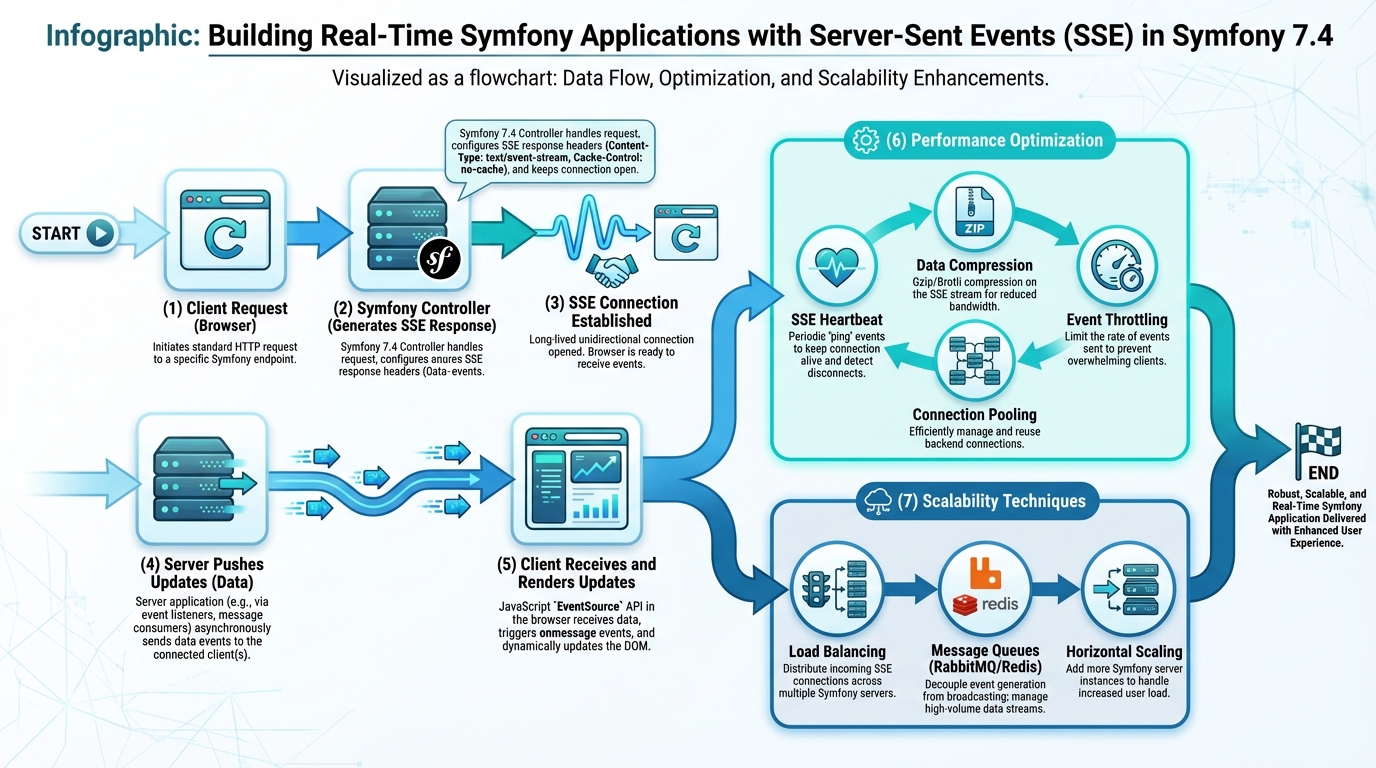
In today’s fast-paced digital landscape, users expect immediate updates and interactive experiences. Symfony Real-Time Applications are designed to meet these demands by providing instant updates without requiring constant page refreshes. This guide explores how to leverage Server-Sent Events (SSE) in Symfony 7.4 to create dynamic and responsive web applications.
Real-time features can significantly enhance user engagement and satisfaction. From live dashboards to collaborative tools, the possibilities are endless. However, building these features efficiently and scalably requires a deep understanding of the underlying technologies and best practices.
This comprehensive guide will walk you through the process of building Symfony Real-Time Applications, covering everything from setting up your project to optimizing performance and ensuring scalability. We’ll delve into the intricacies of SSE, providing practical examples and actionable insights.
Understanding Server-Sent Events (SSE)
Server-Sent Events (SSE) is a web technology that enables a server to push updates to a client over a single HTTP connection. Unlike WebSockets, SSE is unidirectional, meaning the server sends data to the client, but the client does not send data back to the server over the same connection. This makes SSE ideal for applications that primarily require server-to-client communication, such as live feeds, notifications, and real-time monitoring.
SSE is based on the HTTP protocol, making it easier to implement and maintain compared to more complex protocols like WebSockets. It also benefits from automatic reconnection capabilities, ensuring that the client automatically reconnects to the server if the connection is interrupted.
SSE utilizes a simple text-based protocol, where each update is sent as a series of lines with specific fields. The `data` field contains the actual data being sent, while other fields like `event` and `id` can be used for custom event handling and message tracking. You can find more details about the SSE standard on the W3C website.
Setting Up a Symfony 7.4 Project for SSE
Before implementing SSE, you need to set up a Symfony 7.4 project. If you already have a project, you can skip this step. Otherwise, follow these steps to create a new Symfony project:
- Install Symfony CLI: The Symfony CLI provides a convenient way to create and manage Symfony projects. You can download it from the official Symfony website.
- Create a new project: Use the Symfony CLI to create a new project with the command:
symfony new my_realtime_app --version=7.4. - Configure your database: Update the
.envfile with your database credentials. - Install required dependencies: Install any additional dependencies required for your project, such as Doctrine for database interaction.
Once your project is set up, you can proceed with implementing SSE. Ensuring your Symfony environment is correctly configured is the first step towards building robust Symfony Real-Time Applications.
Implementing SSE in Symfony 7.4
Implementing SSE in Symfony 7.4 involves creating a controller that streams events to the client. Here’s a step-by-step guide:
- Create a controller: Create a new controller that will handle the SSE stream. For example, you can create a
RealTimeController. - Implement the SSE endpoint: Within the controller, create an action that returns a
StreamedResponse. This response will continuously send events to the client. - Set the appropriate headers: Set the
Content-Typeheader totext/event-streamto indicate that the response is an SSE stream. - Send events: Use the
StreamedResponsecallback to send events to the client. Each event should be formatted as a series of lines with thedatafield containing the event data.
Here’s an example of a simple SSE controller action:
 namespace App\Controller;

 use Symfony\Bundle\FrameworkBundle\Controller\AbstractController;
 use Symfony\Component\HttpFoundation\StreamedResponse;
 use Symfony\Component\Routing\Annotation\Route;

 class RealTimeController extends AbstractController
 {
  #[Route('/realtime', name: 'realtime')]
  public function stream(): StreamedResponse
  {
   $response = new StreamedResponse();
   $response->headers->set('Content-Type', 'text/event-stream');
   $response->headers->set('Cache-Control', 'no-cache');
   $response->headers->set('Connection', 'keep-alive');

   $response->setCallback(function () {
    while (true) {
     $data = ['time' => date('Y-m-d H:i:s')];
     echo "data: " . json_encode($data) . "\n\n";
     ob_flush();
     flush();
     sleep(1);
    }
   });

   return $response;
  }
 }
This code creates an endpoint that sends the current time to the client every second. This is a basic example, but it demonstrates the fundamental principles of implementing SSE in Symfony. Remember to handle errors and exceptions appropriately in a production environment. This is crucial for building reliable Symfony Real-Time Applications.
Handling Events and Data Updates
To create more sophisticated Symfony Real-Time Applications, you need to handle events and data updates effectively. This involves using Symfony’s event dispatcher to trigger and listen for events.
- Define events: Define custom events that represent specific actions or data changes in your application.
- Dispatch events: Use the event dispatcher to dispatch these events when the corresponding actions occur.
- Listen for events: Create event listeners that subscribe to these events and send updates to the SSE stream.
Here’s an example of how to use the event dispatcher to send updates:
 namespace App\Event;

 use Symfony\Contracts\EventDispatcher\Event;

 class DataUpdateEvent extends Event
 {
  public const NAME = 'data.update';

  public function __construct(private array $data)
  {
  }

  public function getData(): array
  {
   return $this->data;
  }
 }


 namespace App\EventListener;

 use App\Event\DataUpdateEvent;
 use Symfony\Component\EventDispatcher\EventSubscriberInterface;

 class DataUpdateListener implements EventSubscriberInterface
 {
  public function __construct(private RealTimeController $realTimeController)
  {
  }

  public static function getSubscribedEvents(): array
  {
   return [
    DataUpdateEvent::NAME => 'onDataUpdate',
   ];
  }

  public function onDataUpdate(DataUpdateEvent $event):
  {
   $data = $event->getData();
   $this->realTimeController->sendData($data);
  }
 }


 // In your controller or service:
 use App\Event\DataUpdateEvent;
 use Symfony\Component\EventDispatcher\EventDispatcherInterface;

 public function updateData(EventDispatcherInterface $eventDispatcher)
 {
  $data = ['message' => 'Data updated!'];
  $event = new DataUpdateEvent($data);
  $eventDispatcher->dispatch($event, DataUpdateEvent::NAME);
 }


 //in RealTimeController
 public function sendData(array $data):
 {
  echo "data: " . json_encode($data) . "\n\n";
  ob_flush();
  flush();
 }
This code defines a DataUpdateEvent that is dispatched when data is updated. The DataUpdateListener listens for this event and sends the updated data to the SSE stream. Using Symfony’s event dispatcher allows you to decouple your application logic from the SSE implementation, making your code more maintainable and testable. This is a key aspect of building scalable Symfony Real-Time Applications.
Consider exploring asynchronous tasks for more complex event handling. You can find useful strategies for [“Symfony asynchronous tasks”](https://tisankan.dev/wp-json/wp/v2/ai-search-engine-ranking).
Performance Optimization Techniques for Symfony Real-Time Applications
Performance is crucial for Symfony Real-Time Applications. Slow response times can lead to a poor user experience and scalability issues. Here are some techniques to optimize the performance of your SSE applications:
- Use a message queue: Use a message queue like RabbitMQ or Redis to decouple the event dispatching from the SSE stream. This prevents the SSE stream from being blocked by long-running tasks.
- Optimize database queries: Ensure that your database queries are optimized to minimize latency. Use indexes, caching, and query optimization techniques to improve performance.
- Use caching: Cache frequently accessed data to reduce the load on your database. Symfony provides a powerful caching system that can be used to cache data at various levels, including the application, database, and HTTP levels.
- Compress data: Compress the data being sent over the SSE stream to reduce bandwidth usage. You can use gzip or other compression algorithms to compress the data before sending it to the client.
- Use a reverse proxy: Use a reverse proxy like Nginx or Varnish to cache static assets and offload SSL encryption. This can significantly improve the performance of your application.
- Minimize data size: Only send the necessary data to the client. Avoid sending large amounts of unnecessary data, as this can increase latency and bandwidth usage.
By implementing these optimization techniques, you can significantly improve the performance of your Symfony Real-Time Applications and ensure a smooth user experience. Understanding these techniques will help you in [“Symfony performance optimization”].
Scaling SSE Applications in Symfony
Scaling Symfony Real-Time Applications requires careful planning and architecture. Here are some strategies for scaling your SSE applications:
- Load balancing: Use a load balancer to distribute traffic across multiple servers. This ensures that no single server is overloaded and that your application can handle a large number of concurrent users.
- Horizontal scaling: Scale your application horizontally by adding more servers to your cluster. This allows you to increase the capacity of your application as needed.
- Stateless architecture: Design your application to be stateless, meaning that each request can be handled by any server in the cluster. This makes it easier to scale your application horizontally.
- Use a distributed cache: Use a distributed cache like Redis or Memcached to store session data and other shared data. This ensures that all servers in the cluster have access to the same data.
- WebSockets as an alternative: Consider using WebSockets as an alternative to SSE for applications that require bidirectional communication. WebSockets can handle a larger number of concurrent connections than SSE.
Properly scaling your Symfony Real-Time Applications ensures that your application can handle increasing traffic and maintain a high level of performance. Consider the strategies for [“Scalable Symfony applications”](https://tisankan.dev/wp-json/wp/v2/optimizing-respiration).
Security Considerations for SSE
Security is paramount when building Symfony Real-Time Applications. Here are some security considerations to keep in mind:
- Authentication: Authenticate users before allowing them to access the SSE stream. Use Symfony’s security component to implement authentication and authorization.
- Authorization: Authorize users to access specific events and data. Ensure that users only have access to the data that they are authorized to see.
- Input validation: Validate all input data to prevent injection attacks. Use Symfony’s validation component to validate data.
- Output encoding: Encode all output data to prevent cross-site scripting (XSS) attacks. Use Symfony’s templating engine to encode data.
- Rate limiting: Implement rate limiting to prevent denial-of-service (DoS) attacks. Limit the number of requests that a user can make within a given time period.
- SSL encryption: Use SSL encryption to protect the SSE stream from eavesdropping. Ensure that your server is configured to use HTTPS.
- CSRF protection: Protect against Cross-Site Request Forgery (CSRF) attacks. Symfony provides built-in CSRF protection mechanisms.
Addressing these security concerns is crucial for protecting your Symfony Real-Time Applications from potential threats. Implementing robust security measures from the outset will help ensure the integrity and confidentiality of your data. You might want to consider [“Cybersecurity for SMBs”](https://tisankan.dev/wp-json/wp/v2/cybersecurity-for-smbs) as well.
Monitoring and Logging
Monitoring and logging are essential for maintaining the health and performance of your Symfony Real-Time Applications. Here are some best practices for monitoring and logging:
- Log events: Log all important events, such as data updates, errors, and security breaches. Use Symfony’s logger to log events.
- Monitor performance: Monitor the performance of your application, including response times, CPU usage, and memory usage. Use tools like New Relic or Datadog to monitor performance.
- Set up alerts: Set up alerts to notify you when critical events occur, such as errors or performance degradation.
- Use a centralized logging system: Use a centralized logging system like ELK (Elasticsearch, Logstash, Kibana) to collect and analyze logs from all servers in your cluster.
- Track SSE connections: Monitor the number of active SSE connections to identify potential bottlenecks or issues.
Effective monitoring and logging enable you to quickly identify and resolve issues, ensuring the stability and reliability of your Symfony Real-Time Applications.
Best Practices for Symfony Real-Time Applications
Following best practices is crucial for building maintainable and scalable Symfony Real-Time Applications. Here are some key best practices:
- Use a framework: Use a framework like Symfony to structure your application and provide reusable components.
- Follow coding standards: Follow coding standards to ensure that your code is consistent and easy to read.
- Write unit tests: Write unit tests to ensure that your code is working correctly.
- Use version control: Use version control to track changes to your code.
- Automate deployments: Automate deployments to ensure that your application is deployed consistently and reliably.
- Keep your dependencies up to date: Regularly update your dependencies to ensure that you are using the latest security patches and bug fixes.
- Document your code: Document your code to make it easier for others to understand.
- Code reviews: Conduct regular code reviews to ensure code quality and identify potential issues.
Adhering to these best practices will help you build robust, maintainable, and scalable Symfony Real-Time Applications. This includes [“Symfony event-driven architecture”](https://tisankan.dev/wp-json/wp/v2/tech-pitch-guide) implementation.
Comparison Table of Real-Time Technologies
| Technology | Communication | Complexity | Use Cases | Advantages | Disadvantages |
|---|---|---|---|---|---|
| Server-Sent Events (SSE) | Unidirectional (Server to Client) | Low | Live feeds, notifications, monitoring | Simple, HTTP-based, automatic reconnection | Unidirectional, limited browser support compared to WebSockets |
| WebSockets | Bidirectional | Moderate | Chat applications, collaborative tools, games | Bidirectional, real-time communication | More complex to implement, requires a persistent connection |
| Long Polling | Bidirectional (Simulated) | Low | Legacy applications, simple updates | Simple to implement, works with most browsers | Inefficient, high latency, server overhead |
This table provides a comparison of different real-time technologies, helping you choose the best option for your Symfony Real-Time Applications.
Frequently Asked Questions (FAQ)
-
What are the advantages of using SSE over WebSockets for Symfony Real-Time Applications?
SSE is simpler to implement and uses the HTTP protocol, making it easier to integrate with existing infrastructure. It also offers automatic reconnection capabilities.
-
How can I handle authentication in SSE?
You can use Symfony’s security component to authenticate users and authorize access to the SSE stream. Pass authentication tokens in the initial HTTP request.
-
What are the best practices for optimizing SSE performance in Symfony?
Use a message queue, optimize database queries, cache frequently accessed data, and compress the data being sent over the SSE stream.
-
How do I scale SSE applications in Symfony?
Use a load balancer, scale horizontally, design your application to be stateless, and use a distributed cache.
-
What are the security considerations for SSE?
Implement authentication, authorization, input validation, output encoding, rate limiting, and SSL encryption.
-
How can I monitor and log SSE applications in Symfony?
Log important events, monitor performance, set up alerts, and use a centralized logging system.
Conclusion
Building Symfony Real-Time Applications with Server-Sent Events (SSE) offers a powerful way to create dynamic and engaging user experiences. By following the strategies and best practices outlined in this guide, you can build scalable, performant, and secure real-time applications using Symfony 7.4. Remember to optimize performance, scale your application appropriately, and prioritize security to ensure a smooth and reliable user experience. Explore further by implementing [“Real-time web applications Symfony”](https://tisankan.dev/wp-json/wp/v2/mmp-success-2025) techniques for improved user engagement.
As you continue to develop your Symfony Real-Time Applications, stay informed about the latest advancements in real-time technologies and best practices. Embrace continuous learning and experimentation to push the boundaries of what’s possible with Symfony and SSE. Furthermore, explore [“7+ Proven Strategies for Mastering AI Search Engine Ranking in 2025”](https://tisankan.dev/wp-json/wp/v2/ai-search-engine-ranking) to better promote your real-time applications online.