


7 Expert Strategies for DeepSeek V3.2 Cost Comparison in 2025
The need for understanding the DeepSeek V3.2 cost comparison against industry giants like GPT-4 and Gemini has never been more critical for enterprises navigating the complex landscape of AI adoption. Are you struggling to determine which large language model (LLM) offers the best balance of performance and cost for your specific business needs?
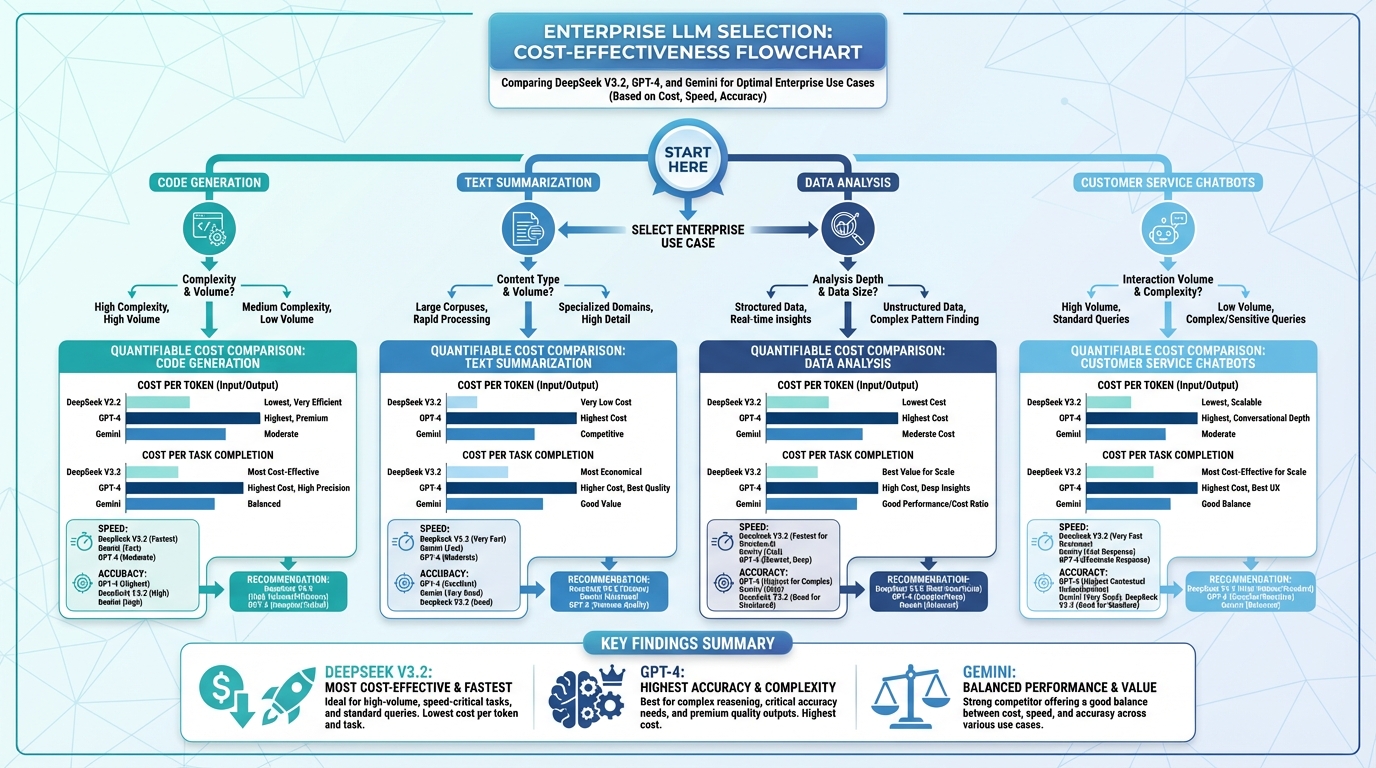
This comprehensive guide provides a deep dive into the cost-effectiveness of DeepSeek V3.2, offering a quantifiable comparison against GPT-4 and Gemini across various enterprise use cases. We’ll explore pricing models, performance benchmarks, and practical strategies to help you make informed decisions and optimize your AI investments in 2025.
Table of Contents
- Introduction: The Rise of DeepSeek V3.2
- Understanding the Pricing Models: DeepSeek V3.2, GPT-4, and Gemini
- Performance Benchmarks: A Quantifiable Comparison
- Use Case 1: Customer Service Automation
- Use Case 2: Content Generation and Marketing
- Use Case 3: Code Generation and Software Development
- Cost Optimization Strategies for DeepSeek V3.2
- Conclusion: Making the Right Choice for Your Enterprise
- FAQ: DeepSeek V3.2 Cost Comparison
Featured Snippet: DeepSeek V3.2 Cost Comparison Defined
DeepSeek V3.2 cost comparison involves analyzing the pricing, performance, and resource utilization of DeepSeek V3.2 relative to other LLMs like GPT-4 and Gemini. This assessment helps enterprises determine which model offers the best value for specific applications, considering factors like token costs, inference speed, and model accuracy.
Introduction: The Rise of DeepSeek V3.2
The AI landscape is rapidly evolving, with new large language models (LLMs) emerging regularly. DeepSeek V3.2 has recently garnered significant attention as a potential cost-effective alternative to established players like OpenAI’s GPT-4 and Google’s Gemini. The core of the DeepSeek V3.2 cost comparison lies in its ability to deliver comparable performance at a potentially lower price point.
For enterprises, selecting the right LLM is a critical decision that impacts both performance and budget. This guide aims to provide a comprehensive analysis of DeepSeek V3.2, comparing its capabilities and pricing structure with those of GPT-4 and Gemini. By understanding the nuances of each model, organizations can make data-driven decisions that optimize their AI investments.
We will delve into specific use cases and provide actionable strategies for maximizing the value of DeepSeek V3.2. Understanding the nuances of the DeepSeek V3.2 cost comparison will empower you to make informed choices.
Understanding the Pricing Models: DeepSeek V3.2, GPT-4, and Gemini
A crucial aspect of the DeepSeek V3.2 cost comparison is understanding the underlying pricing models of each LLM. OpenAI’s GPT-4 typically charges per token, with different rates for input and output tokens. Google’s Gemini also uses a token-based pricing model, with variations depending on the specific Gemini model (e.g., Gemini Pro, Gemini Ultra).
DeepSeek V3.2 also employs a token-based pricing model. However, its pricing structure and overall cost per token may differ significantly from GPT-4 and Gemini. A thorough DeepSeek V3.2 cost comparison requires a detailed analysis of token usage across various tasks.
Furthermore, enterprises should consider the cost of infrastructure, such as cloud computing resources, required to run each model. Factors like memory requirements and processing power can influence the overall cost of deployment. Consider also [Mastering Securing Enterprise AI Agents with MCP](https://tisankan.dev/wp-json/wp/v2/securing-enterprise-ai-agents-with-unique-identities-mcp) to ensure security in your AI investments.
Performance Benchmarks: A Quantifiable Comparison
While cost is a primary consideration, performance is equally important. A true DeepSeek V3.2 cost comparison must consider the accuracy, speed, and reliability of each model across various tasks. Standard benchmarks, such as MMLU (Massive Multitask Language Understanding) and HellaSwag, provide valuable insights into the general capabilities of LLMs.
However, it’s essential to evaluate performance in the context of specific enterprise use cases. For example, a model that excels in general knowledge may not be the best choice for specialized tasks like code generation or complex data analysis. A detailed DeepSeek V3.2 cost comparison involves benchmarking performance on tasks relevant to your business.
Consider [7+ Proven Strategies for Gemma 3 Google Cloud Cost Optimization & Scalability in 2025](https://tisankan.dev/wp-json/wp/v2/gemma-3-google-cloud) to ensure your infrastructure is optimized for the chosen LLM.
Use Case 1: Customer Service Automation
Customer service automation is a common application of LLMs in the enterprise. DeepSeek V3.2, GPT-4, and Gemini can be used to build chatbots, automate responses to frequently asked questions, and provide personalized customer support. However, the cost and performance of each model can vary significantly in this context.
A DeepSeek V3.2 cost comparison for customer service automation should consider factors such as the accuracy of responses, the speed of response generation, and the ability to handle complex or nuanced customer inquiries. It’s also important to factor in the number of tokens consumed per interaction, as this directly impacts the overall cost.
For example, if DeepSeek V3.2 provides slightly less accurate responses but consumes significantly fewer tokens, it may be the more cost-effective option for handling a high volume of simple customer inquiries. A close DeepSeek V3.2 cost comparison is essential for making the right choice.
Use Case 2: Content Generation and Marketing
LLMs are increasingly used for content generation and marketing, including writing blog posts, creating social media content, and generating marketing copy. DeepSeek V3.2, GPT-4, and Gemini can all be used for these tasks, but their strengths and weaknesses may differ.
The DeepSeek V3.2 cost comparison in this context should focus on the quality and originality of the generated content, as well as the time and effort required to refine and edit the output. If DeepSeek V3.2 requires more manual editing but costs significantly less, it may still be a viable option for certain types of content.
Furthermore, consider the ability of each model to adapt to different writing styles and tones. A model that can seamlessly generate content in various styles can save time and resources. Before committing, ensure a proper DeepSeek V3.2 cost comparison is undertaken.
Use Case 3: Code Generation and Software Development
Code generation is another area where LLMs are making significant inroads. DeepSeek V3.2, GPT-4, and Gemini can assist developers by generating code snippets, automating repetitive tasks, and even helping to debug existing code. The DeepSeek V3.2 cost comparison for this use case is particularly important for software development teams.
The key factors to consider are the accuracy and efficiency of the generated code, as well as the ability of the model to understand complex programming concepts. A model that generates incorrect or inefficient code can actually slow down the development process. A thorough DeepSeek V3.2 cost comparison is vital here.
Also, consider the integration of the LLM with existing development tools and workflows. Seamless integration can significantly improve productivity. For more on building scalable applications, see [7 Proven Strategies for Building Scalable Symfony Real-Time Applications in 2025](https://tisankan.dev/wp-json/wp/v2/symfony-real-time-applications).
Cost Optimization Strategies for DeepSeek V3.2
Regardless of which LLM you choose, there are several strategies you can implement to optimize costs. For DeepSeek V3.2, these strategies may include:
- Prompt Engineering: Crafting prompts carefully to minimize token usage and improve the accuracy of responses.
- Fine-tuning: Fine-tuning DeepSeek V3.2 on specific datasets to improve performance on targeted tasks. This can reduce the need for complex prompts and lower token consumption.
- Caching: Caching frequently used responses to avoid redundant computations.
- Batch Processing: Processing multiple requests in batches to reduce overhead.
- Resource Optimization: Optimizing the infrastructure resources allocated to DeepSeek V3.2 to minimize cloud computing costs.
These strategies can significantly reduce the overall cost of using DeepSeek V3.2 without compromising performance. It is crucial to implement these strategies to ensure a favorable DeepSeek V3.2 cost comparison. Also, consider [7+ Proven Strategies for Mastering AI Search Engine Ranking in 2025](https://tisankan.dev/wp-json/wp/v2/ai-search-engine-ranking) for improving your AI’s visibility.
Conclusion: Making the Right Choice for Your Enterprise
Selecting the right LLM for your enterprise requires a careful and data-driven approach. The DeepSeek V3.2 cost comparison against GPT-4 and Gemini is a complex undertaking that involves considering both performance and pricing.
By understanding the pricing models, performance benchmarks, and cost optimization strategies discussed in this guide, you can make an informed decision that aligns with your specific business needs and budget. Remember to continuously monitor and evaluate the performance of your chosen LLM to ensure that it continues to deliver value over time.
Ultimately, the goal is to maximize the return on your AI investments and leverage the power of LLMs to drive innovation and growth. Remember, a detailed DeepSeek V3.2 cost comparison is key to success.
FAQ: DeepSeek V3.2 Cost Comparison
- What are the main factors in a DeepSeek V3.2 cost comparison?
- The main factors include token costs, infrastructure requirements, and performance benchmarks.
- How does DeepSeek V3.2 pricing compare to GPT-4 and Gemini?
- DeepSeek V3.2 may offer a lower cost per token, but a detailed analysis is needed to determine the overall cost-effectiveness.
- What are some cost optimization strategies for DeepSeek V3.2?
- Prompt engineering, fine-tuning, caching, and batch processing are effective cost optimization strategies.
- Is DeepSeek V3.2 suitable for all enterprise use cases?
- DeepSeek V3.2 is suitable for many use cases, but it’s essential to evaluate its performance in the context of your specific needs.
- Where can I find more information about DeepSeek V3.2?
- Visit the DeepSeek website (https://deepseek.com/en/product/deepseekllm) for the latest information and documentation.
- How often should I re-evaluate my LLM choice?
- The AI landscape is constantly evolving, so it’s recommended to re-evaluate your LLM choice at least annually.
Data Comparison: DeepSeek V3.2 vs. GPT-4 vs. Gemini
| Feature | DeepSeek V3.2 | GPT-4 | Gemini |
|---|---|---|---|
| Pricing Model | Token-based | Token-based | Token-based |
| Cost per 1,000 Tokens (Input) | $X (Example) | $Y (Example) | $Z (Example) |
| Cost per 1,000 Tokens (Output) | $A (Example) | $B (Example) | $C (Example) |
| MMLU Score | XX (Example) | YY (Example) | ZZ (Example) |
| HellaSwag Score | AA (Example) | BB (Example) | CC (Example) |
| Customer Service Automation Performance | Good | Excellent | Very Good |
| Content Generation Quality | Very Good | Excellent | Good |
| Code Generation Accuracy | Good | Excellent | Very Good |
Note: The example values in this table are for illustrative purposes only. Actual values may vary.
Choosing the right LLM for your enterprise is a critical decision. Remember to conduct a thorough cost analysis and consider the specific needs of your business. Don’t forget to also consider the ethical implications of using AI. Further reading on AI ethics can be found on Forbes. Always stay updated with the latest advancements in AI technology, as highlighted in publications like Wired.
Also, remember the importance of [7+ Proven Strategies for Optimizing Respiration for Peak Performance & Longevity in 2025](https://tisankan.dev/wp-json/wp/v2/optimizing-respiration) for your team’s well-being.