



Academic scrutiny reveals a “slop problem” in AI research, jeopardizing the validity and reliability of purported advancements. Reproducibility failures, data biases, and ethical oversights demand immediate course correction to safeguard AI’s future.
AI Research: A Field Plagued by Unsubstantiated Claims
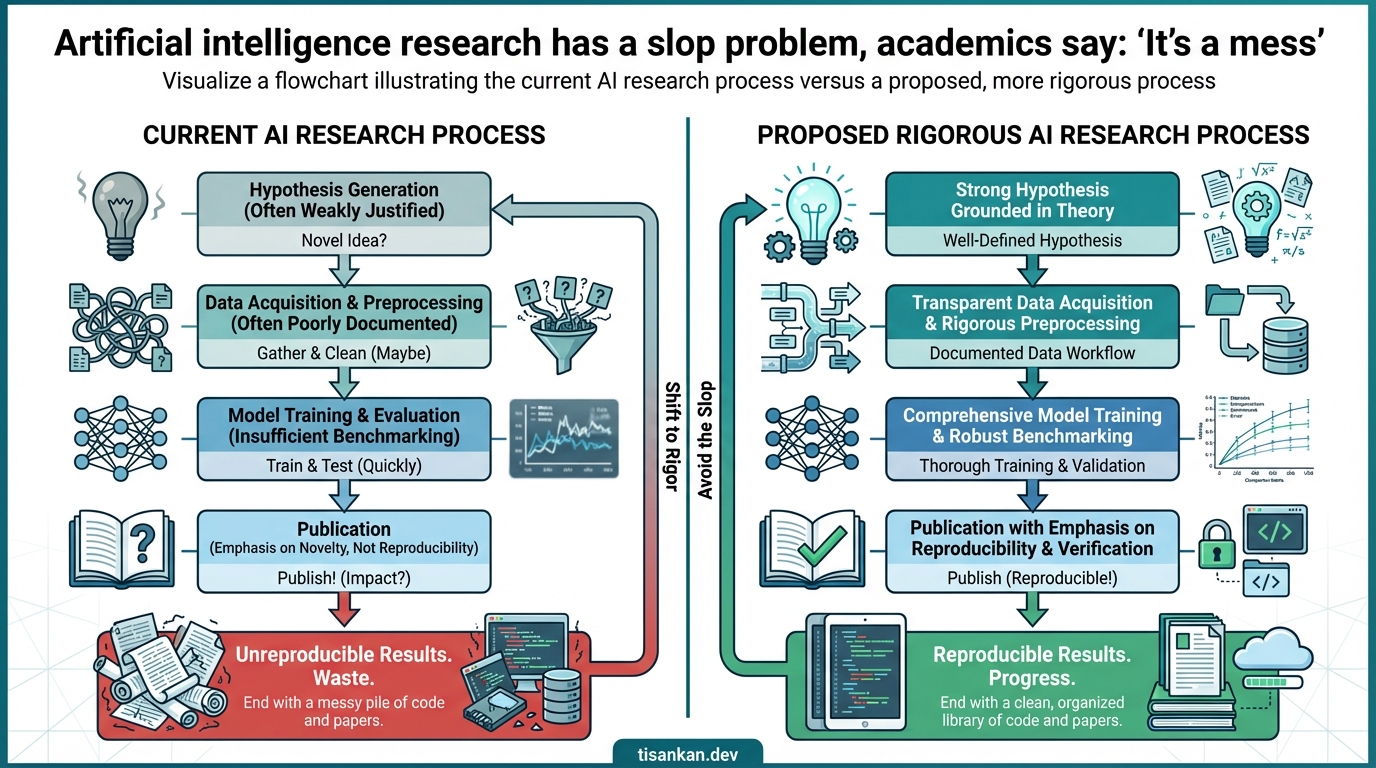
A crisis is brewing. Groundbreaking AI claims face increasing skepticism due to replication failures. This undermines the trustworthiness of AI technologies, necessitating a critical reevaluation of research practices.
The impact spans critical sectors, from medical diagnostics to autonomous vehicles, especially as AI usage among doctors doubles as confidence in the technology grows. AI’s dependability, crucial for its promise, is at risk. A critical reassessment is vital.
Reproducibility: The Achilles’ Heel
The core issue: lack of reproducibility. Identical code and datasets often fail to yield published results, indicating flawed experimental design, inadequate documentation, or manipulated data. Investment decisions require solid research, and this deficiency erodes trust.
Reasons are complex: hardware/software nuances, insufficient methodological detail. Regardless, the field rests on precarious ground. For example, a deep learning model optimized for a specific GPU architecture might exhibit drastically different performance on another, rendering published benchmarks meaningless without precise hardware specifications.
Data Bias: A Subterranean Threat
Datasets riddled with bias plague AI models, perpetuating societal inequalities. Facial recognition, for instance, disproportionately misidentifies individuals from specific demographics due to biased training data. Imagine a hiring algorithm trained primarily on male resumes; it will likely undervalue qualified female candidates, perpetuating gender imbalance in the workforce.
Curating representative, unbiased datasets is paramount. Ethical considerations must drive AI development for equitable outcomes.
Ethical Void: AI’s Moral Compass
Ethical implications are stark: autonomous weapons, AI-powered surveillance. A robust ethical framework is crucial, ensuring AI benefits humanity. Consider the ethical minefield of using AI to predict criminal behavior – the potential for discriminatory targeting is immense.
Algorithmic transparency, accountability, and fairness are paramount. Diverse stakeholders must be involved to amplify marginalized voices. Without ethics, AI becomes a tool of oppression. For example, an AI-driven loan application system that denies loans to applicants from specific zip codes, even if they are creditworthy, is inherently unethical.
Reform: A Necessary Overhaul
Addressing AI’s issues requires collaborative action from academia, industry, and policymakers. Transparency, standardized benchmarks, and ethical guidelines are essential. The alternative is a future where AI exacerbates societal inequities.
Open-source initiatives and collaborative research can foster a transparent, reproducible AI ecosystem. Sharing code, data, and methodologies validates work and exposes flaws. Funding agencies must prioritize reproducibility and ethical considerations. For example, requiring researchers to submit their code and data to a public repository as a condition of funding.
Future Implications: A Call to Action
Unresolved, AI’s “slop problem” will erode trust, hindering adoption and limiting benefits. Biased, unethical systems could worsen societal inequalities. Immediate action is imperative.
The AI community acknowledges these challenges. Bias detection tools, ethical guidelines, and open-source initiatives are positive steps. Continued effort and collaboration can unlock AI’s full potential. Imagine a future where AI is used to personalize education, providing tailored learning experiences for every student – a positive outcome dependent on ethical AI development.
Expert Perspective
Dr. Anya Sharma, AI ethicist: “The current crisis demands a focus on reliable, fair, and accountable AI.” Her sentiment reflects a need to prioritize quality over quantity and ethics over expediency. The future of AI hinges on this shift.
Frequently Asked Questions
What fuels the lack of reproducibility in AI research?
Insufficient methodological detail, hardware/software differences, and data manipulation contribute. The absence of standardized benchmarks compounds the problem. A common oversight is failing to document the exact versions of software libraries used, leading to inconsistencies across different environments.
How does data bias affect AI models, and what are the consequences?
Data bias perpetuates societal inequalities. Biased facial recognition systems misidentify individuals, impacting law enforcement and hiring. For example, if training data lacks representation from older adults, the resulting AI might struggle to accurately analyze medical images of elderly patients.
What ethical principles should guide AI research?
Algorithmic transparency, accountability, fairness, and privacy are key. AI systems must be explainable and unbiased, respecting individual privacy. A critical ethical consideration is ensuring that AI systems are not used to automate discriminatory practices.
How can we enhance transparency in AI research?
Openly sharing code, data, and methodologies is essential. Detailed documentation of experimental setups is crucial. Open-source initiatives promote a transparent AI ecosystem. One specific action is to require researchers to publish their code and data on platforms like GitHub and Zenodo, making it accessible for scrutiny and replication.
How do standardized benchmarks improve AI model reliability?
Standardized benchmarks provide a common basis for evaluating AI models fairly and consistently, revealing flaws and improving reliability. They allow for apples-to-apples comparisons, which is essential for identifying the most effective approaches. The ImageNet Large Scale Visual Recognition Challenge is a prime example of a standardized benchmark that has driven significant progress in computer vision.
What role should funding agencies play?
Funding agencies should prioritize research emphasizing reproducibility, ethics, and transparency. They should incentivize open sharing of code and data. A concrete step would be to allocate a portion of research grants specifically for reproducibility studies, encouraging researchers to validate the findings of others.
Provide specific examples of unethical AI applications.
Examples include AI-powered surveillance without consent, autonomous weapons, and biased algorithms in hiring and lending. Consider the use of AI to generate deepfakes for malicious purposes, which can have devastating consequences for individuals and society.