

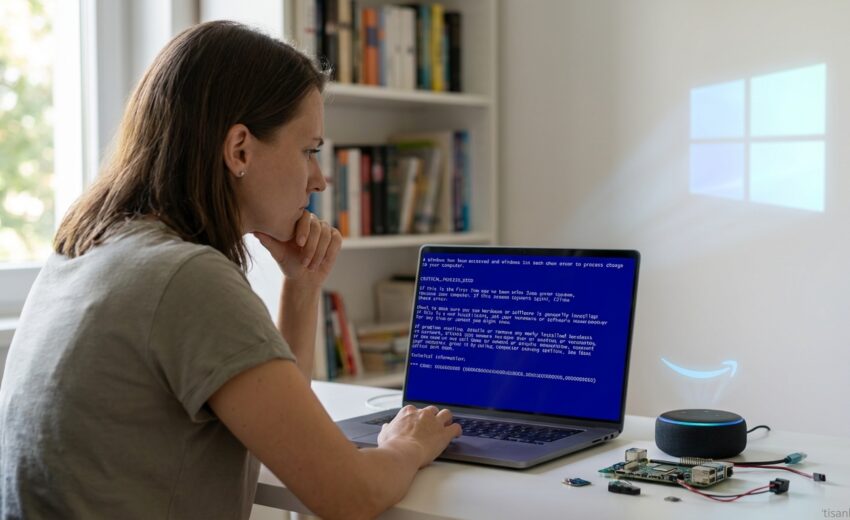
This week’s tech landscape presents a minefield for small businesses: Windows 11’s AI is spewing nonsense, Amazon is aggressively pushing AI agents, and the Nana Banana Pro gets scrutinized. Here’s the unfiltered breakdown.
Windows 11 AI Hallucinations: Microsoft’s Credibility Nosedives
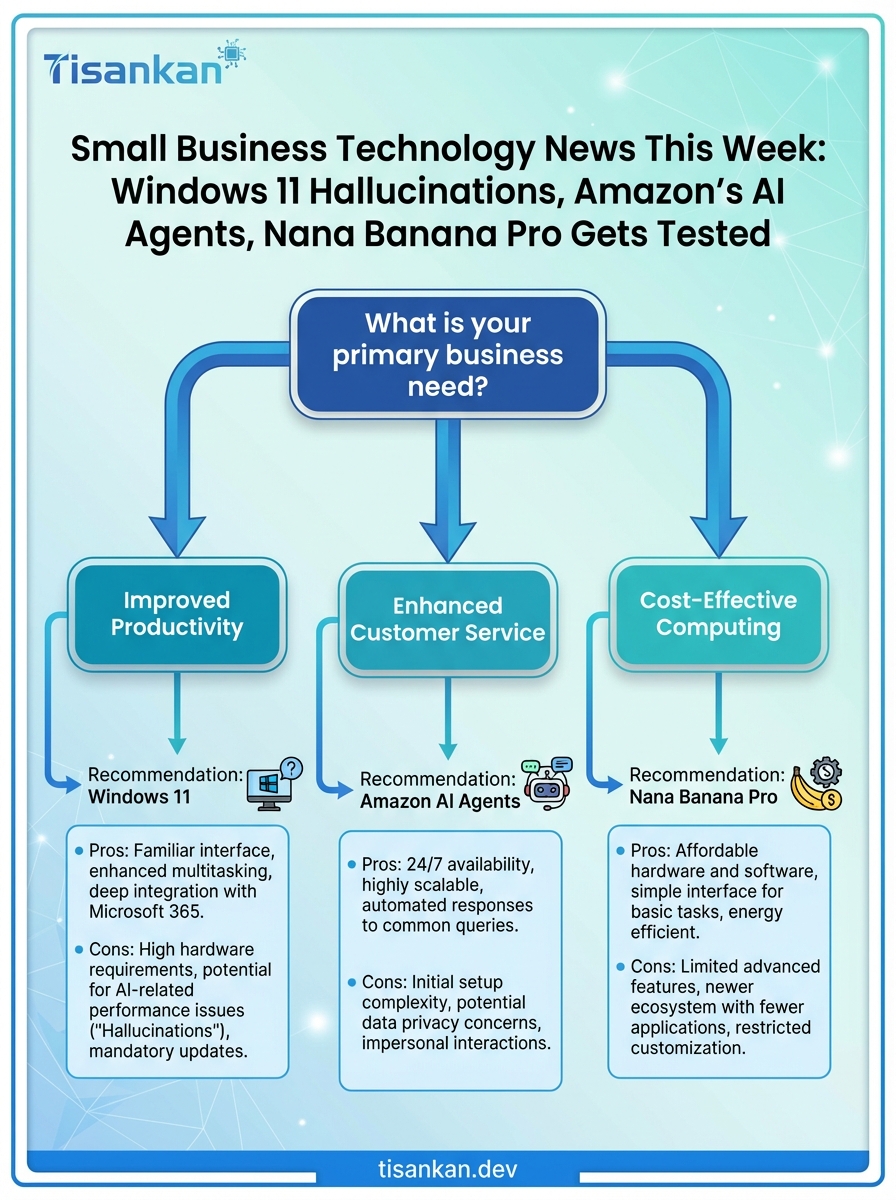
Microsoft’s AI integration in Windows 11 isn’t just buggy; it’s actively fabricating information. These “hallucinations”—inaccurate and nonsensical AI responses—erode trust, making the OS a liability for businesses relying on it for critical tasks. Can you afford to gamble your operations on an unreliable OS?
The problem stems from flawed training data. Biased or incomplete datasets produce biased and unreliable AI. For small businesses, this translates to wasted time, corrected errors, and potential for critical miscommunication. The productivity hit can be crippling.
Microsoft’s silence on this issue is deafening. They need to be transparent about the AI’s limitations, offering concrete mitigation strategies. Until then, widespread adoption is reckless. Real-world scenario: A small law firm uses Copilot to summarize legal documents, only to find key clauses completely fabricated, jeopardizing a client’s case and opening the firm to legal action.
Amazon’s AI Agent Push: A Trojan Horse for Small Businesses?
Amazon’s relentless promotion of AI agents promises efficiency and cost reduction. These agents aim to automate tasks from customer service to data analysis. But are small businesses ready for this level of integration, or is it an overreach that introduces more problems than it solves?
While efficiency gains are tempting, the challenges are steep. Integrating these agents demands specialized expertise. More critically, security vulnerabilities are amplified. Can a small business, without enterprise-level security infrastructure, truly safeguard its data when relying on third-party AI? Real-world scenario: A small e-commerce business integrates an Amazon AI agent for customer service, only to experience a data breach that exposes customer credit card information, leading to lawsuits and irreparable damage to their reputation.
Amazon must provide substantial support and resources for small businesses navigating this complex transition. A one-size-fits-all approach is a recipe for disaster. Furthermore, the ethical implications – the displacement of human workers – cannot be ignored.
Nana Banana Pro: Budget Computing That Cuts Too Many Corners?
The Nana Banana Pro promises affordable computing. We tested it to see if it delivers or if it’s just cheap hardware masquerading as a viable solution. The allure of low-cost computing is strong, especially for startups.
Initial tests reveal surprising capabilities for the price. It handles basic office tasks and some light development. However, demanding applications expose its limitations. Performance degrades rapidly under pressure. Real-world scenario: A small graphic design firm tries to use the Nana Banana Pro for image editing, only to find the software crashes repeatedly, rendering it useless for their core business function.
The Nana Banana Pro is a niche tool, not a workstation replacement. Evaluate your specific needs ruthlessly before investing. If you need power, look elsewhere.
The Developer’s Burden: Navigating the AI Minefield
These developments directly impact developers. They must understand AI model limitations and design applications accordingly. The rise of AI agents creates opportunities for innovative solutions, but also demands a heightened focus on security and data privacy.
The Nana Banana Pro offers a low-cost platform for experimentation, particularly for open-source projects. However, developers bear the responsibility of ensuring ethical AI usage and broad benefit sharing.
The Immediate Challenges
The coming months will be critical. Microsoft must fix the Windows 11 AI fiasco. Amazon needs to prove the value and security of its AI agents. The Nana Banana Pro must demonstrate long-term reliability. Small businesses must stay informed and make strategic technology adoption decisions.
Proceed with caution, skepticism, and a clear understanding of the risks involved.
Frequently Asked Questions
What are the specific examples of “hallucinations” in Windows 11 AI?
Copilot provides incorrect document summaries, fabricates search results, and misinterprets voice commands. The root cause: flawed AI model training data and limited contextual understanding. Example: Copilot invents non-existent clauses in a contract summary.
How can small businesses mitigate the risks of AI inaccuracies in Windows 11?
Implement multi-layered verification. Double-check AI-generated content against trusted sources. Train employees on AI limitations and critical thinking. Consider alternative tools for critical tasks. Crucially: Never rely solely on AI for legal or financial decisions.
What are the security concerns associated with Amazon’s AI agents?
Data breaches are a major risk due to AI agent access to sensitive data. Phishing attacks targeting AI agents are also a concern. Mitigation: Implement robust security measures, including encryption, access controls, and regular security audits. Demand SOC 2 Type II compliance from Amazon.
What level of technical expertise is required to integrate Amazon’s AI agents?
Integration demands a solid understanding of APIs, data structures, and security protocols. Reality: Most small businesses will need to hire specialized IT staff or partner with a managed service provider. Factor this cost into your ROI calculations.
What are the key specifications of the Nana Banana Pro?
Typically: quad-core ARM processor, 2-4GB of RAM, 16-64GB onboard storage, Wi-Fi, Bluetooth, HDMI, and USB. Caveat: Performance varies significantly between models. Check independent benchmarks before purchasing.
What operating systems are compatible with the Nana Banana Pro?
Typically supports various Linux distributions (Debian, Ubuntu, Fedora) and potentially Android. Warning: Driver support can be spotty. Research compatibility with your required software before committing.
Is the Nana Banana Pro suitable for running a small business web server?
Yes, for *extremely* low-traffic websites only. Its limited resources mean it won’t handle any significant load. Recommendation: Use a content delivery network (CDN) and aggressively optimize your website. Prioritize security. A Raspberry Pi 4 is often a better choice.