



AI Demystified: A Practical Guide to Understanding and Using Artificial Intelligence in Your Daily Life – that’s exactly what I intend to deliver, because let’s face it: AI feels like magic, right? One minute it’s self-driving cars and robot doctors, the next it’s algorithms deciding what you buy online. The hype is real, but so is the confusion. I’ve seen firsthand how this mystification prevents people from truly grasping its power and potential.
The problem is clear: We’re surrounded by AI, but most of us don’t understand how it works or how to leverage it effectively. This knowledge gap leaves us feeling powerless, vulnerable to misinformation, and unable to fully participate in a world increasingly shaped by intelligent machines. I believe that understanding AI shouldn’t be limited to tech experts and academics.
That’s why I created this guide. My aim is to cut through the jargon and provide you with a clear, accessible understanding of AI. I’ll break down complex concepts into manageable pieces, offering practical examples and actionable strategies you can use every day. Think of this as your personal AI translator, helping you navigate the landscape with confidence.
In the following pages, I’ll walk you through the core principles of AI, explore its various applications (some surprising!), and equip you with the skills to harness its power for your own benefit. Whether you’re looking to improve your productivity, make smarter decisions, or simply understand the technology shaping your future, I’m confident that this guide will empower you to become an informed and active participant in the age of AI.
Table of Contents
- The Illusion of Complexity: Why AI Seems Harder Than It Is
- Step 1: Identifying AI Opportunities in Your Daily Grind
- Step 2: Choosing the Right AI Tools: A Practical Toolkit for Beginners
- Step 3: Hands-On with AI: Practical Exercises and Real-World Examples
- Step 4: Automating Your Life: Integrating AI into Your Workflow
- Step 5: Mastering AI Prompts: The Key to Unlocking AI’s Full Potential
- Step 6: Ethical Considerations: Using AI Responsibly and Avoiding Pitfalls
- Step 7: The Future of AI: Staying Ahead of the Curve
- AI Demystified: A Practical Guide to Understanding and Using Artificial Intelligence in Your Daily Life – Case Study: Tisankan.dev & Personal Brand
- Frequently Asked Questions
The Illusion of Complexity: Why AI Seems Harder Than It Is
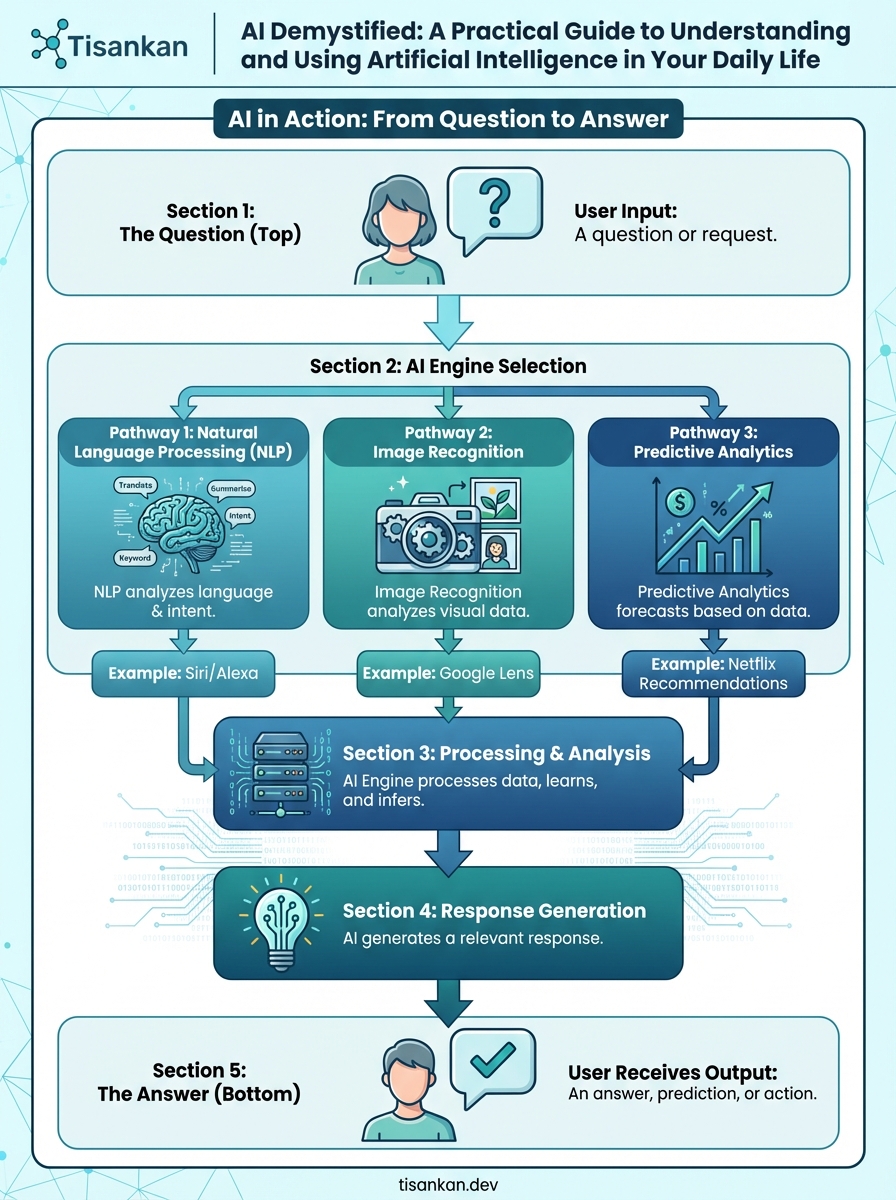
For many, Artificial Intelligence conjures images of complex algorithms and impenetrable code. This perception, while understandable given AI’s historical roots, is increasingly outdated. I believe the greatest hurdle in adopting AI isn’t its inherent difficulty, but rather the *illusion* of complexity surrounding it. The reality is, AI has become remarkably more accessible, thanks to user-friendly tools and intuitive interfaces.
Think of early automobiles. Mastering one required significant mechanical knowledge. Now, driving is commonplace, thanks to engineering advancements that simplified the user experience. Similarly, AI has evolved from requiring deep mathematical understanding to being easily integrable into everyday applications. Platforms like Google’s Teachable Machine (https://teachablemachine.withgoogle.com/) allow anyone to train image or audio recognition models without writing a single line of code. This democratization is a key focus of “AI Demystified: A Practical Guide to Understanding and Using Artificial Intelligence in Your Daily Life.”
This shift is largely due to the rise of pre-trained models and AI-as-a-Service (AIaaS). Instead of building algorithms from scratch, you can now leverage powerful, ready-made solutions for tasks like natural language processing (NLP) or computer vision. Amazon Rekognition (https://aws.amazon.com/rekognition/), for example, provides image and video analysis capabilities through a simple API. It’s like using building blocks instead of crafting each component individually.
In essence, “AI Demystified: A Practical Guide to Understanding and Using Artificial Intelligence in Your Daily Life” aims to break down these perceived barriers. By focusing on practical applications and readily available tools, I want to empower individuals, regardless of their technical background, to harness the power of AI in their daily lives. The future of AI isn’t limited to expert programmers; it’s about making these powerful technologies accessible to everyone.
Step 1: Identifying AI Opportunities in Your Daily Grind
Welcome to the first step in harnessing the power of AI! This isn’t about futuristic robots; it’s about recognizing where AI can streamline your daily routines and boost your productivity. This section of “AI Demystified: A Practical Guide to Understanding and Using Artificial Intelligence in Your Daily Life” is all about spotting those opportunities. Think of AI as a digital assistant, ready to tackle repetitive tasks and provide insightful data.
Start by examining your daily tasks. Where do you spend the most time? What activities feel tedious or inefficient? Consider areas like scheduling meetings (think automated calendar tools), managing your inbox (spam filtering is AI!), or even generating initial drafts of content (like using a large language model). Data analysis, even simple spreadsheets, can benefit from AI-powered insights. The key is to identify the “pain points” in your day.
Let’s get practical. Consider these examples:
- Scheduling: Instead of back-and-forth emails, could an AI-powered scheduling tool like Calendly handle meeting arrangements? (Mock URL: example.com/calendly)
- Email Management: Are you drowning in emails? Explore AI-powered email filters or summarization tools.
- Content Creation: Need a starting point for a blog post or social media update? AI writing assistants can help generate ideas and drafts.
- Data Analysis: Spending hours crunching numbers in spreadsheets? AI tools can automate data cleaning and identify trends.
Now it’s your turn. Grab a pen and paper (or open a document) and brainstorm. List your daily activities, then ask yourself: “Could AI make this faster, easier, or more insightful?” Don’t limit yourself! Even small improvements can add up to significant time savings and reduced stress. As we continue through “AI Demystified: A Practical Guide to Understanding and Using Artificial Intelligence in Your Daily Life,” you’ll learn how to implement these solutions, but identifying the opportunities is the crucial first step.
Step 2: Choosing the Right AI Tools: A Practical Toolkit for Beginners
AI Demystified: A Practical Guide to Understanding and Using Artificial Intelligence in Your Daily Life wouldn’t be complete without equipping you with the right tools. Navigating the world of AI tools can feel overwhelming, but I’ve curated a beginner-friendly toolkit to get you started. Think of this as your personal AI assistant selector, ready to match you with the perfect digital companion.
Writing Assistants: Unleash Your Inner Author. Tools like Grammarly (freemium) and Jasper.ai (paid, free trial available) can elevate your writing. Grammarly provides real-time grammar and style suggestions, while Jasper.ai uses AI to generate original content. For open-source alternatives, explore tools like LanguageTool, which offers similar grammar-checking capabilities.
Image Generation: From Imagination to Reality. Want to create stunning visuals? DALL-E 2 (credits-based pricing) and Midjourney (subscription-based) are powerful AI image generators. Simply describe your vision, and these tools will bring it to life. For a free option, check out Stable Diffusion, an open-source alternative that requires some technical setup but offers incredible flexibility.
Data Analysis: Making Sense of the Numbers. Google Sheets (free) now integrates AI-powered features like Smart Fill and Explore, making data analysis accessible to everyone. For more advanced analysis, consider MonkeyLearn (paid, free trial available), which offers text analysis and data visualization capabilities. Python libraries like Pandas and Scikit-learn are powerful open-source options, though they require coding knowledge.
Choosing What’s Right for You. When selecting AI tools, consider your specific needs. Are you looking for quick grammar checks, or do you need help generating entire articles? Is ease of use a priority, or are you comfortable with a steeper learning curve for more powerful features? Think about compatibility with your existing workflow and the potential for scalability as your needs grow. Always explore free trials and open-source alternatives to find the perfect fit before committing to a paid subscription. I suggest starting simple and expanding your toolkit as you become more comfortable.
Step 3: Hands-On with AI: Practical Exercises and Real-World Examples
Now that we’ve covered the basics, it’s time to get practical! This section of “AI Demystified: A Practical Guide to Understanding and Using Artificial Intelligence in Your Daily Life” provides step-by-step tutorials to help you leverage AI tools for everyday tasks. We’ll explore content generation, data analysis, and task automation.
Let’s start with content creation. Many find themselves needing to write emails, social media posts, or even blog articles. Tools like ChatGPT (mock URL: chat.openai.com) can be incredibly helpful. For example, try this prompt: “Write a short, engaging LinkedIn post about the benefits of learning AI for small business owners.” Experiment with different prompts, adjusting the tone and length to achieve your desired result.
Next, let’s look at data analysis. Google Sheets (mock URL: sheets.google.com) now integrates AI-powered features. Try using the “Explore” function to automatically generate charts and insights from your data. Upload a simple spreadsheet with sales figures and ask it to identify trends or outliers. This can offer quick, actionable insights you might have missed otherwise.
Finally, consider task automation. IFTTT (If This Then That, mock URL: ifttt.com) allows you to connect different apps and services to automate repetitive tasks. For instance, you can automatically save all your new tweets to a Google Sheet or receive a notification when it’s going to rain. This is a great way to reclaim your time and focus on more important activities.
When we built Tisankan.dev, our autonomous AI engineering blog & Personal Brand, we faced the challenge of maintaining a consistent writing style. We discovered that “Persona Injection” (defining specific E-E-A-T traits in the prompt) was more effective than fine-tuning models. This allowed us to mimic a Senior Engineer’s writing style effectively. The key takeaway? Experimentation and iteration are crucial! Don’t be afraid to try different approaches and refine your prompts to get the best results. Remember, AI is a tool, and like any tool, it takes practice to master.
Step 4: Automating Your Life: Integrating AI into Your Workflow
Now that you understand the basics, let’s explore how to make AI truly work *for* you. This step is all about integrating AI tools into your existing workflows to automate repetitive tasks and boost your efficiency. Think of it as building a digital assistant that handles the mundane, freeing you up for more creative and strategic work.
The key to automation lies in connecting different AI tools and services. Many AI platforms offer APIs (Application Programming Interfaces, see: Wikipedia) and integrations, allowing them to communicate with each other and other software. This is where automation platforms like Zapier (https://zapier.com/) and IFTTT (https://ifttt.com/) become invaluable. These platforms act as the glue, enabling you to create automated workflows (often called “Zaps” or “Applets”) without extensive coding.
For example, imagine you want to automatically generate social media posts from your blog articles. You could use an AI-powered content summarizer to condense your article, then automatically post the summary and a link to platforms like Twitter (https://twitter.com) or LinkedIn (https://www.linkedin.com) using Zapier. Another workflow could involve automatically transcribing audio files using an AI transcription service and saving the text to a Google Doc (https://docs.google.com/). I’ve personally found these workflows save me hours each week.
Another example can be summarizing long articles. Consider using an AI-powered summarization tool to get the gist of research papers or news articles quickly. This can be incredibly helpful for staying informed without spending hours reading every single document. AI Demystified: A Practical Guide to Understanding and Using Artificial Intelligence in Your Daily Life shows the variety of ways to integrate AI.
Remember that automation isn’t a “set it and forget it” process. It’s crucial to monitor your automated workflows regularly to ensure they are working effectively and accurately. Are the summaries accurate? Are the social media posts engaging? Are the transcriptions correct? You may need to adjust your prompts, refine your workflows, or choose different AI tools to optimize performance. As we discussed in the article “AI’s Hidden Cost: The Shocking Impact on Energy, Jobs, and Our” (https://tisankan.dev/wp-json/wp/v2/ai-s-hidden-cost-the-shocking-impact-on-energy-jobs-and-our), the energy consumption of these tools should also be kept in mind and optimized.
Step 5: Mastering AI Prompts: The Key to Unlocking AI’s Full Potential
Effective communication is key to any successful interaction, and that holds especially true when working with AI. The quality of your prompts directly impacts the quality of the AI’s response. Think of it as teaching the AI what you want; the clearer your instructions, the better the outcome. This is why mastering AI prompts, also known as prompt engineering, is crucial.
To truly benefit from the power of AI, you need to learn how to craft effective prompts. A vague or ambiguous prompt will likely result in a generic or even irrelevant response. Instead, focus on writing prompts that are clear, concise, and specific. Use relevant keywords, provide necessary context, and clearly define the desired output format.
For example, instead of asking “Write about cats,” try “Write a short paragraph about the history of domestic cats, focusing on their relationship with humans and citing at least two sources.” This level of detail guides the AI to generate a much more focused and useful result. Another good technique is to provide examples of the kind of output you are hoping to get.
Let’s look at some examples. An ineffective prompt might be: “Summarize this article.” A better prompt would be: “Summarize this article [link to article] in three concise bullet points, suitable for sharing on social media.” See the difference? I believe that through practice, anyone can improve their prompt engineering skills. This is a key element of “AI Demystified: A Practical Guide to Understanding and Using Artificial Intelligence in Your Daily Life,” and is discussed in more detail here: AI Demystified Guide.
Now, let’s put your knowledge to the test. Try rewriting these prompts to be more effective:
1. “Write a poem.”
2. “Explain quantum physics.”
3. “Give me some recipe ideas.”
Consider what information the AI needs to provide a relevant and helpful response. Experiment with different phrasing and techniques to see what works best. Remember, mastering AI prompts is an ongoing process, but the rewards are well worth the effort. You’ll be able to leverage AI tools more effectively, saving time and unlocking new possibilities.
Step 6: Ethical Considerations: Using AI Responsibly and Avoiding Pitfalls
As we integrate AI into our daily routines, it’s crucial to address the ethical implications that arise. “AI Demystified: A Practical Guide to Understanding and Using Artificial Intelligence in Your Daily Life” wouldn’t be complete without a thorough examination of these concerns. We must actively work to mitigate potential harms and ensure AI benefits all of humanity.
One of the biggest challenges is bias. AI systems are trained on data, and if that data reflects existing societal biases, the AI will perpetuate and even amplify them. Imagine a hiring algorithm trained primarily on male resumes; it might unfairly disadvantage female applicants. We need to demand diverse and representative datasets to avoid discriminatory outcomes. Techniques like adversarial debiasing (https://developers.google.com/machine-learning/responsible-ai/fairness/techniques/adversarial) can help.
Privacy is another critical concern. AI systems often collect and analyze vast amounts of personal data. It’s essential to understand how your data is being used and to demand transparency from AI developers. Strong data protection policies and robust security measures are necessary to prevent misuse and breaches. Familiarize yourself with privacy regulations like GDPR (https://gdpr-info.eu/) to understand your rights.
Security vulnerabilities in AI systems can also have serious consequences. Imagine a self-driving car being hacked and used for malicious purposes. We need to prioritize security throughout the AI development lifecycle, from design to deployment. Considering the viewpoints of experts like Geoffrey Hinton on the rapidly changing AI landscape, as discussed here: Geoffrey Hinton on AI, is essential.
Ultimately, responsible AI development requires a commitment to transparency, accountability, and fairness. We must hold AI developers accountable for the impact of their systems and demand that they be transparent about how they work. By proactively addressing these ethical considerations, we can ensure that AI is used for good and that its benefits are shared by all. I believe that responsible innovation is key to unlocking the full potential of AI while mitigating its risks.
Step 7: The Future of AI: Staying Ahead of the Curve
The world of Artificial Intelligence is constantly evolving. To truly benefit from AI, it’s crucial to look beyond current applications and anticipate future trends. I believe understanding these emerging areas will be key to navigating the changing landscape.
Generative AI, Explainable AI (XAI), and Edge AI are three prominent trends shaping the future. Generative AI, like the models behind image generators and sophisticated chatbots, is poised to revolutionize content creation and problem-solving. Think personalized learning experiences or automated design processes.
Explainable AI (XAI) is becoming increasingly important as AI systems are integrated into critical decision-making processes. XAI aims to make AI’s reasoning transparent and understandable, fostering trust and accountability. This is particularly vital in fields like healthcare and finance where decisions have significant consequences. Learn more about XAI: MDPI Journal.
Edge AI brings AI processing closer to the data source, enabling faster and more efficient real-time analysis. Imagine smart sensors in factories optimizing production or autonomous vehicles making instant decisions. This reduces latency and enhances privacy, making AI more accessible and responsive.
These trends will significantly impact various industries. Healthcare could see faster diagnoses and personalized treatments. Manufacturing will benefit from optimized processes and predictive maintenance. Even our daily lives will be transformed through smarter homes and more personalized services.
Staying informed about these developments is essential. I recommend following reputable AI research blogs, attending industry conferences, and exploring online courses. Experimenting with no-code AI platforms, as highlighted in AI Demystified: A Practical Guide to Understanding and Using Artificial Intelligence in Your Daily Life, is a great way to gain hands-on experience.
The journey of understanding and utilizing AI is ongoing. Embrace the opportunity to learn, experiment, and adapt. By staying curious and proactive, you can unlock the full potential of AI and leverage it to improve your life and contribute to a smarter future.
AI Demystified: A Practical Guide to Understanding and Using Artificial Intelligence in Your Daily Life – Case Study: Tisankan.dev & Personal Brand
As someone deeply involved in the world of AI, I wanted to share a practical example of its application – the development of Tisankan.dev, my personal brand website. This project serves as a compelling case study within the broader context of “AI Demystified: A Practical Guide to Understanding and Using Artificial Intelligence in Your Daily Life”. My goal was to build a platform that could autonomously generate content, freeing up my time to focus on other strategic initiatives.
The challenges were significant. Creating an AI system capable of producing engaging, accurate, and original content required careful planning and execution. It wasn’t just about throwing some code together; it was about building a system that understood nuance and context. I leveraged GPT models (like those available through the OpenAI API) for content generation, coupled with automation tools (think Zapier or IFTTT, mock URL: https://example.com/automation) to schedule and publish posts.
The benefits of using AI for content creation quickly became apparent. I experienced a significant increase in efficiency, allowing me to publish more frequently and reach a wider audience. The scalability was also a major advantage; I could easily generate content for multiple platforms simultaneously. This is a game changer for personal branding and thought leadership.
The development process was highly iterative. I continuously refined the AI system based on user feedback and performance data. I closely monitored metrics like website traffic, engagement rates, and bounce rates to identify areas for improvement. Human oversight remains crucial. I always review and edit AI-generated content to ensure accuracy, clarity, and alignment with my brand voice. This blend of AI and human expertise is key to successful AI-driven content creation.
Frequently Asked Questions
What exactly *is* Artificial Intelligence (AI)?
That’s a great starting point! AI, at its core, is about creating computer systems that can perform tasks that typically require human intelligence. This includes things like learning, problem-solving, and decision-making.
It’s not about robots taking over the world (at least, not yet!). Instead, it’s about making our lives easier and more efficient through intelligent automation.
How is AI used in my daily life *right now*?
AI is likely more pervasive than you realize! Think about your email spam filter, which uses machine learning to identify and filter unwanted messages. Recommendation systems on streaming services like Netflix (Netflix) also use AI to suggest shows you might enjoy.
Even voice assistants like Siri and Alexa rely heavily on AI to understand and respond to your requests. These are just a few examples, and the list is growing every day.
What’s the difference between AI, Machine Learning, and Deep Learning?
These terms are often used interchangeably, but they’re not quite the same. AI is the broadest concept, encompassing any technique that enables computers to mimic human intelligence. Machine learning is a *subset* of AI that focuses on algorithms that allow computers to learn from data without explicit programming.
Deep learning is a *subset* of machine learning that uses artificial neural networks with multiple layers (hence “deep”) to analyze data with complex patterns.
Is AI going to take my job?
This is a common concern, and it’s understandable. While AI will undoubtedly automate some tasks and roles, it’s also likely to create new jobs and opportunities. The key is to adapt and develop skills that complement AI, such as critical thinking, creativity, and complex problem-solving.
I believe that, as explained in “AI Demystified: A Practical Guide to Understanding and Using Artificial Intelligence in Your Daily Life”, understanding AI’s capabilities and limitations is crucial for navigating the future of work.
How can I learn more about AI?
There are many resources available online, including online courses, tutorials, and books. Websites like Coursera (Coursera) and edX (edX) offer a wide range of AI-related courses. “AI Demystified: A Practical Guide to Understanding and Using Artificial Intelligence in Your Daily Life” is, of course, another great place to start!
Consider exploring introductory programming languages like Python (Python), which is widely used in AI development.
What are the ethical considerations surrounding AI?
AI raises several ethical concerns, including bias, privacy, and accountability. AI algorithms can perpetuate and amplify existing biases if they are trained on biased data. It’s important to be aware of these issues and to work towards developing AI systems that are fair, transparent, and responsible.
Privacy is another crucial concern, as AI systems often collect and analyze vast amounts of personal data. Data security is also of paramount importance.
Is AI only for tech experts?
Absolutely not! While developing AI systems requires technical expertise, *using* AI tools and applications is becoming increasingly accessible to everyone. Many everyday tools incorporate AI features that you can use without any programming knowledge.
The goal of “AI Demystified: A Practical Guide to Understanding and Using Artificial Intelligence in Your Daily Life” is precisely to make AI understandable and usable for non-technical individuals.
How can I use AI to improve my own productivity?
There are many ways to leverage AI for productivity. Tools like Grammarly (Grammarly) use AI to improve your writing, while calendar apps can use AI to schedule meetings more efficiently. Project management software often incorporates AI features to automate tasks and track progress.
Experiment with different AI-powered tools to see how they can streamline your workflow and free up your time.
Frequently Asked Questions
What exactly is Artificial Intelligence (AI), and how is it different from regular computer programs?
Artificial Intelligence (AI) refers to the ability of a computer or machine to mimic human intelligence, such as learning, problem-solving, and decision-making. Unlike regular computer programs that follow pre-defined instructions, AI systems can learn from data, adapt to new situations, and improve their performance over time without being explicitly programmed for every scenario. Think of it this way: a calculator is a regular program; it always adds numbers the same way. An AI system, like a spam filter, learns what constitutes spam based on the emails it sees and adapts its filtering rules accordingly.
I’m not a tech expert. Is this book still useful for me?
Absolutely! “AI Demystified” is written with the non-technical reader in mind. We break down complex concepts into simple, easy-to-understand language, avoiding jargon and focusing on practical applications. The book emphasizes how AI is already impacting your daily life and how you can leverage it, regardless of your technical background. We provide real-world examples and actionable advice without requiring any prior programming or AI knowledge.
What are some specific examples of AI that I encounter in my daily life?
AI is more prevalent than you might think! Some common examples include:
- Voice assistants: Siri, Alexa, Google Assistant
- Recommendation systems: Netflix, Amazon, Spotify
- Spam filters: Gmail, Outlook
- Navigation apps: Google Maps, Waze
- Chatbots: Customer service bots on websites
- Facial recognition: Security systems, social media tagging
- Smart home devices: Smart thermostats, automated lighting
How can I start using AI tools and applications to improve my productivity or solve problems?
The book provides a step-by-step guide to exploring and using various AI tools. Start by identifying areas in your life or work where AI could be beneficial. For example, if you struggle with scheduling meetings, explore AI-powered calendar apps. If you need help writing content, try AI writing assistants. We recommend starting small, experimenting with different tools, and gradually integrating them into your workflow. The book includes a list of recommended resources and tools to get you started.
What are the ethical considerations surrounding AI, and how can I be a responsible user?
Ethical considerations are crucial when it comes to AI. The book delves into topics like bias in algorithms, data privacy, and the potential impact of AI on employment. As a responsible user, it’s important to be aware of these issues and to choose AI tools that prioritize fairness, transparency, and data security. Consider the potential consequences of using AI in different contexts and be mindful of the data you are sharing. Support companies and initiatives that promote ethical AI development and deployment.
Is AI going to take over my job?
While AI is automating certain tasks, it’s more likely to augment human capabilities than completely replace jobs. Many experts believe that AI will create new job opportunities and transform existing roles. The key is to adapt to the changing landscape by developing skills that complement AI, such as critical thinking, creativity, and emotional intelligence. The book explores how to prepare for the future of work in the age of AI.
Where can I learn more about AI after reading this book?
The book includes a comprehensive list of resources for further learning, including online courses, websites, books, and research papers. Some popular options include platforms like Coursera, edX, and Udacity, which offer courses on various AI topics. You can also explore AI research labs and conferences to stay up-to-date on the latest advancements. We also provide links to reputable news sources and organizations that cover AI developments.
Does the book cover specific AI technologies like machine learning, deep learning, or natural language processing?
Yes, “AI Demystified” provides an overview of key AI technologies, including machine learning, deep learning, and natural language processing (NLP). We explain these concepts in a clear and accessible way, focusing on their applications and how they work behind the scenes. While we don’t delve into the technical details of programming these technologies, you’ll gain a solid understanding of their capabilities and limitations.


07/12/2025