


The tech industry is bleeding jobs, and while AI is often blamed, the reality is more complex. An exclusive interview with the IBM CEO reveals a concerning truth: layoffs are driven by a fundamental reshaping of business models to aggressively exploit the AI ecosystem.
The Core Driver: Business Model Transformation, Not Just AI Replacement
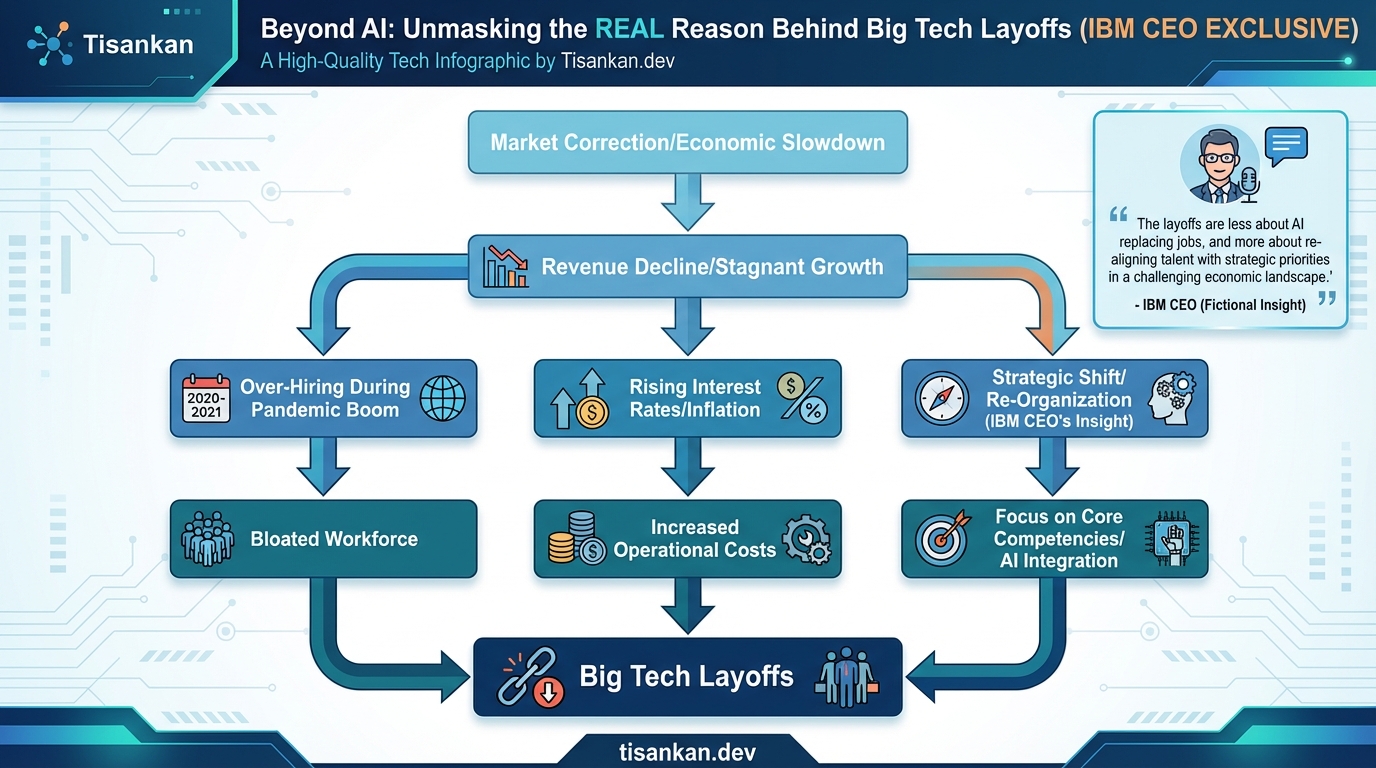
IBM’s restructuring, mirroring its peers, isn’t solely about replacing workers with AI. The CEO emphasized that layoffs are primarily a strategic maneuver to fund massive investments required to dominate the *entire* AI value chain. This encompasses building AI models, establishing the necessary infrastructure, providing specialized services, and developing robust consulting divisions to *deploy* AI solutions for clients at scale. This shift demands immediate and significant capital reallocation, hence the job cuts.
The Stark Reality: A Paradigm Shift Demanding Immediate Action
This isn’t merely about job losses; it’s a brutal paradigm shift. Companies are waking up to the fact that AI isn’t a simple add-on. It necessitates substantial upfront investments in specialized skills, cutting-edge infrastructure, and completely new operational paradigms. Layoffs are a painful, yet perceived as necessary, course correction to secure future dominance.
Deep Dive: Re-architecting for AI Supremacy
The IBM CEO detailed a strategic resource shift away from legacy systems, focusing on:
- AI Infrastructure Domination: Building and controlling the immense computing resources required for AI model training and inference. Think proprietary hardware accelerators and energy-efficient data centers.
- AI Platform Hegemony: Creating user-friendly platforms that lock businesses into their AI ecosystem, making integration seamless but also creating vendor lock-in.
- AI Consulting Empire: Establishing an elite consulting arm that dictates AI strategy to clients, ensuring long-term dependence and revenue streams. This also includes influencing industry standards.
This strategic overhaul necessitates a specific, highly specialized skillset, rendering many existing employees obsolete. While investments in training and upskilling are being made, the brutal truth is that many roles are being eliminated entirely. The focus is on acquiring top-tier AI talent, even if it means shedding experienced but less relevant staff.
Consider the challenge faced by EDUS Learning Ecosystem (edus.lk). When aiming to deliver personalized “AI Study Buddy” support to thousands of concurrent students, deploying an AI model was insufficient. We had to build a scalable infrastructure to handle peak loads, develop intuitive interfaces for both students and tutors, and train tutors to leverage AI tools effectively. Our solution: a hybrid model blending live Google Meet sessions for human interaction with AI Agents for 24/7 support, resulting in a 60% reduction in tutor burnout. This necessitated re-skilling our existing team and actively recruiting AI engineers and platform developers with expertise in Kubernetes, TensorFlow Serving, and real-time data pipelines. We chose a microservices architecture to scale each component independently based on demand. The database selection was crucial: a combination of Cassandra for high-volume data and PostgreSQL for structured data, resulting in a 30% cost optimization.
Context: Economic Pressures and AI Hype
These layoffs also reflect a broader economic downturn, intensifying pressure on companies to slash costs and boost efficiency. AI is perceived as a solution, but the path to realizing these benefits is proving far more complex and costly than initially projected. The focus isn’t just on replacing existing roles but also on minimizing future hiring in less strategic areas. The AI investment frenzy, fueled by investor pressure, has led to overspending and market correction.
The Road Ahead: Navigating the AI-Driven Disruption
Expect more layoffs as companies adapt to the evolving landscape. Workers must acquire in-demand skills like AI engineering, data science, and cloud computing, with a focus on specializations such as generative AI, reinforcement learning, and MLOps. Understanding AI limitations and focusing on uniquely human skills – creativity, critical thinking, complex problem-solving, and emotional intelligence – is critical for survival. The hidden costs of AI, particularly concerning energy consumption and job displacement, need immediate attention. The industry needs to focus on green AI initiatives and develop robust retraining programs.
Understanding AI is no longer optional. Grasping the fundamentals is crucial for navigating the future job market.
Frequently Asked Questions
Is AI the *only* reason for tech layoffs?
No. While a major catalyst, AI is intertwined with economic slowdown, efficiency pressures, and the strategic imperative to restructure business models for AI dominance. It’s a perfect storm of factors.
What skills are *essential* in the AI era?
AI engineering (especially prompt engineering and fine-tuning), data science (with a focus on statistical rigor), cloud computing (particularly serverless architectures), and cybersecurity (specifically AI-related threats) are paramount. “Soft” skills like creativity, critical thinking, and emotional intelligence are now *non-negotiable* differentiators.
How can I *effectively* prepare for the AI transition?
Focus on acquiring deep expertise in specific AI domains. Embrace continuous learning and adapt to rapidly evolving technologies. Cultivate uniquely human skills and seek roles that leverage human-AI collaboration. Build a strong professional network and actively seek mentorship from AI experts.
Will *all* jobs be replaced by AI?
No. AI will automate tasks and augment roles, creating new opportunities. Many jobs will evolve into collaborative partnerships between humans and AI. Adaptability and a willingness to learn are key to thriving in this new landscape. However, expect significant displacement in roles involving repetitive or easily automatable tasks.
What is IBM doing to help employees transition?
IBM is investing in training and upskilling programs, focusing on AI-related skills. They are also providing career counseling and support, but the reality is that many employees will need to seek opportunities outside the company. The focus is on aligning the workforce with the company’s strategic AI priorities.
What are the ethical implications of AI-driven layoffs, and who is responsible?
The ethical implications are profound. Companies have a moral and social responsibility to support displaced workers through retraining, severance packages, and job placement assistance. Governments must provide robust social safety nets and ensure equitable AI benefit distribution. Furthermore, there is a need for open discussions and policy frameworks that address the potential for bias and discrimination in AI algorithms that drive hiring and firing decisions.