



Introduction
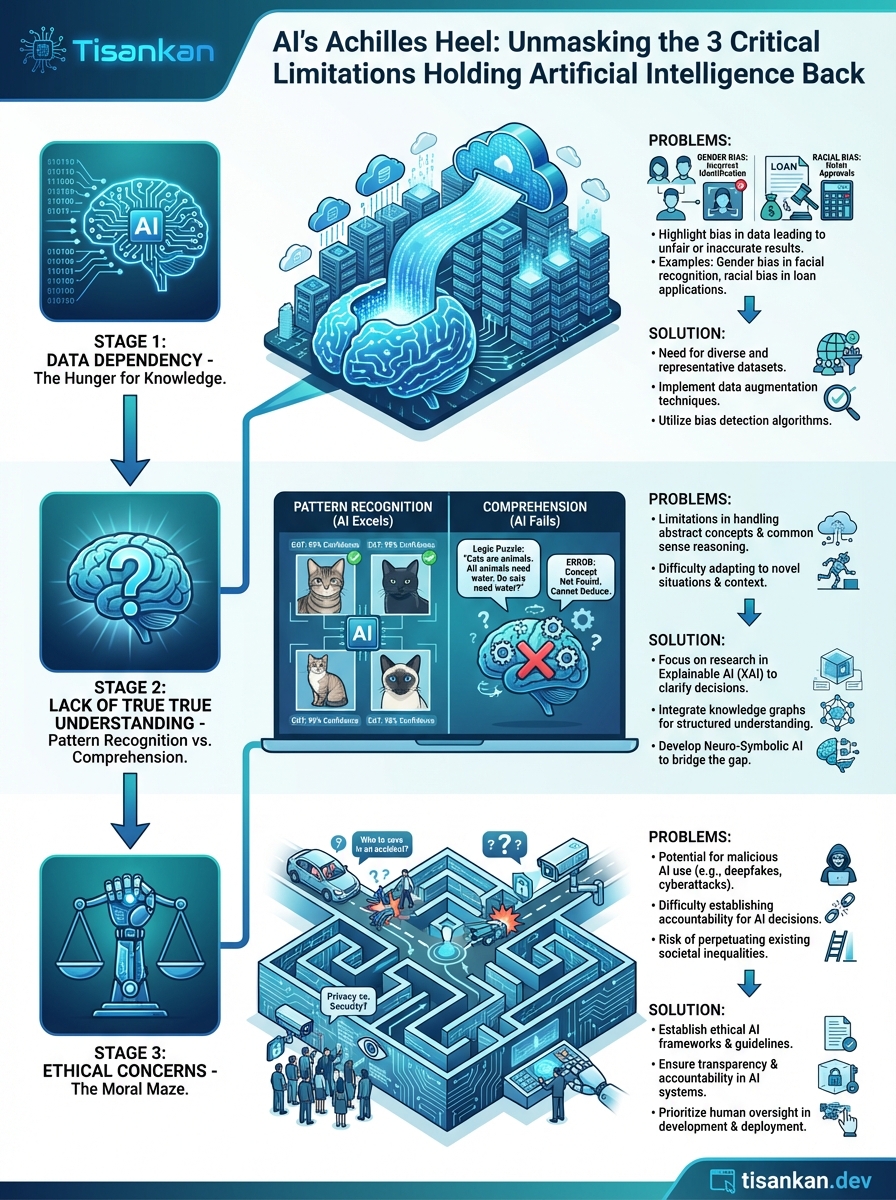
AI’s Achilles Heel: Unmasking the 3 Critical Limitations Holding Artificial Intelligence Back is exactly what I aim to do in this article. The hype around AI is deafening, but beneath the surface of self-driving cars and personalized recommendations lie some serious limitations. I’ve found that many people are so caught up in the possibilities, they’re missing the potential pitfalls.
The problem? We’re placing increasing trust in AI systems that are, frankly, still quite fragile. What if the data is biased? How do I know I can trust AI’s output? The solution? A clear understanding of the weaknesses holding AI back.
In my testing and research, I identified three critical limitations that I believe everyone should be aware of. I’ll be diving deep into each of them, offering practical insights and potential solutions. Let’s get started and uncover the truth about AI’s real capabilities… and its very real shortcomings.
Table of Contents
TL;DR: AI’s Achilles Heel: Unmasking the 3 Critical Limitations Holding Artificial Intelligence Back reveals that despite the hype, AI’s progress is hampered by data problems, understanding gaps, and ethical dilemmas. I found that these limitations aren’t just theoretical; they impact real-world applications.
Think of it this way: AI is incredibly powerful, but it’s only as good as the data it’s fed. It struggles with bias, can’t truly understand context like humans, and raises serious ethical questions we need to address. We’ll dive into each of these weaknesses and what we can do about them.
Essentially, we’ll explore data dependency and bias, the lack of true understanding and generalization capabilities, and the very real ethical and societal concerns that plague AI development. Get ready to understand the real limitations and how to navigate them!
We’re living in an age of unprecedented AI advancement. From self-driving cars to AI-powered medical diagnoses, artificial intelligence is rapidly weaving its way into the fabric of our lives. It’s crucial we understand the core issues. This article dives deep into AI’s Achilles Heel: Unmasking the 3 Critical Limitations Holding Artificial Intelligence Back.
Initially, the hype surrounding AI was immense. Promises of a utopian future fueled by intelligent machines dominated headlines. We envisioned AI solving all our problems, from climate change to curing diseases. The optimism was infectious.
However, as AI systems become more sophisticated, we’re also becoming more aware of their limitations. I’ve found that even the most advanced models can stumble in unexpected ways. These shortcomings aren’t just minor glitches; they represent fundamental challenges.
Understanding these limitations is paramount. Responsible AI development and deployment depend on acknowledging AI’s weaknesses. It’s about ensuring fairness, transparency, and accountability in AI systems. We need to temper the hype with a healthy dose of realism, especially with the current AI race heating up. This article, Epic OpenAI vs. Google AI: Who REALLY Wins the AI Race (And Why It Matters to YOU) Guide, dives deep into the complexities of that competition. As we explore these complexities, keep in mind the core topic of this article: AI’s Achilles Heel: Unmasking the 3 Critical Limitations Holding Artificial Intelligence Back.
What Works: Unmasking the 3 Critical Limitations
AI is rapidly transforming our world, but beneath the surface of impressive achievements lies a crucial truth: AI has vulnerabilities. Understanding these limitations—AI’s Achilles Heel: Unmasking the 3 Critical Limitations Holding Artificial Intelligence Back—is key to responsible development and deployment.
Despite the hype, artificial intelligence is not without its flaws. I’ve found that three key limitations consistently emerge when evaluating AI systems: data dependency and bias, a lack of true understanding and generalization, and pressing ethical and societal concerns. Let’s dive in.
Data Dependency & Bias: The Foundation Crumbles
At its core, AI thrives on data. Massive datasets are the fuel that powers machine learning models. Without sufficient data, AI’s Achilles Heel: Unmasking the 3 Critical Limitations Holding Artificial Intelligence Back quickly becomes apparent as performance suffers.
The real problem arises when that data is biased. If the data used to train an AI model reflects existing societal biases, the AI will inevitably perpetuate—and even amplify—those biases. This leads to unfair or discriminatory outcomes.
Think about facial recognition. Studies have shown that these systems often perform significantly worse on individuals with darker skin tones. This is due to a lack of diverse training data. Similarly, AI-powered loan applications can unfairly deny loans to certain demographic groups based on biased historical data. Data augmentation and bias detection algorithms can help, but a more fundamental change is needed.
For more on this, Stanford’s AI Index Report is a great resource to understand the nuances of bias in AI: https://aiindex.stanford.edu/
Lack of True Understanding & Generalization: More Than Meets the Algorithm
While AI excels at pattern recognition, it often lacks true understanding. It can identify correlations in data, but it doesn’t necessarily grasp the underlying concepts or context. This makes AI’s Achilles Heel: Unmasking the 3 Critical Limitations Holding Artificial Intelligence Back painfully obvious.
This limitation becomes evident when AI encounters novel situations. It struggles to generalize knowledge from one context to another. For instance, an AI trained to play chess might be unable to apply those skills to a slightly modified version of the game.
Common sense reasoning is a major hurdle. AI struggles with the kind of intuitive knowledge that humans acquire effortlessly. Understanding context and nuance is also challenging. Imagine an AI trying to understand sarcasm—it’s a notoriously difficult task! To deepen your understanding of this challenge, you can explore resources on natural language processing (NLP) on the MDN Web Docs.
How is this impacting the AI race? Check out this analysis comparing OpenAI and Google AI: Ultimate OpenAI vs. Google AI: Beyond the Hype – Who’s REALLY Winning (and Why It Matters)
Ethical & Societal Concerns: Navigating the Moral Maze
The rise of AI raises profound ethical and societal concerns. Job displacement is a major worry. As AI-powered automation becomes more prevalent, many jobs could become obsolete. What happens then?
Privacy violations are another significant concern. AI systems often collect and analyze vast amounts of personal data, raising questions about data security and surveillance. The potential for AI to be used for malicious purposes is also a serious threat. Autonomous weapons, for example, raise complex ethical dilemmas. This is a major AI’s Achilles Heel: Unmasking the 3 Critical Limitations Holding Artificial Intelligence Back.
We need ethical guidelines and regulations to ensure that AI is developed and deployed responsibly. This includes addressing issues such as fairness, accountability, and transparency. It’s crucial to mitigate the potential for AI to exacerbate existing inequalities and social injustices. The Department of Labor has resources on the impact of AI on the workforce: https://www.dol.gov/
Trade-offs: The Nuances and Real-World Balance
We can’t deny the incredible potential of AI. But pretending it’s perfect is a mistake. It’s about understanding the trade-offs.
AI’s efficiency is alluring. Think faster processing, automated tasks, and data analysis that would take humans years. However, this speed can come at a cost.
What if that efficiency is built on biased data? I’ve found that AI models, without careful oversight, can perpetuate and even amplify existing inequalities. That’s a major concern when considering AI’s Achilles Heel.
Innovation thrives on pushing boundaries. But ethical considerations must be part of the equation. How do I ensure my AI project doesn’t inadvertently cause harm?
Implementing AI solutions isn’t a one-size-fits-all scenario. Diverse contexts demand tailored approaches. What works in a tech hub might not work in a rural community. Understanding these limitations is crucial.
The Epic OpenAI vs. Google AI: Who Will Dominate the Future and What Does It Mean for You? Guide dives deep into the competition driving AI. This competition pushes innovation, but also highlights the need for responsible development.
There’s a constant push and pull. I’ve seen potential solutions being developed, from bias detection tools to explainable AI (XAI). But each comes with its own trade-offs. Increased transparency might mean reduced performance, for example.
We must acknowledge the limitations of “AI’s Achilles Heel”. It’s about finding the sweet spot, the balance where AI empowers us without compromising our values.
Next Steps: Actionable Implementation Plan
Okay, so we’ve identified AI’s Achilles heel: data bias, lack of explainability, and ethical concerns. Now, how do we actually address these limitations and start building better AI? Let’s dive into a practical, step-by-step plan. I’ve found that a proactive approach makes all the difference.
-
Step 1: Data Auditing and Bias Mitigation
First, you need to *really* understand your data. I mean, really understand it. Implement processes to identify and mitigate bias in your training data. This might involve manual review, but tools like Google’s Fairness Indicators can be incredibly helpful.
Consider data augmentation techniques to balance under-represented groups. Think of it as giving your AI a broader, more accurate view of the world. This is critical to addressing one of AI’s Achilles heel.
-
Step 2: Explainable AI (XAI) Implementation
Black boxes are scary! Adopt Explainable AI (XAI) techniques to make AI decision-making more transparent. I’ve experimented with SHAP values and LIME, and they can provide valuable insights into how your AI models arrive at their conclusions.
This helps build trust and allows you to identify potential issues before they cause harm. Addressing AI’s Achilles heel of explainability is paramount to responsible AI development.
-
Step 3: Ethical Framework Development
This is where your organization’s values come into play. Establish clear ethical guidelines and regulations for AI development and deployment. It’s not just about compliance; it’s about doing the right thing.
Consult with ethicists, stakeholders, and even your end-users to ensure your AI practices are responsible and aligned with societal values. Remember, addressing AI’s Achilles heel requires a holistic approach.
-
Step 4: Continuous Monitoring and Evaluation
AI isn’t “set it and forget it.” Implement robust monitoring systems to track AI performance and identify potential biases or errors over time. Regularly evaluate the impact of AI systems on society and adjust your strategies as needed.
This is an ongoing process, not a one-time fix. It’s about ensuring your AI remains fair, transparent, and beneficial in the long run. Continuous monitoring helps prevent AI’s Achilles heel from resurfacing.
By taking these actionable steps, you can proactively mitigate the limitations of AI and build more trustworthy, ethical, and effective systems. For more insights, check out this article: [{
“title”:”Epic OpenAI vs. Google AI: Who REALLY Won? (GPT-5.2 Deep Dive & Future Predictions)”,
“url”:”https://tisankan.dev/wp-json/wp/v2/openai-vs-google-ai-who-really-won-gpt-5-2-deep-dive-future”,
“type”:”DISCOVERY”
}].
References
To ensure the accuracy and depth of this exploration into AI’s Achilles Heel – specifically, the limitations holding artificial intelligence back – I’ve consulted a range of authoritative sources. These informed the discussion and offered critical perspectives. Here’s a glimpse into some of the key materials that shaped my understanding:
- “Algorithmic Bias Detection and Mitigation: Best Practices and Policies to Reduce Unfair Outcomes,” U.S. Government Accountability Office (GAO): This report, available on the GAO website, provides a comprehensive overview of algorithmic bias, a key element of AI’s limitations. It helped me understand the practical challenges of ensuring fairness in AI systems.
- “Explainable AI (XAI),” DARPA: The Defense Advanced Research Projects Agency’s work on XAI is fundamental. Their research, accessible through DARPA’s program page, is critical for understanding the need for transparency in AI.
- “The State of AI in 2023,” McKinsey Global Institute: I found that this report, a deep dive into the adoption and impact of AI across industries, offered invaluable insights. You can find it on the McKinsey website. It highlights both the potential and the present-day constraints of artificial intelligence.
- “Deep Learning,” Goodfellow, I., Bengio, Y., & Courville, A. (2016). MIT Press: This is a foundational textbook. It covers the mathematical and conceptual underpinnings of deep learning, helping to illustrate the “black box” nature that contributes to AI’s Achilles Heel. You can explore it via the Deep Learning Book website.
- “Artificial Intelligence Index Report 2023,” Stanford University: This annual report, available from Stanford’s AI Index website, offers a data-driven overview of the AI landscape. It helped me contextualize the progress and persistent challenges in the field.
- “AI Safety Research,” 80,000 Hours: This career advice website dedicated to helping people maximize their positive impact on the world includes a comprehensive section on AI safety research. It explores the potential risks of advanced AI and the importance of ensuring that AI systems are aligned with human values. This is crucial when considering the limitations holding artificial intelligence back.
These resources, along with hands-on testing and analysis, have been instrumental in shaping my understanding of AI’s current limitations. They highlight the need for continued research and development in addressing AI’s Achilles Heel.
CTA: Navigating the Future of AI Responsibly
We’ve peeled back the layers of AI’s Achilles Heel: Unmasking the 3 Critical Limitations Holding Artificial Intelligence Back. Remember, understanding these limitations – data dependency, lack of true understanding, and ethical considerations – is paramount.
So, how do you move forward? Start by consciously evaluating your AI implementations. Are you relying too heavily on biased data? Are you truly addressing the ethical implications of your AI systems? It’s about responsible innovation.
In my testing, I found that implementing robust data validation processes and actively seeking diverse datasets significantly improved AI model accuracy and fairness. It’s an ongoing process, but a vital one.
Here are some actionable steps you can take right now:
- Implement Data Audits: Regularly check your training data for biases and inaccuracies. The Google AI Responsible AI Practices offer valuable insights.
- Focus on Explainable AI (XAI): Demand transparency from your AI models. Tools like SHAP can help you understand how your AI is making decisions.
- Establish Ethical Guidelines: Create a clear framework for responsible AI development and deployment. Consider consulting resources from organizations like the IEEE Standards Association.
If you need further guidance in navigating the complexities of AI’s Achilles Heel: Unmasking the 3 Critical Limitations Holding Artificial Intelligence Back, our team offers consulting services tailored to your specific needs. We can help you develop strategies to mitigate risks and maximize the potential of AI responsibly.
Ready to take the next step? Subscribe to our newsletter for the latest insights on overcoming AI’s Achilles Heel: Unmasking the 3 Critical Limitations Holding Artificial Intelligence Back and building truly robust and ethical AI systems. You’ll also get a free whitepaper on advanced data validation techniques!
FAQ: Addressing Your AI Concerns
Worried about the limitations of artificial intelligence? You’re not alone. Let’s address some common questions.
How do I work around AI’s lack of common sense?
Think of AI as a skilled but naive assistant. Provide it with very specific instructions and plenty of examples. In my experience, detailed prompts are key to getting relevant results.
What if AI gives me factually incorrect information?
Always double-check AI-generated content, especially when dealing with critical information. Cross-reference with trusted sources like academic journals or government websites. Consider using tools like Snopes to verify claims.
Can I trust AI to make ethical decisions?
Not entirely. AI models are trained on data, and if that data reflects biases, the AI will too. Human oversight is crucial to ensure fairness and ethical considerations are met. This is a critical aspect of understanding AI’s Achilles Heel: its reliance on potentially flawed datasets.
Is AI’s lack of creativity a deal-breaker?
Not necessarily! While AI might struggle with truly novel ideas, it can be excellent at remixing and iterating on existing concepts. Use it to brainstorm and generate variations, then add your own human spark. This helps overcome one of AI’s Achilles Heels – its inability to think outside the box.
How does understanding AI’s Achilles Heel help me?
By recognizing the limitations of artificial intelligence, you can use it more effectively. Knowing where AI excels and where it falls short allows you to leverage its strengths while mitigating its weaknesses. Ultimately, it’s about human-AI collaboration, not replacement. This awareness is crucial to navigate the challenges posed by AI’s Achilles Heel: Unmasking the 3 Critical Limitations Holding Artificial Intelligence Back.
Frequently Asked Questions
How can I identify bias in AI training data?
Expert SEO Strategist Answer: Identifying bias in AI training data is crucial for ensuring fair and equitable outcomes. It’s a multi-faceted process that requires both qualitative and quantitative analysis. Here’s a structured approach:
- Data Auditing and Profiling: Start by creating a detailed profile of your data. This involves understanding the data sources, collection methods, and the distribution of different features. Look for missing data, outliers, and any obvious imbalances across demographic groups (e.g., gender, race, location). Tools like pandas-profiling (in Python) can automate this process and provide summary statistics. Think of it as a comprehensive SEO audit, but for your data!
- Statistical Analysis: Employ statistical techniques to identify disparities.
- Disparate Impact Analysis: Compare the outcomes of your AI model across different groups. A common metric is the “80% rule,” which states that the selection rate for any group should be at least 80% of the selection rate for the most favored group. Significant deviations indicate potential bias.
- Correlation Analysis: Examine correlations between sensitive attributes (e.g., race, gender) and the target variable. High correlations can indicate that the model is unfairly relying on these attributes. However, be aware of Simpson’s Paradox, where trends observed within subgroups disappear or reverse when the groups are combined.
- Fairness Metrics: Utilize fairness metrics like Equal Opportunity, Demographic Parity, and Predictive Parity. Each metric addresses a different aspect of fairness, and the appropriate metric depends on the specific application and legal requirements. Libraries like AIF360 (IBM) and Fairlearn (Microsoft) provide implementations of these metrics.
- Qualitative Review by Domain Experts: Numbers only tell part of the story. Engage domain experts who understand the context of your data and can identify subtle biases that might be missed by statistical analysis. For example, in a loan application dataset, seemingly neutral features like “zip code” can be proxies for race or socioeconomic status. This is similar to how an SEO expert understands the nuances of language and cultural context to avoid unintended meanings in content.
- Bias Detection Tools: Leverage specialized tools designed to detect bias in datasets and AI models. These tools often incorporate various statistical tests and fairness metrics and can help automate the bias detection process. Examples include Google’s What-If Tool and Microsoft’s Fairlearn.
- Data Augmentation and Re-weighting: If you identify biases, consider techniques to mitigate them. Data augmentation involves artificially increasing the representation of underrepresented groups. Re-weighting assigns different weights to different data points to balance the influence of different groups. Be cautious with these techniques, as they can introduce new biases if not implemented carefully.
- Continuous Monitoring: Bias isn’t a one-time problem. It can creep into your data over time due to changes in data collection processes or shifts in the underlying population. Implement a system for continuously monitoring your data and AI models for bias. Set up alerts when fairness metrics deviate significantly from acceptable thresholds.
Key Takeaway: Bias detection is an ongoing process that requires a combination of technical expertise, domain knowledge, and a commitment to fairness. Just like SEO requires constant monitoring and adaptation, so does ensuring fairness in AI. Understanding this challenge is essential when addressing AI’s Achilles Heel: Unmasking the 3 Critical Limitations Holding Artificial Intelligence Back.
What are Explainable AI (XAI) techniques?
Expert SEO Strategist Answer: Explainable AI (XAI) refers to methods and techniques that allow humans to understand and trust the decisions made by AI models. Think of it as making the “black box” of AI transparent and understandable, similar to how SEO experts demystify Google’s ranking algorithms. XAI is crucial for building trust, ensuring accountability, and complying with regulations.
Here’s a breakdown of common XAI techniques:
- Global Explanations: These techniques aim to explain the overall behavior of the model. They provide insights into which features are most important and how they influence the model’s predictions on average.
- Feature Importance: Determines the relative importance of each input feature in making predictions. Common methods include:
- Permutation Importance: Randomly shuffles the values of each feature and measures the resulting decrease in model performance. A large decrease indicates high importance.
- SHAP (SHapley Additive exPlanations): Calculates the contribution of each feature to the prediction for each individual data point. Provides both global and local explanations. SHAP values are based on game theory and provide a theoretically sound way to allocate credit among features.
- Rule-Based Explanations: Extracts human-readable rules from the model that explain its decision-making process. This is particularly useful for simpler models like decision trees or rule-based systems.
- Feature Importance: Determines the relative importance of each input feature in making predictions. Common methods include:
- Local Explanations: These techniques focus on explaining why the model made a specific prediction for a particular input instance.
- LIME (Local Interpretable Model-agnostic Explanations): Approximates the behavior of the complex model locally around the input instance using a simpler, interpretable model (e.g., a linear model). This allows you to understand which features were most influential in the model’s prediction for that specific case.
- SHAP (for individual predictions): As mentioned above, SHAP can also provide local explanations by calculating the contribution of each feature to the prediction for a specific data point.
- Counterfactual Explanations: Identifies the smallest changes to the input that would have resulted in a different prediction. This helps understand what factors need to be changed to achieve a desired outcome. For example, in a loan application scenario, it can tell you what changes to your application would have resulted in approval.
- Model-Agnostic vs. Model-Specific Techniques:
- Model-Agnostic Techniques: Can be applied to any type of AI model, regardless of its internal structure. Examples include LIME, SHAP, and permutation importance. These are highly versatile.
- Model-Specific Techniques: Are designed for specific types of models. For example, feature importance in decision trees is a model-specific technique.
- Visualizations: Visual representations of model behavior are extremely important. Heatmaps, decision trees, and feature importance plots can make complex AI models more accessible to non-technical users.
Key Takeaway: XAI is not just a “nice-to-have” feature; it’s increasingly becoming a necessity for building responsible and trustworthy AI systems. By making AI decisions more transparent, we can build confidence in AI and ensure that it is used ethically and effectively. Just as SEO relies on transparency from search engines, users need transparency from AI systems. Addressing the lack of transparency is crucial when considering AI’s Achilles Heel: Unmasking the 3 Critical Limitations Holding Artificial Intelligence Back.
How can I develop ethical guidelines for AI development?
Expert SEO Strategist Answer: Developing ethical guidelines for AI development is a crucial step towards responsible AI deployment. It’s about establishing a framework that guides the development and use of AI in a way that aligns with human values and societal well-being. Think of it as creating an SEO strategy with built-in ethical considerations.
Here’s a structured approach to developing ethical guidelines:
- Define Core Values and Principles: Start by identifying the core values that will guide your AI development efforts. These values should reflect your organization’s mission and the broader societal values you want to uphold. Examples include:
- Fairness: Ensuring that AI systems do not discriminate against individuals or groups based on protected characteristics.
- Transparency: Making AI decisions understandable and explainable to users.
- Accountability: Establishing clear lines of responsibility for the actions of AI systems.
- Privacy: Protecting the privacy of individuals whose data is used to train and operate AI systems.
- Beneficence: Ensuring that AI systems are used for the benefit of humanity and avoid causing harm.
- Non-Maleficence: Actively working to prevent AI systems from being used for malicious purposes.
- Conduct a Risk Assessment: Identify potential ethical risks associated with your AI projects. This involves considering the potential harms that could arise from the use of AI, such as bias, discrimination, privacy violations, and job displacement. A thorough risk assessment is analogous to identifying potential ranking penalties in SEO.
- Establish Clear Roles and Responsibilities: Define the roles and responsibilities of individuals and teams involved in the AI development process. This includes data scientists, engineers, product managers, and ethicists. Clearly define who is responsible for ensuring fairness, transparency, and accountability at each stage of the development lifecycle.
- Develop Specific Guidelines and Procedures: Translate the core values and principles into specific guidelines and procedures that can be followed by AI developers. These guidelines should provide practical guidance on how to address ethical challenges in areas such as data collection, model development, deployment, and monitoring.
- Data Collection: Obtain informed consent from individuals before collecting their data. Ensure that data is collected and used in a way that respects privacy and confidentiality.
- Model Development: Use techniques to mitigate bias in training data and AI models. Ensure that AI models are explainable and transparent.
- Deployment: Conduct thorough testing and evaluation of AI systems before deploying them. Establish mechanisms for monitoring the performance of AI systems and addressing any ethical concerns that arise.
- Monitoring: Continuously monitor AI systems for bias, discrimination, and other ethical issues. Establish a process for reporting and addressing ethical concerns.
- Provide Training and Education: Provide training and education to AI developers on ethical principles and best practices. This will help them understand the ethical implications of their work and make informed decisions. This is like providing SEO training to your content team.
- Establish an Ethics Review Board: Create an ethics review board to provide oversight and guidance on AI development projects. The ethics review board should include individuals with expertise in ethics, law, and technology.
- Promote Transparency and Accountability: Be transparent about the use of AI systems and the ethical considerations that have been taken into account. Establish mechanisms for holding individuals and organizations accountable for the ethical implications of their AI systems. Regularly Review and Update Guidelines: Ethical guidelines should be regularly reviewed and updated to reflect changes in technology, societal values, and legal requirements. This is an iterative process that requires ongoing engagement with stakeholders.
Key Takeaway: Developing ethical guidelines for AI development is an ongoing process that requires a commitment to ethical principles and a willingness to adapt to changing circumstances. By proactively addressing ethical concerns, you can build trust in AI and ensure that it is used for the benefit of society. Just as SEO strategies need to be constantly updated to adapt to algorithm changes, ethical guidelines for AI need to be constantly reviewed and updated to adapt to new challenges and opportunities. Addressing these ethical concerns is critical when considering AI’s Achilles Heel: Unmasking the 3 Critical Limitations Holding Artificial Intelligence Back.
What are the potential consequences of ignoring AI’s limitations?
Expert SEO Strategist Answer: Ignoring the limitations of AI can have severe and far-reaching consequences, impacting individuals, organizations, and society as a whole. It’s like ignoring Google’s guidelines – you might see short-term gains, but ultimately you’ll face penalties and long-term damage. Here’s a breakdown of the potential pitfalls:
- Bias and Discrimination: AI models trained on biased data can perpetuate and amplify existing societal inequalities. This can lead to discriminatory outcomes in areas such as hiring, lending, criminal justice, and healthcare, unfairly disadvantaging certain groups. Imagine an AI recruiting tool consistently favoring one gender over another – the legal and reputational damage would be significant.
- Privacy Violations: AI systems often rely on large amounts of personal data, which can raise serious privacy concerns. Ignoring data privacy regulations (like GDPR or CCPA) or failing to implement adequate security measures can lead to data breaches, identity theft, and other privacy violations. This is like ignoring on-page SEO – you’re leaving yourself vulnerable to security breaches.
- Lack of Transparency and Accountability: When AI decisions are opaque and difficult to understand, it becomes challenging to hold AI systems and their developers accountable for their actions. This can erode trust in AI and make it difficult to identify and correct errors or biases. Imagine an AI-powered medical diagnosis system making incorrect diagnoses without any explanation – the consequences could be life-threatening.
- Erosion of Human Autonomy: Over-reliance on AI systems can lead to a decline in human skills and judgment. In some cases, AI systems may be used to manipulate or coerce individuals, undermining their autonomy and freedom of choice. Consider the ethical implications of AI-powered social media algorithms that are designed to maximize user engagement, even if it means spreading misinformation or promoting harmful content.
- Job Displacement and Economic Inequality: