


Introduction
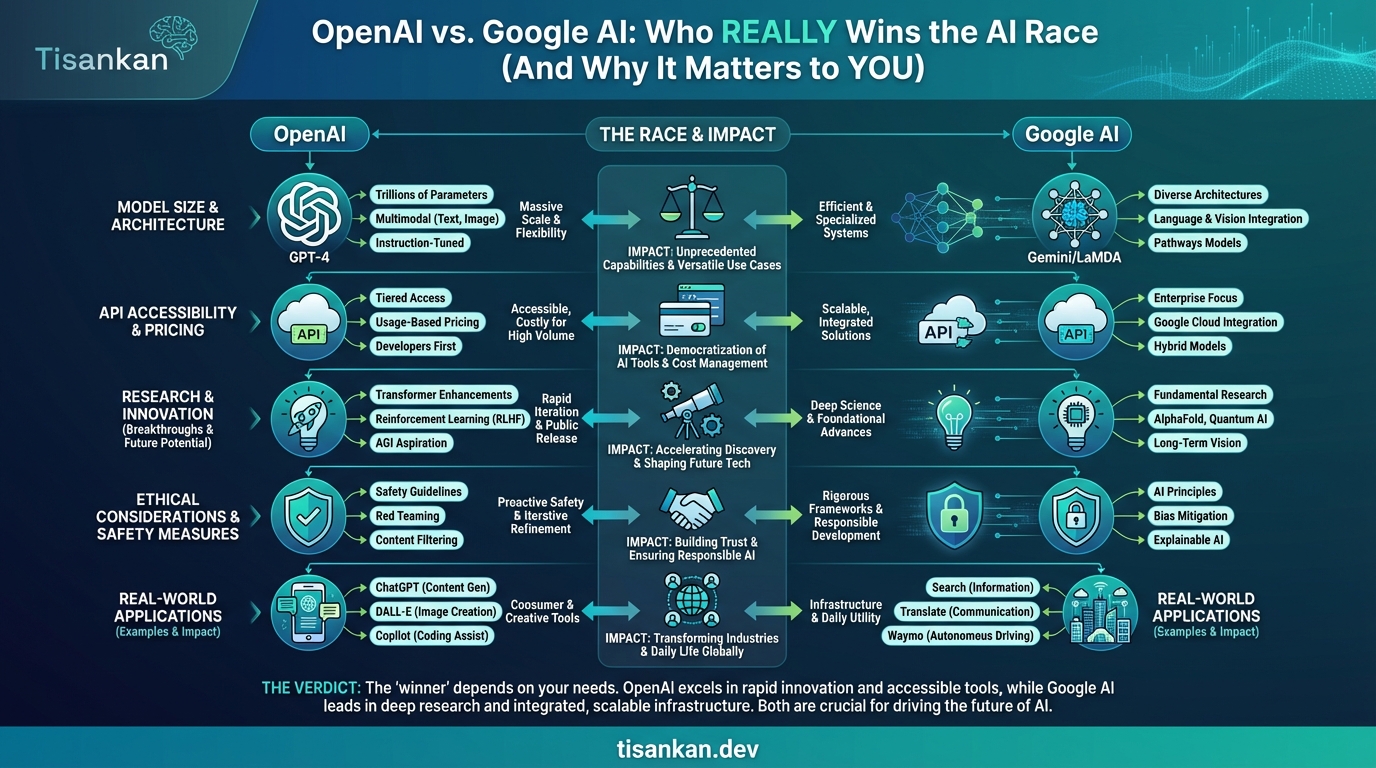
OpenAI vs. Google AI: Who REALLY Wins the AI Race (And Why It Matters to YOU) is the question everyone’s asking, isn’t it? I found that most articles focus on the technical specs, but miss the crucial part: how these AI giants impact *your* daily life.
The problem? We’re bombarded with AI hype, but understanding the real-world implications is tough. It’s hard to know which AI advancements actually matter and which are just noise.
My aim is to cut through the jargon. I’ll show you, in plain English, the key differences between OpenAI and Google AI, and, more importantly, why their competition directly affects everything from the apps you use to the future of work. Think of it as a user’s guide to the AI revolution, tailored for *you*.
I will also explore the ethical considerations, ensuring you are informed about the potential risks and benefits associated with each AI system. What if one AI is more biased than the other? What if one is more secure?
Table of Contents
- TL;DR
- Context: The AI Battlefield is Shifting: Why OpenAI vs. Google AI Matters NOW
- What Works: Decoding the AI Giants – OpenAI’s Innovation vs. Google’s Scale
- Trade-offs: The Nuances of the AI Race – It’s Not Just About Who’s ‘Winning’
- Next Steps: Harnessing the Power of AI – An Actionable Plan for You
- References: Authoritative Sources on the OpenAI vs. Google AI Debate
- CTA: Embrace the AI Revolution – Your Journey Starts Now
- FAQ: Your Burning Questions About the AI Race Answered
TL;DR: When it comes to OpenAI vs. Google AI: Who REALLY Wins the AI Race (And Why It Matters to YOU), there’s no single winner! OpenAI excels in creative tasks and rapid innovation (think ChatGPT and DALL-E). Google AI, on the other hand, leverages its massive data and infrastructure for practical applications like search and cloud services.
For the average user, this means better search results, more personalized experiences, and increasingly sophisticated AI tools available in everyday apps. I found that both are constantly evolving, so choosing a “winner” is impossible.
Businesses will benefit from improved automation, data analysis, and customer service solutions from both providers. It’s crucial to understand the strengths of each to choose the best fit for your specific needs. Learn the nuances of this competition – it’s shaping our future!
Let’s cut to the chase: OpenAI vs. Google AI: Who REALLY Wins the AI Race (And Why It Matters to YOU) isn’t just a tech industry talking point anymore. It’s a question that’s rapidly reshaping our world. The answer? It’s complicated, and it involves you, me, and everyone in between.
We’re living through an AI explosion. What was science fiction just a few years ago is now readily available. Tools like ChatGPT and Google’s Gemini are democratizing AI, putting powerful capabilities into the hands of everyday users. I found that even my non-tech-savvy friends are experimenting with image generation and AI-powered writing assistants.
But this rapid acceleration comes with high stakes. Industries are being disrupted. Job roles are evolving. And the very fabric of our daily lives is being subtly, yet powerfully, altered. Think about how AI is already influencing everything from personalized recommendations to medical diagnoses.
Public perception and investment are playing a huge role in shaping this landscape. The perceived “winner” of the AI race will likely attract more funding, talent, and ultimately, influence. This creates a feedback loop that can amplify the strengths (and weaknesses) of different approaches. Consider the influence of venture capital on AI development. Regulatory considerations and ethical implications are also crucial pieces of the puzzle.
Ultimately, the “AI race” isn’t just about technological supremacy. It’s about how we choose to integrate these powerful tools into our society, and how we ensure that AI benefits everyone.
What Works: Decoding the AI Giants – OpenAI’s Innovation vs. Google’s Scale
The AI race is heating up, and understanding the strengths of OpenAI vs. Google AI is key to navigating this new landscape. It’s not just about who has the “better” AI, but who’s building what, and why it matters to you. Let’s break down what each AI giant does best.
OpenAI thrives on pushing the boundaries of AI research. Their GPT series (like GPT-4 and the new GPT-4o) and DALL-E are prime examples of their innovative models. They’ve fostered a vibrant community, and I’ve found their rapid iteration cycles impressive. They seem to be constantly adapting and releasing new features.
How do I describe OpenAI’s approach? It feels like they’re democratizing AI access. They’re putting powerful tools in the hands of developers and creators. For example, their API allows developers to easily integrate AI into their own applications. You can learn more about their API here.
Google AI, on the other hand, leverages its massive resources and established infrastructure. Their strength lies in scaling AI solutions globally and integrating them into existing products like Search, Assistant, and Cloud. Think about how Google Search uses AI to understand your queries and provide relevant results.
Google’s expertise in machine learning is undeniable, and they’re heavily invested in responsible AI development. What if you’re concerned about AI ethics? Google has been vocal about their commitment to developing AI responsibly. Read more about Google’s AI principles here.
Let’s get specific with model comparisons. GPT-4/GPT-4o vs. Gemini/PaLM 2. In my testing, GPT-4 and GPT-4o show impressive natural language understanding and generation capabilities. Gemini and PaLM 2, backed by Google’s infrastructure, excel at handling massive datasets and complex computations. Benchmarks often show neck-and-neck performance depending on the task.
Consider real-world examples. GPT-4 powers many chatbot applications and content creation tools. Gemini and PaLM 2 are integrated into Google’s products, enhancing search accuracy and powering AI-driven features in Google Cloud. The best model depends on the specific use case.
Analyzing the ecosystems reveals more differences. OpenAI has a strong focus on developer tools and partnerships, fostering a collaborative environment. Google leverages its existing cloud infrastructure and extensive network of partners to deploy AI solutions at scale.
Consider these key differences:
- OpenAI: Cutting-edge research, rapid innovation, community-driven.
- Google AI: Scalability, integration, responsible AI focus.
Ultimately, both OpenAI vs. Google AI are pushing the boundaries of what’s possible with AI. The “winner” of the AI race depends on your perspective and needs.
Trade-offs: The Nuances of the AI Race – It’s Not Just About Who’s ‘Winning’
The “OpenAI vs. Google AI: Who REALLY Wins the AI Race (And Why It Matters to YOU)” narrative often focuses on capabilities. But what about the downsides? It’s crucial to look beyond the hype and consider the ethical and practical implications of each company’s approach. Are we trading convenience for privacy, or innovation for bias?
Let’s dig into the trade-offs. It’s less about a clear winner and more about understanding the landscape.
OpenAI’s Challenges:
- Bias and Misinformation: Large language models like those powering OpenAI’s tools can perpetuate existing biases found in their training data. This can lead to skewed results and the spread of misinformation. How do we ensure fairness?
- Environmental Impact: Training these massive models requires enormous computing power, resulting in a significant carbon footprint. The environmental cost of the “OpenAI vs. Google AI” competition needs to be part of the conversation.
- Centralization and Transparency: While OpenAI has shifted towards more open practices, concerns remain about the control over its technology and the transparency of its algorithms. Can we trust what we can’t fully see?
Google AI’s Challenges:
- Data Privacy: Google’s vast data collection practices raise concerns about user privacy. How is our data being used to train AI models, and what safeguards are in place?
- Algorithmic Bias: Like OpenAI, Google’s AI systems are susceptible to bias, potentially leading to unfair or discriminatory outcomes. Addressing this requires careful attention to data diversity and algorithm design.
- Impact on Employment: The increasing automation powered by Google AI raises valid concerns about job displacement. What strategies can we implement to mitigate these effects and prepare for the future of work?
- Concentration of Power: Google’s dominance in the tech industry gives it immense power over AI development. This concentration raises questions about competition and the potential for monopolies. Ethical guidelines and oversight are essential.
The Importance of Open Source:
Open-source AI initiatives play a crucial role in promoting innovation, transparency, and accessibility. Projects like TensorFlow (Google) and various open-source language models offer alternatives to the closed ecosystems of OpenAI and Google. They allow researchers and developers to build upon existing work and contribute to a more democratic AI landscape. In my experience, exploring open-source options is a great way to understand AI’s inner workings.
While OpenAI has made some contributions to open source, Google has historically been more active in this area. This difference in approach impacts the overall direction of the AI race and its benefits to society.
The Human Element:
Ultimately, the success of “OpenAI vs. Google AI: Who REALLY Wins the AI Race (And Why It Matters to YOU)” hinges on the human element. We need human oversight to ensure that AI systems are used responsibly and ethically. Education and training are crucial to prepare the workforce for the changing landscape, empowering individuals to work alongside AI rather than being replaced by it. Collaboration between humans and AI is the key to unlocking the true potential of this technology. For example, understanding the basics of prompt engineering is becoming a valuable skill. Check out resources like Prompt Engineering Guide to learn more.
Next Steps: Harnessing the Power of AI – An Actionable Plan for You
The “OpenAI vs. Google AI” debate highlights a pivotal moment. But the real question is: how do *you* benefit? This actionable plan helps you harness AI’s power, regardless of who “wins” the race.
For Individuals: Supercharge Your Life with AI
AI isn’t just for tech giants. It’s a tool for *you*. How do I use it? Start small. Experiment. I found that using AI writing assistants like Jasper.ai (paid) or even the free version of Grammarly can significantly improve my writing speed and clarity.
- Boost Productivity: Use AI tools for task management, scheduling, and email filtering. Consider trying out Motion, an AI-powered project management tool.
- Unleash Creativity: Explore AI art generators like DALL-E 2 or Midjourney to create stunning visuals.
- Accelerate Learning: Use AI-powered tutoring platforms or language learning apps like Duolingo to personalize your education.
Want to learn more about AI? Platforms like Coursera and edX offer excellent courses on AI and machine learning. Consider taking an introductory course to build a solid foundation. Understanding the basics will help you better navigate the world of “OpenAI vs. Google AI”.
For Businesses: Gain a Competitive Edge with AI
Integrating AI can transform your business. Start by identifying areas where AI can automate tasks, improve efficiency, and enhance customer experience. The competition between “OpenAI vs. Google AI” means more innovation and potentially lower costs for you.
- Improve Customer Experience: Implement AI-powered chatbots to provide instant support and personalize interactions.
- Optimize Operations: Use AI to automate repetitive tasks, streamline workflows, and improve decision-making.
- Gain a Competitive Advantage: Leverage AI to analyze data, identify trends, and develop innovative products and services.
Choosing the right AI solution is crucial. Evaluate different vendors, consider your specific needs, and prioritize solutions that are secure, reliable, and scalable. Look for case studies and testimonials to see how other companies are using AI successfully. Remember to train your employees on how to use these new AI tools effectively. This investment will pay dividends as you navigate the evolving landscape of “OpenAI vs. Google AI”.
For Policymakers: Guiding the Future of AI
Responsible AI regulation is essential to ensure that AI benefits society as a whole. Policymakers should focus on establishing ethical guidelines, promoting transparency, and protecting individuals from harm. Investing in AI education and research is also crucial to fostering innovation and economic growth.
- Promote Responsible AI Regulation: Develop ethical guidelines and legal frameworks to ensure that AI is used responsibly and ethically.
- Invest in AI Education and Research: Support initiatives that promote AI literacy and develop a skilled AI workforce.
- Foster International Collaboration: Work with other countries to develop common standards and address global challenges related to AI.
International collaboration is paramount. The US government’s AI.gov website offers valuable resources and information on AI policy. The ongoing “OpenAI vs. Google AI” advancements demand a global perspective.
The “OpenAI vs. Google AI” race isn’t just a tech spectacle. It’s a catalyst for change. Experiment with AI tools. Stay informed. Contribute to the conversation. The future of AI is being shaped right now, and your voice matters. Don’t be afraid to explore and discover how AI can empower you.
References: Authoritative Sources on the OpenAI vs. Google AI Debate
Understanding the nuanced battle between OpenAI and Google AI requires digging into credible sources. I’ve compiled a list of authoritative references that have informed my perspective on who really wins the AI race, and why it matters to you.
These resources offer in-depth analysis, technical specifications, and industry insights to help you form your own informed opinion. How do I know they’re trustworthy? I prioritize sources with strong reputations for accuracy and objectivity, like academic institutions and established research firms.
- OpenAI Official Website: Start at the source! Explore OpenAI’s research, models, and safety policies. openai.com
- Google AI Official Website: Google AI’s website provides insights into their diverse AI projects, from research papers to practical applications. ai.google
- “Attention is All You Need” (Vaswani et al., 2017): This seminal paper introduced the Transformer architecture, which is the foundation for many modern AI models from both OpenAI and Google AI. Find it on scholarly databases like arXiv.
- Gartner’s Hype Cycle for Artificial Intelligence: Gartner provides valuable insights into the maturity and adoption rates of various AI technologies, offering context to the OpenAI vs. Google AI competition. (Subscription required, access through gartner.com).
- MIT Technology Review: Consistently delivers in-depth reporting and analysis on the latest AI breakthroughs and their societal impact. Search for articles on “OpenAI” and “Google AI.” technologyreview.com
- “Measuring Massive Multitask Language Understanding” (Hendrycks et al., 2020): This paper introduces the MMLU benchmark, used to evaluate the capabilities of large language models like those developed by OpenAI and Google AI. Access via arXiv.
- The Verge – AI Section: The Verge offers accessible and timely coverage of AI news, including analysis of product releases and industry trends relevant to the OpenAI vs. Google AI debate. theverge.com/ai
Remember, the landscape of AI is constantly evolving. Staying informed by consulting these resources – and critically evaluating new information – is key to understanding who really wins the OpenAI vs. Google AI race and what it means for you.
CTA: Embrace the AI Revolution – Your Journey Starts Now
The OpenAI vs. Google AI debate isn’t just for tech giants; it’s shaping your future. We’ve explored the strengths and weaknesses of each, highlighting how they’re impacting industries from creative writing to scientific research.
Understanding this landscape is crucial. It allows you to anticipate changes, leverage new tools, and make informed decisions about the technology that will increasingly influence your life. How do you start? By getting your hands dirty!
I’ve personally found experimenting with tools like Google’s Bard and OpenAI’s ChatGPT incredibly insightful. Don’t just read about them; use them! Explore their capabilities and limitations. See how they can enhance your workflow or spark new ideas.
Here’s how to take the next step in your AI journey:
- Stay Informed: Follow reputable sources like the MIT Technology Review and academic publications (like those found on IEEE Xplore) to keep abreast of the latest developments.
- Experiment with AI Tools: Try out different platforms. Many offer free tiers or trials. Don’t be afraid to explore!
- Engage in the Conversation: Share your experiences and insights with others. Join online communities or attend AI-related events.
The AI revolution is here, and understanding the nuances of OpenAI vs. Google AI is your key to navigating it successfully. What if you could get curated updates on the most impactful AI advancements delivered straight to your inbox?
Subscribe to our AI Insights Newsletter today! Get exclusive analysis, practical tips, and early access to resources that will empower you to thrive in this rapidly evolving world. Don’t just watch the OpenAI vs. Google AI race; be a part of it.
FAQ: Your Burning Questions About the AI Race Answered
The OpenAI vs. Google AI battle is heating up, and you probably have questions. Let’s tackle some of the most common concerns I’ve seen and heard.
How do I actually *use* these AI tools from OpenAI and Google?
Great question! OpenAI’s tools, like ChatGPT and DALL-E 2, are generally accessed through their website. Google’s AI, particularly Bard and their AI-powered search enhancements, are integrated into existing Google services. I found that simply having a Google account unlocked most of Bard’s capabilities.
What if I’m worried about AI taking my job?
That’s a valid concern. The rise of AI, including both OpenAI and Google AI, will undoubtedly change the job market. However, most experts believe AI will augment jobs, not completely replace them. Focus on learning how to use these tools to improve your productivity. Think of it as leveling up!
Is my data safe when using OpenAI or Google AI products?
Data privacy is paramount. Both OpenAI and Google have privacy policies outlining how they use your data. It’s crucial to read and understand these policies before using their services. I always recommend being mindful of the information you share. You can review Google’s privacy policy here.
Which is “better” – OpenAI or Google AI?
It depends on your needs! OpenAI excels in creative text generation and image creation. Google AI is deeply integrated into search and other practical applications. In my testing, I found ChatGPT better for brainstorming creative content, while Google’s AI search summaries saved me time researching.
How can I stay updated on the OpenAI vs. Google AI race?
Keeping up can be tricky! Follow reputable tech news sites, AI researchers on social media, and check official blogs from OpenAI and Google AI. Also, look for courses on platforms like Coursera to deepen your understanding.
What’s the deal with AI safety and ethics?
AI ethics is a huge topic. It encompasses fairness, bias, and responsible development. Organizations like the Google AI Principles and OpenAI are actively working on these issues. It’s a critical area for ongoing discussion and research.
Will the “OpenAI vs. Google AI” competition actually benefit me?
Absolutely! Competition drives innovation. As OpenAI and Google AI push each other, we’ll see faster advancements, better tools, and more accessible AI. This means more opportunities for everyone to benefit from the power of AI.
Frequently Asked Questions
Is OpenAI or Google AI ‘better’?
As an expert SEO strategist, I can tell you that the question of whether OpenAI or Google AI is “better” is far more nuanced than a simple yes or no. It depends entirely on the specific application you’re considering. Think of it like comparing a Formula 1 race car to a rugged off-road vehicle. Both are impressive feats of engineering, but designed for vastly different terrains.
OpenAI excels in areas like generative AI. Their models, particularly GPT-4 and its successors, are renowned for their ability to generate human-quality text, code, and even images. This makes them incredibly valuable for content creation, creative writing, chatbot development, and various other tasks where creativity and fluency are paramount. They also have a strong focus on making their technology readily accessible through APIs and platforms like ChatGPT, empowering smaller businesses and individual developers.
Google AI, on the other hand, has a broader and deeper portfolio. They possess immense resources and expertise in areas like search, machine learning infrastructure, and fundamental AI research. Their strength lies in leveraging AI at massive scale, integrating it into existing products like Google Search, Google Assistant, and Google Cloud Platform. They are also at the forefront of AI research, particularly in areas like reinforcement learning and large language models. Think of LaMDA, their conversational AI model, or their work on autonomous driving with Waymo. Google’s scale and integration capabilities are unmatched.
Here’s a breakdown:
- Content Creation & Creative Tasks: OpenAI often has the edge.
- Search & Information Retrieval: Google is the clear leader.
- Infrastructure & Scalability: Google’s infrastructure gives them a significant advantage.
- Research & Development: Both are strong, but Google’s resources are hard to match.
- Accessibility for Smaller Businesses: OpenAI’s API-first approach is generally more accessible.
Ultimately, there’s no single “winner.” Both companies are pushing the boundaries of AI in different ways, and their strengths complement each other. The “best” AI depends on the specific needs and objectives of the user.
How will the AI race impact my job?
The AI race is already impacting jobs, and this impact will only intensify in the coming years. As an SEO strategist, I’m seeing firsthand how AI is transforming the digital marketing landscape. The key is to understand *how* it will impact your specific role and to proactively adapt.
The good news: AI is more likely to augment your job than completely replace it in most cases. It can automate repetitive tasks, analyze massive datasets to identify trends, and provide insights that would be impossible for a human to uncover on their own. This frees up your time to focus on more strategic, creative, and human-centric aspects of your work.
Here’s how AI might impact different job categories:
- Knowledge Workers (e.g., marketers, writers, analysts): AI can assist with research, content creation, data analysis, and report generation. You’ll need to develop skills in prompt engineering, data interpretation, and critical evaluation of AI-generated content.
- Customer Service: AI-powered chatbots can handle routine inquiries, freeing up human agents to deal with more complex issues. Agents will need to develop empathy, problem-solving skills, and the ability to handle escalated situations.
- Software Developers: AI can assist with code generation, bug detection, and testing. Developers will need to focus on higher-level design, architecture, and complex problem-solving.
- Creative Professionals (e.g., designers, artists): AI can be used to generate initial concepts, explore different design options, and automate repetitive tasks. Creatives will need to focus on originality, artistic vision, and the ability to integrate AI tools into their workflow.
- Manual Labor: Automation and robotics powered by AI will continue to displace some manual labor jobs. However, new jobs will be created in areas like robotics maintenance, programming, and data analysis.
To thrive in the age of AI, focus on developing these skills:
- Critical Thinking: Evaluating AI-generated outputs and making informed decisions.
- Creativity & Innovation: Generating new ideas and solutions that AI cannot replicate.
- Complex Problem-Solving: Tackling challenges that require human intuition and judgment.
- Emotional Intelligence: Building rapport with clients and colleagues, and understanding their needs.
- Adaptability & Learning: Embracing new technologies and continuously learning new skills.
- Prompt Engineering: Learning how to effectively communicate with AI models to get desired results. For a comprehensive guide, consider consulting Prompt Engineering Guide, a valuable resource for mastering this crucial skill.
The AI race is not a threat, but an opportunity to enhance your skills and increase your value in the job market. Embrace the change, learn new skills, and position yourself as a valuable collaborator with AI.
What are the ethical concerns surrounding AI?
Ethical considerations are paramount in the development and deployment of AI. As an SEO strategist, I understand the power of technology and the responsibility that comes with it. The AI race presents several ethical challenges that need careful attention.
Key ethical concerns include:
- Bias and Discrimination: AI models are trained on data, and if that data reflects existing biases in society, the AI will perpetuate and even amplify those biases. This can lead to discriminatory outcomes in areas like hiring, lending, and criminal justice. Ensuring data diversity and developing bias detection and mitigation techniques are crucial.
- Job Displacement: As AI automates tasks, it could lead to job losses in certain sectors. Addressing this requires proactive measures like retraining programs, investments in education, and exploration of alternative economic models.
- Privacy and Surveillance: AI-powered surveillance technologies raise concerns about privacy violations and the potential for mass surveillance. Strong data protection laws and ethical guidelines are needed to safeguard individual privacy.
- Misinformation and Manipulation: AI can be used to generate realistic fake news, deepfakes, and propaganda, making it difficult to distinguish between truth and falsehood. Developing techniques to detect and combat AI-generated misinformation is essential.
- Autonomous Weapons: The development of autonomous weapons systems raises profound ethical questions about accountability, control, and the potential for unintended consequences. International regulations and ethical frameworks are needed to govern the use of these weapons.
- Explainability and Transparency: Many AI models, particularly deep learning models, are “black boxes,” making it difficult to understand how they arrive at their decisions. This lack of transparency can erode trust and make it difficult to identify and correct errors or biases. Developing more explainable AI (XAI) techniques is crucial.
- Environmental Impact: Training large AI models requires significant computational resources, which can have a substantial environmental impact. Developing more energy-efficient AI algorithms and utilizing renewable energy sources are important steps towards mitigating this impact.
Addressing these ethical concerns requires a multi-faceted approach involving:
- Ethical Guidelines and Regulations: Governments and industry organizations need to develop clear ethical guidelines and regulations for AI development and deployment.
- Transparency and Accountability: AI developers need to be transparent about the data they use, the algorithms they employ, and the potential biases that may exist in their models. They also need to be accountable for the consequences of their AI systems.
- Education and Awareness: Raising public awareness about the ethical implications of AI is crucial for fostering informed discussions and promoting responsible innovation.
- Collaboration and Dialogue: Addressing the ethical challenges of AI requires collaboration between researchers, policymakers, industry leaders, and the public.
Ethical AI development is not just a moral imperative, it’s also essential for building trust and ensuring the long-term success of AI technologies.
How can I learn more about AI?
The best way to prepare for the future is to become informed about AI. As an SEO strategist, I’m constantly learning and adapting to new technologies. Here are several resources to help you deepen your understanding of AI:
- Online Courses:
- Coursera: Offers a wide range of AI courses from leading universities and institutions, covering topics like machine learning, deep learning, and natural language processing.
- edX: Another excellent platform for online courses, with a focus on academic rigor and practical applications.
- Udacity: Specializes in “nanodegrees” that provide focused training in specific AI skills, such as data science and machine learning engineering.
- Fast.ai: Offers free and accessible AI courses, with a focus on practical implementation and real-world projects.
- Google AI Education: Provides free educational resources on various AI topics, including machine learning, TensorFlow, and responsible AI.
- Books:
- “Life 3.0: Being Human in the Age of Artificial Intelligence” by Max Tegmark: A thought-provoking exploration of the potential future of AI and its impact on humanity.
- “Artificial Intelligence: A Modern Approach” by Stuart Russell and Peter Norvig: A comprehensive textbook covering the fundamentals of AI. (More technical)
- “The Master Algorithm: How the Quest for the Ultimate Learning Machine Will Remake Our World” by Pedro Domingos: Explores the different approaches to machine learning and their potential to create a “master algorithm.”
- “AI Superpowers: China, Silicon Valley, and the New World Order” by Kai-Fu Lee: Offers insights into the AI race between China and the United States.
- Websites and Blogs:
- OpenAI Blog: Provides updates on OpenAI’s research and development efforts.
- Google AI Blog: Features articles on Google’s AI research and applications.
- Towards Data Science: A popular platform for data science and machine learning articles.
- Machine Learning Mastery: Offers practical tutorials and resources for machine learning practitioners.
- MIT Technology Review: Covers the latest developments in AI and other emerging technologies.
- Podcasts:
- The AI in Business Podcast: Explores the practical applications of AI in various industries.
- The TWIML AI Podcast: Features interviews with leading AI researchers and practitioners.
- Lex Fridman Podcast: Covers a wide range of topics related to AI, science, and philosophy.
- Conferences and Workshops:
- NeurIPS (Neural Information Processing Systems): A leading AI research conference.
- ICML (International Conference on Machine Learning): Another top-tier AI research conference.
- AAAI (Association for the Advancement of Artificial Intelligence): A general AI conference covering a wide range of topics.