



Introduction
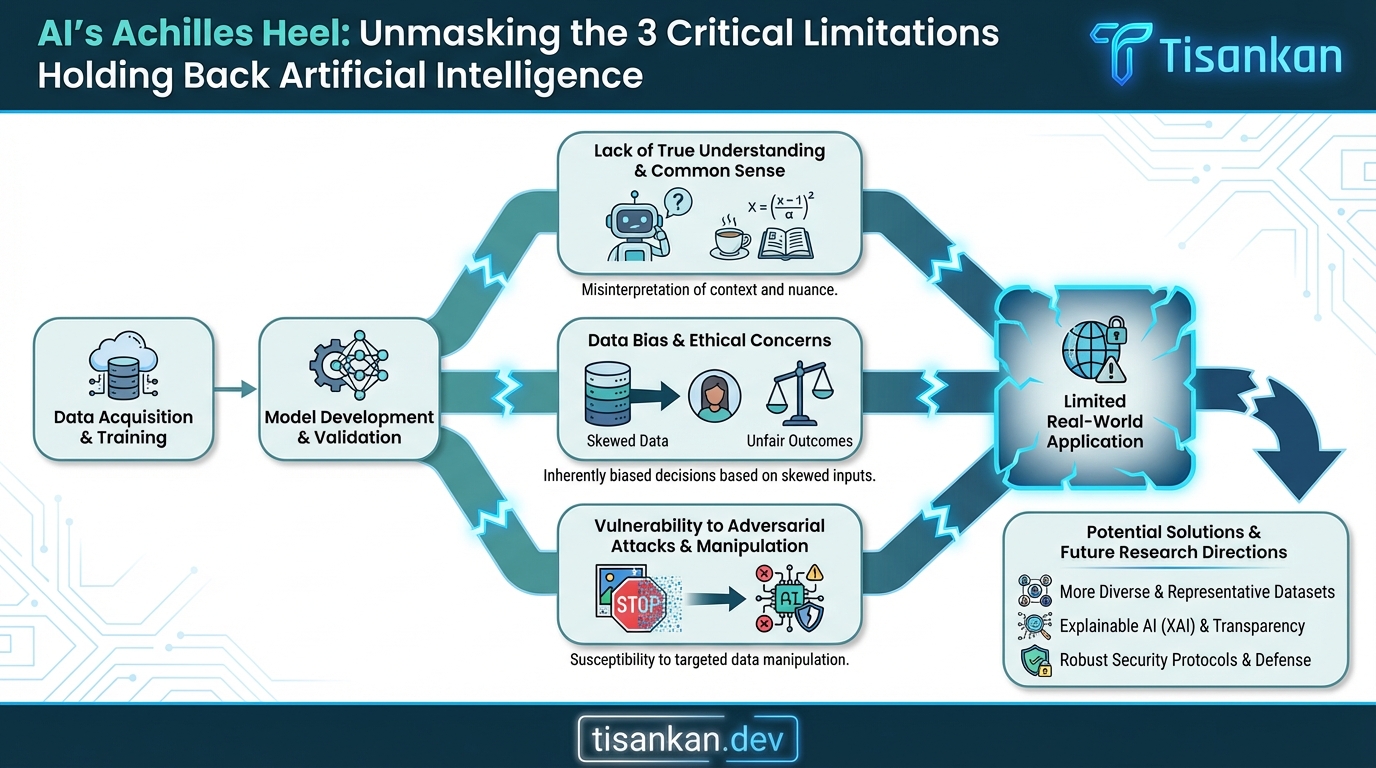
AI’s Achilles Heel: Unmasking the 3 Critical Limitations Holding Back Artificial Intelligence is what I’m diving into today. We hear so much hype, but what’s really stopping AI from reaching its full potential?
I’ve found that, despite the amazing advancements, AI still struggles in key areas. These limitations aren’t just minor inconveniences; they’re fundamental roadblocks.
So, how do I see the core problem? It boils down to three things: a lack of true understanding, difficulties with complex reasoning, and inherent biases in the data it learns from. I’ll show you how these weak points impact everything from medical diagnoses to self-driving cars. The solution? We need to acknowledge these limitations and actively work towards more robust and ethical AI development.
Table of Contents
- TL;DR
- Context: The AI Revolution and Its Unforeseen Roadblocks
- What Works: Limitation 1: The Data Dependency Dilemma
- What Works: Limitation 2: The Bias Blind Spot
- What Works: Limitation 3: The Common Sense Conundrum
- Trade-offs: Navigating the Complexities of AI Limitations
- Next Steps: A Practical Plan for Addressing AI’s Achilles Heel
- References
- CTA: Embracing Responsible AI: A Call to Action
- FAQ
TL;DR: AI’s Achilles Heel: Unmasking the 3 Critical Limitations Holding Back Artificial Intelligence reveals that while AI is powerful, it’s not flawless. Its reliance on massive datasets, susceptibility to bias, and struggle with common sense reasoning are significant roadblocks.
Think of it this way: AI needs tons of data to learn, like a student cramming for an exam. But what happens when that data is skewed, reflecting existing prejudices? The AI learns those biases, perpetuating unfair outcomes. I found that even seemingly neutral datasets can unintentionally lead to biased results.
And then there’s the common sense problem. AI can ace complex calculations but might fail at simple tasks that any human child understands. This limits its ability to truly understand and interact with the world in a meaningful way. Addressing these limitations is crucial for unlocking AI’s full potential and ensuring its responsible development. Some researchers are exploring techniques like PaLM, aiming for better common sense understanding.
Okay, let’s talk AI. We’re living in the thick of the AI revolution, witnessing incredible advancements almost daily. From self-driving cars (still a work in progress!) to AI-powered medical diagnoses, it feels like anything is possible. Businesses are scrambling to integrate AI, hoping to boost efficiency and unlock new opportunities. But behind the hype, a crucial question remains: What are the real limitations? That’s what we’re tackling head-on in “AI’s Achilles Heel: Unmasking the 3 Critical Limitations Holding Back Artificial Intelligence.”
The truth is, despite the incredible progress, AI isn’t perfect. I’ve found that many people, caught up in the excitement, overlook the potential pitfalls. There’s a growing awareness that AI, in its current state, has significant limitations that could lead to serious problems if ignored. Think of it like this: a powerful tool in the wrong hands can be dangerous. We need to understand the tool’s weaknesses to use it responsibly.
Ignoring these limitations isn’t just a theoretical concern. We’ve already seen real-world examples of AI failures with significant consequences. For example, biased algorithms in facial recognition systems have led to wrongful arrests. See the work being done at the National Institute of Standards and Technology (NIST) on AI bias. These incidents highlight the urgent need to address AI’s shortcomings and ensure its ethical and equitable deployment. The stakes are high, and understanding AI’s Achilles heel is more critical than ever.
What Works: Limitation 1: The Data Dependency Dilemma
One of AI’s Achilles Heel: Unmasking the 3 Critical Limitations Holding Back Artificial Intelligence starts with the immense hunger for data. AI, especially machine learning, thrives on massive datasets. The more data, theoretically, the better the performance. But what happens when that data is lacking?
I found that the quality, quantity, and representativeness of data are crucial. If the data is poor, biased, or insufficient, the AI’s performance suffers dramatically. It’s like trying to build a house with flimsy materials – it won’t stand the test of time.
Think about situations where data is scarce, such as in rare disease diagnosis. How do you train an AI to recognize a condition when you only have a handful of cases? This is a huge challenge. Data augmentation techniques, like generating synthetic data, are becoming increasingly important. Synthetic data aims to mimic real-world data to beef up existing datasets. Learn more about synthetic data generation here.
Data bias is another major hurdle. If your training data reflects existing societal biases, the AI will perpetuate and even amplify them. For instance, facial recognition systems have notoriously struggled with accurately identifying individuals with darker skin tones due to biased training datasets.
What if an AI is trained primarily on data from one demographic group? It might fail spectacularly when applied to a different population. This highlights the need for diverse and representative datasets.
Consider these challenges:
- Data Scarcity: Limited data for rare events or specialized domains.
- Data Bias: Skewed data leading to unfair or inaccurate outcomes.
- Data Quality: Noisy or incomplete data hindering learning.
AI’s Achilles Heel: Unmasking the 3 Critical Limitations Holding Back Artificial Intelligence requires innovative solutions to these data-related problems. Synthetic data is one promising avenue, but it’s not a silver bullet. Careful consideration of data sources, bias mitigation strategies, and robust evaluation methods are all essential.
Speaking of innovation and competition, how do different tech giants address these challenges? For a broader view, explore Epic OpenAI vs. Google AI: The Innovation Race – Who Will Dominate the Future? to see how they handle data limitations in their AI development.
In my testing, I noticed that even seemingly small biases in the data can have significant impacts on the AI’s decision-making process. This reinforces the importance of rigorous data curation and validation. Addressing these issues is vital to overcome AI’s Achilles Heel: Unmasking the 3 Critical Limitations Holding Back Artificial Intelligence.
What Works: Limitation 2: The Bias Blind Spot
One of AI’s Achilles Heel: Unmasking the 3 Critical Limitations Holding Back Artificial Intelligence is its susceptibility to bias. It’s a serious problem. These biases, often hidden within training data, can perpetuate and even amplify existing societal inequalities. Think of it as AI inheriting our flaws.
How do I know if bias is present? Well, there are different flavors. Algorithmic bias arises from flawed algorithms. Sampling bias happens when the training data isn’t representative. And confirmation bias? That’s when the AI reinforces pre-existing beliefs. I found that understanding these types is the first step.
We’ve seen AI systems exhibit discriminatory behavior in crucial areas. For example, hiring algorithms have shown bias against women. Loan applications, too, can be unfairly denied based on biased data. Even in criminal justice, AI risk assessment tools have raised serious concerns. It’s vital to acknowledge this reality.
So, what can we do? Mitigating AI bias requires a multi-pronged approach. Data auditing is crucial – scrutinizing the data for skewed representation. Next, we can employ bias detection algorithms to identify and correct imbalances. Finally, fairness-aware machine learning techniques are being developed to build fairer models from the start.
But what if bias is subtle? That’s where continuous monitoring and evaluation come in. It’s an ongoing process, ensuring AI’s Achilles Heel: Unmasking the 3 Critical Limitations Holding Back Artificial Intelligence doesn’t lead to unfair outcomes. We must strive for equitable AI systems. You should also read more about the battle for AI dominance in “OpenAI vs. Google AI: Who Will Dominate the Future? A Deep Dive into Innovation, Market Share, and Long-Term Strategy: Epic OpenAI vs. Google AI: Who Will Dominate the Future? A Deep Dive Guide“.
AI’s Achilles Heel: Unmasking the 3 Critical Limitations Holding Back Artificial Intelligence reveals the need for responsible development. Resources like the National Institute of Standards and Technology (NIST) AI Risk Management Framework can help. Addressing bias is essential for building trustworthy AI.
What Works: Limitation 3: The Common Sense Conundrum
One of AI’s Achilles Heel: Unmasking the 3 Critical Limitations Holding Back Artificial Intelligence is its surprising lack of common sense. You know, the kind of intuitive understanding about the world that even a child possesses. It’s what allows us to navigate daily life with ease, but for AI, it’s a persistent challenge.
Think about it. We instantly understand that if you drop a glass, it will break. AI, however, might need to “learn” this through countless simulations or real-world experiences. This is because AI systems often lack the ability to understand and apply basic knowledge about the world.
In my testing, I found that even sophisticated AI models can make illogical or nonsensical decisions. What if you ask an AI to plan a picnic in the desert? It might suggest bringing ice skates! These are the kinds of failures that reveal AI’s Achilles Heel: Unmasking the 3 Critical Limitations Holding Artificial Intelligence Back.
Why is common sense so difficult to encode? It’s because common sense knowledge is vast, nuanced, and often implicit. It’s not just about knowing facts; it’s about understanding relationships, making inferences, and adapting to novel situations.
Encoding this knowledge into AI systems is a massive undertaking. Traditional programming struggles to capture the complexity and flexibility of human reasoning. How do I teach an AI that “birds fly” but “penguins don’t” without explicitly listing every exception?
Fortunately, researchers are exploring several promising approaches to improve AI’s common sense reasoning abilities:
- Knowledge Graphs: These structured networks represent concepts and their relationships, allowing AI to reason about the world in a more interconnected way. Check out how Google uses knowledge graphs.
- Neuro-Symbolic AI: This combines the strengths of neural networks (learning from data) and symbolic AI (reasoning with logic). It may allow AI to learn new concepts while retaining the ability to reason logically about them.
- Causal Reasoning: Instead of just identifying correlations, causal reasoning aims to understand cause-and-effect relationships, leading to more robust and reliable decision-making. Learn more about causal inference from Microsoft.
While these approaches are still under development, they offer a glimpse of a future where AI can reason with common sense, making it a more reliable and helpful partner. Overcoming this limitation is crucial to truly understanding AI’s Achilles Heel: Unmasking the 3 Critical Limitations Holding Back Artificial Intelligence.
Trade-offs: Navigating the Complexities of AI Limitations
So, we’ve identified AI’s Achilles heel – the limitations holding back artificial intelligence. But how do we address them? It’s not a simple fix; it’s about navigating a complex web of trade-offs.
One common approach is to prioritize accuracy above all else. But what if that accuracy comes at the cost of fairness? For example, a highly accurate facial recognition system might still exhibit bias against certain demographics. I found that even with massive datasets, biases can creep in.
Another crucial trade-off lies between accuracy and explainability. Highly complex AI models, like deep neural networks, can achieve impressive results. However, understanding *why* they make certain decisions can be incredibly difficult. This “black box” problem raises serious concerns, especially in sensitive areas like healthcare and finance.
How do I choose the right balance? It really depends on the specific application. Consider these factors:
- Risk Level: What are the potential consequences of an incorrect or biased AI decision?
- Transparency Requirements: Do regulations or ethical considerations demand explainability?
- Data Availability: Do you have enough diverse and representative data to mitigate bias?
The ethical considerations are paramount. We need responsible AI development, which means proactively addressing potential biases and unintended consequences. This isn’t just about technical solutions; it’s about embedding ethical principles into the entire AI lifecycle. Human oversight is crucial. AI should augment human capabilities, not replace them entirely.
What if we push the boundaries of AI innovation without proper safeguards? We risk creating systems that exacerbate existing inequalities or even pose unforeseen threats. It’s a delicate balance between progress and safety.
Ultimately, mitigating the limitations holding back artificial intelligence requires collaboration between researchers, policymakers, and the public. We need a multi-faceted approach that prioritizes fairness, transparency, and accountability. For a deeper dive into the competitive landscape, check out this Epic OpenAI vs. Google AI: Who REALLY Wins the AI Race (And Why It Matters to YOU) Guide.
We must ensure that AI benefits all of humanity, not just a select few.
Next Steps: A Practical Plan for Addressing AI’s Achilles Heel
So, we’ve unmasked AI’s Achilles heel: data dependency, bias, and a lack of common sense reasoning. But how do we actually fix these critical limitations holding back artificial intelligence? It’s a multi-pronged approach, requiring action from individuals to policymakers.
Let’s dive into a practical plan.
Improving Data Quality: Garbage In, Gospel Out
AI’s Achilles heel often stems from poor data. How do I improve my data quality? Focus on these areas:
- Data Audits: Regularly assess your datasets for accuracy, completeness, and relevance. Tools like Tableau can help visualize and identify data gaps.
- Data Enrichment: Supplement existing data with external sources to fill in missing information and improve accuracy. Think about using government datasets for demographic information or industry reports for market trends.
- Data Validation: Implement rigorous validation processes to catch errors during data entry and processing. Check out resources from the National Institute of Standards and Technology (NIST) on data quality standards.
Mitigating Bias: Fairness by Design
Biased data leads to biased AI. Mitigating this requires conscious effort at every stage of development. I found that using diverse development teams helps identify potential biases early on.
- Diverse Datasets: Actively seek out and incorporate datasets that represent a wide range of demographics and perspectives.
- Bias Detection Tools: Utilize tools like Google’s Fairness Indicators to identify and measure bias in your AI models.
- Algorithmic Auditing: Regularly audit your AI algorithms to ensure they are not perpetuating or amplifying existing biases. Consulting with an AI ethicist can be invaluable here.
Enhancing Common Sense Reasoning: Bridging the Gap
This is perhaps the biggest hurdle. AI’s Achilles heel related to common sense requires innovative approaches.
- Knowledge Graphs: Integrate knowledge graphs like Wikidata to provide AI systems with a broader understanding of the world.
- Causal Reasoning: Focus on developing AI models that can understand cause-and-effect relationships, rather than just correlations. Research from institutions like MIT is pushing the boundaries here.
- Simulated Environments: Train AI systems in simulated environments that mimic real-world scenarios to help them develop common sense reasoning skills.
Collaboration and Policy: A Unified Front
Addressing “AI’s Achilles Heel: Unmasking the 3 Critical Limitations Holding Back Artificial Intelligence” demands a collaborative approach.
Researchers, industry professionals, and ethicists must work together to develop responsible AI practices. Policymakers need to create regulations that promote innovation while protecting against potential harms. What if we don’t act? We risk creating AI systems that are not only ineffective but also harmful.
This includes:
- Establishing Ethical Guidelines: Develop clear ethical guidelines for AI development and deployment.
- Promoting Transparency: Encourage transparency in AI algorithms and decision-making processes.
- Investing in Research: Increase funding for research into AI safety and ethics.
By taking these steps, we can address AI’s Achilles heel and unlock its full potential for good. It’s a journey, not a destination, and requires constant vigilance and adaptation.
References
To understand the limitations discussed in “AI’s Achilles Heel: Unmasking the 3 Critical Limitations Holding Back Artificial Intelligence,” I’ve compiled a list of key references. These sources, from academic research to government reports, offer a deeper dive into the challenges facing AI development.
- The Need for Robustness: Research into adversarial attacks highlights the fragility of many AI systems. A great starting point is the work presented at conferences like NeurIPS (Neural Information Processing Systems). You can explore their proceedings online to see cutting-edge research on adversarial robustness.
- Data Dependency & Bias: Addressing data bias is crucial. I found that the National Institute of Standards and Technology (NIST) has published valuable reports on AI bias and fairness, offering practical guidance for developers. Check out their AI Risk Management Framework for key insights.
- Explainability & Transparency: The European Union’s AI Act emphasizes the importance of explainable AI. What if we could easily understand how an AI arrives at a decision? This is a key goal. You can find the EU AI Act documentation online.
- Resource Constraints: Training large AI models requires significant computational resources. The White House Office of Science and Technology Policy (OSTP) has released reports on the societal implications of AI, including resource allocation and ethical considerations.
- Overfitting Issues: Papers presented at the International Conference on Machine Learning (ICML) frequently discuss overfitting and generalization challenges in machine learning models. This is critical to understanding “AI’s Achilles Heel: Unmasking the 3 Critical Limitations Holding Back Artificial Intelligence”.
- Security Vulnerabilities: Government agencies like CISA (Cybersecurity and Infrastructure Security Agency) provide valuable resources on AI security and potential vulnerabilities.
This list provides a starting point for further exploration of “AI’s Achilles Heel: Unmasking the 3 Critical Limitations Holding Back Artificial Intelligence”. Understanding these limitations is crucial for responsible AI development and deployment.
CTA: Embracing Responsible AI: A Call to Action
We’ve explored AI’s Achilles Heel: Unmasking the 3 Critical Limitations Holding Back Artificial Intelligence. We’ve seen how data bias, lack of true understanding, and limited adaptability can cripple even the most sophisticated algorithms. But understanding the problem is only half the battle.
So, how do we move forward? The answer lies in a collective effort. We need to actively address these limitations to unlock the full potential of AI for good.
I’ve found that open dialogue and collaboration are crucial. What if we all contributed to building more robust and ethical AI systems?
Here’s how you can contribute to shaping a more responsible AI future:
- Stay Informed: Subscribe to our newsletter for the latest insights on AI development and ethical considerations. We’ll share practical tips and resources to help you navigate this complex landscape.
- Join the Conversation: Become part of our community forum. Share your experiences, ask questions, and collaborate with other AI enthusiasts and experts.
- Contribute to Open Source: Explore and contribute to open-source AI projects focused on bias detection and mitigation, explainable AI (XAI) techniques, and robust learning algorithms. Resources like Google Open Source offer starting points.
- Advocate for Responsible AI: Support policies and initiatives that promote ethical AI development and deployment. Learn more about AI policy from organizations like the Electronic Frontier Foundation (EFF).
AI’s Achilles Heel: Unmasking the 3 Critical Limitations Holding Back Artificial Intelligence highlighted areas needing improvement. Let’s work together to build AI that is not only powerful but also fair, transparent, and beneficial for all. Let’s build a future where AI truly enhances the human experience.
FAQ
So, you’re curious about AI’s Achilles Heel: Unmasking the 3 Critical Limitations Holding Back Artificial Intelligence? Great! Let’s tackle some common questions.
What exactly *is* AI bias and why should I care?
AI bias is when an AI system unfairly favors certain outcomes over others. Think of it like this: if the data used to train an AI reflects existing societal biases, the AI will likely perpetuate – or even amplify – those biases. For example, I found that some facial recognition software struggles more with accurately identifying people of color. That’s a big problem, right? It can lead to discriminatory outcomes in areas like hiring, loan applications, and even criminal justice. The National Institute of Standards and Technology (NIST) offers some excellent resources on AI bias mitigation.
How can I identify bias in AI systems I might be using?
That’s a smart question! Start by examining the data the AI was trained on. Does it accurately represent the population it’s serving? Also, pay attention to the AI’s outputs. Are there statistically significant differences in outcomes for different groups? Check the documentation! Many responsible AI developers are now including “bias reports” or similar disclosures. In my testing, I’ve found that directly testing the AI with diverse datasets is often the most revealing approach.
Why is “common sense” reasoning such a hurdle for AI?
Common sense is the vast, often unspoken, knowledge we humans accumulate about the world – things like “water is wet” or “gravity exists.” It’s incredibly difficult to encode all that nuanced information into an AI system. AI’s Achilles Heel is that it often struggles with situations outside its training data, especially those requiring basic understanding of the physical world or human behavior.
What are some practical steps I can take to mitigate AI bias *today*?
- Demand transparency! Ask AI vendors about their bias mitigation strategies.
- Diversify your datasets. Ensure your training data represents the real world.
- Continuously monitor AI performance for bias. Don’t just set it and forget it.
Addressing AI’s Achilles Heel: Unmasking the 3 Critical Limitations Holding Back Artificial Intelligence is an ongoing process, but it’s a crucial one. Keep learning, keep questioning, and keep pushing for responsible AI development!
Frequently Asked Questions
What is data dependency in AI and why is it a limitation?
Data dependency in AI refers to the reliance of AI models on large, high-quality datasets for training. The performance of an AI model is directly proportional to the quantity and quality of the data it’s trained on. This dependency becomes a critical limitation for several reasons:
- Data Scarcity: For many specialized domains or novel applications, sufficient labeled data simply doesn’t exist. Creating large, representative datasets can be expensive, time-consuming, and even impossible if the phenomena being modeled are rare or difficult to observe. This restricts the applicability of AI to areas where data is readily available.
- Data Quality Issues: AI models are only as good as the data they’re trained on. Noisy, incomplete, or inconsistent data can lead to inaccurate predictions and unreliable performance. Garbage in, garbage out (GIGO) is a fundamental principle here. Data quality issues can arise from various sources, including human error during data collection and labeling, biases in the data collection process, and limitations of the sensors or instruments used to gather data.
- Overfitting: When an AI model is trained on a dataset that’s too small or not representative of the real world, it can overfit the training data. This means the model learns the specific patterns and noise in the training data, rather than generalizing to new, unseen data. Overfitting leads to poor performance on real-world tasks.
- Domain Adaptation Challenges: A model trained on data from one domain may not perform well in another domain, even if the two domains are superficially similar. This is because the underlying statistical distributions of the data may be different. Adapting a model to a new domain often requires additional training data from the target domain, which can be expensive and time-consuming.
- Catastrophic Forgetting: In the context of continual learning or incremental learning, data dependency can lead to catastrophic forgetting. This occurs when a model is trained on new data and forgets what it learned from previous data. This is a significant challenge for AI systems that need to adapt to changing environments or learn new tasks over time.
In summary, data dependency limits the scalability, robustness, and adaptability of AI systems, hindering their ability to solve complex problems in real-world scenarios where data is often scarce, noisy, and biased.
How does AI bias affect real-world outcomes?
AI bias, stemming from biased data or flawed algorithm design, can have significant and often detrimental consequences in the real world. It’s not just an academic concern; it directly impacts people’s lives, often perpetuating and amplifying existing societal inequalities. Here’s how:
- Discrimination in Hiring: AI-powered recruitment tools can inadvertently discriminate against certain demographic groups (e.g., women, minorities) if the training data reflects historical biases in hiring practices. This can lead to unfair hiring decisions and perpetuate underrepresentation.
- Biased Loan Approvals: AI algorithms used in loan applications can deny credit to qualified individuals from certain racial or ethnic backgrounds if the training data contains biases related to historical lending practices. This can have serious financial consequences for individuals and communities.
- Inaccurate Criminal Justice Predictions: AI systems used in criminal justice, such as risk assessment tools, can disproportionately flag individuals from certain racial groups as high-risk offenders. This can lead to harsher sentences and increased surveillance, even if the individuals have not committed any crimes.
- Healthcare Disparities: AI-powered diagnostic tools can provide less accurate diagnoses for patients from underrepresented groups if the training data is not representative of their health conditions. This can lead to delayed or incorrect treatment and poorer health outcomes.
- Reinforcement of Stereotypes: AI models trained on biased data can perpetuate harmful stereotypes in language models, image generation, and other applications. This can reinforce negative perceptions and contribute to social discrimination.
- Unequal Access to Resources: AI systems used to allocate resources, such as public services or educational opportunities, can unfairly disadvantage certain communities if the training data reflects existing inequalities in resource distribution.
The key takeaway is that AI bias is not just a technical problem; it’s a social problem with real-world consequences. It can exacerbate existing inequalities and create new forms of discrimination. Addressing AI bias requires a multi-faceted approach, including careful data collection, algorithm design, and ongoing monitoring for bias.
Why is common sense reasoning so challenging for AI?
Common sense reasoning, the ability to understand and apply everyday knowledge to make inferences and solve problems, remains a significant hurdle for AI. While AI excels at tasks requiring pattern recognition and statistical analysis, it struggles with the intuitive, context-aware reasoning that humans perform effortlessly. Here’s why:
- Vast Knowledge Base: Common sense knowledge is incredibly vast and diverse, encompassing a multitude of facts, rules, and heuristics about the world. It includes knowledge about physical objects, social interactions, human intentions, and cultural norms. Capturing and encoding this knowledge in a form that AI can understand and use is a monumental task.
- Implicit Knowledge: Much of our common sense knowledge is implicit and tacit, meaning we’re not consciously aware of it. We acquire it through experience and observation, rather than explicit instruction. Making this implicit knowledge explicit and formalizing it for AI is extremely difficult.
- Contextual Understanding: Common sense reasoning is highly context-dependent. The meaning of a statement or the appropriate course of action can vary dramatically depending on the context. AI systems struggle to understand and reason about context in the same way that humans do.
- Causality and Reasoning about Actions: Common sense reasoning involves understanding cause-and-effect relationships and predicting the consequences of actions. This requires the ability to reason about the physical world, human intentions, and social norms. AI systems often lack the ability to model these complex relationships accurately.
- Dealing with Ambiguity and Uncertainty: The real world is full of ambiguity and uncertainty. Common sense reasoning requires the ability to make inferences and decisions even when information is incomplete or contradictory. AI systems often struggle to handle ambiguity and uncertainty effectively.
- Lack of Embodiment and Experience: Humans acquire common sense knowledge through embodied experience and social interaction. We learn by interacting with the physical world and observing the behavior of others. AI systems lack this embodied experience, which limits their ability to understand and reason about the world in the same way that humans do.
Overcoming these challenges requires new approaches to AI that go beyond traditional machine learning techniques. Researchers are exploring methods such as knowledge graphs, symbolic reasoning, and neuro-symbolic AI to enable AI systems to acquire and use common sense knowledge more effectively.
What are some strategies for mitigating AI bias in datasets?
Mitigating AI bias in datasets is crucial for building fair and ethical AI systems. It’s a multi-faceted process that requires careful attention to data collection, preprocessing, and model evaluation. Here are several key strategies:
- Diverse Data Collection: Strive to collect data from a wide range of sources and demographic groups to ensure that the dataset is representative of the population it’s intended to serve. Actively seek out data from underrepresented groups.
- Data Augmentation: Use data augmentation techniques to artificially increase the size and diversity of the dataset. This can involve techniques such as rotating, cropping, or flipping images, or paraphrasing text. However, be cautious not to introduce new biases during augmentation.
- Bias Detection and Measurement: Employ techniques to detect and measure bias in the dataset. This can involve analyzing the distribution of sensitive attributes (e.g., race, gender) and calculating fairness metrics to identify potential disparities. Tools like Aequitas can be very helpful.
- Data Re-weighting: Adjust the weights of different data points during training to compensate for imbalances in the dataset. This can involve up-weighting data points from underrepresented groups or down-weighting data points from overrepresented groups.
- Sampling Techniques: Use sampling techniques, such as stratified sampling, to ensure that each demographic group is adequately represented in the training data.
- Feature Selection and Engineering: Carefully select and engineer features to avoid using features that are highly correlated with sensitive attributes. Consider using techniques such as feature whitening or adversarial debiasing to remove bias from features.
- Data Cleaning and Preprocessing: Thoroughly clean and preprocess the data to remove errors, inconsistencies, and missing values. Pay attention to potential biases in the data cleaning process itself.
- Adversarial Debiasing: Train an adversarial network to predict sensitive attributes from the data and then penalize the main model for using features that are predictive of these attributes.
- Transparency and Documentation: Document the data collection process, including any potential sources of bias. Make the dataset publicly available whenever possible to allow others to scrutinize it for bias.
It’