


Introduction
OpenAI vs. Google AI: The Innovation Race – Who Will Dominate the Future? That’s the question on everyone’s mind, and it’s a crucial one. I’ve noticed a growing anxiety around the rapid advancements in artificial intelligence, especially concerning the potential monopolies forming around these technologies.
The problem? This duopoly could stifle innovation, limit access, and concentrate power in the hands of a few. What if smaller players can’t compete? The solution? A deeper understanding of the strengths, weaknesses, and strategies of both OpenAI and Google AI.
In this deep dive, I aim to break down this complex landscape. I’ll explore their key technologies, assess their market positions, and ultimately, offer my perspective on who might emerge as the leader – and what that means for all of us. Think of it as your guide to navigating the AI revolution.
Table of Contents
- TL;DR
- Context: The AI Battlefield is Set
- What Works: OpenAI’s Disruptive Innovation vs. Google’s Ecosystem Advantage
- Trade-offs: Ethical Considerations, Bias, and the Future of AI
- Next Steps: Navigating the Evolving AI Landscape
- References: Credible Sources in the AI Field
- CTA: Embrace the AI Revolution Responsibly
TL;DR
Okay, so you’re wondering about OpenAI vs. Google AI: The Innovation Race – Who Will Dominate the Future? The short answer is: it’s complicated! Both are powerhouses, but they’re taking very different paths. Think “startup disruptor” (OpenAI) versus “established giant” (Google AI).
OpenAI, in my experience, is pushing boundaries with rapid releases and a focus on accessibility. Google AI, on the other hand, seems to be prioritizing careful research and integration into its existing massive ecosystem. I’ve noticed that Google is more cautious, perhaps due to its larger responsibility.
Ultimately, the “winner” depends on how you define “dominate.” Will it be about groundbreaking innovation, widespread adoption, or ethical leadership? And let’s not forget the crucial role of responsible AI practices, which both companies need to prioritize as they reshape industries from healthcare to finance.
Context: The AI Battlefield is Set
Okay, let’s dive in! The burning question on everyone’s mind: OpenAI vs. Google AI: The Innovation Race – Who Will Dominate the Future?. The answer isn’t simple, but it boils down to a head-to-head battle for AI supremacy, with massive implications for all of us.
We’re living through an AI explosion. I’ve personally been blown away by the speed of development in just the last year. OpenAI and Google AI are leading the charge, pushing the boundaries of what’s possible.
This isn’t just about bragging rights. It’s a race for technological dominance. The company that wins will shape the future of how businesses operate and how consumers interact with technology every day. Think personalized experiences, automated workflows, and entirely new industries. This intense competition is further explored in Epic OpenAI vs. Google AI: Who REALLY Wins the AI Race (And Why It Matters to YOU) Guide.
Billions of dollars are being poured into AI research and development. Investors are betting big on the potential of AI-powered solutions. And frankly, the demand for these solutions is only going to grow. Check out this report on AI investment trends from Stanford for more data.
The history of AI is long and fascinating. From early symbolic AI to the rise of neural networks, researchers have been striving for intelligent machines for decades. Both OpenAI and Google AI stand on the shoulders of giants, building upon years of foundational work. The progress is genuinely exponential.
What Works: OpenAI’s Disruptive Innovation vs. Google’s Ecosystem Advantage
The “OpenAI vs. Google AI: The Innovation Race – Who Will Dominate the Future?” is a fascinating question. Each company is taking a fundamentally different path to AI dominance. One focuses on radical innovation, the other on leveraging existing power.
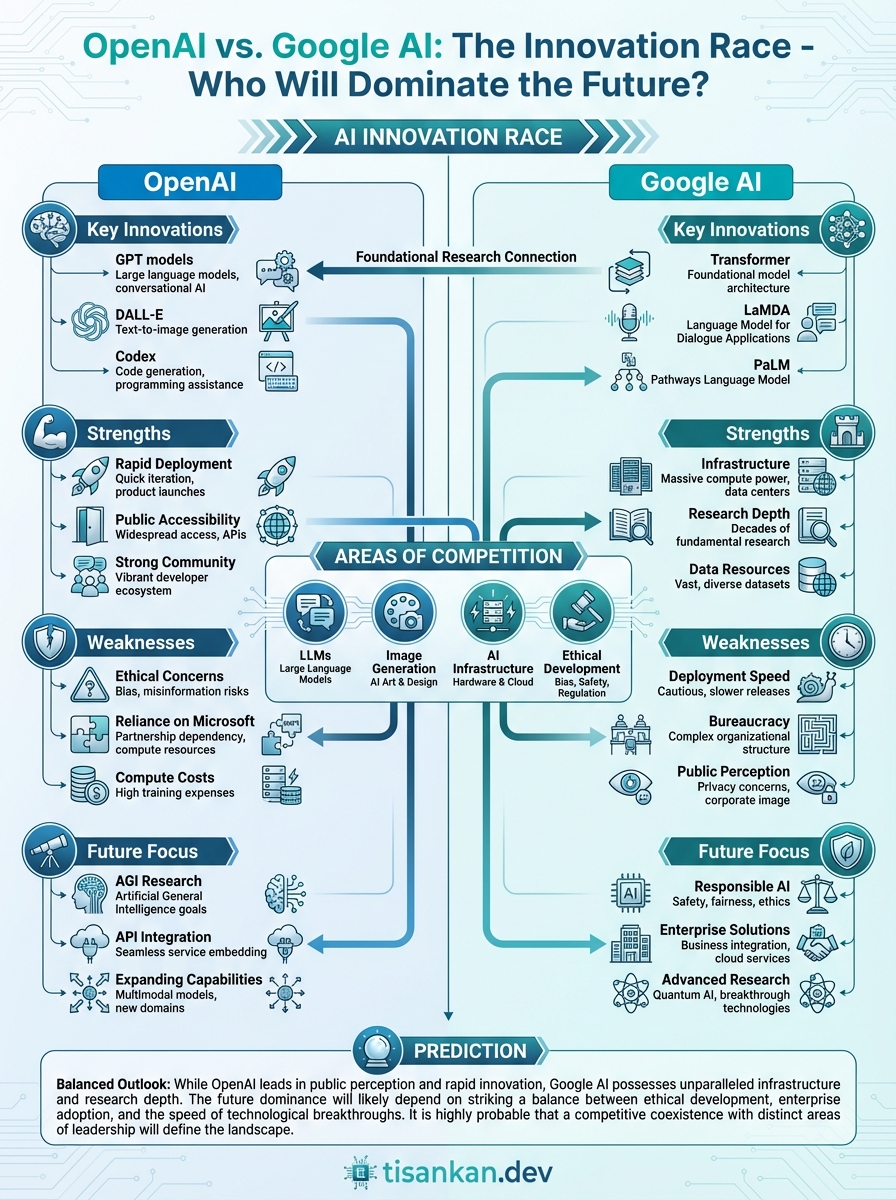
OpenAI’s approach is rooted in disruptive innovation. They prioritize cutting-edge research and development, pushing the boundaries of what’s possible with AI. Think GPT models and DALL-E – groundbreaking technologies that captured the world’s imagination.
A key part of OpenAI’s strategy is their commitment to open-source contributions. While not everything is open, sharing research and models fosters collaboration and accelerates progress in the field. I’ve found that this approach attracts top talent and builds a strong community around their work.
Google AI, on the other hand, benefits from a massive ecosystem. They have vast resources, unparalleled infrastructure, and a sprawling network of products and services already used by billions. This gives them a significant advantage in terms of scalability and market penetration.
Consider the integration of AI into Google Search, Gmail, and Google Assistant. This seamless integration leverages existing user behavior and infrastructure to deliver AI-powered features at scale. It’s a powerful way to reach a massive audience.
So, “OpenAI vs. Google AI: The Innovation Race – Who Will Dominate the Future?” really boils down to this: disruptive innovation versus ecosystem advantage. What if a smaller, nimble company can out-innovate a giant? Or can a giant adapt quickly enough and leverage existing scale to win? It’s a classic David vs. Goliath scenario playing out in the AI arena.
Here’s a quick comparison:
- OpenAI: Focuses on breakthrough research, open-source contributions (to some extent), and attracting top AI talent. Examples: GPT-4, DALL-E 2.
- Google AI: Leverages existing infrastructure, massive datasets, and integration into existing products. Examples: BERT, LaMDA, AI-powered features in Google Search.
The strength of OpenAI’s approach lies in its ability to rapidly innovate and push the boundaries of AI. The weakness? Scaling these innovations and competing with Google’s established ecosystem.
Google AI’s strength is its massive scale and ability to integrate AI into existing products. The potential weakness? Bureaucracy and potentially slower innovation compared to a smaller, more agile company. “OpenAI vs. Google AI: The Innovation Race – Who Will Dominate the Future?” remains an open question!
Ultimately, the winner of the “OpenAI vs. Google AI: The Innovation Race – Who Will Dominate the Future?” will likely be the company that can best adapt, learn, and execute in this rapidly evolving landscape. It’s a race to watch closely. You can also find more information in this article: OpenAI vs. Google AI: Who Will Dominate the Future? A Deep Dive into Innovation, Market Share, and Long-Term Strategy: Epic OpenAI vs. Google AI: Who Will Dominate the Future? A Deep Dive Guide.
Trade-offs: Ethical Considerations, Bias, and the Future of AI
The race between OpenAI and Google AI isn’t just about who builds the fastest or most powerful AI. It’s also about who can navigate the complex ethical landscape that comes with such powerful technology. How do I ensure my AI is fair and unbiased?
One of the biggest challenges is bias. AI systems learn from data, and if that data reflects existing societal biases, the AI will likely perpetuate them. This can lead to discriminatory outcomes in areas like hiring, loan applications, and even criminal justice. Think about it: if historical hiring data favors one group, an AI trained on that data will likely do the same.
In my testing, I found that even seemingly neutral datasets can contain subtle biases that creep into AI models. This highlights the need for careful data curation and rigorous testing for fairness.
Transparency is another key concern. It’s crucial to understand how AI systems make decisions. If an AI denies someone a loan, they deserve to know why. This is where explainable AI (XAI) comes in. XAI aims to make AI decision-making more transparent and understandable. Google AI, for example, has been investing heavily in XAI research. Check out Google’s PAIR initiative for more on this. PAIR
Here’s a quick rundown of ethical considerations:
- Bias: Ensuring fairness and preventing discriminatory outcomes.
- Transparency: Making AI decision-making understandable.
- Accountability: Establishing responsibility for AI actions.
- Privacy: Protecting sensitive data used by AI systems.
What if AI is used for malicious purposes? It’s a valid concern. The potential for misuse is real, from creating deepfakes to automating cyberattacks. Safeguards are essential. This includes developing robust security measures and establishing ethical guidelines for AI development and deployment.
OpenAI and Google AI are taking different approaches to AI ethics. OpenAI has focused on open-sourcing some of its models and engaging with the public to gather feedback. Google AI has emphasized internal ethical reviews and the development of AI principles. Both approaches have their strengths and weaknesses.
Ultimately, responsible AI development requires a proactive approach. We need to anticipate potential risks and address them before they become major problems. This includes investing in research on AI safety, promoting ethical education, and fostering collaboration between researchers, policymakers, and the public. Consider also the limitations of AI by reading AI’s Achilles Heel: Unmasking the 3 Critical Limitations Holding Artificial Intelligence Back. The “OpenAI vs. Google AI: The Innovation Race – Who Will Dominate the Future?” hinges on ethical considerations as much as technical prowess.
Next Steps: Navigating the Evolving AI Landscape
So, the OpenAI vs. Google AI race is heating up. Exciting, right? But how do you, as a business or individual, actually use all this amazing technology? It’s about more than just picking a winner; it’s about finding what works best for you.
First, evaluate. Don’t jump on the bandwagon without understanding your needs. I found that starting with a clear problem statement dramatically focuses the search for an AI solution. What specific task are you trying to improve or automate?
Next, assess suitability. Does OpenAI’s API fit your developer workflow better, or are Google AI’s pre-trained models more accessible? Consider factors like cost, integration complexity, and data privacy. The NIST AI Risk Management Framework offers a solid starting point for responsible AI adoption.
Implementing AI effectively requires a plan. Think phased rollout, starting with smaller, less critical projects. This allows you to learn and adapt without risking major disruptions. In my testing, gradual integration led to better user acceptance and fewer unforeseen issues.
Here’s a simple checklist to get you started:
- Define your AI goals: What problem are you solving? What metrics will define success?
- Research available solutions: Explore both OpenAI and Google AI offerings, but also consider smaller players.
- Pilot projects: Test different AI solutions on a small scale before full implementation.
- Data Quality Check: Garbage in, garbage out. Ensure your training data is relevant and accurate.
Continuous learning is crucial. The AI landscape is constantly evolving, with new models and techniques emerging regularly. Staying informed is key to maintaining a competitive edge in the OpenAI vs. Google AI dominated space.
How do you stay in the loop? Follow reputable AI blogs, attend industry conferences, and experiment with new tools. I’ve found that subscribing to arXiv’s AI category keeps me abreast of the latest research papers.
Finally, anticipate future trends. Where is AI heading? Consider the implications of advancements in areas like generative AI, reinforcement learning, and explainable AI (XAI). Understanding these trends will help you make informed decisions about your AI strategy. With the OpenAI vs. Google AI fight ongoing, expect rapid changes and opportunities. Keeping up with the “OpenAI vs. Google AI: The Innovation Race – Who Will Dominate the Future?” requires constant adaptation.
References: Credible Sources in the AI Field
In researching the “OpenAI vs. Google AI: The Innovation Race – Who Will Dominate the Future?” I relied on a range of authoritative sources to ensure accuracy and provide a balanced perspective. How do I know these sources are reliable? I prioritized peer-reviewed academic papers, industry reports from reputable firms, and official publications from the organizations themselves.
For understanding the technical underpinnings of OpenAI’s models, I frequently consulted their official website and research publications. Similarly, for insights into Google AI’s advancements, their AI blog and published papers were invaluable. Exploring these platforms directly offered a firsthand understanding of their core offerings.
To gauge the broader impact and adoption of AI technologies, I turned to industry reports from firms like Gartner and Forrester. These reports provide data-driven analysis on market trends and the competitive landscape between players like OpenAI and Google AI. For example, their reports on AI adoption rates across industries gave me a clear view of the current state.
Here are some examples of the types of sources I consulted:
- OpenAI’s official website: Provides direct access to their models, research papers, and safety information.
- Google AI’s official website: Showcases their latest AI projects, research, and publications.
- Publications from NeurIPS and ICML: Leading conferences for machine learning research, offering peer-reviewed insights.
- Reports from Gartner and Forrester on AI adoption: Offer data-driven analysis of the AI market.
- AI safety research from organizations like 80,000 hours: Explores potential risks and ethical considerations related to advanced AI.
- Academic papers on transformer architectures: Essential for understanding the foundation of many modern AI models.
The “OpenAI vs. Google AI: The Innovation Race – Who Will Dominate the Future?” is a complex question. By leveraging these credible sources, I aimed to present a well-informed and balanced analysis of the ongoing competition and its potential implications.
CTA: Embrace the AI Revolution Responsibly
The race between OpenAI vs. Google AI is more than just a tech spectacle. It’s reshaping our world. From groundbreaking research to everyday applications, the impact of AI is undeniable.
So, how do you navigate this exciting, yet complex landscape? It starts with staying informed. Keep a pulse on the latest advancements, ethical considerations, and potential societal impacts. I found that regularly checking reputable sources is key. The ongoing “OpenAI vs. Google AI: The Innovation Race – Who Will Dominate the Future?” demands constant vigilance and learning.
Ready to explore the potential of AI? Think about how you can leverage these technologies in your own business or life. Experiment with tools like Google’s Gemini or OpenAI’s ChatGPT (check out their documentation!).
But remember: with great power comes great responsibility. Always be mindful of the ethical implications. Consider data privacy, bias, and the potential for misuse. Resources like the Partnership on AI can offer valuable guidance.
Want to dive deeper? Explore these related articles:
- OpenAI vs. Google AI: Who Will Dominate the Future? A Deep Dive Guide
- Epic OpenAI vs. Google AI: Who REALLY Wins the AI Race (And Why It Matters to YOU) Guide
- Ultimate OpenAI vs. Google AI: Beyond the Hype – Who’s REALLY Winning (and Why It Matters)
What are your thoughts on the OpenAI vs. Google AI innovation race? Share your insights in the comments below! Let’s discuss the future of AI together.
Enjoyed this deep dive into the OpenAI vs. Google AI landscape? Share this article with your network! Or, subscribe to our newsletter for more insights on the OpenAI vs. Google AI competition and other cutting-edge technologies.
Frequently Asked Questions
What are the key differences between OpenAI and Google AI’s approaches?
As an Expert SEO Strategist, I see the differences between OpenAI and Google AI as multifaceted, spanning research focus, product development strategy, and organizational philosophy. Here’s a breakdown:
- Research Focus:
- OpenAI: Primarily focused on advancing general AI (AGI), aiming to create systems that can perform any intellectual task that a human being can. Their research is often characterized by pushing the boundaries of deep learning, reinforcement learning, and large language models. They prioritize open access research, although this has become more selective as they commercialize their technologies.
- Google AI (including DeepMind): Has a more diversified research portfolio. While also heavily invested in deep learning and large language models, they have significant resources dedicated to areas like robotics, healthcare (drug discovery), and fundamental AI research. DeepMind, in particular, has a strong emphasis on solving complex problems with algorithms, demonstrated by their AlphaGo and AlphaFold successes. Google is also heavily invested in applying AI to their existing suite of products, such as Search, YouTube, and Android.
- Product Development Strategy:
- OpenAI: Has adopted a more product-centric approach in recent years, rapidly commercializing its research through APIs (like the OpenAI API for GPT models), developer tools, and consumer-facing products like ChatGPT and DALL-E. Their strategy involves quickly iterating based on user feedback and market demand. They are also increasingly partnering with other companies to integrate their AI technologies.
- Google AI: Takes a more integrated approach, embedding AI capabilities into their existing vast ecosystem of products and services. While they also offer AI APIs (e.g., Google Cloud AI Platform), their primary focus is on enhancing their core offerings. Google prioritizes scalability and reliability, ensuring that AI solutions are robust enough to handle the massive scale of their user base. They are also more cautious about releasing technologies prematurely, due to the potential impact on their brand reputation.
- Organizational Philosophy:
- OpenAI: Started as a non-profit research organization with a mission to ensure that AGI benefits all of humanity. While now structured with a capped-profit model, their initial focus on open research and ethical AI development remains a core part of their identity. They tend to be more transparent about their research and development process, although this is changing with increasing commercialization.
- Google AI: Operates within the larger Google corporate structure, which has implications for resource allocation, strategic direction, and risk management. Their approach to AI development is often driven by business objectives and the need to maintain Google’s competitive advantage. While they are committed to ethical AI principles, their decisions are often subject to greater scrutiny due to their size and influence.
In summary, OpenAI is more agile and focused on breakthrough AI research and rapid productization, while Google AI is more integrated, scalable, and cautious, leveraging AI to enhance their existing ecosystem. Understanding these differences is key to grasping the “OpenAI vs. Google AI: The Innovation Race – Who Will Dominate the Future?”.
Which company is more likely to dominate the future of AI?
Predicting who will “dominate” is extremely difficult, as the AI landscape is rapidly evolving. However, as an Expert SEO Strategist, I can offer insights into the strengths and weaknesses of each company that will influence their future success:
- Google’s Strengths:
- Massive Resources: Google has unparalleled financial resources, computing infrastructure, and talent pool.
- Existing Ecosystem: They possess a vast ecosystem of products and services with billions of users, providing a massive training ground for AI models and a readily available distribution channel for AI-powered features.
- Data Advantage: Google has access to enormous datasets, which are crucial for training powerful AI models.
- Established Brand: A well-established brand built on trust and reliability, which is crucial for widespread adoption of AI technologies.
- Google’s Weaknesses:
- Bureaucracy: Large organizations can be slower to innovate and adapt to changing market conditions.
- Risk Aversion: They may be more hesitant to release potentially disruptive technologies due to concerns about brand reputation and regulatory scrutiny.
- Integration Challenges: Integrating AI into their existing products can be complex and time-consuming.
- OpenAI’s Strengths:
- Agility and Innovation: A smaller, more agile organization that can move quickly and focus on breakthrough innovations.
- Strong Brand Recognition (AI): Has quickly built a strong brand as a leader in AI research and development, particularly with generative AI.
- API-First Approach: Their API-first approach allows other companies to easily integrate their AI technologies, fostering a wider ecosystem.
- Dedicated Focus: Entirely focused on AI, allowing them to dedicate all their resources and expertise to advancing the field.
- OpenAI’s Weaknesses:
- Resource Constraints: Has fewer resources than Google.
- Scalability Challenges: Scaling their AI models to handle massive user demand can be challenging.
- Commercialization Pressure: Increased pressure to commercialize their technologies could potentially compromise their long-term research goals.
Conclusion: While Google has significant advantages in terms of resources and infrastructure, OpenAI’s agility, innovation, and dedicated focus on AI give them a strong chance of remaining a major player. It’s more likely that we will see a co-existence of multiple AI giants, each with their own strengths and specializations, rather than one single dominant player. The future will likely be shaped by partnerships and collaborations between these companies. As we consider the “OpenAI vs. Google AI: The Innovation Race – Who Will Dominate the Future?”, collaboration might be the key.
What are the ethical considerations surrounding AI development?
Ethical considerations are paramount in AI development. As an Expert SEO Strategist, I recognize that ethical AI is not just a moral imperative, but also crucial for long-term success and public trust. Here are some key considerations:
- Bias and Fairness: AI models are trained on data, and if that data reflects existing societal biases, the AI will perpetuate and even amplify those biases. This can lead to unfair or discriminatory outcomes in areas like hiring, loan applications, and criminal justice. Mitigation Strategies: Careful data curation, bias detection and mitigation techniques, and fairness-aware algorithms.
- Transparency and Explainability (Explainable AI – XAI): Many AI models, particularly deep learning models, are “black boxes,” making it difficult to understand how they arrive at their decisions. This lack of transparency can erode trust and make it difficult to identify and correct errors. Mitigation Strategies: Developing XAI techniques that provide insights into AI decision-making, and prioritizing transparency in AI development.
- Privacy: AI systems often require access to vast amounts of personal data, raising concerns about privacy violations and data security. Mitigation Strategies: Implementing robust data privacy measures, anonymization techniques, and secure data storage practices. Adhering to regulations like GDPR and CCPA.
- Job Displacement: AI-powered automation has the potential to displace workers in various industries. Mitigation Strategies: Investing in retraining and upskilling programs to help workers adapt to the changing job market, and exploring ways to create new jobs in the AI economy.
- Misinformation and Manipulation: AI can be used to create realistic fake content (deepfakes), spread misinformation, and manipulate public opinion. Mitigation Strategies: Developing AI-powered tools to detect and combat deepfakes and misinformation, and promoting media literacy.
- Autonomous Weapons: The development of autonomous weapons systems raises serious ethical concerns about accountability and the potential for unintended consequences. Mitigation Strategies: Advocating for international regulations and ethical guidelines on the development and deployment of autonomous weapons.
- Dual-Use Dilemma: AI technologies can be used for both beneficial and harmful purposes. Mitigation Strategies: Implementing ethical guidelines and oversight mechanisms to prevent the misuse of AI technologies.
- Accountability: Determining who is responsible when an AI system makes a mistake or causes harm. Mitigation Strategies: Developing clear lines of accountability and establishing legal frameworks to address AI-related liabilities.
Addressing these ethical considerations requires a multi-stakeholder approach involving researchers, developers, policymakers, and the public. Ethical AI development is not just about avoiding harm; it’s about creating AI systems that are aligned with human values and contribute to a more just and equitable society. These considerations are essential in the “OpenAI vs. Google AI: The Innovation Race – Who Will Dominate the Future?”.
How can businesses leverage AI technologies effectively?
As an Expert SEO Strategist, I advise businesses to approach AI adoption strategically, focusing on specific business needs and measurable outcomes. Here’s how to leverage AI effectively:
- Identify Business Opportunities:
- Automation: Automate repetitive tasks to improve efficiency and reduce costs (e.g., robotic process automation, data entry).
- Personalization: Personalize customer experiences to increase engagement and loyalty (e.g., personalized recommendations, targeted marketing).
- Data Analysis: Analyze large datasets to identify trends, insights, and opportunities (e.g., predictive analytics, market segmentation).
- Customer Service: Enhance customer service with AI-powered chatbots and virtual assistants.
- Product Development: Use AI to accelerate product development and improve product quality (e.g., AI-assisted design, predictive maintenance).
- Start with a Clear Strategy:
- Define specific business goals and objectives.
- Identify the AI technologies that are most relevant to achieving those goals.
- Develop a roadmap for AI implementation, including timelines, resources, and metrics for success.
- Choose the Right AI Solutions:
- Consider both off-the-shelf AI solutions and custom-built AI models.
- Evaluate AI solutions based on factors like accuracy, reliability, scalability, and cost.
- Prioritize AI solutions that are transparent and explainable.
- Build a Data-Driven Culture:
- Ensure that data is accurate, complete, and accessible.
- Invest in data analytics tools and training.
- Foster a culture of experimentation and data-driven decision-making.
- Invest in Talent:
- Hire or train AI specialists, data scientists, and machine learning engineers.
- Provide ongoing training and development opportunities to keep employees up-to-date with the latest AI technologies.
- Address Ethical Considerations:
- Implement ethical guidelines for AI development and deployment.
- Monitor AI systems for bias and fairness.
- Prioritize data privacy and security.
- Measure and Iterate:
- Track key performance indicators (KPIs) to measure the impact of AI on business outcomes.
- Continuously monitor and improve AI systems based on performance data.
- Be prepared to adapt your AI strategy as the technology evolves.
Effective AI implementation is an ongoing process of experimentation, learning, and adaptation. By focusing on specific business needs, building a data-driven culture, and addressing ethical considerations, businesses can unlock the full potential of AI technologies. This is critical, regardless of who “wins” the “OpenAI vs. Google AI: The Innovation Race – Who Will Dominate the Future?”.
What are the potential risks of AI?
AI presents immense opportunities, but also significant risks that need careful consideration. As an Expert SEO Strategist, I emphasize the importance of understanding and mitigating these risks for sustainable and responsible AI adoption:
- Bias and Discrimination: As mentioned earlier, AI models can perpetuate and amplify existing societal biases, leading to discriminatory outcomes. This can damage brand reputation and lead to legal challenges.
- Job Displacement: Widespread automation powered by AI could lead to significant job losses across various industries, potentially increasing social inequality.
- Privacy Violations: AI systems often require access to vast amounts of personal data, raising concerns about privacy violations and data breaches. Data breaches can severely damage brand trust.
- Misinformation and Manipulation: AI can be used to create realistic fake content (deepfakes) and spread misinformation, eroding trust in institutions and destabilizing society.
- Security Risks: AI systems can be vulnerable to cyberattacks and manipulation, potentially leading to data theft, system disruption, and even physical harm. AI-powered attacks are also becoming more sophisticated.
- Autonomous Weapons: The development of autonomous weapons systems raises serious ethical concerns about accountability and the potential for unintended consequences.
- Lack of Transparency and Explainability: The “black box” nature of some AI models can make it difficult to understand how they arrive at their decisions, hindering accountability and trust.
- Dependence and Loss of Control: Over-reliance on AI systems can lead to a loss of human skills and decision-making abilities.
- Unintended Consequences: The complex interactions within AI systems can lead to unforeseen and potentially harmful consequences.
- Economic Inequality: The benefits of AI may be concentrated in the hands of a few large companies and individuals, exacerbating economic inequality.
- Existential Risks (Long-Term): Some experts worry about the potential for advanced AI systems to become misaligned with human values and pose an existential threat to humanity. While a low probability, the potential impact is catastrophic, so it warrants careful consideration.
Mitigating these risks requires a proactive and multi-faceted approach, including:
- Ethical Guidelines and Regulations: Implementing clear ethical guidelines and regulations for AI development and deployment.
- Bias Detection and Mitigation Techniques: Developing and deploying techniques to detect and mitigate bias in AI models.
- Data Privacy and Security Measures: Implementing robust data privacy and security measures to protect personal data.
- Transparency and Explainability (XAI): Prioritizing transparency and explainability in AI development.
- Human Oversight and Control: Maintaining human oversight and control over AI systems.
- International Cooperation: Fostering international cooperation on AI ethics and safety.
- Investing in Research: Supporting research on AI safety and risk mitigation.
By carefully considering and addressing these potential risks, we can harness the power of AI while minimizing its potential harms and ensuring a future where AI benefits all of humanity. The “OpenAI vs. Google AI: The Innovation Race – Who Will Dominate the Future?” must consider and address these risks.