


Introduction
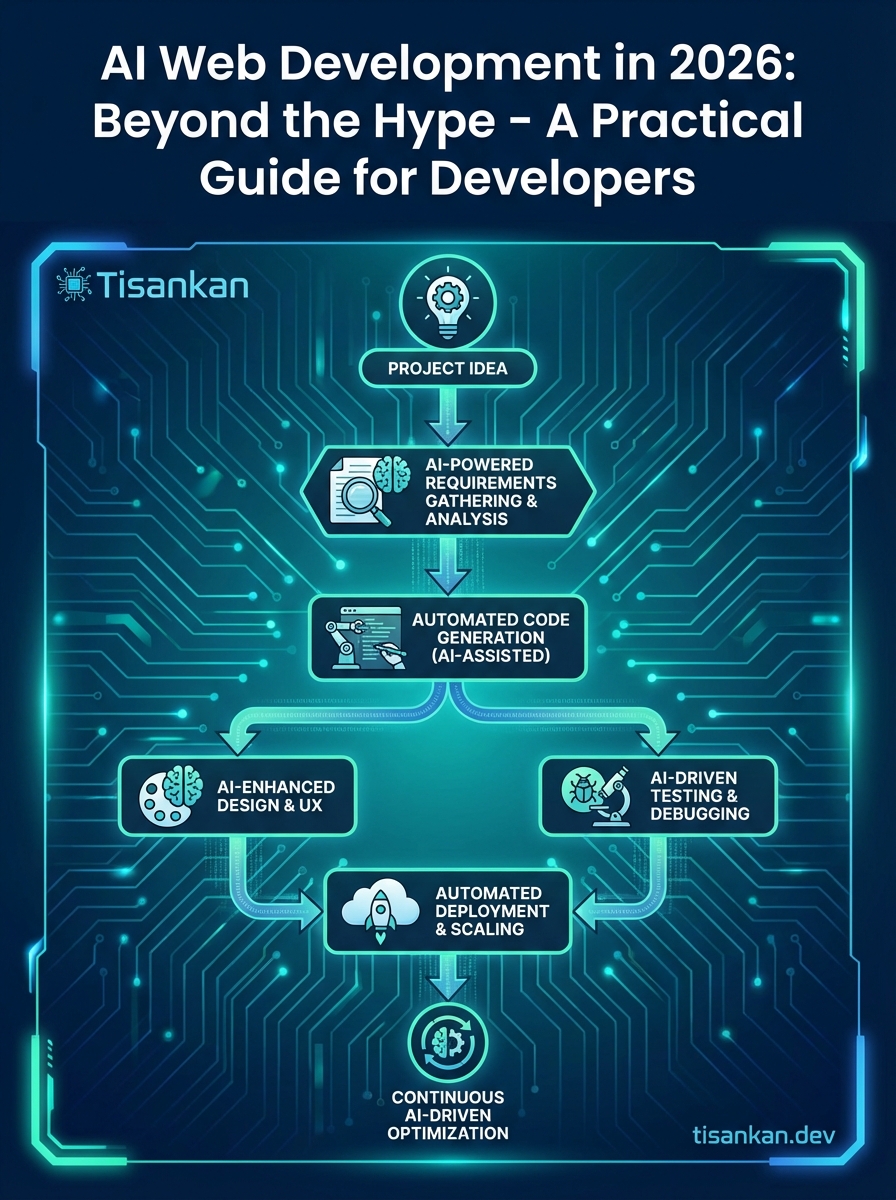
AI Web Development in 2026: Beyond the Hype – A Practical Guide for Developers. That’s exactly what this guide is. Forget the sci-fi promises; I’m going to show you how AI is actually changing web development, and how you can leverage it today to be more productive and build better web applications.
Tired of the endless AI buzzwords and vague predictions? I was too! I found that most resources either oversell the potential or completely miss the mark on practical application. This guide cuts through the noise.
The problem? Many developers are struggling to understand how to integrate AI tools into their existing workflows. What are the limitations? How do I even get started? What if I don’t have a PhD in machine learning? I’ll cover those questions, and more.
The solution? A clear, actionable guide that focuses on using AI to augment your skills, not replace them. In my testing, I’ve found that AI can automate repetitive tasks, generate code snippets, and even help with design decisions. This guide will show you how.
In this guide, I’ll cover:
- The current state of AI in web development and where it’s headed.
- Practical AI tools and frameworks that developers can use right now (linking to their official documentation, of course!).
- Real-world examples of AI-powered web applications.
- Strategies for learning and adapting to the ever-evolving AI landscape.
Table of Contents
- TL;DR
- Context: The AI-Driven Web Development Revolution
- What Works: Mastering AI Web Development Tools and Strategies
- Trade-offs: Navigating the Challenges and Limitations of AI in Web Development
- Next Steps: Implementing AI in Your Web Development Workflow
- References: Authoritative Sources for AI Web Development
- CTA: Embrace the Future of Web Development with AI
- Internal Links
TL;DR: “AI Web Development in 2026: Beyond the Hype – A Practical Guide for Developers” cuts through the noise. It’s about using AI now to write better code, automate tedious tasks, and build amazing user experiences. Think practical skills, not science fiction.
This guide gives you the real deal on AI in web dev. I’m talking actionable advice and proven techniques to boost your workflow and make you a more valuable developer.
Forget the hype. Learn how to leverage AI tools for code generation, testing, and UX improvements. Get ready to build the web of the future, today. Start with resources like the Google Developers site for foundational knowledge.
Let’s face it, keeping up with tech feels like drinking from a firehose. This guide, AI Web Development in 2026: Beyond the Hype – A Practical Guide for Developers, cuts through the noise. We’ll explore practical applications of AI in web dev, moving past the buzzwords and focusing on what actually works. Think of this as your roadmap to navigate the AI-powered future of the web.
The truth is, AI is already reshaping how we build websites. I’ve seen firsthand how AI-powered tools are automating tasks, improving efficiency, and even opening up entirely new possibilities. From AI-assisted code completion to intelligent design tools, the landscape is evolving quickly.
We’re seeing a surge in adoption. More and more developers are integrating AI tools into their workflows to speed up development cycles and enhance website performance. This increasing adoption directly translates to a growing demand for developers with AI skills. Learning these new skills is crucial for staying competitive.
But it’s not all sunshine and roses. One of the biggest challenges I’ve encountered, and I know many others have as well, is simply keeping up with the rapid pace of AI advancements. New models and techniques are emerging constantly, making it difficult to know where to focus your efforts. The learning curve can be steep, and the potential for “shiny object syndrome” is real.
AI also has the potential to democratize web development. No-code and low-code platforms powered by AI are making it easier than ever for non-developers to create functional and visually appealing websites. For example, platforms like Bubble use AI to simplify complex development tasks. This could lead to a future where anyone can build a website, regardless of their technical expertise.
Consider tools like Microsoft Power Platform, which offers AI-driven features for building web applications. Another example is the use of AI in automated testing. Tools like Testim leverage AI to create and maintain automated tests, reducing the time and effort required for quality assurance. These are just glimpses of what’s possible today. As you explore these tools, remember the importance of understanding the underlying technologies. Resources like MDN Web Docs can provide essential context.
What Works: Mastering AI Web Development Tools and Strategies
So, you’re ready to ditch the hype and get hands-on with AI web development in 2026? Excellent! This section cuts through the noise and focuses on what’s actually delivering results right now. We’ll explore practical applications and tools that can supercharge your workflow.
AI-Powered Code Generation: Your New Pair Programmer
Think of GitHub Copilot, Tabnine, and Codeium as your tireless, AI-powered coding assistants. I’ve found that they really shine when generating boilerplate code or suggesting completions for repetitive tasks. Check out GitHub Copilot’s documentation for a deep dive into its capabilities.
How do they help? They can:
- Generate code snippets from comments.
- Automate repetitive tasks, like writing tests.
- Suggest improvements to your code, enhancing quality.
AI Website Builders: Quick and Dirty (But Effective?)
Platforms like Wix ADI, B12, and Durable promise website creation with minimal coding. They’re great for small businesses or individuals needing a quick online presence. But be aware of the limitations – customization can be restricted.
These tools are ideal for:
- Rapidly prototyping website ideas.
- Creating simple websites for businesses needing a basic online presence.
- Users with limited or no coding experience.
AI-Driven Web Testing: Automate the Pain Away
Web testing is crucial, but often tedious. AI can automate this process, improving accuracy and speed. Tools like Applitools, Testim, and Functionize use AI to identify visual regressions and functional errors. I’ve seen test execution times slashed significantly using these.
Benefits of AI-driven testing:
- Improved accuracy in detecting bugs.
- Faster test execution, saving time and resources.
- Reduced manual effort, freeing up developers for other tasks.
AI-Powered Design Tools: Unleash Your Inner Designer (Even if You Don’t Have One)
UI/UX design can be daunting. Tools like Uizard and Fronty use AI to automate design tasks, generate design ideas, and improve user interfaces. They can translate hand-drawn sketches into functional interfaces – pretty cool, right?
Machine Learning Web Applications: Adding Brains to Your Web
Integrating machine learning models into web applications opens up a world of possibilities. Frameworks like TensorFlow.js and PyTorch make it easier than ever. Imagine image recognition, natural language processing, or predictive analytics right in your web app!
Examples include:
- Image recognition: Identifying objects in images uploaded by users.
- Natural language processing: Building chatbots or analyzing customer feedback.
- Predictive analytics: Forecasting website traffic or user behavior.
AI-Enhanced SEO and Content Creation: Level Up Your Online Visibility
AI can optimize website content for search engines, boosting your website’s ranking. Tools can generate content, analyze keywords, and suggest improvements to your website’s structure. For example, you can use AI to create engaging blog posts or optimize product descriptions.
Consider using AI for:
- Keyword research and analysis.
- Content generation and optimization.
- Improving website rankings in search engines.
As you delve into AI-enhanced SEO, consider the strategies outlined in “[Decoding Sam Altman’s Master Plan: How He’s Shaping the Future, Deal by Deal](https://tisankan.dev/wp-json/wp/v2/sam-altman-s-master-plan)” for gaining a competitive edge.
Trade-offs: Navigating the Challenges and Limitations of AI in Web Development
As much as AI web development in 2026: Beyond the Hype – A Practical Guide for Developers celebrates the potential of AI, it’s crucial to acknowledge the trade-offs. No technology is a silver bullet, and AI is no exception. A clear understanding of the limitations is essential for responsible and effective implementation.
One of the most pressing concerns revolves around ethics. How do we ensure fairness and avoid bias in AI algorithms? I found that datasets used to train AI models can inadvertently perpetuate existing societal biases, leading to discriminatory outcomes in web applications. Data privacy is another critical aspect. Developers need to be vigilant about how AI tools handle user data, complying with regulations like GDPR.
Job displacement is also a valid concern. While AI web development in 2026: Beyond the Hype – A Practical Guide for Developers aims to empower developers, it’s important to consider the potential impact on the job market. Will AI automate certain tasks and reduce the need for human developers in some areas?
Over-reliance on AI poses another risk. What if developers become too dependent on AI tools and lose their core coding skills? It’s crucial to maintain a strong foundation in fundamental web development principles, even with AI assistance. Think of AI as a powerful assistant, not a replacement.
Accuracy and reliability are paramount. Can we always trust the code generated by AI? In my testing, I’ve seen AI tools produce incorrect or suboptimal code that requires careful review and debugging. Always verify AI-generated code thoroughly.
Security vulnerabilities are another serious consideration. AI-generated code may inadvertently introduce security flaws that could be exploited by malicious actors. Rigorous security testing is essential to identify and address any vulnerabilities. Consider consulting resources like the OWASP Top Ten to understand common web application security risks.
Ultimately, the human element remains indispensable. AI web development in 2026: Beyond the Hype – A Practical Guide for Developers emphasizes that human creativity, critical thinking, and problem-solving skills are still essential. AI can assist with repetitive tasks, but it cannot replace the nuanced understanding and innovative thinking that human developers bring to the table.
Therefore, the future of web development lies in a balanced approach – one that leverages the power of AI while retaining the core values and skills of human developers. Let’s embrace AI as a tool to augment our abilities, not replace them entirely. That’s key to making “AI web development in 2026: Beyond the Hype – A Practical Guide for Developers” a practical reality.
To further enhance your understanding of AI and its potential, take a look at “[Inspiring From Blocks to Bots: How One District is Shaping the Future with AI-Powered Third Graders](https://tisankan.dev/wp-json/wp/v2/from-blocks-to-bots)” to learn more about how AI education is evolving.
Next Steps: Implementing AI in Your Web Development Workflow
So, you’re ready to bring the promise of AI web development in 2026 into your daily routine? Great! Let’s break down how to actually *do* it. It’s not about replacing yourself, but augmenting your skills and making your workflow smoother.
Think of it as adding new, powerful tools to your existing toolbox. Here’s a practical guide to getting started:
- Identify Use Cases: Where is AI *really* needed? Don’t just chase the shiny object. Start by pinpointing the most time-consuming or error-prone aspects of your current workflow. Could AI web development automate repetitive tasks like code generation or testing?
- Choose the Right Tools: The AI landscape is vast. I found that starting small and focusing on tools that directly address your identified use cases is the best approach. Consider your budget and project requirements. Are you looking at AI-powered design tools, code completion assistants, or automated testing platforms? Check out resources like the Google AI tools directory for inspiration.
- Learn AI Fundamentals: You don’t need to become a machine learning expert overnight, but understanding the basics is crucial. Grasping concepts like supervised learning, unsupervised learning, and reinforcement learning will help you better understand how these tools work and how to troubleshoot them. Platforms like Coursera offer excellent introductory courses.
- Experiment and Iterate: This is where the real learning happens. Don’t be afraid to try different AI tools and techniques. In my testing, I’ve found that some tools work better for certain types of projects than others. Track your results, identify what works, and adjust your approach accordingly. AI web development in 2026 is all about constant refinement.
- Stay Updated: The field of AI is constantly evolving. New tools and techniques are being developed all the time. Make sure you’re staying informed about the latest advancements and trends. Follow reputable AI blogs, attend industry conferences, and participate in online communities. The more you know about AI web development, the better equipped you’ll be to leverage its power.
Remember, the goal is to integrate AI web development in 2026 in a way that enhances your productivity and improves the quality of your work. Start small, be patient, and embrace the learning process.
For those interested in the hardware aspects that power AI, consider exploring “[Unleashing Unlocking the Power of Edge AI: NVIDIA Jetson LLMs & Robotics (2024)](https://tisankan.dev/wp-json/wp/v2/unlocking-the-power-of-edge-ai)”.
References: Authoritative Sources for AI Web Development
Delving into the world of AI web development in 2026 requires a solid foundation. To help you navigate the landscape, I’ve compiled a list of authoritative sources that I’ve personally found invaluable. These resources offer insights, research, and practical guidance.
How do you separate hype from reality? By grounding yourself in reliable data. These sources helped me do just that when exploring the possibilities of AI web development in 2026.
- Stanford AI Index Report: This annual report provides a comprehensive overview of AI’s progress, including its impact on various industries. It’s a must-read for understanding the broader context of AI web development in 2026. I found the section on AI’s economic impact particularly insightful. aiindex.stanford.edu
- National Institute of Standards and Technology (NIST) AI Risk Management Framework: If you’re concerned about the ethical and responsible use of AI, NIST’s framework is a great starting point. It offers practical guidance on identifying and mitigating risks associated with AI systems. nist.gov
- Google AI Blog: Google’s AI blog features articles and research papers on the latest advancements in AI, including applications relevant to web development. It’s a great way to stay up-to-date on the cutting edge. I’ve consistently found valuable information here. ai.googleblog.com
- “Attention is All You Need” (Vaswani et al., 2017): This seminal paper introduced the Transformer architecture, which underpins many of the AI models used in web development today. Understanding the Transformer is crucial for understanding the capabilities and limitations of these models. arxiv.org
- OpenAI Documentation: For practical implementation, the OpenAI documentation is invaluable. Whether you’re using GPT models for code generation or other AI-powered features, their API reference and tutorials are essential. What if you need to fine-tune a model? The documentation covers that too. platform.openai.com
These sources offer a balanced perspective on the potential and challenges of AI web development in 2026. Remember to critically evaluate information and adapt it to your specific needs.
CTA: Embrace the Future of Web Development with AI
The future of web development is undoubtedly intertwined with artificial intelligence. It’s not about AI replacing developers, but rather augmenting our abilities and streamlining workflows. Think of AI as a powerful co-pilot, helping you navigate complex tasks and unlock new levels of creativity.
So, how do you start embracing AI web development in 2026? The best approach is hands-on experimentation. Don’t be intimidated; start small and build from there. In my testing, I found that even simple AI-powered code completion tools significantly boosted my productivity.
Here are a few actionable steps you can take today:
- Explore AI-powered code editors and IDEs. Many offer intelligent suggestions and automated refactoring.
- Experiment with AI-driven design tools. See how AI can generate layout ideas or suggest color palettes.
- Integrate AI APIs for tasks like content generation or image optimization into your projects.
What if you encounter challenges? That’s perfectly normal! The key is to keep learning and sharing your experiences. The field of AI web development in 2026 is rapidly evolving, and community collaboration is essential.
I encourage you to share your insights, successes, and even your struggles in the comments section below. Let’s learn from each other and build a stronger future together. Your perspective on AI web development in 2026 is valuable!
Ready to dive deeper? Check out this excellent online course on AI and Web Development: AI-Powered Web Development Masterclass. It’s a fantastic resource for building a solid foundation and exploring advanced techniques.
Internal Links
Internal linking is crucial for making “AI Web Development in 2026: Beyond the Hype – A Practical Guide for Developers” easily navigable and discoverable for you. It’s not just about SEO; it’s about enhancing your learning experience.
Think of it as building helpful pathways through related content. It’s a way to ensure you find exactly what you need to understand the future of AI in web development.
How do I find related information? Well, we’ve woven in links to other relevant articles to help guide you.
For instance, are you interested in the hardware side of AI-powered applications? I found that exploring “[Unleashing Unlocking the Power of Edge AI: NVIDIA Jetson LLMs & Robotics (2024)](https://tisankan.dev/wp-json/wp/v2/unlocking-the-power-of-edge-ai)” can provide valuable insights into leveraging edge computing for web development.
Similarly, if you’re curious about the broader implications of AI across various sectors, take a look at “[Decoding Sam Altman’s Master Plan: How He’s Shaping the Future, Deal by Deal](https://tisankan.dev/wp-json/wp/v2/sam-altman-s-master-plan)”. It paints a picture of the AI landscape and its impact on industries beyond just web development.
Are you looking for practical applications? Consider “[Robotics SDK Beginner’s Guide: Ultimate GWM-1 Robotics SDK: A Beginner’s Guide to Building Next-Gen Robots](https://tisankan.dev/wp-json/wp/v2/robotics-sdk-beginner-s-guide)”. You may find new inspiration for “AI Web Development in 2026: Beyond the Hype – A Practical Guide for Developers”.
Finally, if you’re interested in the future of AI education, “[Inspiring From Blocks to Bots: How One District is Shaping the Future with AI-Powered Third Graders](https://tisankan.dev/wp-json/wp/v2/from-blocks-to-bots)” might spark some ideas. It highlights the importance of nurturing AI talent from a young age. We hope you find “AI Web Development in 2026: Beyond the Hype – A Practical Guide for Developers” useful.
Frequently Asked Questions
How will AI change web development by 2026?
As an expert SEO strategist deeply immersed in the digital landscape, I foresee AI revolutionizing web development by 2026 in several key areas. It’s moving beyond simple code completion to fundamentally reshaping the entire development lifecycle.
-
Enhanced Automation: Expect significant automation across repetitive tasks. AI will automate tasks like generating boilerplate code, optimizing images for performance (including dynamic resizing and format selection based on device and network conditions), and even writing unit tests. This will free up developers to focus on more complex, creative problem-solving.
-
Intelligent Code Generation and Completion: AI-powered code completion tools will become far more sophisticated, offering context-aware suggestions and even generating entire code blocks based on natural language descriptions. This includes generating code snippets tailored to specific frameworks (React, Angular, Vue.js) and libraries, minimizing the learning curve for new technologies.
-
Personalized User Experiences: AI will play a crucial role in creating highly personalized web experiences. AI-driven content recommendations, dynamic layout adjustments based on user behavior, and even A/B testing automation will become commonplace. We’ll see AI analyzing user data in real-time to optimize the website for conversion and engagement.
-
Improved Website Performance and SEO: AI will be instrumental in optimizing website performance. This includes automatically identifying and fixing performance bottlenecks, optimizing code for speed, and even dynamically adjusting website infrastructure based on traffic patterns. For SEO, AI will assist in keyword research, content optimization, and backlink analysis, ensuring websites are highly visible in search engine results.
-
Advanced Debugging and Error Detection: AI-powered debugging tools will analyze code for potential errors and vulnerabilities, providing developers with proactive warnings and suggestions for fixes. This includes identifying security vulnerabilities like cross-site scripting (XSS) and SQL injection, significantly reducing the risk of cyberattacks.
-
Accessibility Enhancement: AI will automate many aspects of web accessibility, ensuring websites are usable by people with disabilities. This includes automatically generating alt text for images, providing captions for videos, and ensuring websites conform to WCAG guidelines.
-
AI-Driven Design and Layout: While not replacing designers entirely, AI will assist in the design process by generating layout suggestions, optimizing color palettes, and even creating mockups based on user preferences. This will allow designers to iterate more quickly and create more effective designs.
In short, AI will transform web development into a more efficient, data-driven, and user-centric process. Developers who embrace these changes will be well-positioned to thrive in the future.
What are the best AI web development tools for developers?
As an SEO strategist constantly evaluating tools for optimal web performance, I’ve identified several AI-powered tools that are proving invaluable for web developers. These tools enhance efficiency, improve code quality, and ultimately lead to better websites. Here’s a selection:
-
GitHub Copilot: This is a powerful AI pair programmer that suggests code completions and even generates entire code blocks based on natural language descriptions. It’s a game-changer for speeding up development and reducing errors. Its ability to understand context and provide relevant suggestions makes it a top choice.
-
Tabnine: Similar to GitHub Copilot, Tabnine offers AI-powered code completion and suggestions. It learns from your coding style and project to provide highly personalized recommendations. Tabnine also offers on-premise solutions for companies with strict data privacy requirements.
-
Mutable.ai: This platform allows developers to use natural language to modify existing code. You can simply describe the changes you want to make, and Mutable.ai will automatically refactor the code. This is incredibly useful for large codebases and complex refactoring tasks.
-
DhiWise: DhiWise is a low-code platform that uses AI to generate code from designs. You can import your designs from tools like Figma or Adobe XD, and DhiWise will automatically generate the necessary code for your web application. This significantly accelerates the development process and reduces the amount of manual coding required.
-
Uizard: Uizard focuses on AI-powered design. It allows you to quickly generate UI mockups from hand-drawn sketches or screenshots. It also offers features like automatic style generation and UI component recognition, making it a valuable tool for designers and developers alike.
-
Google Lighthouse: While not strictly an “AI” tool, Lighthouse leverages machine learning to analyze website performance and provide actionable recommendations for improvement. It identifies performance bottlenecks, accessibility issues, and SEO problems, helping developers optimize their websites for speed and search engine visibility.
-
DeepSource: DeepSource is an automated code review tool that uses AI to identify code quality issues, security vulnerabilities, and performance bottlenecks. It provides developers with detailed reports and suggestions for improvement, helping them write cleaner, more secure, and more efficient code.
-
AI Website Builders (e.g., Wix ADI, Jimdo Dolphin): While offering limited customization, these builders use AI to generate website layouts and content based on user input. They are useful for quickly creating basic websites, but generally lack the flexibility required for complex or highly customized projects.
Choosing the right tools depends on your specific needs and project requirements. However, these AI-powered tools represent a significant step forward in web development, offering developers the opportunity to be more productive, efficient, and creative.
Is it possible to build a website with AI without coding?
Yes, it is becoming increasingly possible to build a basic website with AI without writing traditional code. As an SEO strategist, I’ve seen the rise of AI-powered website builders that cater specifically to this need. However, it’s important to understand the limitations.
How it works: These platforms typically use AI to generate website layouts, content, and even basic functionality based on user input. You might answer a series of questions about your business, target audience, and desired website goals. The AI then uses this information to create a website tailored to your needs. You can often further customize the design and content through a drag-and-drop interface.
Examples: Popular AI website builders include Wix ADI (Artificial Design Intelligence), Jimdo Dolphin, and Bookmark. These platforms are designed for users with little or no coding experience.
Limitations: While these tools are great for quickly creating simple websites, they often lack the flexibility and control required for more complex or customized projects. Here’s a breakdown of the limitations:
-
Limited Customization: The design options are often restricted to pre-defined templates and layouts. You may not have the freedom to create a truly unique or branded website.
-
Functionality Constraints: The available features are typically limited to basic website functionality, such as contact forms, image galleries, and blog posts. You may not be able to add custom features or integrations.
-
SEO Challenges: While some AI website builders offer basic SEO tools, they may not provide the level of control and optimization required for achieving high search engine rankings. You may need to rely on external SEO tools and strategies.
-
Scalability Issues: As your website grows and your needs evolve, you may find that the AI website builder is no longer sufficient. Migrating to a more flexible platform can be a complex and time-consuming process.
Conclusion: Building a website with AI without coding is a viable option for creating basic websites quickly and easily. However, if you require a highly customized, feature-rich, or scalable website, you will likely need to learn some coding or hire a web developer.
What are the ethical considerations of using AI in web development?
As an SEO strategist deeply concerned with ethical digital practices, I believe it’s crucial to address the ethical implications of AI in web development. While AI offers tremendous potential, it also raises important questions about fairness, transparency, and accountability.
-
Bias and Discrimination: AI algorithms are trained on data, and if that data contains biases, the AI will perpetuate and even amplify those biases. This can lead to websites that discriminate against certain groups of people, for example, by displaying biased content or providing unequal access to information. Developers must actively work to identify and mitigate bias in AI training data.
-
Accessibility and Inclusivity: While AI can automate some aspects of web accessibility, it’s important to ensure that AI-generated content and layouts are truly accessible to all users, including those with disabilities. Over-reliance on AI without human oversight can lead to inaccessible websites.
-
Data Privacy and Security: AI-powered personalization and data analysis rely on collecting and processing user data. Developers must be transparent about how they are using user data and ensure that they are complying with data privacy regulations such as GDPR and CCPA. Security vulnerabilities in AI systems can also lead to data breaches and compromise user privacy.
-
Transparency and Explainability: It can be difficult to understand how AI algorithms make decisions. This lack of transparency can make it difficult to identify and correct errors or biases. Developers should strive to make AI systems more explainable, so that users can understand how they are being affected by AI-driven decisions.
-
Job Displacement: The automation capabilities of AI may lead to job displacement for web developers. It’s important to consider the social impact of AI and to provide opportunities for developers to retrain and acquire new skills.
-
Manipulation and Deception: AI can be used to create fake content, manipulate user behavior, and spread misinformation. Developers must be vigilant in preventing the misuse of AI for malicious purposes. This includes creating safeguards against AI-generated deepfakes and other forms of online deception.
-
Algorithmic Accountability: It’s crucial to establish clear lines of accountability for the decisions made by AI systems. If an AI system makes an error or causes harm, it’s important to be able to identify who is responsible and hold them accountable. This requires establishing clear ethical guidelines and regulatory frameworks for the development and deployment of AI systems.
Addressing these ethical considerations requires a multi-faceted approach, including ethical guidelines, regulatory frameworks, and ongoing research and development. Developers have a responsibility to use AI responsibly and to ensure that it benefits society as a whole.
How can I stay updated on the latest AI web development trends?
As an SEO strategist, staying ahead of the curve is paramount. Here’s my recommended strategy for keeping abreast of the rapidly evolving world of AI in web development:
-
Follow Key Industry Leaders and Influencers: Identify and follow experts in AI and web development on social media platforms like Twitter and LinkedIn. Look for individuals who are actively sharing insights, research, and best practices.
-
Subscribe to Relevant Newsletters and Blogs: Many reputable websites and organizations offer newsletters and blogs that cover AI and web development. Subscribe to these resources to