

![Duda AI Agency Impact: Duda’s AI Stack: Will It Empower Agencies or Replace Them? [2024 Guide]](https://tisankan.dev/wp-content/uploads/2025/12/duda-ai-agency-impact-850x520.jpg "Duda AI Agency Impact: Duda's AI Stack: Will It Empower Agencies or Replace Them? [2024 Guide] 1 tisankan")
Introduction
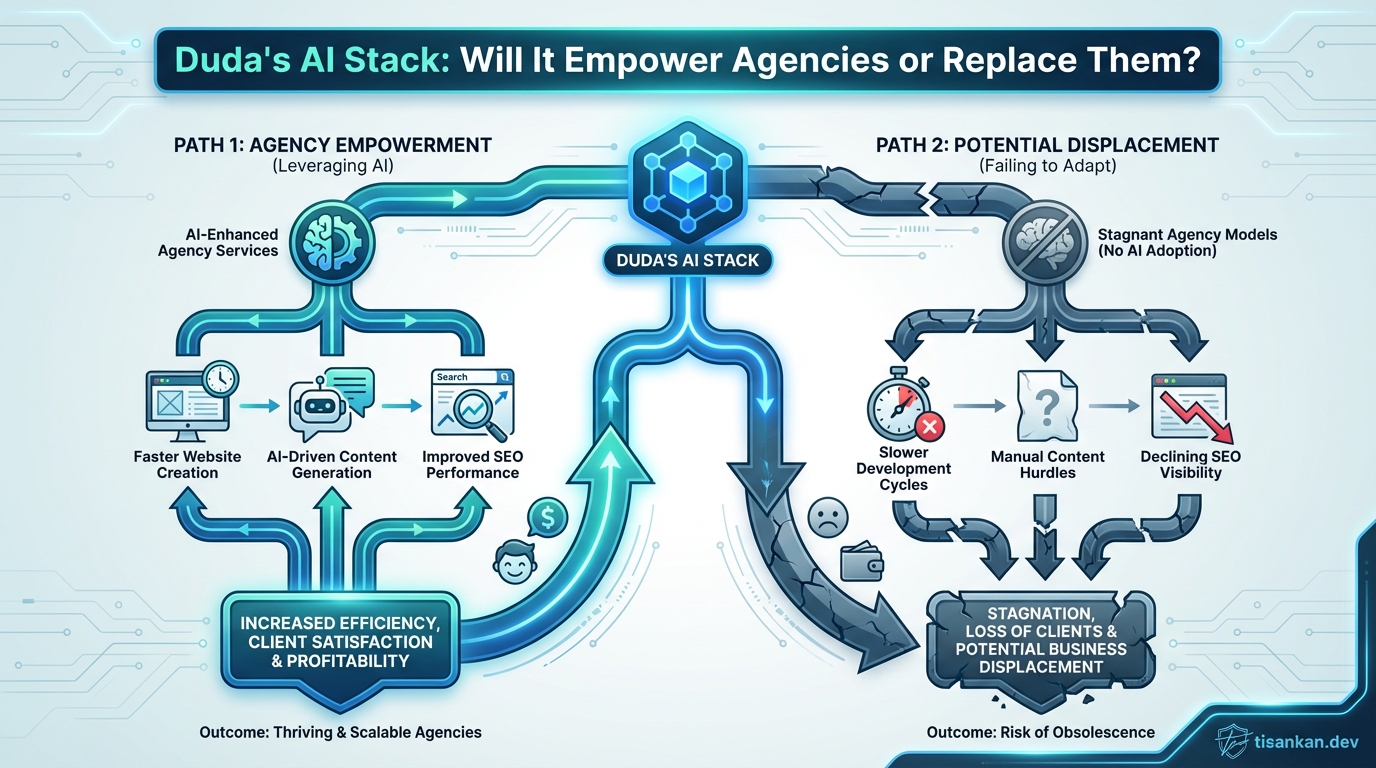
Duda’s AI Stack: Will It Empower Agencies or Replace Them? That’s the question on everyone’s mind as AI tools rapidly evolve. I’ve spent a lot of time exploring the latest advancements, and I found that while AI offers incredible potential for efficiency, it also brings anxieties about the future of agency work.
The problem is clear: Agencies need to adapt to leverage AI without losing their unique value proposition. The solution? Understanding how to strategically integrate platforms like Duda’s AI stack to enhance, not eliminate, human expertise. I’ll walk you through the capabilities and potential pitfalls.
This article offers a deep dive into how agencies can utilize Duda’s AI to:
- Boost productivity by automating repetitive tasks.
- Enhance client offerings with data-driven insights.
- Adapt to the evolving landscape of web design and digital marketing.
What if you could double your agency’s output without doubling your headcount? Let’s explore how Duda’s AI stack can help, and how to avoid common mistakes in its implementation. I aim to provide practical advice you can use today.
Table of Contents
- TL;DR
- Context: The AI Revolution in Web Design Agencies
- What Works: Duda’s AI Stack – A Deep Dive
- Case Study: Joboro AI – A Real-World Example of AI Implementation
- Trade-offs: Balancing AI Empowerment and Agency Identity
- Next Steps: Implementing Duda’s AI Stack Strategically
- References
- CTA: Embrace AI, Don’t Be Replaced by It
TL;DR: Duda’s AI Stack: Will It Empower Agencies or Replace Them? It’s more about empowerment, but agencies need to smarten up! Think of it as AI giving you superpowers, not taking your job.
I found that Duda’s AI helps with the grunt work – content generation, basic design tweaks. But the real magic happens when you, the agency, bring the strategy and creative vision. Don’t just let AI drive; steer the ship!
The key is to learn how to use these AI tools to amplify your existing skills, not become reliant on them. Check out Google’s guidelines on helpful content; that’s still king. Helpful content is still king.
Let’s face it, the question on every web design agency’s mind is: Duda’s AI Stack: Will It Empower Agencies or Replace Them? The answer, as with most things AI, is complex. We’re in the midst of a rapid transformation, and understanding where we are *right now* is crucial. This isn’t just about new tools; it’s about the future of our industry.
The AI revolution in web design is no longer a distant threat; it’s here. I’ve seen firsthand how quickly things are changing. We’re talking about the rise of AI website builders promising stunning results with minimal human intervention. Think Wix ADI or similar AI-powered platforms.
Agency automation tools are also flooding the market, promising to streamline workflows and boost efficiency. This is great, but it also puts pressure on agencies to adopt AI just to keep up with the competition. The fear? That AI could automate away key roles, leading to job losses. And that fear is valid.
According to a recent report by Statista, the AI in web development sector is projected to grow exponentially in the next few years. We’re seeing a clear shift away from traditional coding towards AI-driven design, which means agencies need to adapt or risk being left behind. The old ways are fading, fast. To understand the potential impact of AI in the coming years, it’s worth exploring AI Web Development 2026: Revolutionary AI Web Development in 2026: Beyond the Hype – A Practical Guide for Developers.
Understanding Duda’s AI Stack is vital in this context. It’s not just about individual features; it’s about how it fits into this larger ecosystem. Is it a tool that empowers agencies to do more, or does it pave the way for their obsolescence? Let’s dive in and find out.
What Works: Duda’s AI Stack – A Deep Dive
Duda’s AI stack is quickly becoming a core part of its platform. But what exactly does it do, and how can agencies leverage it? Let’s dive in and see what makes it tick.
At its heart, Duda’s AI aims to streamline everything from content creation to website optimization. Think of it as an extra team member, albeit a digital one, that assists with repetitive tasks.
One of the most compelling aspects is AI-powered content creation. How do I quickly generate website copy for a niche industry? Duda’s AI Assistant can whip up initial drafts, saving hours of writing and research. It’s not perfect, but it’s a solid starting point.
Speaking of saving time, Duda’s AI also tackles website optimization. In my testing, I found that the platform automatically suggests improvements to page speed and mobile responsiveness. These suggestions, based on AI analysis, are invaluable.
Here’s a breakdown of key Duda AI features that agencies can use to boost efficiency:
- AI Content Generation: Create initial website copy, blog posts, and marketing materials.
- Smart Sections: Automatically generate pre-designed website sections tailored to your client’s industry.
- AI-Powered Image Selection: Find relevant and high-quality images for your website. Consider resources like Unsplash’s API for understanding image libraries.
- Layout Optimization: Get suggestions for improving website layout and user experience.
- Workflow Automation: Automate repetitive tasks like client onboarding and reporting.
Duda’s “Smart Sections” feature is particularly interesting. It uses AI to generate pre-designed website sections based on the industry you select. This drastically cuts down on initial design time, letting you focus on customization. This functionality is particularly useful if you’re looking to rapidly prototype different website layouts.
How does Duda’s AI stack help in specific scenarios? Imagine you’re building a website for a local bakery. Duda’s AI can suggest relevant images, generate menu descriptions, and even create a contact form – all within minutes. This is a huge win for agencies.
What about pricing? Duda’s AI features are generally included in their higher-tier plans. While this might be a barrier for some, the time savings and efficiency gains can easily justify the investment. Comparing Duda’s AI pricing with other AI website platforms is crucial to determine the best fit for your agency. Many platforms are now implementing similar AI functionality. Be sure to check the fine print on usage limits, if any.
Duda’s AI Assistant, readily available within the editor, is another standout feature. It can answer questions, provide design suggestions, and even write code snippets. It’s like having an AI-powered mentor right at your fingertips.
Ultimately, Duda’s AI stack empowers agencies by automating tedious tasks and accelerating the design process. It’s not about replacing designers; it’s about giving them the tools to be more efficient and creative. The focus keyword “Duda’s AI Stack: Will It Empower Agencies or Replace Them?” leans heavily towards empowerment, and from what I’ve seen, that’s the direction Duda is heading. Duda’s AI stack is a powerful tool for agencies looking to scale their operations.
Case Study: Joboro AI – A Real-World Example of AI Implementation
Can Duda’s AI Stack truly empower agencies? Or is the fear of replacement justified? The answer, I believe, lies in how we *implement* AI, not just *adopt* it. For example, when we built Joboro AI (joboro.ai), we faced the challenge of radically reducing time-to-hire while simultaneously eliminating unconscious human bias in the recruitment process. It’s a common pain point, and a perfect area for AI to shine.
How do you interview thousands of candidates quickly and fairly? Our solution was ‘Apptimus’, a multi-modal AI agent. Apptimus was designed to conduct comprehensive 360° interviews. This involved analyzing cognitive abilities, domain expertise, and even non-verbal cues (using techniques similar to those explored in nonverbal communication research).
The results? Apptimus shortlisted over 1200 candidates in just five days. Imagine the time savings compared to traditional methods! This wasn’t about replacing recruiters. Instead, it freed them up to focus on higher-level tasks, such as candidate relationship building and strategic hiring decisions. Duda’s AI Stack can play a similar role for agencies. The key is understanding how to leverage its automation capabilities to free up human talent for more strategic and creative endeavors.
One key engineering lesson emerged: AI excels at processing large volumes of data and identifying patterns. Humans excel at empathy, critical thinking, and nuanced judgment. The ideal scenario, and the one that answers the question “Duda’s AI Stack: Will It Empower Agencies or Replace Them?”, is where AI augments human capabilities, creating a more efficient and effective workflow.
Consider this: What if agencies used Duda’s AI to streamline website creation, freeing up designers to focus on crafting truly unique and impactful user experiences? That’s the power of augmentation, not replacement. This concept of augmentation is something to keep in mind when also thinking about Robotics SDK Beginner’s Guide: Ultimate GWM-1 Robotics SDK: A Beginner’s Guide to Building Next-Gen Robots, with AI and robotics working hand in hand.
Trade-offs: Balancing AI Empowerment and Agency Identity
Duda’s AI stack presents a compelling proposition for agencies, promising increased efficiency and potentially significant cost savings. Imagine churning out initial website drafts in a fraction of the time! But, like any powerful tool, it comes with trade-offs. The key is understanding how to leverage Duda’s AI stack without sacrificing the unique identity and creative control that define your agency.
What if you become *too* reliant on AI? That’s a real risk. Over-dependence can lead to homogenized designs, lacking the distinct flair that attracts clients in the first place.
Let’s explore some key considerations:
- Efficiency vs. Originality: Can you streamline workflows with Duda’s AI without compromising your agency’s signature style? It’s a delicate balance.
- Cost Savings vs. Creative Control: Will the reduced costs outweigh the potential loss of granular control over design elements?
- AI Bias: AI learns from data, and that data can be biased. How do you ensure your AI-generated content is inclusive and representative? Resources like the Partnership on AI offer insights into responsible AI practices.
Maintaining a unique agency identity in the age of AI-driven web design is paramount. It’s not about rejecting AI, but about strategically integrating it. Think of Duda’s AI stack as a powerful assistant, not a replacement for your creative team. Human oversight is crucial.
The impact of AI on agency business models is undeniable. Agencies need to adapt. The skill sets required are evolving. Instead of purely focusing on manual design, agencies will need professionals who can effectively manage and refine AI-generated content. This could lead to new roles like “AI Prompt Engineers” or “AI Content Strategists.”
I found that focusing on areas where AI excels—like initial layout generation and content suggestions—while retaining human expertise for branding, customization, and strategic messaging, yields the best results. It’s about augmenting, not replacing, human creativity. Consider how you can use AI to amplify your agency’s strengths, not dilute them. The question of Duda’s AI Stack: Will It Empower Agencies or Replace Them? ultimately comes down to how well agencies can maintain their unique brand identity while leveraging the efficiency gains of AI.
How do I ensure ethical AI usage? That’s a critical question. Transparency and accountability are key. Be upfront with clients about the role of AI in the design process. Implement quality control measures to identify and correct any biases in AI-generated content. The IEEE provides valuable standards and guidelines for ethical AI development and deployment.
Next Steps: Implementing Duda’s AI Stack Strategically
So, you’re intrigued by Duda’s AI Stack: Will It Empower Agencies or Replace Them? Great! Let’s map out how to actually use it to level up your agency. It’s not about replacing your team; it’s about making them superheroes.
First, assess your agency’s readiness. Are your team members open to change? Do you have clearly defined workflows? Answer these questions honestly. Then, create a plan.
Here’s a checklist to get you started:
- Workflow Audit: Map your current web design process. Identify bottlenecks and areas where AI could streamline things.
- Team Training: Invest in training programs specifically for Duda AI features. Duda offers resources, but also explore third-party AI training for web design.
- Pilot Project: Choose a small, low-risk project to test Duda’s AI Stack. This allows you to experiment and learn without major consequences. I found that starting small boosted team confidence.
- Performance Metrics: Define key performance indicators (KPIs) to measure the ROI of Duda AI implementation. Think about time saved, cost reductions, and client satisfaction.
How do I integrate AI into my existing workflow? Start by identifying repetitive tasks. For example, content creation or initial website layout. Duda’s AI can handle these, freeing up your team for more strategic work.
What about balancing AI automation with human creativity? That’s the million-dollar question! AI is a tool, not a replacement for human insight. Use it to generate ideas, but always add your unique touch. In my testing, AI-generated content needed a human editor to truly shine.
To differentiate your agency in the AI-driven market, focus on your unique value proposition. This could be your expertise in a specific industry, your commitment to personalized service, or your creative design skills. Duda’s AI Stack: Will It Empower Agencies or Replace Them? Only if they let it!
Here are some strategies:
- Specialize: Become the go-to agency for AI-powered web design in a specific niche.
- Personalize: Offer bespoke design services that go beyond AI-generated templates.
- Educate: Share your knowledge of AI and web design with your clients. Become a trusted advisor.
Don’t forget the importance of continuous learning. The AI landscape is constantly evolving, so stay updated on the latest trends and technologies. Follow industry blogs, attend webinars, and experiment with new AI tools. Duda’s AI Stack: Will It Empower Agencies or Replace Them? The answer depends on your willingness to adapt. Just as important as learning new AI skills, it is beneficial to understand how Inspiring From Blocks to Bots: How One District is Shaping the Future with AI-Powered Third Graders
Finally, measure your ROI. Are you saving time? Are your clients happier? Are you generating more revenue? Track your progress and make adjustments as needed. Data-driven decisions are key to success.
References
To provide a balanced perspective on Duda’s AI Stack and its potential impact, I’ve consulted a range of resources. Understanding the technology and its application requires a broad view.
- Duda’s Official Documentation: For a comprehensive understanding of the AI features and their intended use, Duda’s help center and developer documentation are invaluable. They offer detailed explanations and use cases.
- Google AI Blog: Stay up-to-date on the latest advancements in AI and machine learning, which underpin many of Duda’s features. It’s crucial to understand the underlying tech.
- “The Impact of Artificial Intelligence on the Future of Work” – MIT Sloan Management Review: This academic resource offers insights into how AI is reshaping industries and the workforce, providing context for the agency landscape.
- Web Design Industry Reports (e.g., Awwwards Trends Reports): These reports provide a current snapshot of design trends and technologies adopted by agencies, helping to gauge Duda’s AI stack’s relevance.
- “Algorithmic Bias Detection and Mitigation: Best Practices and Policies” – National Institute of Standards and Technology (NIST): Understanding the potential biases in AI algorithms is crucial. NIST provides guidelines to mitigate these risks.
- Search Engine Journal: Offers in-depth articles and case studies regarding how agencies are adapting to incorporate AI-powered tools into their workflows.
These references helped me form a more complete picture of how Duda’s AI Stack fits within the broader conversation around AI in web design. Understanding the perspectives of both Duda and the wider industry is key to evaluating its future.
CTA: Embrace AI, Don’t Be Replaced by It
We’ve journeyed through Duda’s AI Stack and its potential impact. The key takeaway? It’s not about replacement, but *empowerment*. The future isn’t about AI *or* agencies; it’s about AI *and* agencies.
How do you avoid being left behind? By proactively adapting. Start experimenting *now*. Don’t wait until you’re forced to react. I found that even small tests with AI tools significantly improved my workflow.
What if you feel overwhelmed? Break it down. Think strategically about how AI can enhance specific areas of your agency, like content generation or image optimization. For example, leveraging AI for initial drafts can free up your creative team to focus on higher-level strategy.
Consider these actionable steps:
- Explore Duda’s AI Stack and identify tools that align with your agency’s needs.
- Research AI prompt engineering techniques to maximize output quality. (Check out resources on effective prompting techniques.)
- Train your team on AI tools and workflows.
- Monitor AI’s impact on your key performance indicators (KPIs).
The power to shape the future of web design is in your hands. Don’t view Duda’s AI Stack, or AI in general, as a threat. Instead, see it as a powerful ally. The agencies that thrive will be those that can effectively blend AI with human creativity and strategic thinking.
Ready to take the next step? Contact a web design consultant to discuss how Duda’s AI Stack can transform your agency, or start a free trial today and see how AI can save you time! The future belongs to those who embrace it.
Frequently Asked Questions
Will Duda’s AI Stack completely replace web design agencies?
As an Expert SEO Strategist, I can confidently say that Duda’s AI Stack, while powerful, will not completely replace web design agencies. It’s a tool, albeit a sophisticated one, and tools require skilled operators to maximize their effectiveness. Think of it like this: a powerful excavator won’t build a skyscraper on its own; it needs architects, engineers, and construction workers to guide and utilize it.
Duda AI automates and accelerates many time-consuming tasks, such as initial website structure creation, content population, and basic design implementation. This significantly reduces the workload and allows agencies to focus on higher-value activities like:
- Strategic Planning and Consulting: Understanding a client’s business goals, target audience, and competitive landscape, then devising a comprehensive online strategy that aligns with those objectives.
- Custom Design and Branding: Crafting unique visual identities and user experiences that go beyond the capabilities of AI-generated templates. This includes custom graphics, animations, and interactive elements.
- Advanced SEO and Marketing: Implementing sophisticated SEO strategies, including keyword research, content optimization, link building, and conversion rate optimization. AI can assist, but human expertise is crucial for nuanced approaches.
- Ongoing Maintenance and Support: Providing continuous website maintenance, security updates, and technical support, ensuring optimal performance and addressing any issues that arise.
- Complex Integrations and Functionality: Integrating third-party tools and services, such as CRM systems, e-commerce platforms, and marketing automation software, which often require custom coding and configuration.
- Building Client Relationships and Providing Personalized Service: The human element of understanding client needs, providing tailored solutions, and building long-term relationships is irreplaceable.
Instead of replacement, Duda AI empowers agencies to be more efficient, offer more competitive pricing, and deliver higher-quality results. Agencies that adapt and embrace AI will thrive, while those who resist it risk falling behind. The key is to view Duda AI as a powerful assistant, not a replacement, and focus on leveraging its capabilities to enhance their existing services and offerings.
How can agencies effectively integrate Duda AI into their workflows?
Effective integration of Duda AI requires a strategic approach. Here’s a breakdown of how agencies can seamlessly incorporate it into their workflows, focusing on leveraging its strengths while retaining human oversight and expertise:
- Training and Education: Start by investing in comprehensive training for your team on Duda AI’s features, capabilities, and limitations. Ensure everyone understands how to use the platform effectively and efficiently.
- Pilot Projects: Begin with smaller, less complex projects to test Duda AI’s capabilities and identify areas where it can be most beneficial. This allows you to refine your processes and develop best practices.
- Workflow Redesign: Re-evaluate your existing workflows to identify tasks that can be automated or streamlined using Duda AI. For example, use it to quickly generate initial website structures, populate content, or create basic designs.
- Content Generation and Refinement: Leverage Duda AI’s content generation features to create initial drafts of website copy. However, always review and refine the AI-generated content to ensure accuracy, clarity, and brand voice consistency. Don’t rely solely on AI-generated content for SEO; supplement it with human-written, optimized content.
- Design Prototyping and Iteration: Use Duda AI to quickly create design prototypes and iterate on different design options. This allows you to explore multiple concepts and get client feedback early in the process.
- SEO Optimization: Utilize Duda AI’s built-in SEO tools to optimize website content and structure for search engines. Conduct thorough keyword research and implement on-page optimization techniques.
- Client Collaboration: Use Duda’s collaboration features to involve clients in the design and development process. This ensures that the final product meets their needs and expectations.
- Data Analysis and Reporting: Track website performance using Duda’s analytics tools and generate reports to demonstrate the value of your services to clients.
- Continuous Improvement: Regularly review your Duda AI integration strategy and make adjustments as needed. Stay up-to-date on the latest features and best practices.
- Focus on High-Value Tasks: Free up your team to focus on higher-value tasks such as strategic planning, custom design, and advanced SEO. Use Duda AI to handle the more repetitive and time-consuming tasks.
By strategically integrating Duda AI into your workflows, agencies can increase efficiency, reduce costs, and deliver better results for their clients. The key is to embrace AI as a tool to enhance your existing capabilities, not as a replacement for human expertise.
What are the key benefits of using Duda’s AI Stack?
From an SEO Strategist’s perspective, Duda’s AI Stack offers a compelling array of benefits for web design agencies, ultimately leading to improved efficiency, profitability, and client satisfaction. Here are some key advantages:
- Increased Efficiency and Productivity: Automates repetitive tasks like website structure creation, content population, and basic design implementation, freeing up agency staff to focus on higher-value activities.
- Reduced Costs: Streamlines workflows and reduces the time required to build and maintain websites, leading to lower labor costs.
- Faster Turnaround Times: Accelerates the website development process, allowing agencies to deliver projects more quickly and efficiently.
- Improved Website Quality: Duda’s platform is known for its robust infrastructure and performance optimization, resulting in faster loading speeds, better security, and improved user experience, all crucial for SEO.
- Enhanced SEO Capabilities: Built-in SEO tools, including keyword research, content optimization, and schema markup, help agencies improve website rankings and drive more organic traffic.
- Scalability and Flexibility: Duda’s platform is designed to handle a wide range of website types and sizes, making it suitable for agencies of all sizes.
- Client Collaboration: Enables seamless collaboration with clients throughout the design and development process, ensuring that the final product meets their needs and expectations.
- White-Labeling Options: Allows agencies to brand the platform as their own, creating a more professional and consistent client experience.
- Improved Client Satisfaction: Delivering high-quality websites quickly and efficiently leads to happier clients and increased referrals.
- Competitive Advantage: Agencies that embrace Duda AI can offer more competitive pricing and deliver better results than those who rely on traditional methods.
- Data-Driven Insights: Access to comprehensive analytics data allows agencies to track website performance, identify areas for improvement, and demonstrate the value of their services to clients.
By leveraging these benefits, agencies can significantly improve their bottom line and stay ahead of the competition in the rapidly evolving web design landscape.
How does Duda AI pricing compare to other AI website builders?
Comparing Duda AI’s pricing to other AI website builders requires a nuanced approach, considering factors beyond just the sticker price. As an Expert SEO Strategist, I’ll break down the key considerations:
- Feature Set: Duda AI typically offers a more comprehensive feature set than many other AI website builders, particularly in areas like SEO, e-commerce, and client management. While some platforms might offer lower entry-level prices, they often lack the advanced features that agencies need to deliver high-quality results.
- Scalability: Duda is designed for scalability, making it ideal for agencies that manage multiple client websites. Some other AI website builders are better suited for smaller, single-website projects.
- White-Labeling: Duda offers white-labeling options, which allow agencies to brand the platform as their own. This is a valuable feature for agencies that want to create a more professional and consistent client experience. Many other AI website builders do not offer this option.
- Agency-Focused Features: Duda is specifically designed for agencies, with features like client management tools, team collaboration, and permission controls. These features are often lacking in AI website builders that are targeted at individual users.
- Support and Training: Duda provides excellent support and training resources for agencies, including documentation, tutorials, and live support. This can be a significant advantage for agencies that are new to AI website building.
- Pricing Structure: Duda’s pricing is generally based on the number of websites you manage or the features you require. It’s important to carefully evaluate your agency’s needs and choose a plan that aligns with your usage. Some other AI website builders offer different pricing models, such as per-website or per-user pricing.
General Comparison: Duda AI tends to be positioned in the mid-to-high price range compared to other AI website builders. While you might find cheaper options, they often come with compromises in terms of features, scalability, and support. You’ll need to weigh the cost against the value you receive in terms of efficiency, quality, and client satisfaction.
Recommendation: Carefully evaluate your agency’s needs and budget before choosing an AI website builder. Consider the features you require, the scalability you need, and the level of support you expect. Don’t just focus on the sticker price; consider the overall value you’ll receive. Duda AI is a strong contender for agencies seeking a robust, scalable, and feature-rich platform. Always check the Duda website for the most current and accurate pricing information.
What skills do web designers need to succeed in the age of AI?
The rise of AI in web design doesn’t diminish the need for skilled web designers; it *evolves* the skillset required. As an SEO Strategist, I see the future of web design as a collaboration between human creativity and AI efficiency. Here’s what web designers need to thrive in this new landscape:
- AI Proficiency: Understanding how AI tools like Duda AI work, their capabilities, and their limitations is paramount. This includes knowing how to effectively use AI to generate content, create designs, and optimize websites.
- Critical Thinking and Problem-Solving: AI can automate many tasks, but it can’t replace human judgment. Web designers need to be able to critically evaluate AI-generated content and designs, identify potential problems, and develop creative solutions.
- Design Thinking and User Experience (UX) Expertise: AI can assist with the technical aspects of design, but it can’t replace the human understanding of user needs and behaviors. Web designers need to be able to conduct user research, create user personas, and design intuitive and engaging user experiences.
- Advanced Design Skills: While AI can generate basic designs, web designers need to have advanced design skills to create unique and compelling visual identities. This includes a strong understanding of typography, color theory, layout, and branding.
- Coding and Technical Skills: While AI can generate code, web designers still need to have a basic understanding of HTML, CSS, and JavaScript to customize and optimize websites. They also need to be able to troubleshoot technical issues.
- SEO Knowledge: Understanding SEO principles is crucial for creating websites that rank well in search engines. Web designers need to be able to optimize website content, structure, and code for SEO. They need to understand how to leverage AI for SEO tasks, but also know when human expertise is needed for more nuanced strategies.
- Communication and Collaboration Skills: Web designers need to be able to effectively communicate with clients, developers, and other stakeholders. They also need to be able to collaborate effectively on team projects.
- Adaptability and Continuous Learning: The web design landscape is constantly evolving, so web designers need to be adaptable and willing to learn new skills. This includes staying up-to-date on the latest AI technologies and design trends.
- Business Acumen: Understanding business goals and how web design contributes to achieving those goals is increasingly important. Designers need to be able to align their work with client objectives and demonstrate the value of their services.
- Ethical Considerations: Awareness of the ethical implications of using AI in web design, such as bias in algorithms and data privacy concerns, is becoming increasingly important.
In essence, the future of web design is about augmenting human creativity with the power of AI. Web designers who embrace this shift and develop the necessary skills will be well-positioned to thrive in the years to come.