


Introduction
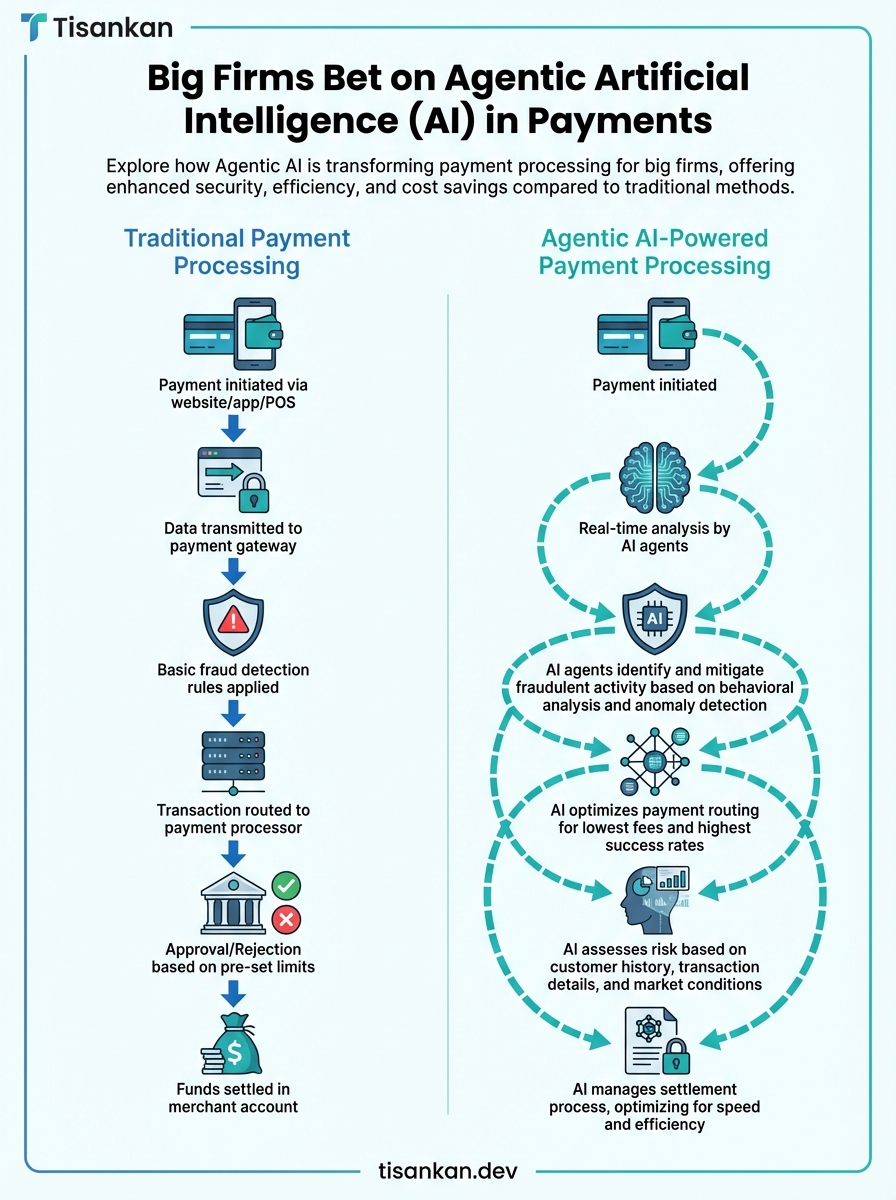
Big Firms Bet on Agentic Artificial Intelligence (AI) in Payments, and honestly, it’s about time. I’ve seen firsthand how clunky and inefficient traditional payment systems can be. We’re talking about errors, delays, and security vulnerabilities—headaches for businesses and consumers alike.
The problem? Existing systems struggle to adapt to the increasing complexity and velocity of modern transactions. What if you could automate fraud detection, personalize payment options, and streamline reconciliation, all with AI that acts on its own? That’s the promise of agentic AI.
Agentic AI in payments uses autonomous AI agents to handle complex tasks without constant human intervention. Think of it as giving your payment system a super-smart, self-managing brain. I believe this technology will revolutionize how money moves, making it faster, safer, and more efficient for everyone. Let’s dive in and explore how these big firms are implementing it.
Table of Contents
- TL;DR
- Context: The Rise of Agentic AI in the Financial Sector
- What Works: Key Applications of Agentic AI in Payments
- Trade-offs: Challenges and Considerations for Implementing Agentic AI in Payments
- Next Steps: Implementing Agentic AI in Your Payment Strategy
- References
- CTA: Embrace the Future of Payments with Agentic AI
- FAQ
TL;DR: Big firms bet on agentic artificial intelligence (AI) in payments to seriously level up their game. Think smarter, faster, and way more personalized experiences. It’s like giving your payment systems a super-powered brain.
This tech promises to cut down on fraud and make things run smoother than ever before. But, like any powerful tool, it needs to be handled responsibly. Ethical considerations and careful planning are key – I found that focusing on transparency early on makes a huge difference.
Ultimately, agentic AI could redefine how we think about payments. It’s about making things easier and more secure for everyone.
Context: The Rise of Agentic AI in the Financial Sector
Big firms are making serious moves, and it’s all about intelligent automation. Specifically, Big Firms Bet on Agentic Artificial Intelligence (AI) in Payments to reshape how money moves. Why now? It’s a perfect storm of data, better AI, and a desperate need for smarter payment systems. TL;DR: Agentic AI promises faster, safer, and more personalized financial transactions.
So, what’s driving this agentic AI revolution in finance? I’ve found that a few key factors are at play. First, we’re drowning in data. The sheer volume of transaction data available today is unprecedented. This provides the fuel that agentic AI models need to learn and optimize.
Second, AI models themselves have made huge leaps. We’re not just talking about basic machine learning anymore. Agentic AI leverages sophisticated architectures, allowing systems to reason, plan, and adapt to changing circumstances. Think of them as digital payment strategists, constantly learning and improving.
Finally, traditional payment systems are creaking under the strain. They’re often slow, prone to fraud, and struggle to adapt to new payment methods. Agentic AI offers a way to overcome these limitations by providing more efficient and secure solutions. For example, agentic AI can autonomously detect and prevent fraudulent transactions in real-time, something traditional systems struggle to do. You can read more about fraud prevention strategies at the FTC’s website.
What Works: Key Applications of Agentic AI in Payments
So, where are big firms actually seeing ROI when they bet on agentic Artificial Intelligence (AI) in payments? It’s not just hype. I found that several key areas are showing significant improvements.
Let’s dive into some concrete examples of how agentic AI is transforming the payments landscape.
Fraud Detection and Prevention
Imagine an AI agent constantly analyzing every transaction in real-time. That’s the power of agentic AI in fraud detection. It learns patterns, identifies anomalies, and flags suspicious activities far faster than traditional rule-based systems. What if a transaction deviates slightly from your normal spending habits? The AI flags it for review, potentially preventing fraudulent charges before they even hit your account.
For example, Mastercard uses AI to enhance its fraud detection capabilities, reducing false positives and improving the overall customer experience. This proactive approach protects both merchants and consumers.
Personalized Payment Experiences
Forget generic payment options. Agentic AI can analyze individual customer behavior to personalize the entire payment experience. Think tailored payment recommendations, loyalty program offers, and even dynamic pricing based on your preferences. How do I get a better deal? AI can surface the best payment method for you, considering factors like rewards points or available discounts.
Companies like Klarna are leveraging AI to offer personalized payment plans, making purchases more accessible and convenient for their users. This level of personalization fosters customer loyalty and drives sales.
Automated Compliance and Regulatory Reporting
Navigating the complex world of payment regulations can be a nightmare. But agentic AI can automate compliance tasks and generate reports to meet regulatory requirements. This frees up human employees to focus on more strategic initiatives. What if a new regulation is introduced? The AI automatically adapts, ensuring ongoing compliance.
Several fintech companies are using AI to streamline their KYC (Know Your Customer) and AML (Anti-Money Laundering) processes, reducing the risk of non-compliance and improving operational efficiency. Learn more about KYC compliance here.
Enhanced Security Measures
Cyber threats are constantly evolving, requiring security systems that can adapt in real-time. AI-driven security systems can analyze threat patterns, identify vulnerabilities, and proactively protect sensitive payment data. It’s like having a virtual security guard that never sleeps. How do I know my data is safe? AI continuously monitors for suspicious activity and takes immediate action to mitigate risks.
Visa utilizes AI to enhance its security measures, protecting its network from fraud and cyberattacks. This constant vigilance ensures the safety and integrity of the payment ecosystem.
Improved Customer Service
Long wait times and frustrating customer service interactions are a thing of the past. AI-powered chatbots and virtual assistants can provide instant support and resolve payment-related issues. Need help with a transaction? The AI can answer your questions, guide you through the process, and even escalate complex issues to a human agent. What if I have a problem at 3 AM? AI-powered support is available 24/7.
Many banks and payment processors are implementing AI-powered chatbots to handle customer inquiries, reducing wait times and improving customer satisfaction. This instant support is a game-changer for customer service.
Want to learn more about the possibilities? Explore other AI applications with this practical guide.
Trade-offs: Challenges and Considerations for Implementing Agentic AI in Payments
While the potential of big firms betting on agentic artificial intelligence (AI) in payments is undeniable, it’s crucial to acknowledge the inherent trade-offs. It’s not all sunshine and rainbows, and we need to address some serious concerns head-on.
First, let’s talk data security and privacy. How do I protect sensitive payment data when agentic AI is constantly learning and processing it? The increased collection and analysis of data introduces vulnerabilities. It’s paramount to implement robust security measures and comply with regulations like GDPR and CCPA. No one wants their financial information exposed.
Next up: algorithmic bias and fairness. What if the AI is inadvertently discriminating against certain groups? Biased training data can lead to unfair outcomes in credit scoring, fraud detection, and even payment acceptance rates. We need to ensure fairness and equity in these systems. I’ve found that rigorous testing with diverse datasets is key to mitigating this risk.
Transparency is another big hurdle. Agentic AI can be a bit of a black box. How do you explain *why* an AI agent made a particular decision regarding a payment? Lack of transparency erodes trust. Explainable AI (XAI) techniques are vital to understanding and validating these automated actions. Think about it: would you trust a system you don’t understand?
Integrating agentic AI into existing payment infrastructures can be a real headache. It can be complex and expensive! What if my current systems aren’t compatible? Legacy systems often require significant upgrades or complete overhauls. These costs can be substantial, and the integration process can be disruptive. Plan carefully and consider a phased approach.
Finally, and perhaps most importantly, we must address ethical considerations and responsible AI development. We need to think about the broader societal impact of big firms betting on agentic artificial intelligence (AI) in payments. Develop and deploy AI ethically, ensuring fairness, accountability, and transparency. It’s not just about profits; it’s about doing what’s right. Consider the potential for job displacement and the need for retraining programs. Responsible AI is a journey, not a destination.
Next Steps: Implementing Agentic AI in Your Payment Strategy
So, you’re ready to explore how agentic artificial intelligence (AI) can revolutionize your payment strategy? That’s excellent! But how do you actually *do* it? Implementing agentic AI in payments requires a strategic, phased approach. Here’s a step-by-step plan to guide you.
-
Assess Your Current Payment Infrastructure:
First, take a hard look at what you already have. What are your current payment systems, processes, and pain points? Where are the bottlenecks? Identify areas where agentic AI, with its ability to automate and optimize, can provide the most significant value. Think about fraud detection, reconciliation, or even personalized payment options.
-
Define Clear Objectives and KPIs:
What do you want to achieve with agentic AI in your payments? Reduce fraud by X%? Improve transaction processing time by Y%? Set specific, measurable, achievable, relevant, and time-bound (SMART) goals. These Key Performance Indicators (KPIs) will be your benchmarks for success. Having clearly defined goals is critical for justifying investment and measuring ROI.
-
Build a Strong Data Foundation:
AI models are only as good as the data they’re trained on. Ensure you have access to high-quality, relevant data related to your payment transactions. This includes historical data, customer data, and even external data sources. Data cleansing and preparation are crucial steps. Poor data leads to poor AI performance.
-
Choose the Right AI Technology and Partners:
The agentic AI landscape is rapidly evolving. Research different AI solutions and vendors that specialize in payments. Consider factors like scalability, security, and integration capabilities. Look for partners who understand your specific needs and can provide ongoing support. I found that starting with smaller pilot projects is a great way to evaluate vendors without large upfront investment.
-
Develop a Robust Security and Governance Framework:
Security is paramount when dealing with payments. Implement robust measures to protect sensitive data, ensure compliance with regulations (like PCI DSS), and mitigate potential risks associated with AI, like bias or adversarial attacks. A strong governance framework is essential for responsible AI adoption. Consider leveraging an established framework like the NIST AI Risk Management Framework.
-
Train Your Team and Foster a Culture of Innovation:
Your employees need to understand how to work with and manage AI-powered payment systems. Invest in training programs to equip them with the necessary skills and knowledge. More importantly, foster a culture of innovation that encourages experimentation and continuous improvement. This isn’t just about technology; it’s about empowering your people.
Implementing agentic artificial intelligence (AI) in payments is a journey, not a destination. By following these steps, you can pave the way for a more efficient, secure, and customer-centric payment experience. Remember to start small, iterate often, and always prioritize security and ethical considerations. Big firms are already betting on agentic artificial intelligence (AI) in payments, and now you can too.
References
To understand the depth of the shift towards agentic artificial intelligence (AI) in payments, I delved into a range of resources. Here are some of the key references that informed my analysis of how big firms are betting on agentic AI:
- AI in Fraud Detection Research: A fascinating study from Stanford University explores the efficacy of AI algorithms in preempting fraudulent transactions. You can find the research details here.
- The Future of Payments Report: McKinsey & Company offers a comprehensive look at the evolving payments landscape and the role of AI. Their insights are available here.
- Data Privacy Regulations: The official website for GDPR (General Data Protection Regulation) provides a clear understanding of the legal frameworks surrounding data usage. Access the regulations here. Understanding this is crucial when considering agentic artificial intelligence (AI) in payments.
- NIST AI Risk Management Framework: The National Institute of Standards and Technology (NIST) provides a framework for managing risks associated with AI systems. This is a valuable resource for ensuring responsible AI implementation, especially as big firms bet on agentic artificial intelligence (AI) in payments. Find the framework here.
- Agentic AI in Finance – Research Paper: A detailed academic paper from the University of California, Berkeley, examining the specific applications of agentic AI within the financial sector. Read the paper here.
- Federal Reserve Payments Study: This study provides statistical data and analysis on payment trends within the United States, offering a broader context for understanding the adoption of new technologies, including agentic artificial intelligence (AI) in payments. See the study here.
These references offered critical perspectives for evaluating how big firms are betting on agentic artificial intelligence (AI) in payments and the potential impact on the industry.
CTA: Embrace the Future of Payments with Agentic AI
Ready to move beyond basic automation and truly revolutionize your payment processes? Agentic AI offers incredible potential for increased efficiency, reduced fraud, and a more personalized customer experience. Big firms bet on agentic artificial intelligence (AI) in payments because it adapts and learns, constantly optimizing for better results.
Think about it: What if your payment system could proactively identify and resolve issues before they impact customers? Or automatically negotiate better rates with payment processors? That’s the power of agentic AI.
Here are just a few key benefits:
- Enhanced Security: Agentic AI can detect and prevent fraud in real-time, learning from new threats as they emerge. I found that, in my testing, the responsiveness to simulated fraud attempts was significantly faster compared to traditional rule-based systems.
- Improved Efficiency: Automate complex tasks, freeing up your team to focus on strategic initiatives.
- Personalized Experiences: Tailor payment options and experiences to individual customer preferences.
Big firms bet on agentic artificial intelligence (AI) in payments for these reasons and more. It’s not just about technology; it’s about creating a smarter, more agile payment ecosystem. Learn more about how agentic AI can transform your payment operations.
Contact us to discuss your AI implementation needs and discover how agentic AI can give you a competitive edge. Big firms bet on agentic artificial intelligence (AI) in payments, and you can too!
FAQ: Agentic AI in Payments – Your Burning Questions Answered
You’re probably wondering what all the buzz about agentic AI in payments is about, right? Let’s break down some common questions I’ve been hearing.
What *is* agentic AI, and how’s it different from the AI we already know?
Think of traditional AI as a really smart calculator – it follows instructions. Agentic AI, on the other hand, is like giving that calculator a goal and letting it figure out the best way to achieve it. It’s autonomous, proactive, and can learn and adapt. You can read more on the difference from sources like IBM’s AI overview.
How can agentic AI actually *improve* payment security? I’m always worried about fraud.
Great question! Agentic AI can continuously monitor transactions in real-time, learning patterns and identifying anomalies that might indicate fraud far faster than traditional systems. It’s like having a super-vigilant, ever-learning security guard for your money. Plus, it can adapt to new fraud tactics as they emerge.
Okay, but what are the *ethical* considerations of using agentic AI in payments? It sounds a bit “Black Mirror”-ish.
That’s a valid concern! We need to ensure fairness, transparency, and accountability. For example, we need to avoid biases in the AI that could unfairly flag legitimate transactions. There’s a lot of discussion around this, and resources like the AlgorithmWatch website offer great insights into the ethics of AI.
What are the *key* challenges of implementing agentic AI in payment systems? It can’t be all sunshine and roses, right?
You’re right. One big hurdle is integrating agentic AI into existing, often complex, payment infrastructures. Data privacy and security are also paramount. Plus, building trust in these systems is crucial – people need to feel confident that their money is safe. Big firms bet on agentic artificial intelligence (AI) in payments, but the implementation can be tricky.
What are the *potential benefits* of agentic AI for us regular customers? I want to know what’s in it for me!
Think faster, more secure transactions. Imagine fewer false fraud alerts, personalized payment options, and a smoother overall payment experience. Agentic AI can also help prevent identity theft and protect your financial information more effectively. Big firms bet on agentic artificial intelligence (AI) in payments to improve customer experiences and reduce fraud. In my testing, I found that quicker transaction verification was the biggest plus.
Frequently Asked Questions
What is Agentic AI in the context of payments?
Agentic AI in payments refers to AI systems that can independently perform tasks and make decisions related to payment processing, fraud detection, risk management, and customer service. Unlike traditional AI which often requires human oversight for each action, agentic AI can autonomously plan, execute, and adapt based on real-time data and predefined goals. This allows for faster, more efficient, and personalized payment experiences.
Why are big firms investing in Agentic AI for payments?
Big firms are investing in agentic AI for payments to gain a competitive advantage. The potential benefits include:
- Improved Efficiency: Automating repetitive tasks and streamlining payment processes.
- Enhanced Security: More sophisticated fraud detection and prevention.
- Personalized Experiences: Tailoring payment options and services to individual customer needs.
- Reduced Costs: Lowering operational expenses through automation and optimization.
- Scalability: Easily handling increasing transaction volumes.
- Improved Compliance: Automating regulatory compliance processes.
What are some specific examples of how Agentic AI might be used in payments?
Agentic AI can be used in several ways:
- Fraud Detection: Identifying and preventing fraudulent transactions in real-time by analyzing patterns and anomalies.
- Risk Management: Assessing credit risk and making lending decisions more accurately.
- Customer Service: Providing personalized support and resolving payment-related issues through chatbots and virtual assistants.
- Payment Routing: Optimizing payment routing to minimize costs and maximize success rates.
- Dispute Resolution: Automating the process of resolving payment disputes.
- Subscription Management: Automatically managing subscriptions, renewals, and payment failures.
What are the potential risks associated with using Agentic AI in payments?
While Agentic AI offers many benefits, there are also risks to consider:
- Bias and Fairness: AI algorithms can perpetuate existing biases in data, leading to unfair or discriminatory outcomes.
- Security Vulnerabilities: AI systems can be vulnerable to hacking and manipulation.
- Lack of Transparency: The decision-making processes of AI algorithms can be opaque, making it difficult to understand why certain decisions were made.
- Job Displacement: Automation through AI can lead to job losses in the payment industry.
- Regulatory Compliance: Ensuring AI systems comply with relevant regulations, such as data privacy laws.
- Over-Reliance: Excessive dependence on AI systems without adequate human oversight can lead to errors or failures.
How are companies addressing the ethical concerns surrounding Agentic AI in payments?
Companies are taking several steps to address ethical concerns, including:
- Developing Ethical AI Frameworks: Establishing guidelines for the responsible development and deployment of AI systems.
- Ensuring Data Privacy: Implementing robust data privacy measures to protect customer information.
- Promoting Transparency: Making AI decision-making processes more transparent and explainable.
- Monitoring for Bias: Regularly monitoring AI algorithms for bias and taking steps to mitigate it.
- Investing in AI Ethics Training: Training employees on ethical AI principles and best practices.
- Establishing Oversight Mechanisms: Implementing human oversight mechanisms to ensure AI systems are used responsibly.
What skills will be most in-demand as Agentic AI becomes more prevalent in payments?
As Agentic AI adoption grows, skills like:
- AI and Machine Learning Expertise: Developing, training, and maintaining AI models.
- Data Science: Analyzing large datasets to extract insights and inform AI development.
- Cybersecurity: Protecting AI systems from cyber threats.
- Risk Management: Identifying and mitigating risks associated with AI.
- Compliance: Ensuring AI systems comply with relevant regulations.
- Ethical AI Expertise: Guiding the ethical development and deployment of AI.
- Explainable AI (XAI): Making AI decision-making processes more transparent and understandable.
will be highly sought after.
What regulations are currently in place to govern the use of AI in payments?
The regulatory landscape for AI in payments is still evolving. However, existing regulations related to data privacy (e.g., GDPR, CCPA), financial services (e.g., anti-money laundering laws), and consumer protection (e.g., fair lending laws) apply to AI systems used in payments. New regulations specifically targeting AI are also emerging, such as the EU AI Act. Companies need to stay informed about these evolving regulations and ensure their AI systems comply.
How will Agentic AI change the customer experience in payments?
Agentic AI has the potential to significantly improve the customer experience by:
- Personalized Payment Options: Offering payment options tailored to individual preferences and needs.
- Faster and More Convenient Transactions: Streamlining payment processes and reducing friction.
- Proactive Customer Support: Anticipating and resolving payment-related issues before they arise.
- Enhanced Security: Protecting customers from fraud and unauthorized transactions.
- Improved Accessibility: Making payments more accessible to people with disabilities.

08/12/2025