


ChatGPT ignited the AI race, but its dominance is faltering. The chatbot, once the undisputed leader, now faces fierce competition. Rivals are not just closing the gap; they’re surpassing ChatGPT in crucial areas. This shift demands a reassessment of AI strategies for businesses and developers.
ChatGPT’s Rise and Inevitable Challenge
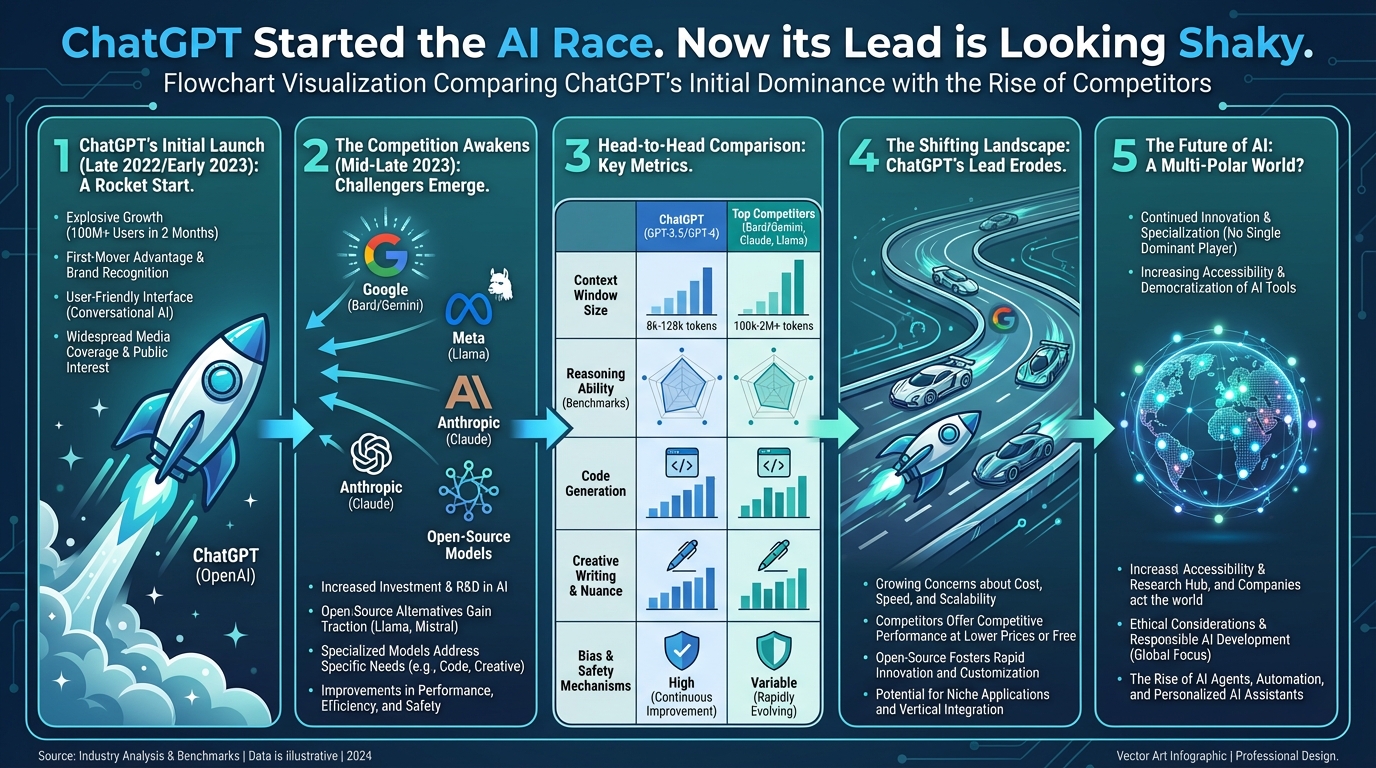
ChatGPT’s arrival was a watershed moment, galvanizing public interest in AI and showcasing the power of Large Language Models (LLMs) beyond academic circles. It democratized AI access, enabling intuitive conversations, content generation, and task automation. However, its initial lead was destined to be challenged. The claim that ChatGPT started the AI race. Now its lead is looking shaky. is a strong one, but it needs to be supported by more evidence.
The Cracks in ChatGPT’s Armor
ChatGPT’s vulnerability stems from three key areas. First, the open-source community’s rapid advancements in LLMs, delivering comparable performance at lower costs. Second, the massive investments by tech giants like Google and Meta, leveraging their resources and ecosystems for seamless AI integration. Third, the emergence of specialized AI models optimized for specific tasks, outperforming general-purpose LLMs in their respective domains. The US health department unveils strategy to expand its adoption of AI technology – AP News.
Open Source: The Agile Competitor
The open-source AI movement, spearheaded by models like Meta’s Llama 2, provides powerful, freely available resources for researchers and developers. This collaborative environment fuels innovation and rapid experimentation, accelerating AI development. A real-world scenario of this is the use of Llama 2 by smaller startups to build custom chatbots for niche industries, something that would have been cost-prohibitive with closed-source models. The open-source community is also actively addressing biases in AI, a vital concern given issues like racial bias in UK police facial recognition technology, as highlighted in 5 Critical Developments: ‘Urgent clarity’ sought over racial bias in UK police facial recognition technology – The Guardian.
Tech Titans: The Data and Infrastructure Advantage
Google’s Gemini and Meta’s LLMs pose a direct challenge to ChatGPT, leveraging unparalleled data resources, advanced research capabilities, and robust infrastructure for large-scale AI deployment. Their integration into existing platforms, such as search engines and social media, offers seamless user experiences and broad exposure. The Home Office admits facial recognition tech issue, a matter we explored in 9 Critical Takeaways: Home Office admits facial recognition tech issue with black and Asian subjects – The Guardian Exposed, underscores the ethical considerations these giants must address.
Specialized AI: Precision and Efficiency
While general-purpose LLMs offer versatility, they often lack the specialized knowledge required for specific applications. Specialized AI models, trained on domain-specific data and optimized for particular tasks, excel in areas like medical diagnosis, financial analysis, and legal research. For instance, an AI model trained on medical imaging can detect tumors with greater accuracy than a general LLM. This specialization trend is a critical factor weakening ChatGPT’s overall lead.
Enterprise Implications: A CTO’s Perspective
From a CTO’s perspective, the evolving AI landscape necessitates a strategic approach. Companies must carefully assess their needs and select the optimal models – potentially a mix of general-purpose and specialized AI – considering cost, scalability, and integration complexity. Open-source models offer cost-effectiveness but demand greater technical expertise. Cloud-based platforms provide scalability but can be more expensive. Consider the Market-Crushing AI Momentum: Top Robotics Technology Stocks Leading the 2026 Growth Trend when evaluating AI investments.
The Future: Fragmentation and Specialization
The AI landscape will likely become increasingly fragmented, with diverse models and platforms catering to specific needs. ChatGPT will remain relevant but face intense competition. Success hinges on adaptability and a willingness to experiment with various AI solutions. Companies that effectively leverage AI will gain a significant competitive edge.
Expert Insights: The Shifting Sands of AI
“ChatGPT validated AI’s potential but also exposed the limitations of general-purpose LLMs. Specialization and customization are the future.”
“The open-source AI movement is democratizing access and accelerating innovation, empowering smaller players to compete.”
“Seamless AI integration into existing products will drive widespread adoption, making AI an invisible but essential component of daily life.”
Navigating the AI Landscape: Key Questions
- Is ChatGPT still relevant? Yes, but it’s no longer the default choice.
- Are open-source LLMs viable? Increasingly, offering competitive performance.
- Will Google and Meta dominate? Their resources are significant, but innovation is unpredictable.
- Is specialized AI superior? It excels in specific domains due to targeted training.
- How to choose the right AI solution? Thoroughly evaluate your needs and test different options.
- What’s the future of AI? A fragmented ecosystem with diverse tools.
- Why is ChatGPT’s lead shaky? Intensifying competition is driving innovation and better alternatives.