


The Guardian’s headline, “Urgent clarity sought over racial bias in UK police facial recognition technology,” isn’t a suggestion; it’s a demand. UK police are deploying facial recognition with demonstrable racial bias, demanding immediate, independent investigation and systemic overhaul.
The Core Issue: Algorithmic Discrimination
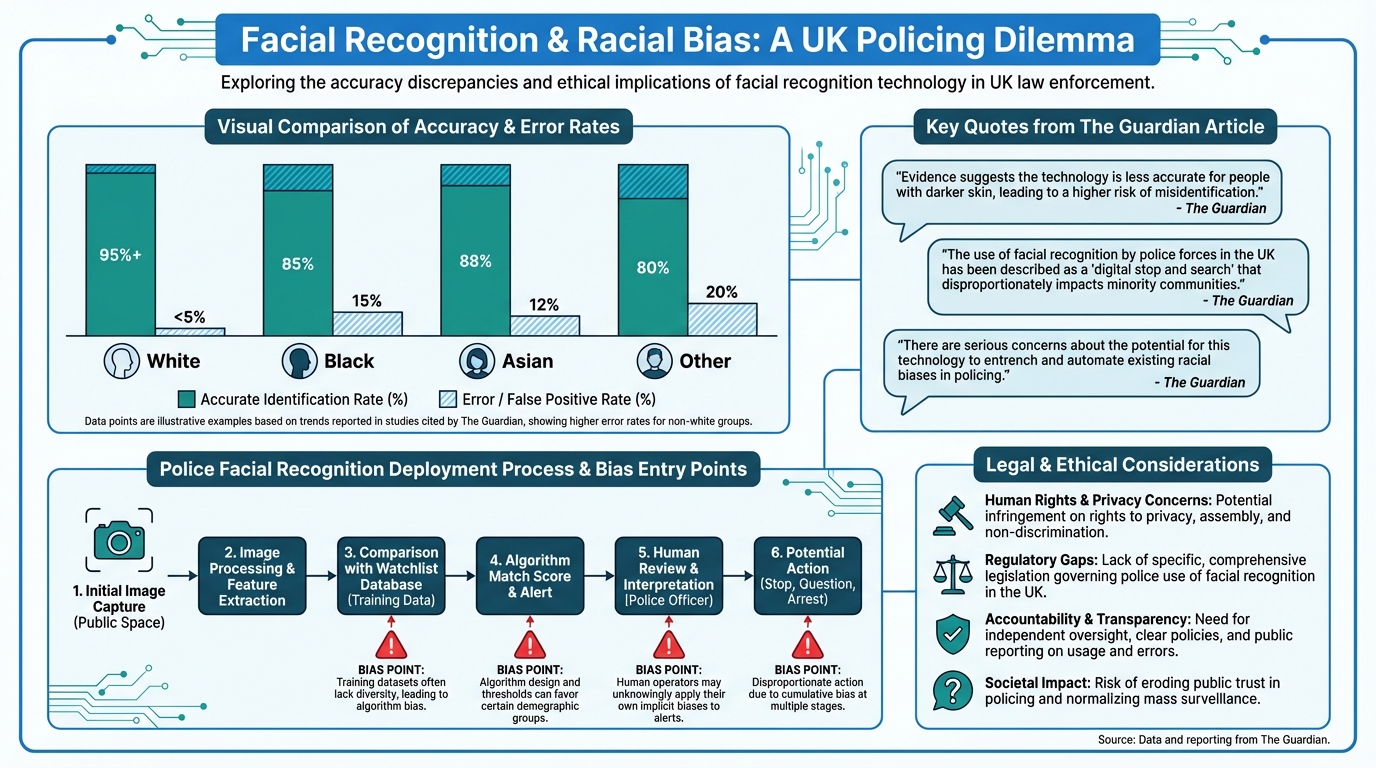
The Guardian’s reporting exposes the inherent flaws in UK police’s deployment of facial recognition. These systems consistently misidentify or disproportionately flag individuals from minority ethnic backgrounds. This isn’t a bug; it’s a feature of poorly designed and implemented technology, directly impacting civil liberties. The Home Office’s admission of facial recognition tech issues with Black and Asian subjects, as previously reported by The Guardian, only scratches the surface.
Technical Root Cause: Skewed Training Data and Biased Algorithms
The problem stems from two critical technical failures. First, training datasets are demonstrably skewed, over-representing white faces and under-representing ethnic minorities. This “garbage in, garbage out” scenario creates a system inherently biased from the start. Second, the algorithms themselves are often designed with implicit biases, prioritizing facial features prevalent in certain ethnic groups, leading to skewed results. Consider the impact of lighting variations on darker skin tones, often not adequately addressed in algorithm training, leading to misidentification.
Demand for Transparency: Beyond Lip Service
The call for “urgent clarity” isn’t about vague promises; it’s a demand for demonstrable transparency and accountability. Civil rights groups and privacy advocates are right to demand granular insight into the development, testing, and deployment pipelines of these systems. Meaningful transparency requires the following:
- Full disclosure of training datasets, including demographic breakdowns and sourcing.
- Detailed explanations of bias detection and mitigation strategies, including specific algorithms and thresholds used.
- Independent, third-party testing across diverse ethnic groups, with publicly available results and error rates.
- Establishment of independent oversight bodies with the power to audit systems, investigate complaints, and enforce penalties for misuse.
Without this level of transparency, public trust is impossible. The “Reality Check” highlighted by *The New York Times* regarding AI technology’s need for a bubble burst is particularly relevant here. Opaque systems breed distrust and allow bias to fester.
Impact on the Tech Industry: A Wake-Up Call
This situation serves as a brutal indictment of the tech industry’s often-careless approach to AI development. AI is not neutral; it’s a reflection of the biases of its creators and the data it’s trained on. Companies developing facial recognition must move beyond superficial “ethics washing” and invest in genuinely diverse training datasets, rigorous, independent testing, and continuous monitoring. The expansion of AI adoption, as seen in the US health department’s strategy (AP News), only amplifies the risks of unchecked bias.
A CTO’s Perspective: Ethical Imperative, Not Optional Extra
As a CTO, I see this as a fundamental ethical failure. We can’t deploy algorithms blindly, trusting them to make decisions without understanding their limitations and potential biases. Our responsibility is to ensure fairness, equality, and justice, not just optimize for accuracy. This requires a shift in mindset:
- **Prioritize fairness metrics:** Move beyond overall accuracy and focus on measuring performance across different demographic groups. Use metrics like disparate impact ratio and equal opportunity difference.
- **Implement adversarial testing:** Actively try to break the system by feeding it challenging images and scenarios, specifically designed to expose biases.
- **Embrace multidisciplinary collaboration:** Bring together data scientists, ethicists, legal experts, and community stakeholders to develop and implement responsible AI practices.
- **Establish independent audit trails:** Log all decisions made by the system, including the confidence scores and demographic information associated with each identification.
Furthermore, we need a culture of radical transparency within the tech industry. Openly disclose data sources, algorithms, and potential biases. Subject systems to independent audits, and be prepared to accept and act on criticism.
The Future of Facial Recognition: Regulation is Inevitable
The future of facial recognition in law enforcement depends on our ability to address bias and transparency effectively. Without meaningful change, regulation is not just likely; it’s necessary. Expect to see requirements for independent testing, stringent data privacy safeguards, and clear, legally enforceable guidelines for its use. Ignoring the societal implications, as highlighted by ASU News, is not an option. This isn’t a technological challenge; it’s a societal one, demanding a fundamental shift in how we develop and deploy AI.
Real-World Scenario: The Wrongful Arrest
Imagine a young Black man, wrongly identified by a biased facial recognition system, being stopped and searched based solely on this flawed identification. He’s late for a job interview, and the unwarranted stop causes him to miss it. The police find nothing, but the damage is done. He’s now lost an opportunity and faces the psychological trauma of being unfairly targeted by law enforcement. This isn’t a hypothetical; it’s a recurring nightmare enabled by biased technology.
FAQs
What is facial recognition technology?
Facial recognition algorithms analyze facial features to identify individuals. Its applications span law enforcement, security, and access control.
Why is racial bias a concern?
Systems exhibit lower accuracy identifying individuals from minority ethnic backgrounds, raising concerns about discrimination.
How can bias be mitigated?
Mitigation requires diverse training data, rigorous testing, and continuous monitoring for equitable performance across demographics.
What regulations govern facial recognition?
Regulations vary, but a growing movement advocates for stricter oversight and data privacy safeguards.
How can I protect my privacy?
Employ privacy-enhancing technologies and advocate for robust data protection laws.
What is the long-term impact of biased technology?
Increased discrimination, eroded trust in law enforcement, and stifled free expression are potential long-term consequences.
Source: The Guardian
Electronic Frontier Foundation
AlgorithmWatch