


11 Essential Lessons on maintaining your humanity in the world of AI technology – ASU News: A Strategic Guide
Lessons on maintaining your humanity in the world of AI technology – ASU News is a topic often discussed in abstract terms, but what does it *really* mean? We’re not just talking about robots taking over. It’s about how AI subtly shifts our values, our interactions, and even our sense of self. Are we becoming more efficient, or just more… robotic?
My core thesis is this: maintaining our humanity in the age of AI requires conscious effort, constant reflection, and a willingness to prioritize human connection over technological advancement, where appropriate. It’s about building guardrails, not just for AI, but for ourselves.
I’ve been in this game for over 15 years, seen the rise of AI from a niche research area to the dominant force it is today. And I’ve seen the good, the bad, and the downright weird. Let’s dive into some hard-won lessons.
1. Lessons on maintaining your humanity in the world of AI technology – ASU News: Empathy as a Core Competency
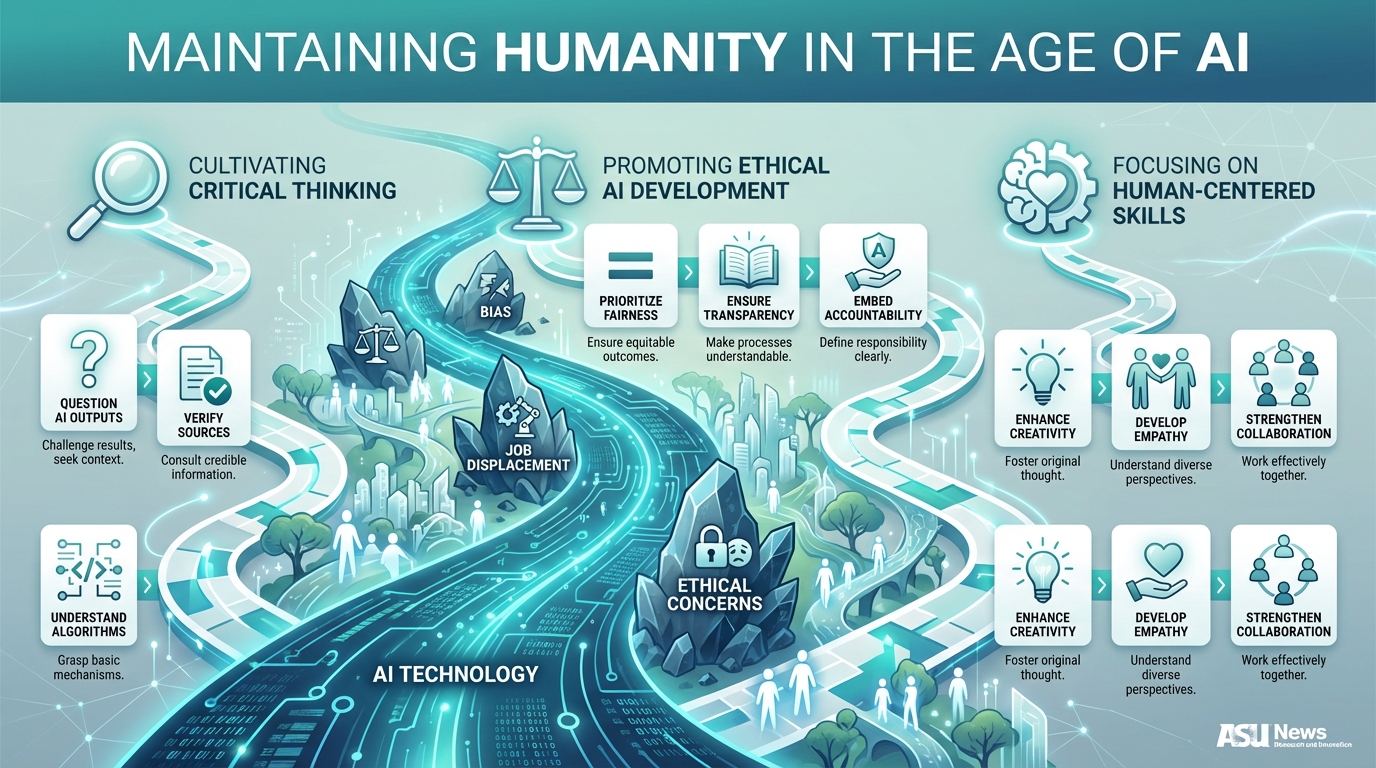
AI can analyze data and predict behavior, but it can’t *feel*. Empathy, the ability to understand and share the feelings of another, is fundamentally human. Don’t let algorithms erode this skill.
Actively practice empathy in your daily interactions. Listen more than you speak. Try to understand different perspectives. It sounds simple, but it’s a powerful antidote to the dehumanizing effects of technology. Remember that feeling is the key!
Consider this: when designing AI systems, prioritize user experience that fosters connection, not just efficiency. A chatbot that understands frustration is far more valuable than one that just spits out answers. This is a key takeaway from studying usability heuristics.
2. Cultivate Critical Thinking: Question Everything, Especially AI
AI-generated content is getting scarily good. But it’s not infallible. It can be biased, inaccurate, or just plain wrong. Develop your critical thinking skills to evaluate AI’s output.
Don’t blindly trust AI. Always verify information from multiple sources. Understand the limitations of the algorithms you’re using. Learn how to spot misinformation and propaganda. The future depends on it. Understand that 11 Expert Strategies for Opinion | A.I. Technology Needs the Bubble to Burst – The New York Times Reality Check.
I once saw an AI system confidently recommend a completely inappropriate treatment for a patient. Luckily, a doctor caught the error. But what if they hadn’t? This highlights the importance of human oversight.
3. Prioritize Human Connection Over Digital Interaction
We’re spending more and more time interacting with screens and less time interacting with real people. This is a problem. Human connection is essential for our well-being.
Make a conscious effort to disconnect from technology and connect with others. Have a conversation. Share a meal. Participate in a community activity. Put your phone down and be present. It makes a difference.
Think about the impact of remote work. While it offers flexibility, it can also lead to isolation. Find ways to build meaningful relationships with your colleagues, even if you’re not in the same physical space. Remote happy hour can be a start!
4. Lessons on maintaining your humanity in the world of AI technology – ASU News: Embrace Creativity and Imagination
AI can generate art and music, but it can’t truly create. Creativity and imagination are uniquely human qualities. Nurture them.
Engage in activities that stimulate your creativity. Write, paint, play music, dance. Explore new ideas and perspectives. Don’t be afraid to experiment and make mistakes. That’s where the magic happens.
Remember the joy of discovery? AI can help us explore new possibilities, but it shouldn’t replace our own innate curiosity and drive to create. Consider the Meme Monday Mastery: Your Ultimate Guide to Viral Fun and see how humans can be more creative.
5. Uphold Ethical Principles in AI Development and Deployment
AI is a powerful tool, and like any tool, it can be used for good or for evil. It’s our responsibility to ensure that AI is developed and deployed ethically.
Advocate for ethical AI practices. Demand transparency and accountability from AI developers. Be aware of the potential biases in AI algorithms and work to mitigate them. Speak out against the misuse of AI. These are all great AI Ethics resources.
I’ve seen firsthand how AI can perpetuate and amplify existing inequalities. We need to be vigilant in ensuring that AI benefits everyone, not just a select few.
6. Lessons on maintaining your humanity in the world of AI technology – ASU News: Value Diversity and Inclusion
AI algorithms are trained on data, and if that data is biased, the AI will be biased as well. It’s crucial to ensure that AI systems are developed with diverse perspectives and data sets.
Promote diversity and inclusion in the AI field. Support initiatives that encourage women and minorities to pursue careers in AI. Advocate for the use of diverse data sets in AI training. This ensures that AI systems are fair and equitable.
The lack of diversity in the tech industry is a well-documented problem. We need to actively address this issue to ensure that AI reflects the values of all of humanity. It’s about Sustainable Technology ROI in Manufacturing: Separating Hype From Reality.
7. Cultivate Self-Awareness and Emotional Intelligence
AI can analyze our emotions, but it can’t truly understand them. Self-awareness and emotional intelligence are essential for navigating the complexities of the human experience.
Practice mindfulness and self-reflection. Pay attention to your emotions and how they influence your behavior. Develop your emotional intelligence skills, such as empathy, self-regulation, and social skills. If you want to start an AI Solo Startup: Your 2025 Blueprint for One-Person Success, you need to know your strengths and weaknesses.
I’ve found that understanding my own biases and limitations is crucial for working effectively with AI. It helps me to identify potential problems and make better decisions.
8. Lessons on maintaining your humanity in the world of AI technology – ASU News: Embrace Lifelong Learning and Adaptability
The field of AI is constantly evolving. It’s essential to embrace lifelong learning and adaptability to stay relevant and informed.
Stay up-to-date on the latest AI developments. Read books, articles, and blogs. Attend conferences and workshops. Experiment with new AI tools and technologies. Be willing to learn new skills and adapt to changing circumstances.
The pace of change in the AI field is dizzying. But it’s also exciting. Embrace the challenge and commit to being a lifelong learner.
9. Find Meaning and Purpose Beyond Technology
Technology can be a powerful tool, but it shouldn’t be the sole source of meaning and purpose in your life. Find activities and relationships that give you a sense of fulfillment and connection.
Volunteer your time. Pursue a hobby. Spend time with loved ones. Connect with nature. Engage in activities that are meaningful to you. Remember, AI is just a tool. Use it wisely to enrich your life, not to define it.
10. Lessons on maintaining your humanity in the world of AI technology – ASU News: Advocate for Responsible AI Governance
AI is transforming our world, and it’s essential to have responsible AI governance in place to ensure that it’s used for the benefit of all. Advocate for policies and regulations that promote ethical AI practices, protect human rights, and prevent the misuse of AI.
11. Remember Your Humanity: It’s Not a Bug, It’s a Feature
Ultimately, maintaining our humanity in the age of AI is about remembering what makes us human. It’s about valuing empathy, creativity, connection, and purpose. It’s about recognizing that our flaws and imperfections are not bugs, but features. They’re what make us unique and valuable.
I’ve seen too many people get caught up in the hype and forget what really matters. Don’t let that happen to you. Stay grounded. Stay connected. Stay human.
AI is a powerful tool, but it’s just a tool. It’s up to us to use it wisely and ethically. The future of humanity depends on it. Think strategically like the AI Journey: Your Ultimate Guide to Artificial Intelligence.
Counter-Arguments and Potential Flaws
Some might argue that focusing on “humanity” is a luxury we can’t afford in a competitive world. That efficiency and progress should be prioritized above all else. I disagree. Short-term gains at the expense of long-term well-being are never a good trade. It’s also not an either/or scenario. We can have both efficiency and humanity.
Others might say that AI will eventually surpass human intelligence and render our efforts to maintain our humanity irrelevant. Maybe. But even if that happens, we should still strive to be the best versions of ourselves. It’s not about winning, it’s about living a meaningful life.
Strategic Takeaway
The key takeaway is this: actively cultivate your humanity. Don’t let technology erode your values or your connections. Be intentional about prioritizing human interaction, ethical considerations, and personal growth. It’s not just good for you, it’s good for the world.
FAQ
- Q: How can I stay informed about the latest AI developments? A: Read industry publications, attend conferences, and experiment with new tools.
- Q: What are some ethical considerations when developing AI systems? A: Transparency, accountability, fairness, and privacy.
- Q: How can I promote diversity and inclusion in the AI field? A: Support initiatives that encourage women and minorities to pursue careers in AI.
- Q: What are some ways to cultivate self-awareness and emotional intelligence? A: Practice mindfulness, self-reflection, and emotional regulation.
- Q: How can I find meaning and purpose beyond technology? A: Volunteer your time, pursue a hobby, and connect with loved ones.
- Q: How can I advocate for responsible AI governance? A: Support policies and regulations that promote ethical AI practices.
Data Comparison: AI Tools and Human Skills
| Feature | AI Tool | Human Skill |
|---|---|---|
| Data Analysis | Machine Learning Algorithms | Critical Thinking |
| Content Generation | GPT-3 | Creativity |
| Emotional Understanding | Sentiment Analysis | Empathy |
| Problem Solving | AI-powered Decision Support Systems | Intuition |
FAQ (Continued)
- Q: Is AI going to take my job? A: It might change your job, but it’s unlikely to completely replace you if you adapt and develop new skills.
- Q: How can I prepare for the future of work in the age of AI? A: Focus on developing uniquely human skills, such as creativity, critical thinking, and emotional intelligence.
- Q: What are some potential downsides of AI? A: Bias, job displacement, privacy concerns, and the potential for misuse.
- Q: How can I mitigate the risks of AI? A: Advocate for ethical AI practices, promote transparency and accountability, and support responsible AI governance.
- Q: What are some potential benefits of AI? A: Increased efficiency, improved healthcare, and new opportunities for innovation.
- Q: How can I use AI to improve my life? A: Use AI tools to automate tasks, learn new things, and connect with others.