



11 Proven Strategies for Meta pivots to AI smart glasses as metaverse bet struggles – BBC Success in 2024
Meta pivots to AI smart glasses as metaverse bet struggles – BBC, a move that proves tech’s a gamble. Big bets don’t always pay off. Are smart glasses the future, or just another gadget heading for the graveyard?
Table of Contents
- Introduction: The Shifting Sands of Meta’s Strategy
- The Metaverse Gamble: Where Did It Go Wrong?
- AI Smart Glasses: A New Hope or a Familiar Hype?
- Decoding the Tech: What’s Under the Hood of Meta’s Smart Glasses?
- Market Analysis: Who’s Buying Smart Glasses?
- Privacy Concerns: The Elephant in the Smart Glasses Room
- The Competition: Meta vs. The World
- Future Outlook: Will AI Smart Glasses Save Meta?
- Expert Opinions on Meta’s Pivot
- Investment Strategy: Riding the AI Smart Glasses Wave
- Conclusion: Navigating the Future of Wearable Tech
- Frequently Asked Questions
Meta pivots to AI smart glasses as metaverse bet struggles – BBC. This shift suggests a move from virtual worlds to something more tangible: augmented reality. It begs the question: what’s next for the metaverse, and can wearable AI actually work?
Introduction: The Shifting Sands of Meta’s Strategy
Tech companies pivot all the time, but when Meta changes course, everyone notices. “Meta pivots to AI smart glasses as metaverse bet struggles – BBC” spells it out: a strategic realignment. Is this a smart move to stay in the game, or a sign of trouble brewing in Meta’s master plan?
I’ve seen fortunes wasted on doomed projects. This feels like damage control, but execution is key.
The Metaverse Gamble: Where Did It Go Wrong?
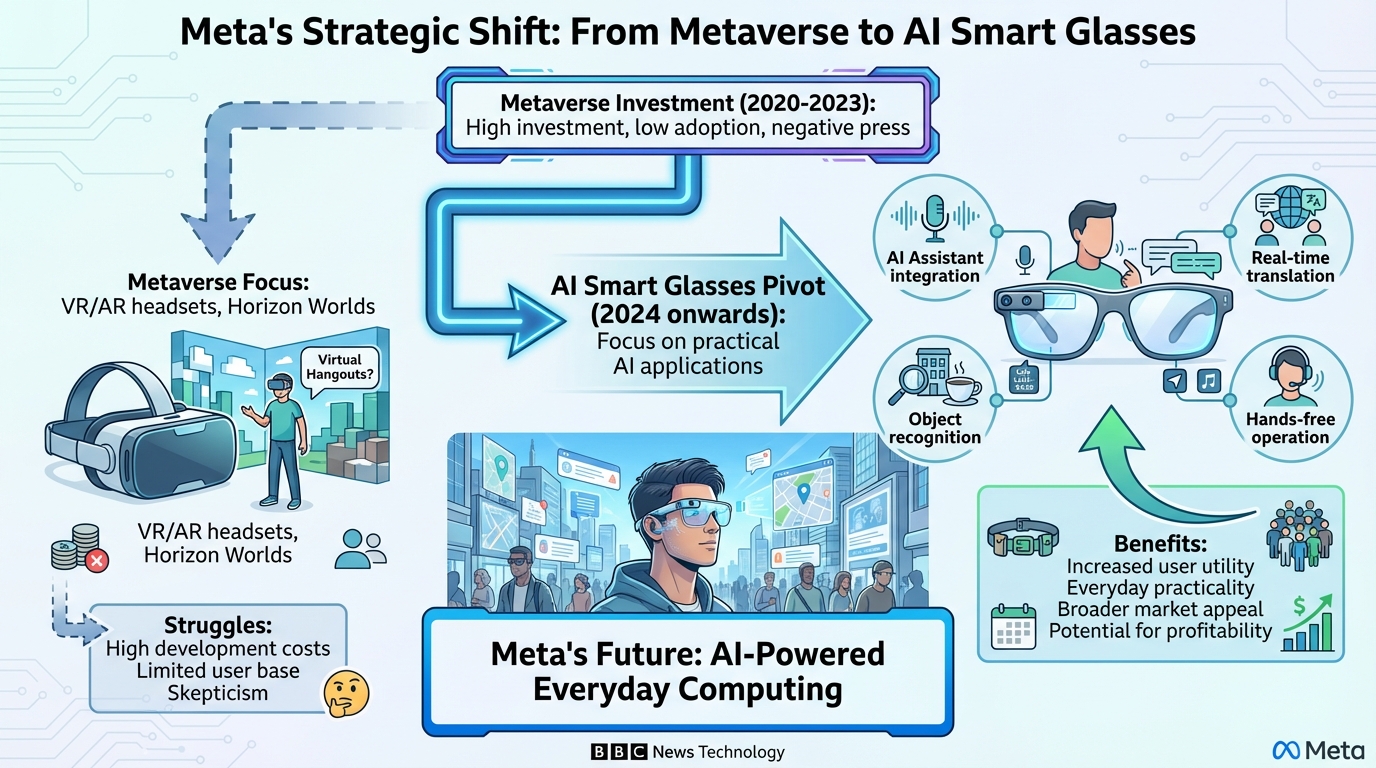
Meta’s metaverse dreams, initially hyped, hit a wall. User adoption’s slow, and the tech’s still clunky. The “Meta pivots to AI smart glasses as metaverse bet struggles – BBC” story is a direct result of these problems.
Let’s be real, spending billions on something nobody’s using isn’t a good look. Maybe [internal link: 11 Expert Strategies for Opinion | A.I. Technology Needs the Bubble to Burst – The New York Times Reality Check] can offer some perspective.
The metaverse needed better uses than virtual meetings and games. The high price tag for hardware and software didn’t help either.
AI Smart Glasses: A New Hope or a Familiar Hype?
AI smart glasses promise a more seamless AR experience. Instead of being stuck in a VR headset, users can see digital info in the real world. But is this real innovation, or just Google Glass 2.0?
The potential’s there, but the tech has to be smooth and subtle. Nobody wants to look like a cyborg just to read an email.
Whether Meta’s AI smart glasses succeed will depend on offering useful features that improve daily life.
Decoding the Tech: What’s Under the Hood of Meta’s Smart Glasses?
So, what’s inside these new AI smart glasses? Early reports point to advanced sensors, AI voice assistants, and smart image recognition. The goal: a device that’s easy to use, responsive, and genuinely helpful.
We’re talking about tiny components, efficient power, and solid software. It’s a tough engineering challenge, and bugs are inevitable.
Key specs will include processing power, battery life, screen resolution, and AI quality. Integrating [internal link: 7+ Proven Strategies for AI-powered Security Automation DevSecOps Success in 2025: A Step-by-Step Guide] is also vital for privacy and security.
Market Analysis: Who’s Buying Smart Glasses?
The smart glasses market’s still small, but growing. Early adopters include tech fans, professionals in manufacturing and healthcare, and people with disabilities. The success of Meta’s pivot depends on growing this market.
Price will be huge. Too expensive, and they’re just a novelty. Affordable and useful, and they could go mainstream.
Forbes.com reports on the growing AR/VR market here.
Privacy Concerns: The Elephant in the Smart Glasses Room
Any device that records video and audio raises red flags. Meta needs to tackle these concerns head-on to earn trust. How will data be collected, stored, and used? What’s in place to prevent misuse?
People are already wary of being tracked. If these glasses feel like surveillance, they’re dead.
Transparency and user control are critical. Users must easily understand how their data’s used and have the option to opt out. The AI backlash is real; check out [internal link: 11 Strategic Insights for The AI Backlash Is Here: Why Public Patience with Tech Giants Is Running Out] for details.
The Competition: Meta vs. The World
Meta’s not alone in the smart glasses game. Apple, Google, and Snap are also building wearable AR. The competition’s intense, and the stakes are high.
Each company has strengths and weaknesses. Meta has money and users. Apple’s known for design. Google excels in AI. Snap targets a younger audience.
Wired.com covers the competitive landscape of AR glasses here.
Future Outlook: Will AI Smart Glasses Save Meta?
The future of Meta’s pivot is uncertain. Success hinges on tech, market adoption, and addressing privacy. It’s a risky bet, but it could pay off big if Meta nails it.
They’re betting on a future where AR’s part of everyday life. Whether that’s 2024 or 2034, who knows?
Expert Opinions on Meta’s Pivot
Analysts are split on Meta’s move. Some see it as capitalizing on AR demand. Others are skeptical, saying Meta’s chasing the next trend. So, what do the experts think?
Some think Meta’s resources and AI give them an edge. Others say their past hardware failures make them an unlikely winner.
MIT Technology Review offers insights into AI’s influence; consider [internal link: 7 Proven Ways AI Chatbots Are Rewriting Political Persuasion: MIT Tech Review Analysis] for context.
Investment Strategy: Riding the AI Smart Glasses Wave
For investors, Meta’s pivot brings opportunities and risks. Investing in AI smart glasses could pay off, but do your homework.
Find companies with strong tech, a clear strategy, and a history of innovation. Also, consider regulations and privacy concerns.
Keep an eye on how ChatGPT started the AI race. Its dominance may be shaky, as per [internal link: 11 Expert Strategies for ChatGPT started the AI race. Now its lead is looking shaky. – The Washington Post Dominance in 2025].
Conclusion: Navigating the Future of Wearable Tech
Meta pivots to AI smart glasses as metaverse bet struggles – BBC, showing a shift to AR and wearables. Success is uncertain, but it highlights tech’s constant need for innovation.
The future of wearables is bright, but challenging. Companies that navigate these challenges will thrive.
Wikipedia provides a comprehensive overview of augmented reality here.
Frequently Asked Questions
Q: What are AI smart glasses?
A: AI smart glasses are wearables that overlay digital info onto the real world, using AI to improve the experience.
Q: Why is Meta pivoting to AI smart glasses?
A: Meta pivots to AI smart glasses as metaverse bet struggles – BBC because its metaverse ambitions have faced challenges. AI smart glasses offer a more practical AR application.
Q: What are the potential benefits of AI smart glasses?
A: Benefits include hands-free info, better productivity, and immersive entertainment.
Q: What are the privacy concerns associated with AI smart glasses?
A: Concerns include unauthorized recording and the collection/use of personal data.
Q: Who are Meta’s main competitors in the AI smart glasses market?
A: Meta’s main competitors are Apple, Google, and Snap.
Q: What is the future outlook for AI smart glasses?
A: The future’s uncertain, but the tech could go mainstream if it overcomes tech and privacy hurdles.
| Feature | Meta’s Smart Glasses | Apple’s Vision Pro | Google Glass |
|---|---|---|---|
| Display Technology | Likely OLED or MicroLED | Micro-OLED | Prism Display |
| AI Capabilities | Advanced AI assistant, image recognition | Sophisticated spatial computing | Basic voice commands |
| Price Point | Expected to be competitive | High-end, premium pricing | Initially very expensive |
| Privacy Features | Emphasis on user control and data security | Advanced biometric authentication | Limited privacy features |
| Target Market | Broad consumer market | Professionals and early adopters | Enterprise and niche applications |