



7+ Proven Strategies for Minimum Marketable Product (MMP) Success in 2025: Achieving Product-Market Fit Faster with AI and Empathy
Minimum Marketable Product (MMP) is the evolved form of the Minimum Viable Product, focusing not just on core functionality but also on delivering a satisfying user experience that resonates with the target market.
The Minimum Marketable Product (MMP) represents the version of a product that can be released with the smallest possible feature set while still delivering enough value to attract early adopters and generate revenue. It’s about finding the sweet spot between functionality and market appeal.
The Evolution from MVP to MMP: Why the Shift?
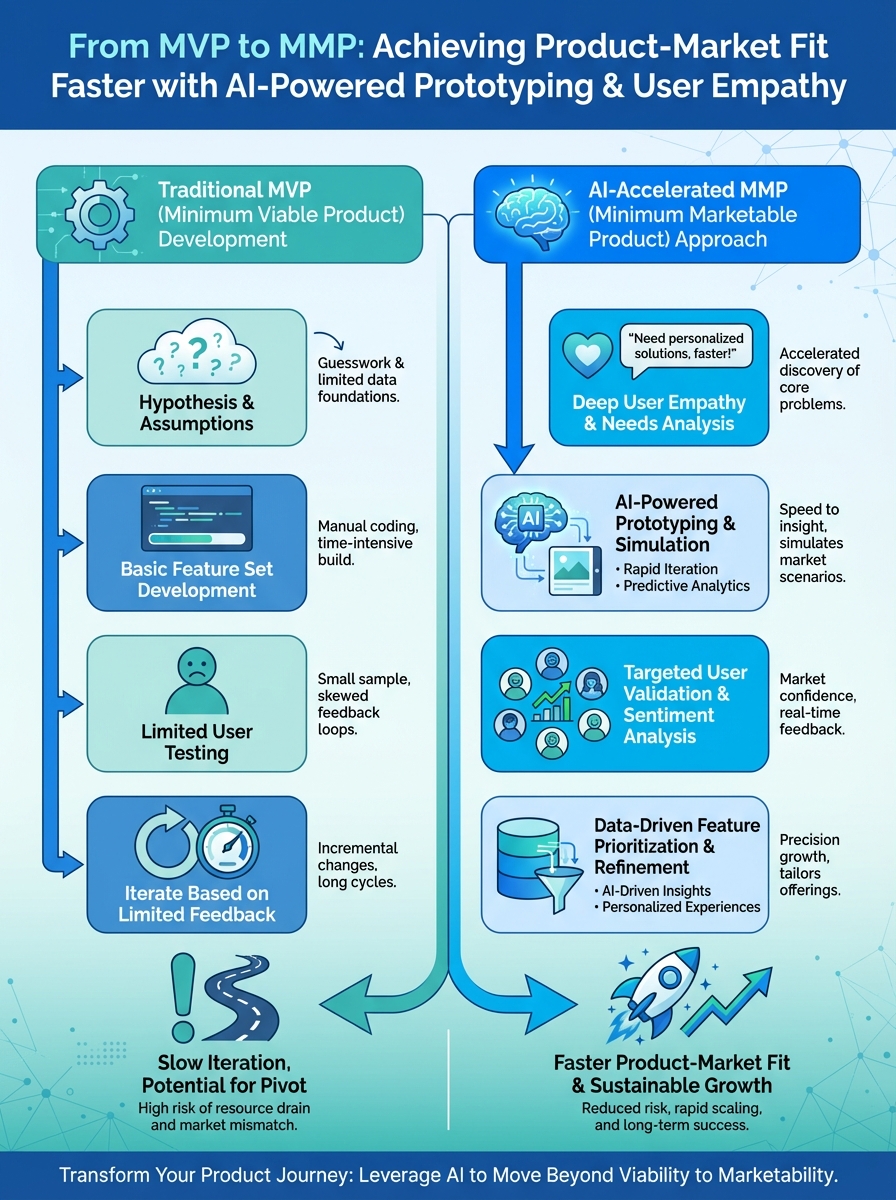
The Lean Startup methodology, popularized by Eric Ries, advocates for building a Minimum Viable Product (MVP) to validate assumptions quickly. However, MVPs often fall short of delivering a truly satisfying user experience, leading to lukewarm market reception. This is where the concept of the Minimum Marketable Product (MMP) comes in. The MMP emphasizes not just viability, but also *marketability*. It’s about creating a product that people actually *want* to use and are willing to pay for. This ensures not only early validation but also a stronger foundation for future growth. Many startups struggle with the MVP approach, releasing products that are technically functional but fail to resonate with their target audience. This can lead to wasted time, resources, and ultimately, failure. The MMP approach addresses this by emphasizing user empathy and market validation from the outset.
Strategy 1: Deep Dive into User Empathy
Understanding your target audience is paramount. User empathy goes beyond basic demographics; it involves understanding their motivations, pain points, and aspirations. This deep understanding informs every aspect of the product development process, from feature prioritization to user interface design. Consider employing techniques like:
- User Interviews: Conduct in-depth interviews with potential users to uncover their needs and desires.
- Surveys: Use surveys to gather quantitative data about user preferences and behaviors.
- Usability Testing: Observe users interacting with prototypes to identify usability issues and areas for improvement.
- Analytics: Track user behavior on existing products or competitor products to gain insights into their usage patterns.
By truly understanding your users, you can create an MMP that addresses their specific needs and provides a delightful user experience. This approach aligns with the core principles of user-centered design. As you build your product, remember that user empathy is not a one-time activity, but an ongoing process. Continuously gather feedback and iterate on your product based on user input.
Strategy 2: AI-Powered Prototyping for Rapid Iteration
AI-powered prototyping tools are revolutionizing the product development process. These tools enable you to create interactive prototypes quickly and efficiently, allowing you to test your ideas with users and gather feedback early on. Some popular AI-powered prototyping tools include:
- UIzard: Generates UI designs from hand-drawn sketches.
- Figma AI: Integrates AI features for design automation and collaboration.
- Adobe XD: Offers AI-powered features for content-aware layout and design.
By using AI-powered prototyping tools, you can significantly reduce the time and cost associated with traditional prototyping methods. This allows you to iterate more quickly and efficiently, ensuring that your MMP is aligned with user needs. For example, you could use AI to generate multiple design variations and then A/B test them with users to determine which design performs best. This data-driven approach helps to ensure that your design decisions are based on evidence rather than intuition. Remember to keep the principles of usability heuristics in mind when designing your prototypes.
Strategy 3: Define Clear Success Metrics for Your MMP
Before launching your MMP, it’s crucial to define clear success metrics. These metrics should be aligned with your overall business goals and should provide insights into the performance of your MMP. Some common success metrics include:
- User Acquisition Cost (CAC): The cost of acquiring a new user.
- Customer Lifetime Value (CLTV): The total revenue generated by a customer over their lifetime.
- Conversion Rate: The percentage of users who complete a desired action, such as signing up for a free trial or making a purchase.
- Churn Rate: The percentage of users who stop using your product over a given period.
- Net Promoter Score (NPS): A measure of customer loyalty and willingness to recommend your product.
By tracking these metrics, you can gain valuable insights into the performance of your MMP and identify areas for improvement. For example, if your CAC is too high, you may need to refine your marketing strategy. If your churn rate is too high, you may need to improve the user experience of your product. Regularly review your success metrics and adjust your strategy as needed. Understanding these metrics is critical for achieving product-market fit.
Strategy 4: Embrace Iterative Design and Continuous Feedback
The MMP is not a static product; it’s a starting point for continuous improvement. Embrace iterative design and continuously gather feedback from users to refine your product. This involves:
- A/B Testing: Experiment with different versions of your product to see which performs best.
- User Feedback Surveys: Regularly solicit feedback from users about their experience with your product.
- Analytics Monitoring: Continuously monitor user behavior to identify areas for improvement.
- Community Forums: Create a community forum where users can share feedback and ideas.
By embracing iterative design and continuous feedback, you can ensure that your product is constantly evolving to meet the needs of your users. This approach aligns with the principles of Agile development. Remember to prioritize feedback based on its impact and feasibility. Don’t try to implement every suggestion; focus on the changes that will have the biggest impact on user satisfaction and business goals.
Strategy 5: Prioritize Features Based on User Value and Business Impact
Not all features are created equal. When building your MMP, it’s crucial to prioritize features based on their user value and business impact. This involves:
- User Story Mapping: Create a visual representation of the user journey and identify the key features that are needed to support each step.
- Prioritization Matrix: Use a prioritization matrix to rank features based on their user value and business impact.
- Moscow Prioritization: Categorize features into Must have, Should have, Could have, and Won’t have.
By prioritizing features effectively, you can ensure that your MMP delivers the most value to users while also supporting your business goals. Focus on building the features that are essential for solving the user’s problem and that will drive the most significant business impact. Avoid adding features that are “nice to have” but don’t provide significant value. Refer to 7 Proven Strategies for MVP in 7 Days: The AI Startup Founder’s Sanity Checklist for more insights on rapid MVP development.
Strategy 6: Market Validation Through Landing Pages and Pre-Orders
Before investing significant resources in building your MMP, it’s essential to validate your market assumptions. This can be done through:
- Landing Pages: Create a landing page that describes your product and its value proposition. Use the landing page to collect email addresses from potential customers.
- Pre-Orders: Offer pre-orders for your product to gauge demand.
- Crowdfunding: Launch a crowdfunding campaign to raise funds and validate your product idea.
By validating your market assumptions early on, you can avoid wasting time and resources on building a product that no one wants. If you’re struggling to generate interest in your product, it may be a sign that you need to revisit your value proposition or target audience. Market validation is a critical step in the MMP process. Make sure you are also aware of 7+ Proven Strategies for Cybersecurity for SMBs Success in 2025: A Data-Driven Guide and how security considerations can affect market perception.
Strategy 7: Focus on a Delightful User Experience
The MMP should not only be functional but also provide a delightful user experience. This involves:
- Intuitive User Interface: Design a user interface that is easy to use and navigate.
- Fast Loading Times: Optimize your product for speed and performance.
- Visually Appealing Design: Create a visually appealing design that is consistent with your brand.
- Personalized Experience: Tailor the user experience to the individual user.
By focusing on a delightful user experience, you can increase user engagement, retention, and advocacy. A positive user experience can be a significant differentiator in a crowded market. Consider conducting user research to understand what aspects of the user experience are most important to your target audience. Also, keep in mind 7 Proven Strategies for H5 Mobile Debugging NIGHTMARES: A Practical Guide to Diagnosing and Fixing the Most Common Performance Bottlenecks (Even on Obscure Devices) as mobile user experience is often critical. Remember that even small details can have a big impact on the overall user experience.
Strategy 8: Leverage No-Code/Low-Code Platforms
No-code and low-code platforms are powerful tools for building MMPs quickly and efficiently. These platforms allow you to create functional applications without writing code, or with minimal coding required. Some popular no-code/low-code platforms include:
- Bubble: A visual programming platform that allows you to build web applications without code.
- Adalo: A no-code platform for building native mobile apps.
- Webflow: A visual web design platform that allows you to build responsive websites without code.
- Zapier: A tool for automating tasks and workflows between different applications.
By leveraging no-code/low-code platforms, you can significantly reduce the time and cost associated with traditional software development. This allows you to launch your MMP more quickly and start gathering feedback from users. These platforms are particularly useful for building prototypes and validating your product idea before investing in custom development. However, it’s important to consider the limitations of no-code/low-code platforms before committing to them. Some platforms may not be suitable for complex applications or may have limitations in terms of customization. It’s important to carefully evaluate the platform’s features and capabilities before making a decision.
Data Comparison: Prototyping and Feedback Tools
| Tool | Type | Key Features | Pricing |
|---|---|---|---|
| Figma | Prototyping & Collaboration | Real-time collaboration, vector editing, prototyping tools | Free plan available, paid plans starting at $12/month |
| Adobe XD | Prototyping & UI Design | Voice prototyping, auto-animate, content-aware layout | Part of Adobe Creative Cloud, starting at $9.99/month |
| UIzard | AI-Powered Prototyping | Generates UI designs from sketches, AI-powered design suggestions | Free plan available, paid plans starting at $12/month |
| UserTesting.com | User Feedback & Testing | Remote usability testing, user interviews, survey tools | Subscription-based pricing, contact for details |
| Typeform | Survey & Feedback Forms | Interactive surveys, conditional logic, customizable design | Free plan available, paid plans starting at $25/month |
FAQ: Minimum Marketable Product (MMP)
- What is the difference between MVP and MMP?
- MVP focuses on core functionality, while MMP prioritizes a satisfying user experience and marketability.
- How do I identify the core features for my MMP?
- Focus on features that address key user pain points and align with your business goals, prioritizing those with high user value and business impact.
- How much user research is enough for an MMP?
- Conduct enough research to understand your target audience’s needs, motivations, and pain points. This can involve user interviews, surveys, and usability testing.
- What are the key metrics to track for my MMP?
- Track user acquisition cost (CAC), customer lifetime value (CLTV), conversion rate, churn rate, and net promoter score (NPS).
- How often should I iterate on my MMP?
- Iterate continuously based on user feedback and data. Embrace an Agile approach and release updates frequently.
- Is it possible to build an MMP without coding?
- Yes, leverage no-code/low-code platforms to build functional applications quickly and efficiently.
By following these strategies, you can significantly increase your chances of building a successful Minimum Marketable Product and achieving product-market fit faster. Remember to prioritize user empathy, embrace AI-powered prototyping, and continuously iterate based on user feedback. The journey from MVP to MMP is a continuous process of learning and improvement. Stay focused on your users, and your product will ultimately succeed. As technology evolves, staying abreast of developments like Sustainable Technology ROI in Manufacturing: Separating Hype From Reality will also affect how users perceive your product’s value. Don’t forget that 7+ Powerful Strategies for Mantine BorderAnimate Performance: A 2025 Deep Dive can help you optimize UI elements.