



No-code AI guide: unlock the power of artificial intelligence without writing a single line of code. Forget complex programming; this guide focuses on understanding the core concepts to help you leverage immediate value from AI.
Table of Contents
- AI: The New Operating System, No-Code: The Interface
- Deep Dive: The Mechanics and Leverage of No-Code AI
- Core AI Concepts: Beyond the Buzzwords
- No-Code AI Platform Landscape: A Curated Selection
- Concrete Applications: From Theory to Practice
- Data: The Foundation of AI Success
- Real-World Scenario: From Spreadsheet to AI-Powered Insight
- Lessons from the Front Lines
- Pro Tip: Unleashing the Power of Fine-Tuning
- Key Takeaway: The Democratization of AI
- Frequently Asked Questions
AI: The New Operating System, No-Code: The Interface
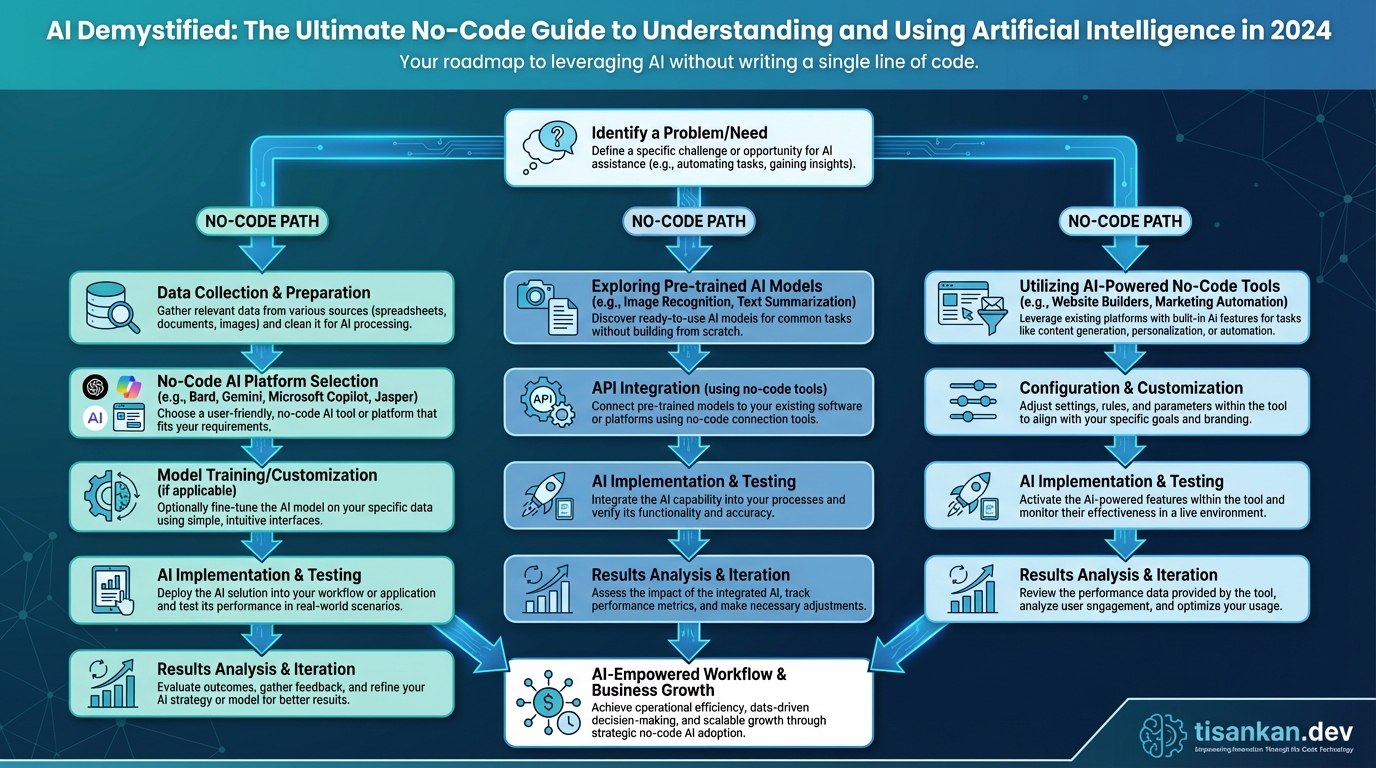
AI is no longer theoretical; it’s actively reshaping industries through automation and novel capabilities. Key trends demonstrate this shift:
- AI-Driven Content: Tools are now capable of generating marketing materials, technical documentation, and even functional code.
- Hyper-Personalization: Algorithms analyze user data to provide highly specific recommendations and content, boosting engagement and conversion.
- Predictive Power: Businesses leverage AI to accurately forecast demand, dynamically optimize pricing, and proactively manage risks.
Previously, these advanced functionalities were exclusive to those with specialized technical knowledge. No-code platforms are disrupting this paradigm by offering intuitive interfaces and pre-built models, enabling the creation of AI-driven applications without any coding. Think of it as circuit building with modular components – assembling pre-engineered blocks to achieve complex outcomes rapidly.
Deep Dive: The Mechanics and Leverage of No-Code AI
Understanding the underlying mechanics of no-code AI is crucial for effective implementation. Here’s how to leverage its potential:
1. Core AI Concepts: Beyond the Buzzwords
Forget the complex math; focus on these fundamental concepts:
- Machine Learning (ML): Algorithms iteratively learn from data patterns without explicit instructions.
- Natural Language Processing (NLP): AI interprets and processes human language for tasks like sentiment analysis and translation.
- Computer Vision: AI analyzes images and videos to identify objects, patterns, and anomalies.
- Training Data: The dataset used to train the AI model. Data quality and volume are paramount for optimal model performance. Garbage in, garbage out.
2. No-Code AI Platform Landscape: A Curated Selection
Numerous platforms exist, each with unique strengths. Consider these options:
- Obviously.AI: excels at building predictive models. Upload your data, specify the target variable, and the platform automatically trains and deploys a model. Ideal for forecasting sales or predicting customer churn.
- MonkeyLearn: specializes in text analysis. Employ it for sentiment scoring, keyword extraction, and sophisticated topic classification. Perfect for analyzing customer feedback or social media trends.
- Google AI Platform (AutoML): facilitates the training of custom machine learning models with minimal coding. Especially effective for image recognition and natural language processing. Suited for projects requiring high accuracy and scalability.
- Teachable Machine: offers a user-friendly environment for creating basic image and audio classification models. Best for educational projects or rapid prototyping of simple AI applications.
3. Concrete Applications: From Theory to Practice
The possibilities are vast. Consider these specific use cases:
- Intelligent Customer Support: Develop a chatbot capable of resolving common inquiries, freeing up human agents for complex issues.
- Data-Driven Marketing: Segment your audience using AI and deliver personalized messages, increasing engagement and conversion rates.
- Enhanced Recommendations: Analyze customer behavior to provide highly relevant product suggestions, boosting sales and customer satisfaction.
- Proactive Fraud Detection: Train a model to flag suspicious transactions in real-time, minimizing financial losses.
- Automated Content Moderation: Automatically filter inappropriate content from online platforms, maintaining a safe and positive user experience.
4. Data: The Foundation of AI Success
No-code doesn’t negate the importance of data quality. Ensure your data is clean, consistent, and relevant before feeding it into an AI model. This involves:
- Rigorous Data Cleaning: Eliminating errors, inconsistencies, and missing values to prevent biased results.
- Strategic Data Transformation: Converting data into the optimal format for the AI model to ensure efficient processing.
- Intelligent Feature Engineering: Selecting and crafting the most relevant features to maximize the model’s predictive power.
Real-World Scenario: From Spreadsheet to AI-Powered Insight
Consider a small e-commerce business struggling with inventory management. They use a simple spreadsheet to track sales and stock levels. By uploading this spreadsheet to Obviously.AI, they can build a predictive model to forecast demand for each product. The model factors in seasonality, past sales trends, and even external factors like weather data (easily integrated via API). This allows them to optimize inventory levels, reducing storage costs and minimizing stockouts. The entire process, from data upload to model deployment, takes less than an hour, with no coding required.
Lessons from the Front Lines
The primary challenge in AI projects lies not in the technology, but in precisely defining the problem. Avoid chasing hype; focus on solving real-world needs.
For example, at Cleverly Write (Firefox Add-on), our serverless AI writing assistant, we prioritized user privacy. We engineered a direct-to-API architecture where all text processing occurs client-side, ensuring user data never reaches our servers. This was non-negotiable. A simpler server-based approach would have compromised privacy. The lesson: prioritize user needs and constraints, then select technology accordingly.
Pro Tip: Unleashing the Power of Fine-Tuning
Most no-code platforms allow fine-tuning pre-trained models with your data. This dramatically improves performance, especially for specialized tasks. Experiment with fine-tuning to achieve optimal results; it’s often the difference between a good model and a great one.
Key Takeaway: The Democratization of AI
AI is now accessible to everyone. No-code platforms empower individuals and businesses to harness its power without coding. Understand the core concepts, explore the available tools, and focus on practical applications to transform your work and life.
Continuously learn and adapt. The AI landscape evolves rapidly. Stay curious, explore new tools, and embrace experimentation. Action is the ultimate teacher.
Consider exploring topics such as Node.js performance optimization to ensure your overall tech stack is efficient as you integrate AI. Furthermore, understanding concepts around server-side rendering can be crucial when deploying AI-powered applications. Also, check out this guide to Node.js performance optimization. For a broader understanding of AI applications, review AI Demystified: Cutting Through the Hype in 2024. For a broader understanding of AI applications, review this practical guide.
Frequently Asked Questions
What exactly is “no-code AI”?
No-code AI platforms empower you to build and deploy AI applications without writing code. Visual interfaces, drag-and-drop functionality, and pre-built models make AI accessible to all skill levels.
What types of AI tasks can I perform with no-code tools?
Perform text analysis (sentiment, keywords), image recognition, predictive modeling (forecasting, risk), chatbot development, and data analysis. Task availability depends on the platform’s capabilities.
How accurate are AI models built with no-code platforms?
Accuracy depends on data quality, task complexity, and platform capabilities. Fine-tuning models with your own data improves results. Evaluate model performance and iterate for optimal accuracy.
Do I need any technical skills to use no-code AI platforms?
Coding isn’t required, but understanding AI concepts and data analysis is beneficial. Familiarity with data formats (CSV, JSON) and manipulation techniques is also helpful. Platforms provide tutorials and documentation.
What are the limitations of no-code AI?
Customization and control are limited compared to coding. Complex tasks may require custom code. Data size and model deployment may also be restricted by some platforms.
How do I choose the right no-code AI platform for my needs?
Consider your requirements, budget, and expertise. Evaluate features, ease of use, scalability, and integrations. Read reviews and compare pricing. Start with a free trial to test suitability.
How can I ensure data privacy and security when using no-code AI platforms?
Select platforms that prioritize data privacy. Review policies and security measures. Ensure data encryption in transit and at rest. Be mindful of shared data and avoid uploading sensitive information unnecessarily.