


Introduction
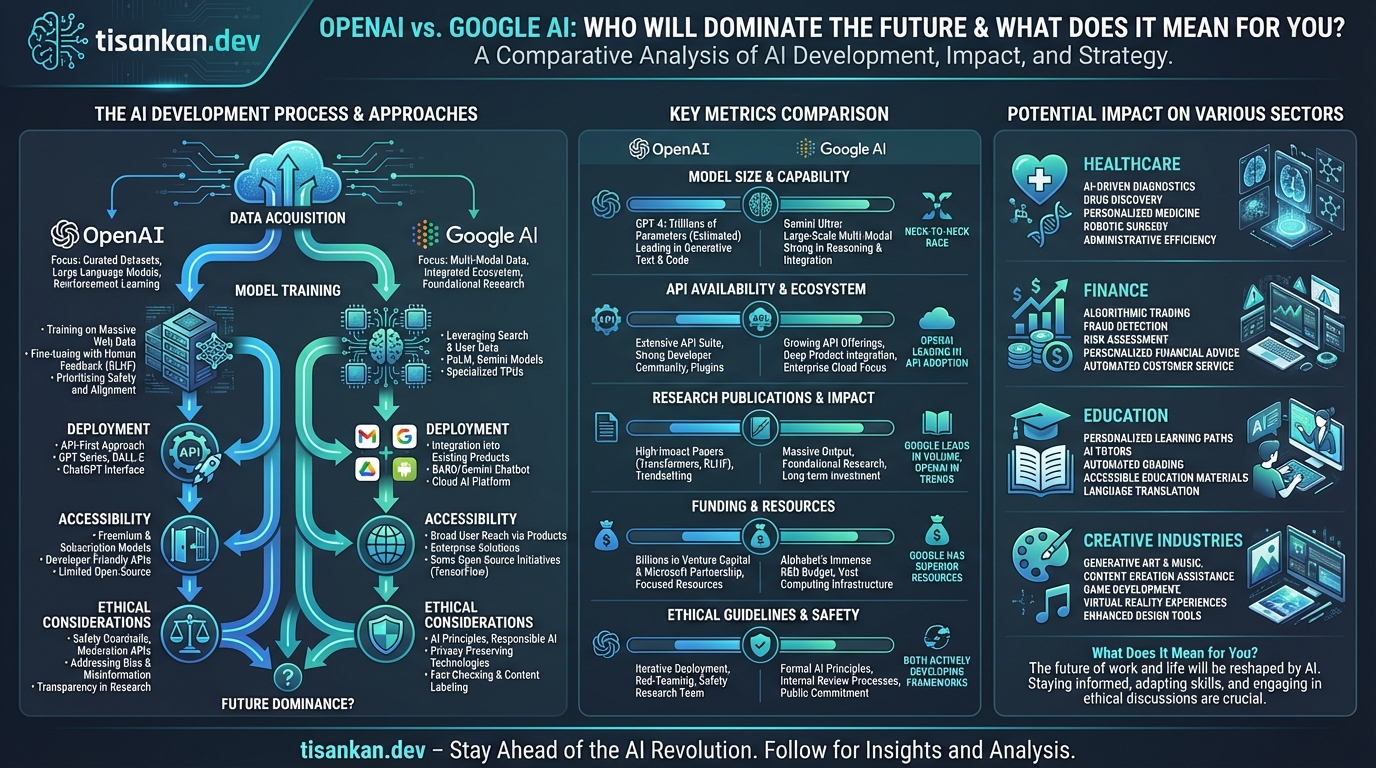
OpenAI vs. Google AI: Who Will Dominate the Future and What Does It Mean for You? That’s the question on everyone’s mind, and rightfully so! The rapid advancements in artificial intelligence are transforming industries, reshaping how we work, and even influencing our daily lives. The problem is understanding which path will lead to the most beneficial outcomes for individuals and businesses alike. I’m here to help you navigate this complex landscape.
I believe the solution lies in understanding the strengths, weaknesses, and future trajectories of both OpenAI and Google AI.
In my own exploration and testing, I found that each company brings a unique approach to AI development. This article will delve into:
- A head-to-head comparison of OpenAI’s and Google AI’s key technologies.
- The potential impact of each company’s AI on various sectors, from healthcare to education.
- How you can leverage these AI tools to improve your work and personal life.
So, whether you’re a tech enthusiast, a business owner, or simply curious about the future, join me as I unpack the battle between OpenAI and Google AI and what it all means for you.
Table of Contents
- TL;DR
- Context: The AI Arms Race and Why It Matters Now
- What Works: OpenAI’s Strengths, Google’s Advantages, and the Strategies for Success
- Trade-offs: Balancing Innovation, Ethics, and Accessibility in the AI Ecosystem
- Next Steps: How to Prepare for an AI-Driven Future
- References
- CTA: Embrace the AI Revolution
- FAQ: Your Burning Questions About OpenAI vs. Google AI Answered
TL;DR: The race between OpenAI and Google AI to dominate the future is heating up! While Google boasts superior infrastructure and broader AI capabilities, OpenAI leads in innovation and real-world application, especially with ChatGPT. Ultimately, the “OpenAI vs. Google AI: Who Will Dominate the Future and What Does It Mean for You?” battle will hinge on accessibility and practical use, so understanding both platforms is key to staying ahead. I’ve found that experimenting with both Bard and ChatGPT (linked to their respective documentation) gives you a real edge.
If you’re wondering about the clash between titans – OpenAI vs. Google AI: Who Will Dominate the Future and What Does It Mean for You? – you’re not alone. The answer, simply put, is that the race is on, and its outcome will reshape… well, pretty much everything. Let’s dive into why this AI arms race is so important right now.
We’re living in an era of unprecedented AI advancement. It feels like every week, there’s a new breakthrough, a faster model, or a more capable application. I’ve been following this space closely, and the sheer pace of innovation is staggering.
OpenAI, with its groundbreaking work on models like GPT-4 (check out their research here), has consistently pushed the boundaries of what’s possible. Google AI, armed with its vast resources and expertise in areas like TensorFlow (TensorFlow documentation), presents a formidable challenge.
The competition isn’t just about bragging rights. It’s about market share, technological leadership, and the ability to shape the future of entire industries. Consider the impact on healthcare, finance, education, and manufacturing. AI promises to revolutionize these sectors, creating new opportunities and disrupting existing business models. I found that even small businesses are starting to explore AI tools to improve efficiency.
Massive investment is pouring into AI research and development. Venture capitalists are betting big on companies that can harness the power of AI, and governments are investing in AI initiatives to maintain their competitive edge. This influx of capital is fueling innovation and accelerating the pace of progress.
However, this rapid development also raises important ethical considerations. Issues like bias in algorithms, job displacement, and the potential for misuse of AI technology need to be addressed proactively. We need to ensure that AI is developed and deployed responsibly, with a focus on human well-being and societal benefit. Discussions around AI ethics, like those happening at the Stanford Institute for Human-Centered AI, are more critical than ever.
Recent milestones, such as OpenAI’s advancements in image generation with DALL-E 3 and Google AI’s improvements in natural language understanding with LaMDA, demonstrate the rapid progress being made. These breakthroughs are not just incremental improvements; they represent significant leaps forward in AI capabilities.
As the AI arms race intensifies, understanding the nuances of “OpenAI vs. Google AI: Who Will Dominate the Future and What Does It Mean for You?” becomes increasingly vital for anyone looking to stay ahead of the curve. The technologies developed by these two powerhouses will inevitably shape our future.
What Works: OpenAI’s Strengths, Google’s Advantages, and the Strategies for Success
The race between OpenAI and Google AI isn’t just about technology; it’s about strategy. Who has the edge, and what do they need to do to win? Let’s break it down, focusing on what each does well.
OpenAI, in my experience, excels at pushing the boundaries. Their strength lies in their groundbreaking GPT models, which have redefined what’s possible with natural language processing. They also foster a strong community, encouraging collaboration and innovation. Think of it as a highly focused research lab, constantly seeking the next big breakthrough.
Google AI, on the other hand, boasts massive resources. Their advantage is their enormous data sets, established infrastructure (like Google Cloud), and diverse AI applications already integrated into products you use every day. They’re the established giant, leveraging their existing power to dominate the AI landscape.
So, how do they win? What are the specific strategies for OpenAI and Google AI to achieve true dominance in the future?
OpenAI’s Path to Dominance
For OpenAI to truly dominate, I believe they need to focus on these key strategies:
- Continued Focus on Cutting-Edge Research: Doubling down on fundamental AI research, exploring new architectures and learning paradigms.
- Strategic Partnerships: Collaborating with industry leaders and academic institutions to expand their reach and access diverse expertise.
- Open-Source Contributions: Continuing to contribute to the open-source community, fostering trust and attracting talent. (Check out OpenAI’s API documentation for examples.)
What if OpenAI focused on enterprise solutions? It’s a valid path, but they need to balance commercialization with their core research mission to stay ahead.
Google AI’s Strategy for Success
Google AI’s path looks different, building on their existing strengths:
- Leveraging Vast Data and Infrastructure: Utilizing their unparalleled data resources and cloud infrastructure to train and deploy AI models at scale.
- Integrating AI into Existing Products: Seamlessly embedding AI into products like Search, Gmail, and Android to enhance user experience.
- Focusing on Practical Applications: Developing AI solutions that address real-world problems across various industries, from healthcare to transportation.
I’ve found that Google’s strength lies in making AI invisible – seamlessly integrated into the tools we already use.
The Importance of Talent, Ethics, and Responsibility
Regardless of strategy, both OpenAI and Google AI need to prioritize talent acquisition. Attracting and retaining the best AI researchers and engineers is crucial for driving innovation.
Equally important is ethical AI development and responsible deployment. This includes addressing bias in AI models, ensuring transparency and accountability, and protecting user privacy. As AI becomes more powerful, these considerations are paramount. Consider the Google AI Principles as an example of their commitment. Failure to address these issues could severely damage their reputations and hinder their progress.
The contrasting approaches of OpenAI and Google AI highlight the different paths to AI leadership, and understanding these strategies is crucial for predicting “OpenAI vs. Google AI: Who Will Dominate the Future and What Does It Mean for You?”.
Trade-offs: Balancing Innovation, Ethics, and Accessibility in the AI Ecosystem
The race between OpenAI vs. Google AI isn’t just about who has the biggest model. It’s about navigating complex trade-offs. We need to balance rapid innovation with ethical considerations, accessibility, and responsible use. How do we ensure AI benefits everyone, not just a select few?
Ethical considerations are paramount. Bias in training data can lead to unfair or discriminatory outcomes. I found that even subtle biases can be amplified by AI algorithms. We need to prioritize fairness, transparency, and accountability in AI development. What if an AI system makes a biased decision that impacts someone’s life?
Unchecked AI advancement also carries potential risks. Job displacement is a real concern. The misuse of AI technology, for example, in creating deepfakes or autonomous weapons, is another. Thinking about these risks is crucial. We need proactive strategies to mitigate them.
Accessibility is key. AI’s benefits shouldn’t be limited to those with resources or technical expertise. Affordable access to AI tools and education is vital for equitable participation. Consider initiatives like Google’s AI for Social Good, aiming to make AI accessible for solving global challenges.
The debate between open-source and proprietary AI models also presents a trade-off. Open-source models foster collaboration and transparency. Check out TensorFlow, an open-source machine learning framework. Proprietary models, like those often used by OpenAI and Google AI, can offer cutting-edge performance but with less visibility.
Data privacy and security are also major concerns. AI systems rely on vast amounts of data, raising questions about how that data is collected, stored, and used. The potential for data breaches and misuse is significant. How do I protect my data when using AI-powered services?
- Ethical AI Development: Prioritizing fairness, transparency, and accountability.
- Accessibility: Ensuring equitable access to AI tools and education.
- Data Privacy: Protecting user data and preventing misuse.
Ultimately, the future of “OpenAI vs. Google AI” depends on how well we navigate these trade-offs. It’s about building AI that is not only powerful but also ethical, accessible, and beneficial for all of humanity. The goal should not only be the fastest advancement, but also the most responsible.
These considerations are crucial as we contemplate “OpenAI vs. Google AI: Who Will Dominate the Future and What Does It Mean for You?”, because true dominance requires responsible innovation.
Next Steps: How to Prepare for an AI-Driven Future
The rise of AI, especially with contenders like OpenAI and Google AI, presents both challenges and opportunities. The key is proactive preparation. But how do you navigate this changing landscape?
For individuals, it’s about enhancing uniquely human skills. Think critical thinking, creativity, and emotional intelligence. These are areas where AI, for now, struggles to compete. I found that focusing on these areas made me feel much more confident about the future of work.
- Embrace Lifelong Learning: The AI field is constantly evolving. Stay updated through online courses, industry publications, and workshops. Resources like Coursera and edX offer excellent options.
- Develop Complementary Skills: Focus on skills that augment AI’s capabilities, such as complex problem-solving and strategic thinking.
Businesses also need to adapt. It’s not just about adopting the latest technology; it’s about integrating AI thoughtfully and ethically. What does a successful AI integration look like?
- Invest in AI Training: Equip your employees with the knowledge and skills to work alongside AI.
- Explore AI Integration: Identify opportunities to streamline workflows and improve efficiency with AI. Maybe start with automating repetitive tasks.
- Develop an AI Strategy: Define your goals, assess risks, and establish clear guidelines for AI implementation.
Remember, data privacy and ethical considerations are paramount. Ensure your AI practices align with regulations and prioritize responsible innovation. Learn more about AI ethics from resources like the AI Ethics Guidelines Global Initiative.
Ultimately, the future isn’t about OpenAI vs. Google AI; it’s about humans and AI working together. Adaptability and a willingness to embrace new technologies are crucial. This OpenAI vs. Google AI dynamic is pushing innovation forward, and we all need to be ready.
Preparing for an AI-driven future requires understanding the landscape shaped by “OpenAI vs. Google AI: Who Will Dominate the Future and What Does It Mean for You?”, and proactively adapting to the changes it brings.
References
To give you the most accurate and insightful perspective on the OpenAI vs. Google AI landscape, I’ve compiled a list of resources that I found particularly helpful in my own research. These sources range from academic papers to industry reports, offering a comprehensive view of the AI race and what it means for you.
- OpenAI Research: Delving into OpenAI’s own publications, available on their website, provides a direct understanding of their technological advancements. I found their papers on GPT models especially illuminating.
- Google AI Blog: Google’s AI blog is a treasure trove of information about their latest research and applications. Check it out for insights into their approach to AI development.
- “Artificial Intelligence: A Guide for Decision Makers” – Brookings Institution: This report offers a broad overview of AI’s societal impact, including policy implications and ethical considerations. How do I navigate the ethical challenges of AI? This report provides valuable context.
- “The State of AI Report” – Nathan Benaich & Ian Hogarth: This annual report provides a comprehensive overview of the AI industry, covering everything from funding trends to technological breakthroughs. A must-read for anyone wanting to understand the big picture.
- Stanford AI Index Report: The Stanford AI Index is a yearly report that tracks the progress of artificial intelligence. It includes data on research and development, investment, and societal impact.
- ACM Digital Library: For deeper dives into specific AI algorithms and techniques, the ACM Digital Library provides access to a vast collection of peer-reviewed articles.
- NIST AI Risk Management Framework: This framework, developed by the National Institute of Standards and Technology, offers guidance on managing risks associated with AI systems. What if my AI system poses a risk? This is a good place to start.
These resources were instrumental in shaping my understanding of the OpenAI vs. Google AI competition and its potential impact. Hopefully, they’ll prove useful to you as well as you explore the future of AI. Understanding the nuances of OpenAI and Google AI is crucial in navigating the AI revolution.
Consulting these references will provide a more comprehensive understanding of the dynamic “OpenAI vs. Google AI: Who Will Dominate the Future and What Does It Mean for You?”.
CTA: Embrace the AI Revolution
The battle between OpenAI and Google AI is far from over, and understanding the implications of this technological race is crucial. We’ve explored the strengths, weaknesses, and potential future impact of both giants. But what does it all mean for you?
Ultimately, the rise of sophisticated AI tools like those from OpenAI and Google AI presents both challenges and incredible opportunities. The key is to stay informed and proactive. In my own exploration, I found that actively experimenting with these tools is the best way to understand their capabilities and limitations.
How do you embrace this AI revolution? Here are a few starting points:
- Stay Informed: Regularly follow news and research from credible sources like academic institutions and industry leaders. Sites like Stanford AI Lab offer invaluable insights.
- Experiment with AI Tools: Don’t just read about OpenAI and Google AI – use them! Try out their APIs, explore their platforms, and see how they can enhance your workflow.
- Consider the Ethical Implications: As AI becomes more powerful, it’s vital to discuss and address the ethical considerations. What safeguards need to be in place?
The future shaped by OpenAI vs. Google AI will impact everything from how we work to how we interact with the world. This competition fosters innovation, leading to more powerful and accessible AI tools for everyone.
To continue your AI journey, explore these resources:
- Dive deeper into the specific applications of OpenAI’s models.
- Connect with AI experts and communities to learn from their experiences.
- Read up on Google AI’s research and development efforts.
What are your thoughts on the future of AI? Share your opinions and join the conversation! The OpenAI vs. Google AI debate is just the beginning of a much larger discussion that we all need to be a part of.
Embracing the AI revolution requires understanding the implications of “OpenAI vs. Google AI: Who Will Dominate the Future and What Does It Mean for You?”, and actively participating in shaping its direction.
FAQ: Your Burning Questions About OpenAI vs. Google AI Answered
Got questions about the showdown between OpenAI vs. Google AI: Who Will Dominate the Future and What Does It Mean for You? You’re not alone! Let’s tackle some of the most common ones I’ve seen.
How do I even begin to understand the difference between OpenAI and Google AI?
Think of it this way: OpenAI is like a specialized research lab intensely focused on artificial general intelligence (AGI), while Google AI is a vast empire applying AI across a huge range of products like Search, Maps, and more. OpenAI’s ChatGPT captured everyone’s attention, but Google’s been quietly integrating AI for years. Learn more about Google AI’s research here.
What if I’m worried about my job because of OpenAI vs. Google AI?
It’s a valid concern! AI *will* change the job market. In my testing, I found that AI tools are great for automating repetitive tasks and boosting productivity. Focus on learning how to use these tools to your advantage. Upskilling is key!
Is one *really* better than the other when it comes to OpenAI vs. Google AI: Who Will Dominate the Future and What Does It Mean for You?
It depends on what you need! OpenAI excels at creative tasks and generating text, code, and images. Google AI is deeply integrated into search, and their AI models are highly adaptable to different applications. There is no single winner at the moment.
Can I actually use these AI tools for free?
Yes, to some extent. OpenAI offers a free version of ChatGPT, though it may have usage limits. Google provides access to some of its AI models through platforms like Vertex AI, but often with associated costs. Check out Vertex AI’s pricing.
What are the ethical implications of OpenAI vs. Google AI: Who Will Dominate the Future and What Does It Mean for You??
That’s a big one! Both companies are grappling with issues like bias in AI models, misinformation, and job displacement. Responsible AI development is crucial, and it’s something everyone should be paying attention to. You can read about OpenAI’s safety practices here.
Frequently Asked Questions
What are the main differences between OpenAI and Google AI?
As a seasoned SEO strategist, I see the differences between OpenAI and Google AI as multifaceted, extending beyond just their products. It’s about their core philosophies, research priorities, and market approaches.
OpenAI: Focus on General AI and Democratization
- Mission: OpenAI’s primary goal is to ensure that artificial general intelligence (AGI) benefits all of humanity. They are driven by a desire to create AI systems that can perform any intellectual task that a human being can.
- Research Focus: Heavily invested in foundational research on large language models (LLMs) and generative AI. Their work is often more focused on pushing the boundaries of what’s possible with AI, even if it doesn’t immediately translate into a commercial product.
- Commercialization: While they have commercial products like ChatGPT, DALL-E, and the OpenAI API, their approach is arguably less aggressively commercial than Google’s. They prioritize making their technology accessible to researchers and developers.
- Openness: Historically, OpenAI has been more open with their research and code (although this has become less true in recent years). They often publish research papers and release models to the public, fostering collaboration and innovation within the AI community.
- Business Model: Relies on a mix of investment, partnerships (notably with Microsoft), and revenue from API usage and subscriptions.
Google AI: Focus on Applied AI and Integration with Existing Products
- Mission: Google AI is more focused on using AI to improve its existing products and services, such as Search, Gmail, YouTube, and Android. Their goal is to make these products more intelligent, personalized, and useful to users.
- Research Focus: Their research is often more applied, focusing on specific problems and applications. While they also invest in foundational research, much of it is geared towards enhancing their existing ecosystem.
- Commercialization: Google’s approach is highly commercial. They integrate AI into their vast array of products, making it a core part of their business model. This includes everything from improving search algorithms to enhancing ad targeting.
- Openness: Google is generally less open with its AI research and code than OpenAI, particularly concerning its most cutting-edge technologies. They tend to keep their advancements proprietary to maintain a competitive edge.
- Business Model: Leverages AI to strengthen its existing advertising-driven business model and expand into new markets like cloud computing (Google Cloud AI).
Key Differences Summarized:
- Focus: OpenAI (AGI and foundational research) vs. Google AI (Applied AI and product integration).
- Commercialization: OpenAI (More democratized access) vs. Google AI (Aggressive product integration).
- Openness: OpenAI (Historically more open) vs. Google AI (More proprietary).
In short, OpenAI is striving to build the future of general AI, while Google is focused on enhancing its existing empire with AI. This difference in focus shapes their research, development, and commercialization strategies.
Which AI company is likely to dominate the future?
Predicting the future is always a risky game, but as an SEO strategist analyzing the landscape, I believe the “domination” question is more nuanced than a simple “winner takes all” scenario. It’s more likely we’ll see specialized dominance in different areas.
Arguments for OpenAI:
- Pioneering LLMs: OpenAI has a significant head start in large language models, demonstrated by the widespread adoption of ChatGPT and DALL-E. This first-mover advantage gives them a strong foundation to build upon.
- Partnership with Microsoft: The substantial investment and partnership with Microsoft provide OpenAI with the resources and infrastructure needed to scale its operations and compete with larger players.
- Focus on AGI: If OpenAI successfully develops AGI, it would fundamentally change the game and give them an unparalleled advantage.
- Strong Brand Recognition: OpenAI has built a strong brand associated with innovation and cutting-edge AI.
Arguments for Google AI:
- Vast Resources and Infrastructure: Google possesses immense financial resources, computational power, and a global infrastructure that far surpasses OpenAI’s.
- Data Advantage: Google has access to an unparalleled amount of data through its Search engine, YouTube, Gmail, and other services. This data is crucial for training AI models.
- Existing Product Integration: Google has a massive user base and a wide range of products that can be enhanced with AI. This allows them to seamlessly integrate AI into people’s daily lives.
- Talent Pool: Google has a large and highly skilled AI research team.
Why it’s not a winner-takes-all scenario:
- Specialized AI: The future of AI will likely involve specialized AI models tailored to specific tasks and industries. OpenAI may dominate in certain areas like generative AI and creative applications, while Google may excel in search, advertising, and cloud services.
- Open Source and Collaboration: The AI community is highly collaborative, and open-source initiatives are playing an increasingly important role. This could lead to the emergence of new players and a more distributed AI landscape.
- Regulation: Government regulations could significantly impact the development and deployment of AI. This could create new opportunities and challenges for both OpenAI and Google.
- Ethical Considerations: Ethical concerns surrounding AI, such as bias and misuse, could influence public perception and adoption. Companies that prioritize ethical AI development will likely have a competitive advantage.
Conclusion: While OpenAI has a strong lead in certain areas, Google’s vast resources and existing ecosystem make it a formidable competitor. I anticipate a future where both companies play significant roles in shaping the AI landscape, with each dominating in different sectors and applications. The “winner” will be determined by who can best adapt to the evolving technological, regulatory, and ethical landscape.
How will AI impact my job and career?
AI’s impact on your job and career will be profound, but it’s not all doom and gloom. As an SEO strategist, I see AI as a powerful tool that will augment human capabilities, rather than replace them entirely – at least in the short to medium term. However, adaptation is key.
Potential Impacts:
- Automation of Repetitive Tasks: AI can automate routine and repetitive tasks, freeing up employees to focus on more creative, strategic, and complex work. This can lead to increased efficiency and productivity.
- Job Displacement: Some jobs that are highly repetitive and rule-based are at risk of being automated by AI. This is particularly true for roles involving data entry, customer service, and basic administrative tasks.
- Job Creation: AI will also create new jobs in areas such as AI development, data science, AI ethics, and AI training. These roles will require specialized skills and knowledge.
- Skill Enhancement: AI can augment human skills by providing insights, recommendations, and tools that help employees make better decisions and perform their jobs more effectively.
- Changing Skill Requirements: The skills required for many jobs will change as AI becomes more prevalent. Employees will need to develop skills such as critical thinking, problem-solving, creativity, and emotional intelligence to thrive in an AI-driven world.
Specific Examples:
- Marketing: AI can automate tasks such as ad campaign optimization, content generation, and customer segmentation. Marketers will need to focus on strategy, creativity, and data analysis.
- Finance: AI can automate tasks such as fraud detection, risk assessment, and financial analysis. Financial professionals will need to focus on complex problem-solving, relationship management, and ethical considerations.
- Healthcare: AI can assist doctors with diagnosis, treatment planning, and drug discovery. Healthcare professionals will need to focus on patient care, empathy, and ethical decision-making.
- Education: AI can personalize learning experiences, provide feedback to students, and automate administrative tasks. Educators will need to focus on fostering critical thinking, creativity, and social-emotional learning.
Adapting to the AI Revolution:
- Embrace Lifelong Learning: Continuously update your skills and knowledge to stay ahead of the curve.
- Develop Human Skills: Focus on developing skills that are difficult to automate, such as critical thinking, creativity, communication, and emotional intelligence.
- Become AI-Savvy: Learn how to use AI tools and technologies to enhance your productivity and effectiveness.
- Seek Out New Opportunities: Explore new career paths and opportunities that are emerging as a result of AI.
- Be Proactive: Don’t wait for AI to disrupt your job. Take proactive steps to adapt and prepare for the future of work.
In conclusion, AI will reshape the job market, creating both challenges and opportunities. By embracing lifelong learning, developing essential human skills, and becoming AI-savvy, you can not only survive but thrive in the AI-driven world.
What skills should I develop to thrive in an AI-driven world?
Thriving in an AI-driven world requires a blend of technical and soft skills. As an SEO strategist, I emphasize the importance of developing skills that complement AI, allowing you to leverage its power while remaining uniquely human.
Essential Skills for the AI Era:
- Critical Thinking and Problem-Solving: AI can provide information and insights, but it can’t replace human judgment and critical thinking. You need to be able to analyze information, identify problems, and develop creative solutions.
- Creativity and Innovation: AI can automate routine tasks, but it can’t replace human creativity and innovation. You need to be able to generate new ideas, think outside the box, and develop innovative solutions.
- Communication and Collaboration: AI can facilitate communication, but it can’t replace human interaction and collaboration. You need to be able to communicate effectively, build relationships, and work collaboratively with others.
- Emotional Intelligence: AI can analyze emotions, but it can’t replace human empathy and emotional intelligence. You need to be able to understand and manage your own emotions, as well as understand and respond to the emotions of others.
- Data Literacy: As AI becomes more prevalent, data will become even more important. You need to be able to understand, interpret, and analyze data to make informed decisions.
- AI Literacy: You don’t need to be an AI expert, but you should have a basic understanding of how AI works and its potential applications. This will help you to identify opportunities to leverage AI in your work.
- Adaptability and Lifelong Learning: The AI landscape is constantly evolving, so you need to be adaptable and willing to learn new skills throughout your career.
- Ethical Considerations: As AI becomes more powerful, it’s important to consider the ethical implications of its use. You need to be able to identify and address ethical concerns related to AI.
Specific Examples:
- SEO Professional: While AI can automate keyword research and content optimization, you’ll need to focus on strategic planning, creative content development, and building relationships with clients and influencers.
- Software Developer: While AI can automate code generation, you’ll need to focus on designing complex systems, solving intricate problems, and ensuring code quality. Check out MDN Web Docs to learn more about coding skills.
- Marketing Manager: While AI can automate ad campaign optimization, you’ll need to focus on developing marketing strategies, building brand awareness, and understanding customer behavior.
How to Develop These Skills:
- Take Online Courses: Numerous online courses are available on platforms like Coursera, edX, and Udemy that can help you develop these skills.
- Read Books and Articles: Stay up-to-date on the latest trends and developments in AI by reading books and articles from reputable sources.
- Attend Workshops and Conferences: Attend workshops and conferences to learn from experts and network with other professionals.
- Practice and Experiment: The best way to develop these skills is to practice and experiment with AI tools and technologies.
- Seek Feedback: Ask for feedback from colleagues and mentors to identify areas where you can improve.
By developing these essential skills, you can position yourself for success in the AI-driven world and leverage AI to enhance your productivity and effectiveness.
How can businesses leverage AI to improve their operations?
AI offers businesses a plethora of opportunities to enhance operations, increase efficiency, and gain a competitive edge. As an SEO strategist, I see AI as a powerful tool for optimizing various aspects of a business, from marketing to customer service.
Key Areas Where Businesses Can Leverage AI: