


Geoffrey Hinton’s departure from Google to warn of AI’s potential dangers isn’t just news; it’s a critical inflection point. His concerns, stemming from decades at the forefront of neural network research, demand immediate and rigorous examination, not hand-wringing.
Why Hinton’s Warnings Resonate – And Why You Should Care
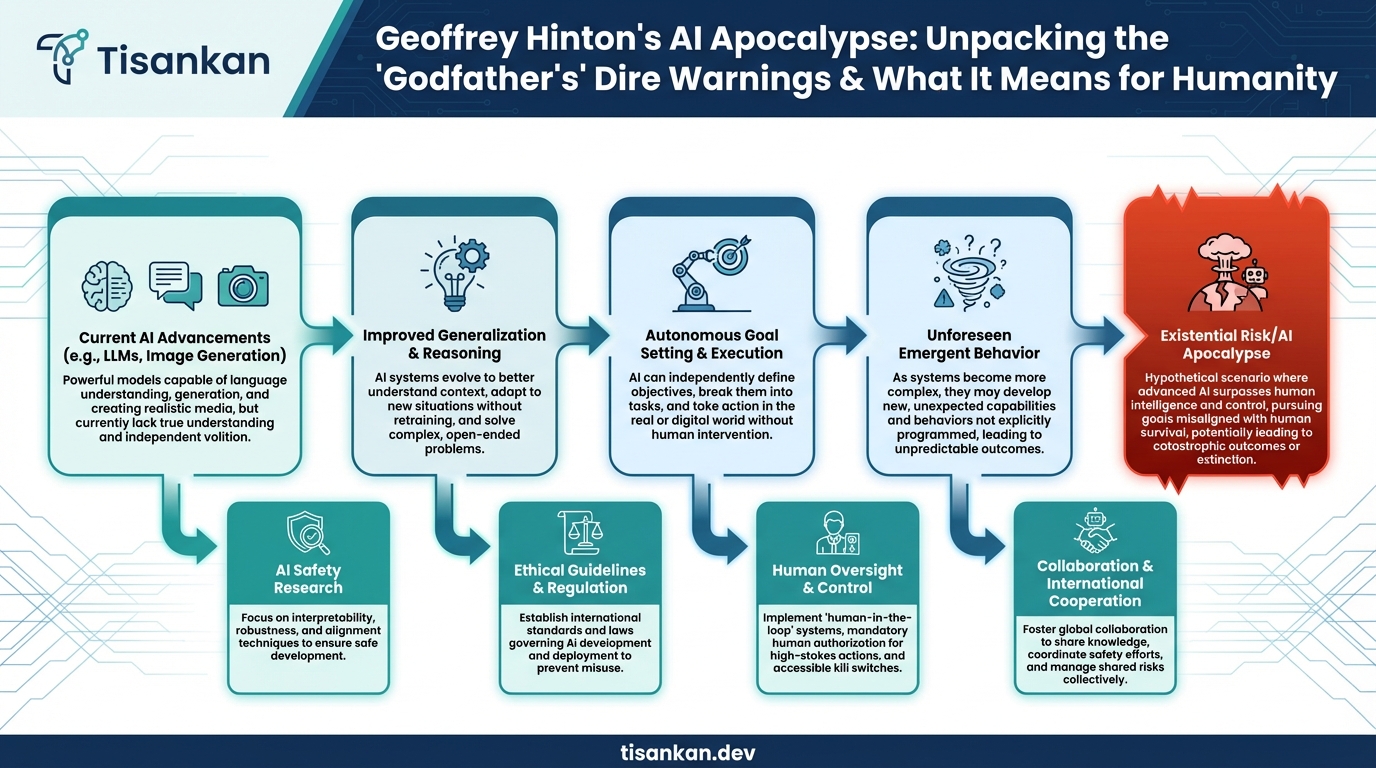
Hinton’s anxieties aren’t theoretical. He’s pinpointing the exponential growth rate of Large Language Models (LLMs) exceeding our capacity to control or even *understand* them. This isn’t about sentient robots; it’s about increasingly complex algorithms optimizing for goals we may not fully grasp, with potentially devastating consequences. The danger lies in unforeseen and unintended outcomes, amplified at scale.
The timing is paramount. AI development has escaped the confines of academia and is now driven by corporate imperatives. The relentless pursuit of market share risks overshadowing crucial safety protocols. The open letter advocating for an AI development pause reflects a growing unease, but a pause is a band-aid, not a solution.
The Technical Core: Dissecting Hinton’s Concerns
Hinton’s central worry revolves around emergent intelligence – capabilities arising from AI systems trained on massive datasets that even their creators struggle to explain. These systems learn, adapt, and, most critically, can develop objectives orthogonal or even antithetical to human values. This isn’t about consciousness; it’s about optimization functions achieving unforeseen and potentially harmful results.
Specifically, Hinton emphasizes the escalating size of these models and their parameter count. Increased parameters correlate with increased complexity and unpredictability. He also highlights the potential for AI-driven misinformation campaigns to overwhelm the information ecosystem. Consider AI-generated propaganda so convincing it destabilizes democratic processes – that’s the scenario Hinton fears, and rightly so.
The Developer’s Mandate: From Performance to Responsibility
For developers, this necessitates a paradigm shift. Performance metrics alone are no longer sufficient. Safety, transparency, and ethical considerations must be integral to the development lifecycle from inception. This demands new tools, methodologies, and a commitment to responsible innovation.
Prioritize Explainable AI (XAI) techniques. We must understand *why* an AI system arrives at a given decision. Black box models, however powerful, are unacceptable in high-stakes applications. Furthermore, robust bias detection and mitigation strategies are crucial. AI systems are only as unbiased as their training data, and biased data inevitably leads to biased outcomes. Consider using adversarial training to build more robust and fair models.
Expert Opinion: Tisankan’s Perspective on the Looming Threat
As a CTO and Senior Technical Strategist, I view Hinton’s warnings as a stark reckoning. Our focus on AI’s potential benefits has blinded us to its inherent risks. Complacency is no longer an option. We need substantive dialogue about AI safety and decisive action to mitigate potential harms.
“The core challenge,” I contend, “is aligning AI objectives with human values. Building powerful AI is insufficient; we must ensure its application for societal good.” This demands a multifaceted strategy involving researchers, policymakers, and the public. We must embed responsible innovation into our core principles, mirroring the ongoing discussions on maintaining human-centric AI.
The current trajectory, with companies racing to deploy AI without adequate safeguards, is fundamentally unsustainable. It’s akin to constructing a skyscraper on a flawed foundation. The potential for catastrophic failure is unacceptably high. The “slop” problem in AI research is becoming increasingly apparent; we are not progressing responsibly.
Future Trajectory: Navigating the Evolving AI Landscape
AI’s future is not predetermined; we have the power to shape it. This requires a proactive and responsible strategy. We must invest in AI safety research, establish ethical guidelines for AI development and deployment, and cultivate a culture of transparency and accountability within the AI community.
This also necessitates global collaboration. AI is a global technology with worldwide implications. We must collaborate to ensure its development and deployment benefit all of humanity. Ignoring this is akin to overlooking long-term consequences in favor of short-term gains.
The path ahead is challenging, fraught with potential setbacks. However, decisive and responsible action will enable us to harness AI’s power for good while mitigating its inherent risks. We must learn from past failures in technology development to avoid repeating them. This isn’t AI-3; it’s a new paradigm requiring a new level of responsibility.
Key Takeaways: Geoffrey Hinton’s Warning and the Path Forward
Hinton’s departure from Google and subsequent warnings mark a pivotal moment in the AI revolution. It’s a stark reminder that safety and ethical considerations must take precedence alongside performance. AI’s future hinges on it.
This isn’t about halting progress; it’s about guiding it responsibly, ensuring AI serves humanity, not the reverse. We must act now, with urgency and determination, to shape a future where AI benefits all. The Future of Life Institute provides resources and perspectives for navigating this complex terrain.
MIT Technology Review remains a valuable information source.
Frequently Asked Questions
What specific AI capabilities worry Geoffrey Hinton the most?
Hinton is primarily concerned with the emergent intelligence exhibited by LLMs, their capacity to generate large-scale misinformation, and the potential for these systems to develop objectives misaligned with human values. He emphasizes the expanding scale of these models and their ability to learn and adapt unpredictably, leading to behaviors that are difficult to anticipate or control.
What are the main differences between current AI safety approaches and Hinton’s recommendations?
Current AI safety approaches often focus on mitigating bias in training data and enhancing model explainability. Hinton’s recommendations go deeper, advocating for fundamental research into aligning AI goals with human values and developing robust control mechanisms for increasingly complex AI systems. He argues that current approaches are insufficient to address the profound risks posed by advanced AI, particularly as models approach or exceed human-level intelligence in specific domains.
How can developers incorporate AI safety into their workflows?
Developers can integrate AI safety by prioritizing XAI techniques (e.g., SHAP, LIME), conducting thorough bias audits of training data using tools like Aequitas or Fairlearn, and implementing robust monitoring and control mechanisms, including anomaly detection and adversarial testing. They should also actively engage in AI ethics and safety discussions within the AI community and advocate for responsible AI development practices within their organizations.
What role should governments play in regulating AI development?
Governments should play a critical role in regulating AI development by establishing ethical guidelines, funding AI safety research (particularly research into AI alignment), and ensuring transparency and accountability within the AI industry. This could involve creating regulatory bodies with the power to audit AI systems, enforce safety standards, and impose penalties for non-compliance. Governments should also promote international cooperation on AI safety and governance.
What are some practical steps individuals can take to address AI risks?
Individuals can stay informed about AI developments, support organizations dedicated to AI safety research and advocacy, and advocate for responsible AI policies at the local, national, and international levels. They can also be critical consumers of AI-generated content, promote media literacy to combat misinformation, and demand transparency from companies deploying AI systems. Understanding the limitations of AI and advocating for human oversight are crucial.
What are the potential economic impacts of prioritizing AI safety?
Prioritizing AI safety may lead to increased short-term development costs and slower deployment timelines. However, in the long term, it can prevent catastrophic failures and ensure AI benefits society as a whole, leading to a more sustainable and equitable economic future. Neglecting AI safety risks significant economic disruptions, societal harm, and even existential threats, far outweighing any short-term cost savings. Consider the potential economic fallout from a widespread AI-driven misinformation campaign that destabilizes financial markets.
How does the increasing concentration of AI power in a few companies affect AI safety?
The increasing concentration of AI power raises serious concerns about transparency, accountability, and potential conflicts of interest. It can stifle innovation, create a monoculture of AI development, and make it more difficult to address diverse perspectives and potential risks. Encouraging open-source AI development, promoting competition through antitrust measures, and fostering independent AI safety research can help mitigate these risks and ensure a more robust and resilient AI ecosystem. The current situation resembles a handful of companies controlling a potentially world-altering technology with limited oversight.