


Beyond AI Hype: The Brutal Truth Behind Tech Layoffs (and Your Survival Guide)
Forget the simplistic “AI is stealing your job” narrative. While AI *is* a catalyst, the tech industry’s bloodletting stems from a toxic cocktail of pandemic-era excess and strategic blunders. The reckoning is here, and more pain is coming. Prepare accordingly.
Why This Matters: Your Career is on the Line
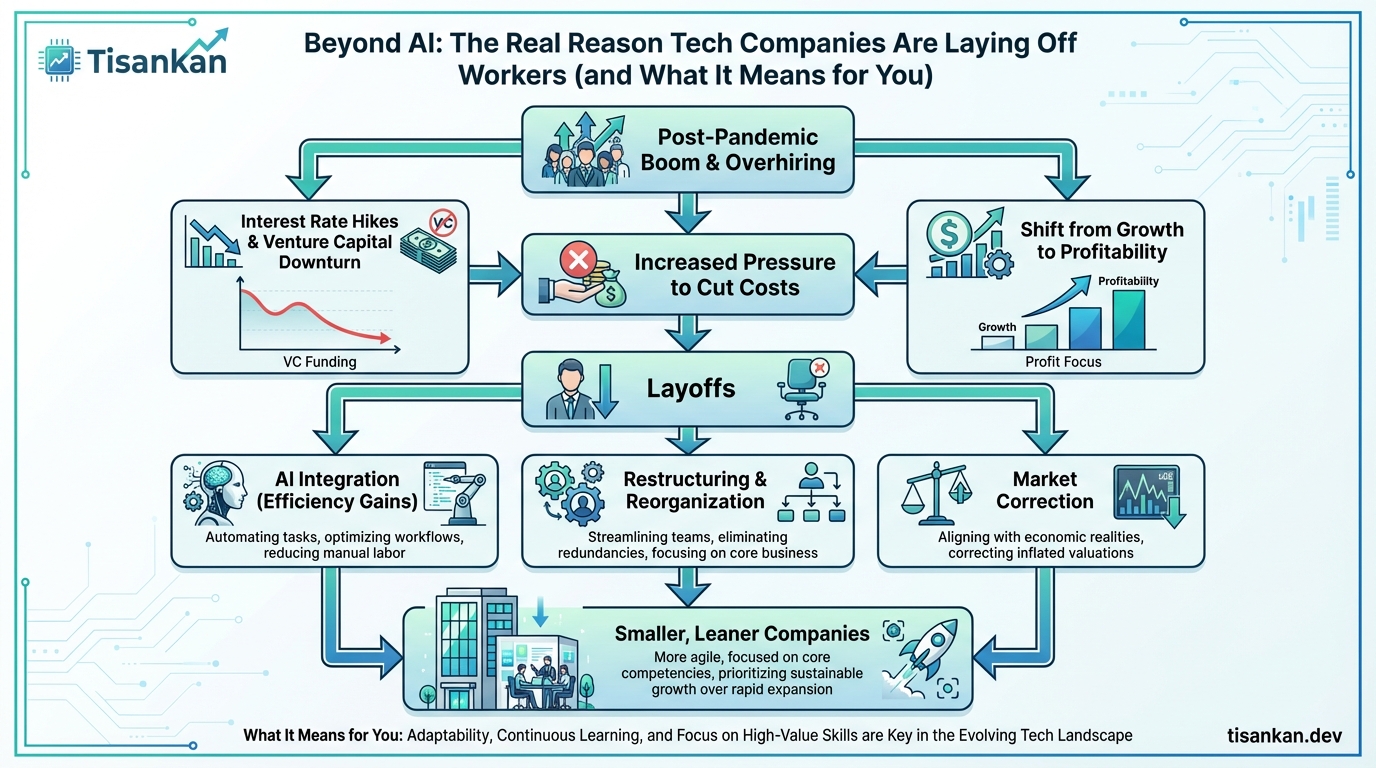
These layoffs aren’t abstract statistics; they’re a seismic shift reshaping the tech landscape. Dismiss this as mere “restructuring” at your peril. Understanding the *real* drivers is paramount for every tech professional – from intern to CTO – to not just survive, but thrive. This is a career-defining moment.
Deconstructing the Carnage: The Real Reasons for the Layoffs
Let’s dissect the factors fueling the tech layoffs. This isn’t a passive observation; it’s about equipping you with actionable insight:
- The Hangover: Market Overcorrection: The pandemic induced artificial demand. Companies, drunk on cheap capital, scaled aggressively, only to face a sobering reality. Now, they’re slashing headcount to pre-2020 levels, erasing years of perceived growth.
- Bloated Bureaucracy: Over-Hiring Driven by FOMO: Fear Of Missing Out fueled reckless hiring sprees. Companies hoarded talent, creating layers of redundancy and managerial bloat. The result? Top-heavy organizations ripe for pruning.
- Ruthless Prioritization: Strategic Asset Stripping: Companies are ruthlessly reassessing their portfolios, axing anything deemed “non-core.” This translates to entire departments being vaporized overnight. Witness Meta’s metaverse pivot – a multi-billion dollar experiment that ended in mass layoffs.
- The AI Paradox: Skills Gap, Not Job Elimination (Yet): AI isn’t replacing *everyone* (yet). It’s exacerbating a critical skills gap. Companies are shedding employees with obsolete skills while desperately seeking AI specialists. Internal retraining is deemed too costly; external hiring is the preferred, albeit brutal, solution.
- The End of Free Money: Interest Rate Realities: The era of near-zero interest rates is over. Capital is no longer cheap and abundant. Companies are now forced to demonstrate profitability, not just potential, leading to drastic cost-cutting measures.
The Macro View: A Systemic Crisis
This isn’t isolated; it’s a systemic correction across the entire tech ecosystem. The hyper-growth era is dead. Profitability, efficiency, and sustainable growth are the new mantras. This demands a fundamental shift in mindset. Consider the renewed focus on developer efficiency – even marginal gains from optimizing serverless functions are now scrutinized. For example, when building Cleverly Write (Firefox Add-on), we prioritized client-side architecture for security and privacy. This eliminated backend server costs, a decision that now seems prescient given the industry’s cost-cutting obsession. This is not just about survival; it’s about building a sustainable business model.
Consolidation and ruthless efficiency are the name of the game. Companies are streamlining operations, doubling down on core competencies, and demanding tangible ROI. Roles in marketing, HR, and project management are particularly vulnerable as engineering and product development take center stage. Furthermore, expect increased regulatory scrutiny regarding data privacy and ethical AI – compliance will be a critical, and costly, factor. The “slop problem” in AI research, as highlighted in AI Research has a Slop Problem, further complicates matters, demanding rigorous validation and responsible development.
Your Battle Plan: Navigating the New Tech Reality
What does this mean for *you*? This isn’t a passive observation; it’s a call to action:
- Hyper-Specialize and Upskill Relentlessly: Generic skills are worthless. Master in-demand areas like AI/ML, cloud architecture, cybersecurity, and data science. Go beyond the tools; understand the underlying principles and architectures.
- Become an Efficiency Evangelist: Identify and eliminate inefficiencies in your current role. Automate tasks, optimize workflows, and champion new technologies that demonstrably improve productivity. Quantify your impact.
- Forge a Powerful Network: Networking is no longer optional; it’s your lifeline. Connect with industry leaders, attend specialized conferences (not generic meetups), and cultivate relationships with decision-makers.
- Embrace Radical Adaptability: The tech landscape is in constant flux. Cultivate a growth mindset, embrace new challenges, and be prepared to pivot your skills and career trajectory on short notice.
The tech industry is undergoing a brutal but necessary transformation. AI is a factor, but not the sole determinant. By understanding the underlying forces and proactively adapting, you can not just survive, but thrive in the years ahead. Stay informed about critical developments in AI safety, as discussed in this analysis of Geoffrey Hinton and the AI Apocalypse. The future belongs to the hyper-skilled, the adaptable, and the ruthlessly efficient.
Monitor resources for small business technology news this week to stay ahead of the curve and anticipate the next wave of disruption.
Frequently Asked Questions
Is AI *really* the main culprit behind these layoffs?
Unequivocally no. AI is a catalyst, not the root cause. Market overcorrection, pandemic-fueled over-hiring, strategic pivots toward profitability, and the end of cheap capital are the primary drivers. AI’s impact is currently more about shifting skill demands than outright job displacement, though that will inevitably change.
What skills offer the best job security in this volatile market?
Deep expertise in AI/ML (not just using pre-built models, but understanding the underlying algorithms), cloud computing (AWS, Azure, GCP – with certifications), cybersecurity (beyond basic awareness), data science (with a focus on statistical rigor), and proficiency in languages like Python, Go, and Rust are highly valued. Crucially, cultivate *transferable* skills like critical thinking, problem-solving, and clear communication. These are recession-proof.
How can I bulletproof my career against future layoffs?
Continuous, *targeted* learning is paramount. Build a professional network of *influencers*, not just contacts. Consistently demonstrate your *unique* value proposition to your employer. Understand the business context of your role – how does your work directly impact the bottom line? Become indispensable by solving critical problems, not just completing assigned tasks. Also, understand Google Gemini vs OpenAI to understand the competitive landscape.
Are all tech sectors equally affected by these layoffs?
No. Sectors like social media, e-commerce, and certain areas of consumer-facing software are experiencing the brunt of the impact. However, even within these sectors, some companies are still hiring aggressively in strategic areas. The key is to identify sectors with long-term growth potential and align your skills accordingly.
What’s the long-term prognosis for the tech industry?
The long-term outlook remains positive, but expect a period of more measured and sustainable growth. The industry will continue to be disrupted by emerging technologies and evolving business models. Adaptability, continuous learning, and a willingness to embrace risk will be essential for long-term success.
How can small businesses navigate this turbulent environment?
Small businesses must be laser-focused on technology investments that deliver tangible ROI. Prioritize solutions that improve efficiency, automate processes, and reduce operational costs. Invest in training employees to effectively leverage new technologies. Cloud-based solutions and automation tools are critical for streamlining operations and maintaining competitiveness.
Is remote work on its way out?
While some companies are mandating a return to the office, remote work is likely to remain a significant part of the tech landscape. However, expect a shift towards hybrid models that balance flexibility with in-person collaboration. Be prepared to demonstrate your ability to work effectively and autonomously in a remote or hybrid environment. Document your productivity and highlight your communication skills.