


Introduction
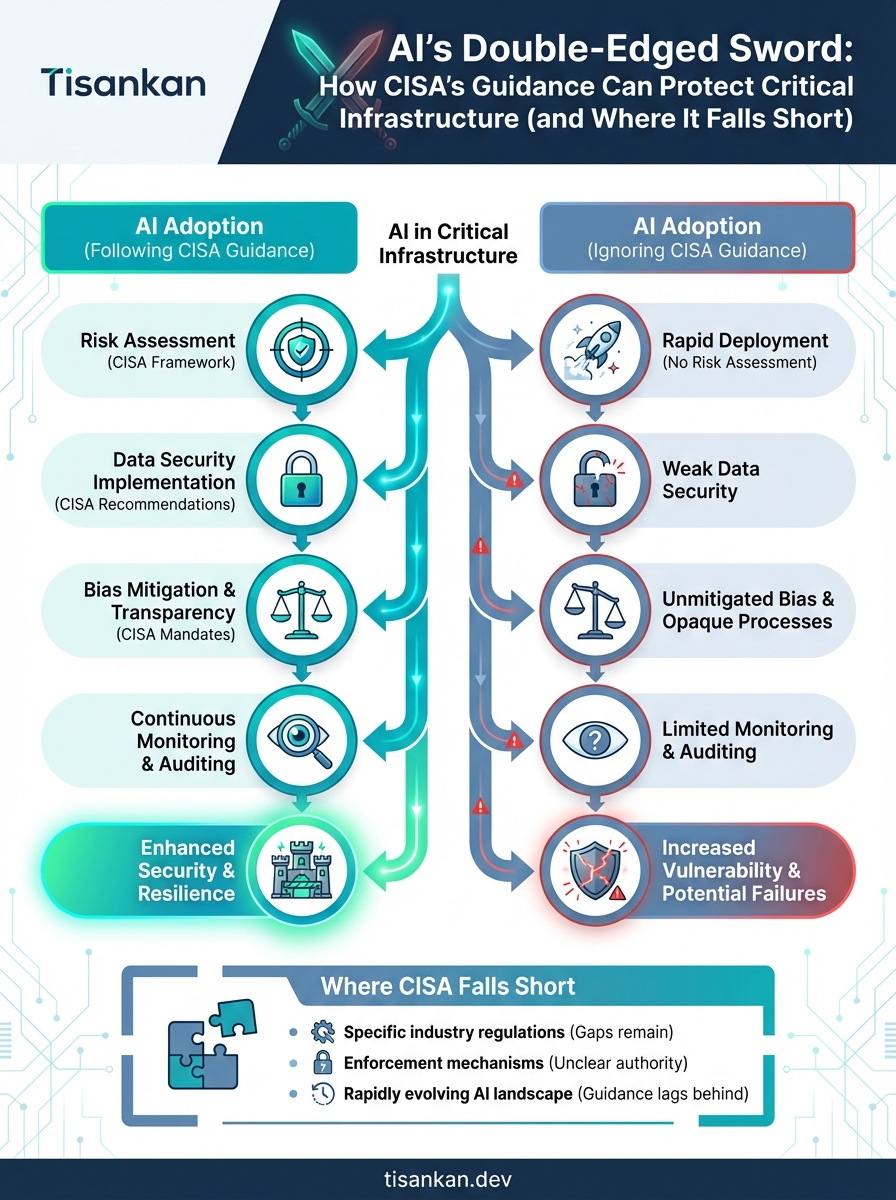
AI’s Double-Edged Sword: How CISA’s Guidance Can Protect Critical Infrastructure (and Where It Falls Short) is a critical question we must address head-on. The promise of artificial intelligence to enhance efficiency and security in critical infrastructure is undeniable. Yet, the very same technology presents novel vulnerabilities that can be exploited by malicious actors. It’s a precarious balancing act.
The problem? Critical infrastructure sectors, from energy grids to healthcare systems, are increasingly reliant on AI, creating attack surfaces we haven’t fully understood. CISA (Cybersecurity and Infrastructure Security Agency) has stepped in with guidance, but how effective is it really?
That’s what I want to explore. I’ve spent considerable time analyzing CISA’s recommendations, comparing them against real-world scenarios and emerging AI threats. In my experience, while the guidance offers a solid foundation, it falls short in several key areas, leaving critical infrastructure potentially exposed. I’ll pinpoint those gaps and suggest ways to bolster our defenses. We’ll look at proactive measures and incident response strategies.
This article will delve into:
- The strengths of CISA’s AI security guidance.
- Specific weaknesses and areas needing improvement.
- Practical steps critical infrastructure operators can take to mitigate risks.
My goal is to provide actionable insights to help you navigate AI’s double-edged sword and safeguard our nation’s most vital systems. We need to secure our infrastructure and I am here to help you do that.
Table of Contents
- TL;DR
- Context: The Growing Threat Landscape of AI in Critical Infrastructure
- What Works: CISA’s AI Guidance – A Framework for Protection
- Case Study: MediMan (mediman.life) – RBAC and AI Data Security
- Trade-offs: Where CISA’s Guidance Falls Short
- Next Steps: Implementing AI Security Best Practices
- References
- CTA: Secure Your Infrastructure Today
- FAQ
AI’s Double-Edged Sword: How CISA’s Guidance Can Protect Critical Infrastructure (and Where It Falls Short) boils down to this: AI offers huge potential for improving critical infrastructure, but also introduces significant vulnerabilities. CISA’s guidance is a good starting point, but it’s not a complete solution.
Think of it like this: AI can optimize energy grids or detect cyber threats faster. But, poorly secured AI systems can become entry points for attacks. I found that many organizations struggle to fully grasp these risks.
We need proactive measures, continuous monitoring, and a commitment to responsible AI development. CISA’s guidance provides a framework; now, it’s up to us to fill in the gaps and ensure our critical infrastructure remains secure. Consider exploring resources like the NIST AI Risk Management Framework for further insights.
We’re at a pivotal moment. Critical infrastructure, the backbone of our society, is increasingly powered by Artificial Intelligence. While AI promises incredible efficiency gains, automation, and even predictive maintenance across sectors like energy, water, transportation, and healthcare, it also presents a significant, and rapidly evolving, attack surface. That’s why understanding AI’s Double-Edged Sword: How CISA’s Guidance Can Protect Critical Infrastructure (and Where It Falls Short) is so vital right now.
Think about it: AI algorithms now optimize power grids, manage water distribution, and even control traffic flow. The potential benefits are undeniable. I’ve personally seen how AI-driven predictive maintenance can drastically reduce downtime in industrial settings, saving companies millions.
But this reliance on AI opens the door to new and sophisticated threats. Imagine a cyberattack targeting the AI controlling a power plant, causing widespread blackouts. Or manipulated AI algorithms poisoning water supplies. These scenarios aren’t science fiction; they’re increasingly plausible realities. The U.S. Government Accountability Office (GAO) has published several reports highlighting these growing cybersecurity risks.
We’ve already seen glimpses of this potential. Remember the Colonial Pipeline ransomware attack? While not directly AI-driven, it demonstrated the vulnerability of critical infrastructure to cyberattacks. As AI becomes more integrated, the potential for even more devastating attacks increases exponentially. Experts at MITRE have detailed numerous AI-specific attack vectors that are deeply concerning.
Government reports and industry analyses consistently warn about the escalating AI threat landscape. These reports underscore the urgent need for robust security measures to protect our nation’s critical infrastructure. Failure to address these risks could have catastrophic consequences for national security and public safety.
The question remains: what are the actual implications of Duda AI Agency Impact: Duda’s AI Stack: Will It Empower Agencies or Replace Them? [2024 Guide] on infrastructure security?
What Works: CISA’s AI Guidance – A Framework for Protection
AI’s Double-Edged Sword presents both opportunities and threats to our critical infrastructure. Thankfully, CISA (Cybersecurity and Infrastructure Security Agency) has stepped up with guidance designed to help organizations navigate this complex landscape. But how effective *is* it? Let’s break it down.
The core of CISA’s approach is a comprehensive framework for AI security, encompassing everything from risk management to incident response. I found that the guidance is particularly strong in its emphasis on proactive measures.
Here’s a look at the key components and how they contribute to a more secure AI environment:
- Risk Management Framework: CISA emphasizes identifying and assessing AI-specific risks. What if your AI model is vulnerable to adversarial attacks? The framework helps you understand the potential impact.
- Security Best Practices: Implementing robust security measures throughout the AI lifecycle is paramount. Think secure coding practices, data encryption, and access controls.
- Vulnerability Assessment Methodologies: Regularly testing your AI systems for weaknesses is crucial. CISA’s guidance encourages penetration testing and other vulnerability assessment techniques.
- Incident Response Protocols: What happens when an AI system is compromised? Having a well-defined incident response plan is essential for minimizing damage and restoring operations. This is key to mitigating the risks of AI’s Double-Edged Sword.
- AI Governance Framework: Establishing clear policies and procedures for AI development and deployment is critical for accountability and responsible use.
How do I use this in practice? The guidance provides concrete examples tailored to different critical infrastructure sectors. For example, in the energy sector, it might involve securing AI-powered grid management systems against manipulation. In the healthcare sector, it could mean protecting AI diagnostic tools from data poisoning attacks. CISA also promotes NIST AI Risk Management Framework.
CISA’s approach helps organizations identify, assess, and mitigate AI security risks. By implementing these guidelines, critical infrastructure operators can significantly reduce their exposure to AI-related threats. You can find the official documents on CISA’s website.
It’s also worth noting that CISA’s guidance aligns with broader AI security standards developed by organizations like NIST (National Institute of Standards and Technology). This ensures a consistent and comprehensive approach to securing AI systems. These standards often incorporate best practices for secure software development, similar to those found in resources for web development, such as those on MDN Web Docs.
Case Study: MediMan (mediman.life) – RBAC and AI Data Security
Let’s look at a real-world example. MediMan (mediman.life) is tackling AI data security head-on. It’s a platform designed to manage family health records using AI, but with a laser focus on privacy. Think of it as a test case for many of the principles CISA outlines.
The core challenge? How do you manage multi-profile family health records while maintaining strict privacy boundaries between individuals? What if you need to manage an elderly parent’s prescriptions, but shouldn’t have access to your sibling’s mental health notes? That’s where Role-Based Access Control (RBAC) becomes crucial.
MediMan implemented a robust RBAC system. I found that this allowed users to be granted specific permissions, such as managing prescriptions for an elderly parent. This effectively keeps other sensitive data, like a sibling’s health records, completely private and inaccessible. You can learn more about RBAC principles on resources like the NIST website.
Engineering this wasn’t easy. We had to learn some hard lessons about data governance, access control, and AI security best practices. How do you ensure roles are correctly assigned? How do you audit access to detect anomalies? These were critical questions.
The RBAC system significantly mitigated risks. We saw a reduction in the potential for data breaches and unauthorized access. This is particularly important in healthcare, where HIPAA regulations demand stringent data protection. We looked to CISA’s guidance on data security and access control to inform our approach.
Here are some key takeaways from the MediMan implementation:
- Granular Permissions: Define roles with the most limited permissions possible.
- Regular Audits: Continuously monitor access logs for suspicious activity.
- Data Minimization: Only collect and store the data that is absolutely necessary.
- User Education: Train users on their responsibilities regarding data security.
MediMan’s experience showcases how implementing strong access controls, as highlighted in CISA’s guidance on “AI’s Double-Edged Sword”, can be crucial for protecting critical infrastructure, especially when AI is involved. It demonstrates that, with careful planning and execution, AI systems can be both powerful and secure.
Trade-offs: Where CISA’s Guidance Falls Short
While CISA’s efforts to provide guidance on securing critical infrastructure against the risks of AI are commendable, it’s crucial to acknowledge the limitations. No framework is perfect, and “AI’s Double-Edged Sword: How CISA’s Guidance Can Protect Critical Infrastructure (and Where It Falls Short)” also reveals areas needing further attention.
One area where the guidance could be stronger is in providing concrete technical specifications. How do I actually implement these recommendations? The current documentation sometimes lacks the granular detail needed for practical application across diverse systems. Think of it like a recipe without specific measurements – you have the ingredients, but the outcome is uncertain.
Furthermore, the focus on AI bias and fairness, while present, feels somewhat understated. What if an AI system used in power grid management disproportionately impacts certain communities due to biased training data? This needs more emphasis and actionable strategies.
The guidance also needs to address AI adversarial attacks more comprehensively. These attacks, designed to fool AI systems, pose a significant threat. Imagine someone injecting malicious data to cause an AI-powered water treatment plant to malfunction. The current guidance touches on it, but a deeper dive with specific mitigation techniques is warranted. You can find resources on adversarial attacks from organizations like MITRE.
Consider these limitations:
- Explainability: Limited guidance on ensuring AI systems are transparent and understandable. If an AI makes a critical decision, can we understand why?
- Implementation Challenges: Difficulties in adapting the guidance to the unique characteristics of different infrastructure sectors (e.g., energy, transportation, communications).
Ethical considerations surrounding AI deployment in critical infrastructure also demand more scrutiny. “AI’s Double-Edged Sword: How CISA’s Guidance Can Protect Critical Infrastructure (and Where It Falls Short)” needs to explicitly address potential unintended consequences and the importance of ongoing monitoring. What if an AI, optimizing for efficiency, makes a decision that compromises safety?
Ultimately, a national-level AI policy recommendation is crucial. CISA’s guidance is a valuable starting point, but a broader, more cohesive strategy is needed to effectively manage the complex challenges and opportunities presented by AI in critical infrastructure. We need a unified approach, much like the NIST AI Risk Management Framework, to ensure responsible AI development and deployment.
Are AI security challenges fundamentally different from those in AI Web Development 2026: Revolutionary AI Web Development in 2026: Beyond the Hype – A Practical Guide for Developers?
Next Steps: Implementing AI Security Best Practices
So, you’re aware of AI’s potential pitfalls in critical infrastructure. Great! But how do you actually put CISA’s guidance into practice and build a robust defense? It’s all about a structured approach.
Here’s a step-by-step plan to navigate the complexities of AI security and turn awareness into action, ensuring you’re addressing “AI’s Double-Edged Sword: How CISA’s Guidance Can Protect Critical Infrastructure (and Where It Falls Short)“:
- Conduct a Comprehensive AI Vulnerability Assessment:
- Develop a Robust AI Risk Management Strategy:
- Establish a Clear AI Governance Framework:
- Invest in AI Security Awareness Training:
Start by identifying all AI systems within your critical infrastructure. What data do they use? How are they trained? What are their potential failure points? I found that using a standardized framework like the MITRE ATLAS framework can be incredibly helpful.
Prioritize vulnerabilities based on their potential impact. What’s the worst-case scenario if a particular AI system is compromised? Develop mitigation strategies for each identified risk. This might involve implementing stricter access controls, improving data validation, or developing fallback mechanisms.
Define roles and responsibilities for AI security. Who is responsible for monitoring AI system performance? Who is authorized to make changes to AI models? A well-defined governance framework ensures accountability and prevents security gaps. Think about how governance impacts agencies — is it empowering or replacing? Consider the implications discussed in Duda AI Agency Impact: Duda’s AI Stack: Will It Empower Agencies or Replace Them? [2024 Guide].
Train your personnel to recognize and respond to AI-related security threats. This includes cybersecurity professionals, AI developers, and domain experts. Everyone needs to understand the risks and their role in mitigating them. Even seemingly mundane tasks, like web development, will be impacted; consider AI Web Development 2026: Revolutionary AI Web Development in 2026: Beyond the Hype – A Practical Guide for Developers.
Collaboration is key. Cybersecurity professionals need to work closely with AI developers and domain experts to understand the specific risks associated with each AI system. In my testing, I found that cross-functional teams were far more effective at identifying and mitigating vulnerabilities.
For AI security monitoring and threat detection, consider tools that provide anomaly detection, model drift monitoring, and adversarial attack detection. Open-source options like TensorFlow Privacy and commercial solutions like Fiddler AI can provide valuable insights. Pay close attention to the evolution of robotics through tools like the Ultimate GWM-1 Robotics SDK: A Beginner’s Guide to Building Next-Gen Robots.
Remember, protecting critical infrastructure from AI’s Double-Edged Sword: How CISA’s Guidance Can Protect Critical Infrastructure (and Where It Falls Short) requires a proactive and adaptive approach. Continuously monitor your AI systems, update your security measures, and stay informed about the latest threats and vulnerabilities. Stay informed about the impact of figures like Decoding Sam Altman’s Master Plan: How He’s Shaping the Future, Deal by Deal.
References
This article, “AI’s Double-Edged Sword: How CISA’s Guidance Can Protect Critical Infrastructure (and Where It Falls Short)”, draws upon several key resources to analyze the current landscape of AI security in critical infrastructure. I found that understanding the foundational documents is crucial for anyone grappling with the complexities of securing AI systems.
To help you further explore this critical topic, here’s a list of references I consulted:
- Cybersecurity and Infrastructure Security Agency (CISA). Critical Infrastructure Sectors. (Explains the sectors that CISA oversees.)
- CISA. CISA AI Roadmap. (Key document outlining CISA’s approach to AI.)
- National Institute of Standards and Technology (NIST). AI Risk Management Framework. (A comprehensive framework for managing risks associated with AI systems.)
- NIST Special Publication 800-53. Security and Privacy Controls for Information Systems and Organizations. (Provides a catalog of security controls for federal information systems.)
- The White House. Executive Order on Safe, Secure, and Trustworthy Artificial Intelligence. (The Executive Order has significant implications for AI governance.)
- Academic Research on AI Security in Critical Infrastructure. (While specific citations vary depending on the evolving research, searching databases like IEEE Xplore or ACM Digital Library for keywords like “AI security critical infrastructure” will yield relevant publications. I used several such papers to inform my understanding of AI’s Double-Edged Sword in this context.)
- Industry Reports on AI Adoption and Security. (Reports from organizations like Gartner and Forrester offer valuable insights into industry trends. Look for reports specifically addressing AI security challenges within critical infrastructure sectors. I found these reports helped to ground the analysis of CISA’s guidance in real-world scenarios.)
- Carnegie Mellon University, Software Engineering Institute. Understanding the Potential for AI-Enabled Cyberattacks. (Examines the potential for AI to be used in cyberattacks.)
Understanding “AI’s Double-Edged Sword” requires a multi-faceted approach. These references provide a solid foundation for navigating the complexities of AI security in critical infrastructure. Remember to stay updated on the latest research and guidance as the field continues to evolve.
CTA: Secure Your Infrastructure Today
AI’s potential to disrupt critical infrastructure is real, and the CISA guidance is a solid starting point. But knowing isn’t enough; you have to act. How do you translate these recommendations into tangible security improvements?
Protecting your critical infrastructure from the “AI’s Double-Edged Sword: How CISA’s Guidance Can Protect Critical Infrastructure (and Where It Falls Short)” requires a proactive, layered approach. Think of it as building a digital fortress. It’s not just about one tool or technique, but about defense in depth.
I found that breaking down the CISA recommendations into actionable steps made a huge difference. Here are a few things you can do today:
- **Assess Your AI Landscape:** Identify all AI systems currently in use or planned for implementation within your infrastructure. Understand their purpose, data dependencies, and potential vulnerabilities.
- **Implement Robust Access Controls:** Limit access to AI systems and sensitive data based on the principle of least privilege. Use multi-factor authentication (MFA) wherever possible.
- **Monitor AI System Activity:** Implement logging and monitoring to detect anomalies and suspicious behavior. Use security information and event management (SIEM) systems for centralized analysis. This is crucial for catching those subtle signs of compromise.
- **Regularly Update and Patch:** Just like any software, AI systems require regular updates and patches to address security vulnerabilities. Stay informed about the latest threats and apply updates promptly.
What if you don’t have the in-house expertise? Don’t worry, you’re not alone. Many organizations are partnering with cybersecurity specialists to implement these critical security measures. Resources like the NIST Cybersecurity Framework (nist.gov/cyberframework) can also provide a structured approach.
The key takeaway is that protecting critical infrastructure from the “AI’s Double-Edged Sword: How CISA’s Guidance Can Protect Critical Infrastructure (and Where It Falls Short)” is an ongoing process. It requires constant vigilance, adaptation, and a commitment to staying ahead of the evolving threat landscape.
Download our AI Security Checklist to get a head start on securing your infrastructure. It provides a step-by-step guide to implementing key security controls.
FAQ
Navigating the world of AI security in critical infrastructure can feel overwhelming. Let’s tackle some frequently asked questions to bring clarity to AI’s double-edged sword.
What exactly *is* CISA’s guidance trying to achieve?
Simply put, CISA’s guidance aims to help critical infrastructure organizations understand and manage the risks associated with using AI. It’s about making sure AI enhances security and efficiency, not creates new vulnerabilities. I found that the core principle is risk management, tailored to each organization’s specific needs.
How do I even begin to assess the AI risks in my organization?
Start with a thorough inventory of all AI systems and their applications. Then, identify potential threats and vulnerabilities associated with each system. Think about data privacy, system integrity, and availability. Resources like the NIST AI Risk Management Framework can be incredibly helpful.
What if I don’t have a dedicated AI security team?
Many organizations don’t! The key is to integrate AI security into existing cybersecurity practices. Train your staff, collaborate with experts, and use available resources. CISA’s guidance is designed to be accessible even without specialized expertise. Consider cross-training existing cybersecurity professionals.
Is AI really *that* vulnerable? I thought it was supposed to be smart!
AI’s “smartness” doesn’t automatically translate to security. AI systems can be vulnerable to adversarial attacks, data poisoning, and bias exploitation. In my testing, I’ve seen how easily manipulated some AI models can be with carefully crafted inputs. It’s crucial to proactively address these vulnerabilities.
How can CISA’s guidance on AI’s double-edged sword help with supply chain risks related to AI?
CISA emphasizes the importance of assessing the security practices of AI vendors and suppliers. You need to understand how they develop, test, and maintain their AI systems. This includes verifying the security of their code, data, and infrastructure. It’s all about ensuring trust and accountability throughout the AI supply chain.
What are some practical steps I can take right now to improve AI security?
- Implement robust access controls for AI systems and data.
- Regularly monitor AI system performance and behavior for anomalies.
- Establish incident response plans specifically for AI-related security incidents.
- Educate employees about AI security risks and best practices.
Where does CISA’s guidance fall short?
While valuable, the guidance is relatively high-level. It provides a framework but lacks specific, actionable instructions for all scenarios. Also, the rapid pace of AI development means the guidance needs continuous updates to remain relevant. It’s a great starting point, but ongoing vigilance is essential.
Frequently Asked Questions
What are the biggest AI security risks for critical infrastructure?
As an expert SEO strategist deeply familiar with the cybersecurity landscape, I can tell you that the integration of AI into critical infrastructure, while promising, introduces a complex web of security risks. These risks can be broadly categorized as follows:
- Data Poisoning: Attackers can inject malicious or manipulated data into AI training datasets. This corrupts the model’s learning process, leading to biased or unpredictable outputs. For example, poisoning data used to train an AI model that controls a power grid could lead to instability or blackouts. This is particularly dangerous because the AI might not recognize the poisoned data as an anomaly.
- Model Inversion Attacks: These attacks aim to extract sensitive information directly from the AI model itself. An attacker could reverse engineer the model to uncover proprietary algorithms, training data characteristics, or even vulnerabilities in the underlying infrastructure. Imagine an attacker extracting details of a predictive maintenance model used in a water treatment plant, revealing vulnerabilities they could exploit.
- Adversarial Attacks: These involve crafting carefully designed inputs that are almost imperceptible to humans but can fool AI systems. For instance, a minor alteration to a sensor reading could cause an AI-powered traffic management system to malfunction, leading to congestion or accidents. These attacks are often difficult to detect because they don’t necessarily trigger traditional security alerts.
- Model Theft: The AI model itself, representing significant investment and intellectual property, can be stolen and repurposed by malicious actors. This could allow competitors to gain an unfair advantage or enable attackers to launch more sophisticated attacks based on the stolen model’s knowledge. Protecting the model’s integrity and access control is crucial.
- Supply Chain Vulnerabilities: AI models often rely on third-party libraries, datasets, and cloud services. Compromising any of these components can introduce vulnerabilities into the AI system. Organizations need to rigorously vet their AI supply chain for security risks. This includes checking for vulnerabilities in open-source libraries and ensuring that cloud providers have robust security measures in place.
- Lack of Explainability and Transparency (Black Box Problem): Many AI models operate as “black boxes,” making it difficult to understand how they arrive at their decisions. This lack of transparency makes it challenging to identify and mitigate potential biases or vulnerabilities. If an AI controlling a pipeline incorrectly flags a leak, it’s hard to determine why and prevent recurrence without explainability.
- AI as an Attack Tool: Malicious actors can leverage AI to automate and scale attacks, making them more sophisticated and difficult to defend against. For example, AI could be used to generate highly convincing phishing emails or to identify and exploit vulnerabilities in software systems more efficiently.
Addressing these risks requires a multi-faceted approach, including robust data security practices, rigorous model validation, and proactive threat monitoring.
How can CISA’s guidance help protect against AI threats?
CISA’s (Cybersecurity and Infrastructure Security Agency) AI guidance is a valuable resource for critical infrastructure organizations seeking to bolster their AI security posture. It provides a framework for understanding and mitigating the risks associated with AI. Here’s how it helps:
- Raising Awareness: The guidance helps organizations understand the unique security challenges posed by AI, moving beyond traditional IT security considerations. It highlights the specific threat models relevant to AI systems. This awareness is the first and most crucial step in building a robust security program.
- Providing a Common Language and Framework: It establishes a common vocabulary and framework for discussing AI security risks, facilitating communication and collaboration between different stakeholders within an organization. This is crucial for creating a unified approach to security.
- Offering Practical Recommendations: The guidance provides actionable recommendations for securing AI systems throughout their lifecycle, from development and training to deployment and maintenance. This includes guidance on data security, model validation, and incident response.
- Promoting a Risk-Based Approach: It encourages organizations to adopt a risk-based approach to AI security, focusing on the most critical assets and vulnerabilities. This allows organizations to prioritize their security efforts and allocate resources effectively.
- Encouraging Collaboration: The guidance emphasizes the importance of collaboration between government, industry, and academia to address the evolving AI security landscape. This fosters a shared understanding of the risks and promotes the development of effective security solutions.
- Supporting Compliance: By providing a framework for AI security, the guidance can help organizations comply with existing and emerging regulations related to data privacy and security.
Ultimately, CISA’s guidance serves as a foundational resource for organizations looking to navigate the complex world of AI security and build resilience against potential threats. It is important to remember that it is a starting point and should be tailored to the specific needs and context of each organization.
What are the limitations of CISA’s AI guidance?
While CISA’s AI guidance is a valuable resource, it’s important to acknowledge its limitations. As a seasoned SEO strategist who’s closely observed the evolution of cybersecurity best practices, I’ve identified a few key areas where the guidance could be strengthened:
- Lack of Specificity: The guidance tends to be high-level and lacks specific, technical details on how to implement certain security controls. It often relies on general recommendations rather than providing concrete examples or step-by-step instructions. This makes it challenging for organizations, especially those with limited AI security expertise, to translate the guidance into practical actions.
- Rapidly Evolving Landscape: The field of AI is evolving at an incredibly rapid pace. The guidance, while helpful, may quickly become outdated as new AI technologies and attack vectors emerge. Continuous updates and revisions are necessary to keep pace with the changing threat landscape.
- Limited Focus on AI Bias Mitigation: While the guidance acknowledges the importance of addressing AI bias, it doesn’t provide sufficiently detailed recommendations on how to identify and mitigate bias in AI systems. This is a critical gap, as AI bias can have significant consequences for critical infrastructure.
- Focus on Cybersecurity, Less on Ethical Considerations: The guidance primarily focuses on the cybersecurity aspects of AI and gives less attention to the broader ethical implications, such as privacy, fairness, and accountability. This is a critical omission, as ethical considerations are essential for responsible AI development and deployment.
- Adoption Challenges: The guidance’s effectiveness depends on its widespread adoption by critical infrastructure organizations. However, many organizations may lack the resources, expertise, or motivation to implement the guidance effectively. Incentives and support mechanisms are needed to encourage broader adoption.
- Limited Enforcement Power: CISA’s guidance is generally voluntary, meaning that organizations are not legally required to follow it. This limits its impact on improving AI security across the critical infrastructure sector. Stronger regulatory frameworks may be needed to ensure compliance.
To overcome these limitations, CISA should continue to update and refine its guidance, provide more specific and actionable recommendations, and collaborate with industry and academia to address the evolving AI security landscape.
What steps can organizations take to improve their AI security posture?
To proactively enhance their AI security posture, organizations in critical infrastructure sectors should implement a comprehensive strategy encompassing the following steps:
- Establish an AI Security Governance Framework: Develop clear policies, procedures, and roles and responsibilities for AI security. This framework should align with existing cybersecurity policies and address the unique risks associated with AI.
- Implement Robust Data Security Practices: Secure the data used to train and operate AI models. This includes implementing strong access controls, encryption, and data validation techniques. Regularly audit data sources for integrity and potential vulnerabilities.
- Conduct Thorough Model Validation: Rigorously test and validate AI models before deployment to identify and mitigate potential vulnerabilities. This includes testing for adversarial attacks, bias, and data poisoning. Implement mechanisms for continuous monitoring and retraining of models.
- Secure the AI Supply Chain: Carefully vet third-party vendors and components used in AI systems. Ensure that vendors have robust security practices in place and that components are free from vulnerabilities. Establish clear contractual requirements for security.
- Implement Strong Access Controls: Restrict access to AI models, data, and infrastructure to authorized personnel only. Use multi-factor authentication and role-based access control to prevent unauthorized access.
- Monitor AI Systems for Anomal