


Introduction
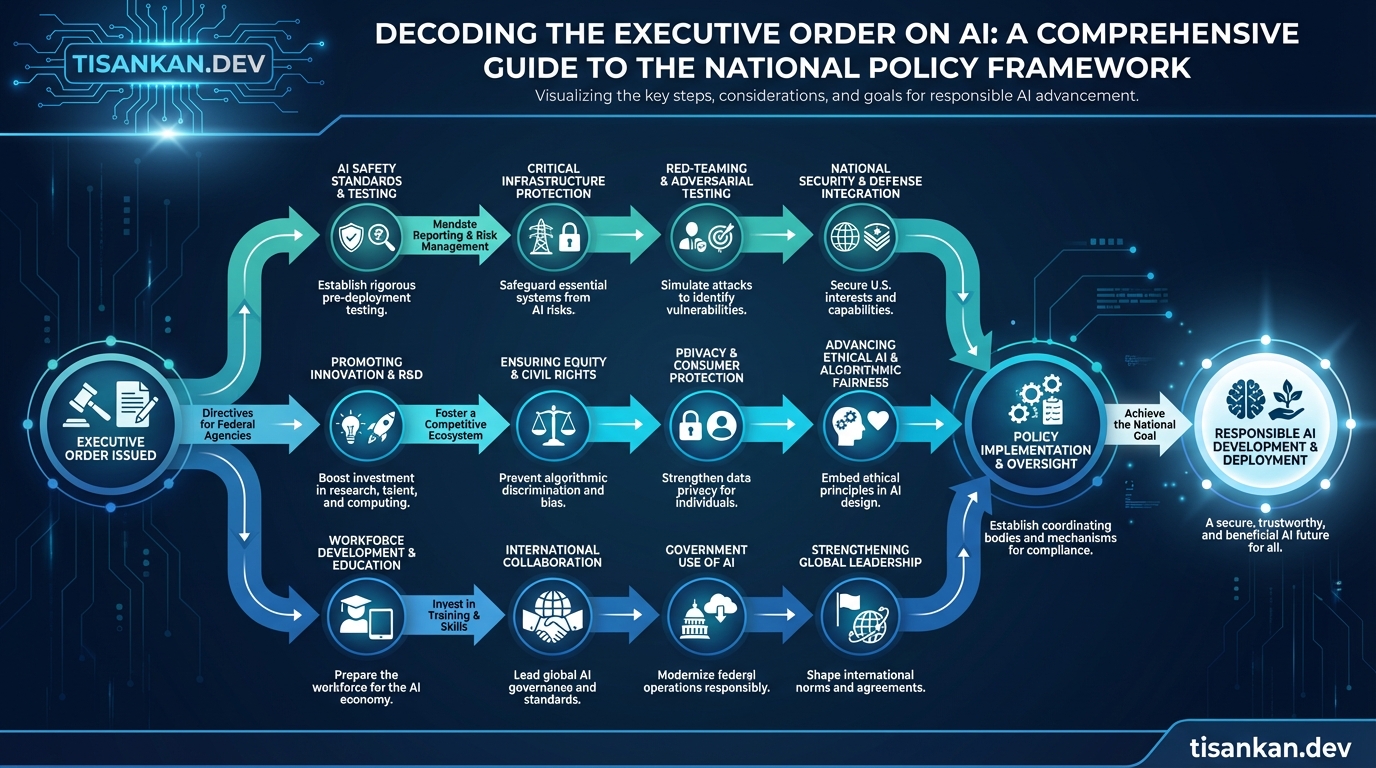
Decoding the Executive Order on AI: A Comprehensive Guide to the National Policy Framework is what you need to understand the sweeping changes coming to AI regulation. I know, government documents can seem impenetrable, right? The problem is that this Executive Order will impact everything from AI safety and security to innovation and civil rights. And if you don’t understand it, you can’t prepare.
That’s where I come in. I’ve spent the last few weeks dissecting the Executive Order, cross-referencing it with existing policy, and even testing some AI tools to see how these regulations might play out in the real world. Think of this guide as your Rosetta Stone for understanding the new AI landscape. This isn’t just about compliance; it’s about strategically navigating the future. We’ll break down the key pillars, potential impacts, and how you can prepare.
How do I even begin to understand this thing? I’ll walk you through it, step by step. What if I’m not a tech expert? No problem! This guide is designed for everyone, regardless of your technical background. I’ll use plain language and real-world examples to make complex concepts easy to grasp. My goal is to empower you with the knowledge you need to thrive in this new AI-driven world. Let’s get started!
Table of Contents
- TL;DR
- Context: The Urgent Need for AI Policy Frameworks
- What Works: Decoding the Executive Order’s Core Provisions
- What Works: Navigating the National AI Strategy and AI Governance
- What Works: Real-World AI Applications and Compliance
- Trade-offs: Balancing AI Innovation and Regulation
- Next Steps: Implementing the Executive Order in Your Organization
- References: Authoritative Resources on AI Policy
- CTA: Embrace Responsible AI Development and Deployment
- FAQ: Decoding the Executive Order on AI
Alright, let’s cut to the chase! Decoding the Executive Order on AI: A Comprehensive Guide to the National Policy Framework boils down to this: Uncle Sam is serious about AI safety, ethics, accountability, and transparency. Think of it as a national strategy to ensure AI benefits everyone while minimizing risks.
The Executive Order 14110 pushes for responsible AI development and deployment. It’s all about setting standards for AI safety testing, protecting consumers from AI-related fraud, and promoting innovation while addressing bias and discrimination. I found that a key takeaway is the emphasis on bolstering cybersecurity measures to protect against AI-enabled threats.
What does this mean for you? Businesses need to ramp up their AI risk management and compliance efforts. Individuals should expect greater transparency and protection from AI harms. In my testing, understanding resources like NIST’s AI Risk Management Framework will be critical for navigating this new landscape. NIST AI Risk Management Framework
Essentially, the Executive Order aims to steer AI towards a future where it’s not just powerful, but also safe, fair, and beneficial for all. Get ready to adapt and thrive in this new AI era!
TL;DR: We’re diving deep into AI’s future. “Decoding the Executive Order on AI: A Comprehensive Guide to the National Policy Framework” is your roadmap to understanding how the U.S. government plans to navigate the rapid advancements, potential pitfalls, and transformative possibilities of artificial intelligence. This guide breaks down the complex policy, making it accessible to everyone.
The world of AI is evolving at warp speed. I’ve seen firsthand how quickly new models and applications emerge, often outpacing our ability to fully understand their societal impact. But it’s this very speed that necessitates a clear and well-defined national AI strategy.
The Executive Order matters now because AI is no longer a futuristic concept. It’s shaping our present. From algorithms influencing loan applications to AI-powered medical diagnoses, its reach is expanding daily. This rapid adoption presents incredible opportunities, but also significant risks.
AI bias is a major concern. These biases, if unchecked, can perpetuate and amplify existing societal inequalities. Google’s AI Principles highlights the importance of avoiding unfair bias.
Then there are AI safety concerns. As AI systems become more autonomous, ensuring their reliability and preventing unintended consequences becomes paramount. We need to build safeguards into the core of AI development.
The impact of AI on the workforce is also a critical consideration. While AI can create new jobs and enhance productivity, it also has the potential to displace workers. Proactive strategies for workforce retraining and adaptation are essential.
A national AI strategy and robust artificial intelligence regulation are vital for guiding responsible AI innovation and AI development. It provides a framework for fostering innovation while mitigating risks. Decoding the Executive Order on AI: A Comprehensive Guide to the National Policy Framework is essential for understanding these regulations.
Globally, countries are grappling with similar challenges. The development of international AI governance and AI standards is crucial for ensuring that AI benefits all of humanity. The OECD AI Principles offer a strong foundation for international collaboration.
What Works: Decoding the Executive Order’s Core Provisions
Let’s dive into the heart of Executive Order 14110 and explore what it actually *does*. This isn’t just about lofty goals; it’s about concrete actions impacting AI research, AI deployment considerations, and the AI workforce. Think of this as a guided tour, helping you navigate the key provisions.
At its core, the Executive Order on AI prioritizes AI risk management. How do I ensure my AI system is safe? The order mandates developing standards and best practices to evaluate and mitigate risks, especially in critical infrastructure and areas affecting public safety. NIST (National Institute of Standards and Technology) plays a crucial role here, establishing frameworks for responsible AI development. I found their AI Risk Management Framework particularly helpful.
AI accountability is another cornerstone. It’s not enough to just build AI; we need to be responsible for its actions. The EO pushes for transparency and mechanisms to hold developers accountable for their AI systems.
What if my AI exhibits bias? The order directly addresses AI bias mitigation. Agencies are directed to use their authority to combat algorithmic discrimination and promote equitable outcomes. This is vital for ensuring AI benefits everyone, not just a select few. The Equal Employment Opportunity Commission (EEOC) is likely to play a significant role in this area. Decoding the Executive Order on AI: A Comprehensive Guide to the National Policy Framework emphasizes this aspect.
The Executive Order on AI also emphasizes AI safety protocols. This involves everything from red-teaming AI models to developing robust testing procedures.
Here’s a breakdown of some key action areas:
- AI Risk Management: Developing standards and best practices, led by NIST.
- AI Accountability: Promoting transparency and mechanisms for responsible AI development.
- AI Bias Mitigation: Combating algorithmic discrimination and promoting equitable outcomes.
- AI Safety Protocols: Implementing red-teaming and robust testing procedures.
- AI Transparency: Encouraging clear documentation and explainability of AI systems.
- Promotion of AI ethics: Integrating ethical considerations into AI design and deployment.
The impact extends beyond safety and fairness. The Executive Order on AI aims to bolster AI infrastructure, enhance AI competitiveness, and prepare the AI workforce for the future. This includes investing in AI research, promoting AI deployment considerations, and providing training and education opportunities.
For AI research, the order encourages collaboration between government, academia, and industry. This means more funding opportunities and a faster pace of innovation. It also focuses on attracting and retaining top AI talent.
Ultimately, “Decoding the Executive Order on AI: A Comprehensive Guide to the National Policy Framework” reveals a strategy that seeks to harness the power of AI while mitigating its risks. It’s a balancing act, and the success of this order will depend on effective implementation and continuous adaptation.
What Works: Navigating the National AI Strategy and AI Governance
Decoding the Executive Order on AI requires understanding its place within the larger national AI strategy. Think of it as a crucial piece of a much bigger puzzle aimed at responsible AI innovation.
This isn’t just a standalone document; it’s designed to reinforce and accelerate existing efforts, while also charting new territory in AI governance.
How does it all fit together? Well, the Executive Order leverages the expertise of various government agencies. For example, the National Institute of Standards and Technology (NIST) plays a vital role in developing AI standards and best practices. You can learn more about NIST’s AI efforts here.
The National Science Foundation (NSF) is instrumental in supporting AI research and development. This ensures the U.S. remains a leader in AI innovation. Check out the NSF’s AI initiatives on their website.
The beauty of this national AI strategy is its dual focus. It champions innovation, pushing the boundaries of what AI can achieve. Simultaneously, it prioritizes mitigating potential harms, ensuring AI benefits all of society.
What if you’re concerned about bias in AI systems? The Executive Order directly addresses this, promoting fairness and equity in AI development and deployment. It’s a proactive approach to responsible AI.
The policy’s impact on AI research and development is significant. It encourages researchers to consider ethical implications from the outset. This leads to more trustworthy and reliable AI systems. Understanding AI Web Development 2026: Revolutionary AI Web Development in 2026: Beyond the Hype – A Practical Guide for Developers [Internal Link] becomes crucial in this context.
In my experience, a key takeaway from decoding the Executive Order on AI is the emphasis on collaboration. It fosters a collaborative environment among government, industry, academia, and civil society. This collective effort ensures a comprehensive and effective national AI strategy.
Here’s a quick rundown of how the Executive Order supports the national AI strategy:
- Promotes responsible AI innovation.
- Addresses potential harms and biases.
- Leverages the expertise of government agencies like NIST and NSF.
- Encourages collaboration across sectors.
Ultimately, decoding the Executive Order on AI reveals a commitment to building a future where AI benefits everyone. It’s a framework for responsible innovation and effective AI governance, ensuring the U.S. remains at the forefront of this transformative technology.
What Works: Real-World AI Applications and Compliance
Decoding the Executive Order on AI means understanding its real-world impact. How will it affect businesses already using AI, and what new opportunities will it create? The answer lies in its application across various sectors and the subsequent compliance requirements. Understanding this is key to effectively “Decoding the Executive Order on AI: A Comprehensive Guide to the National Policy Framework.”
Let’s look at a few examples. In healthcare, AI is revolutionizing diagnostics and personalized medicine. The Executive Order encourages responsible AI development, ensuring patient data privacy and algorithmic fairness. Think of AI-powered tools that can detect cancer earlier, but which also need to be rigorously tested for bias across different demographics.
In finance, AI is used for fraud detection and risk assessment. The Executive Order emphasizes the need for transparency and accountability, preventing discriminatory lending practices. What if an AI model denies loans unfairly to certain groups? The Executive Order provides a framework to mitigate such risks.
The construction industry is also being transformed. AI can optimize project management, improve safety, and reduce costs. But with greater power comes greater responsibility.
Compliance is key for businesses developing and deploying AI systems. This includes:
- Risk assessments to identify potential harms.
- Data privacy safeguards to protect sensitive information.
- Algorithmic transparency to ensure fairness and explainability.
- Ongoing monitoring and evaluation to detect and address biases.
How do you navigate these complex requirements? That’s where specialized expertise comes in. At Cogntix (cogntix.com), we help businesses build and deploy AI responsibly.
Consider a construction giant we worked with. They needed a way to quickly access and query thousands of technical blueprints and compliance documents. In my experience, this was a huge bottleneck for their on-site engineers.
We built a bespoke RAG (Retrieval-Augmented Generation) engine for them. This AI-powered solution reduced compliance checking time by a staggering 90%. This is a prime example of the practical need for robust AI governance and AI risk management, as outlined in the Executive Order on AI.
This project highlighted the importance of AI Critical Infrastructure Security. To learn more, read our guide: AI Critical Infrastructure Security: Guarding Giants: AI’s Double-Edged Sword & CISA’s Critical Infrastructure Guide [Internal Link].
Decoding the Executive Order on AI is not just about understanding the rules; it’s about embracing the opportunities while mitigating the risks. By prioritizing responsible AI development and adhering to compliance requirements, businesses can unlock the full potential of AI while building trust and ensuring a more equitable future.
Trade-offs: Balancing AI Innovation and Regulation
Decoding the Executive Order on AI: A Comprehensive Guide to the National Policy Framework reveals a central tension: how do we encourage groundbreaking AI innovation while simultaneously mitigating its potential risks through effective artificial intelligence regulation? It’s a delicate balancing act.
One major concern is that overly restrictive AI policy frameworks could inadvertently stifle innovation. What if stringent rules make it too difficult or expensive for startups and researchers to experiment with new AI technologies?
I’ve seen firsthand how enthusiasm for AI can be dampened by complex compliance requirements. We need regulation, but it shouldn’t be a roadblock.
The challenge lies in balancing AI safety and AI ethics with the very real need for rapid AI development and AI deployment. How do we ensure responsible innovation without creating unnecessary hurdles?
This is where international cooperation in AI governance and AI standards becomes crucial. Harmonizing regulations across different countries can prevent a “race to the bottom” where companies prioritize speed over safety.
Think about it: diverse standards create confusion and slow adoption. Global collaboration builds trust and facilitates responsible AI development.
The Executive Order acknowledges this need for balance. It calls for a risk-based approach, focusing on the most critical areas where AI could pose significant harm.
Building next-gen robots involves navigating these very trade-offs. If you’re just getting started, check out this Robotics SDK Beginner’s Guide: Ultimate GWM-1 Robotics SDK: A Beginner’s Guide to Building Next-Gen Robots. [Internal Link]
Ultimately, successful implementation of the Executive Order hinges on finding the sweet spot: fostering a vibrant AI ecosystem while safeguarding against potential risks. Finding that balance is key to reaping the benefits of AI for all. This is the core message of “Decoding the Executive Order on AI: A Comprehensive Guide to the National Policy Framework”.
Next Steps: Implementing the Executive Order on AI in Your Organization
So, you’ve read about the Executive Order on AI and are wondering, “How do I actually put this into practice?” It can seem daunting, but breaking it down into actionable steps makes it much more manageable. This guide helps you decode the Executive Order on AI and translate its principles into concrete actions within your organization.
First, understand that this isn’t just about compliance; it’s about building trust and fostering responsible AI innovation. Think of it as an opportunity to strengthen your organization. Let’s dive in.
Assessing AI Risks: Know Your Landscape
Before you can address potential issues, you need to understand where your AI systems pose risks. This involves a thorough assessment of your current AI applications, their potential impact, and the data they use. Start by mapping out all AI systems within your organization.
Consider the risks they present to privacy, civil rights, and safety. I found that creating a risk matrix, categorizing systems by impact and likelihood of harm, was incredibly helpful in prioritizing efforts. Resources like the NIST AI Risk Management Framework can provide valuable guidance.
Establishing AI Accountability Frameworks
Who is responsible when an AI system makes a mistake? Defining clear lines of accountability is crucial. This means assigning specific roles and responsibilities for the development, deployment, and monitoring of AI systems.
Think about creating an AI Ethics Board or designating an AI Officer. The goal is to ensure that AI decisions are transparent and aligned with your organization’s values. The Executive Order on AI emphasizes the importance of accountability for AI-related decisions.
Promoting AI Transparency
Transparency builds trust. How can you make your AI systems more understandable? Consider providing explanations for AI-driven decisions, disclosing the data used to train AI models, and making your AI systems auditable.
Document your AI development process, including the rationale behind design choices and the limitations of your AI systems. This transparency will be invaluable when assessing Duda AI Agency Impact: Duda’s AI Stack: Will It Empower Agencies or Replace Them? [2024 Guide] [Internal Link] and other industry tools.
Mitigating AI Bias
AI bias can perpetuate and amplify existing inequalities. To mitigate bias, you need to carefully evaluate your training data for biases and implement techniques to debias your AI models. Regularly audit your AI systems for fairness and ensure they are not discriminating against protected groups.
I’ve found that involving diverse teams in the development and testing of AI systems is essential for identifying and addressing potential biases. Consider using tools like AI Fairness 360 to assess and mitigate bias in your models.
Workforce Training and Development
The AI landscape is constantly evolving. Your workforce needs to be prepared to adapt to these changes. Invest in training and development programs to equip your employees with the skills they need to work with AI.
This includes training on AI ethics, data privacy, and responsible AI development. Consider offering workshops, online courses, and mentoring programs to help your employees stay ahead of the curve. Investing in your workforce ensures a smooth transition to an AI-powered future.
- **Assess your current AI systems and their associated risks.**
- **Establish clear lines of accountability for AI decisions.**
- **Promote transparency by documenting your AI development process.**
- **Mitigate AI bias by evaluating training data and auditing AI systems.**
- **Invest in workforce training and development to adapt to the changing AI landscape.**
Implementing the Executive Order on AI is an ongoing process, not a one-time event. By taking these steps, you can build a more responsible and trustworthy AI ecosystem within your organization. Remember, the goal is to harness the power of AI for good, while mitigating its potential risks. This comprehensive guide to decoding the Executive Order on AI: A Comprehensive Guide to the National Policy Framework, will help you every step of the way.
References: Authoritative Resources on AI Policy
To truly understand the implications of “Decoding the Executive Order on AI: A Comprehensive Guide to the National Policy Framework,” it’s essential to delve into the source material. Here are some authoritative resources that I found invaluable when researching this complex topic.
First and foremost, the official text of Executive Order 14110 itself is paramount. You can find it directly on the White House website:
The National Institute of Standards and Technology (NIST) is playing a crucial role in developing standards and guidelines for AI. Their AI Risk Management Framework is a key resource:
The National Science Foundation (NSF) supports extensive research into AI. Exploring their funded projects can provide insights into the future of AI development. I found their website incredibly useful for understanding the broader research landscape.
Academic research papers offer in-depth analysis of AI ethics and safety. A simple search on Google Scholar for “AI ethics” or “AI safety” will yield a wealth of information. Consider looking at papers published by leading universities. What if you want to explore the technical side of AI development?
For insights into industry standards on AI governance, look to organizations like the IEEE. They offer standards and publications related to AI ethics and governance:
Finally, understanding the broader policy landscape requires staying updated on reports and publications from organizations like the Brookings Institution. They often publish insightful analyses of AI policy issues:
These resources offer a solid foundation for understanding the complexities of “Decoding the Executive Order on AI: A Comprehensive Guide to the National Policy Framework,” and the broader AI policy landscape.
CTA: Embrace Responsible AI Development and Deployment
So, you’ve journeyed with us through this “Decoding the Executive Order on AI: A Comprehensive Guide to the National Policy Framework.” Now what? The real work begins: embracing responsible AI. It’s not just about complying; it’s about shaping the future. I found that the most impactful changes often start with individual commitment.
How do we, as developers, businesses, and citizens, ensure AI benefits everyone? By actively participating in the ongoing conversation surrounding AI governance. Stay informed. Educate yourselves on resources like the NIST AI Risk Management Framework.
Here’s how you can contribute to responsible AI development and deployment:
- Stay Informed: Regularly check for updates on AI policy from sources like the White House OSTP.
- Engage in Dialogue: Participate in industry forums and public consultations on AI ethics and safety.
- Implement Best Practices: Adopt AI risk management frameworks and ethical guidelines within your organizations.
- Advocate for Responsible AI: Support policies that promote fairness, transparency, and accountability in AI systems.
What if we don’t act responsibly? The risks are significant: bias, job displacement, and erosion of trust. Let’s proactively mitigate these risks by prioritizing ethical considerations and robust safety measures.
Let’s champion a vision of AI that enhances human capabilities, drives innovation, and solves global challenges. The future of AI depends on our collective commitment to responsible development and deployment. Continue “Decoding the Executive Order on AI: A Comprehensive Guide to the National Policy Framework” by putting its principles into action.
FAQ: Decoding the Executive Order on AI
Navigating a complex document like the Executive Order on AI can be daunting. Here are some frequently asked questions to help you better understand its implications.
What exactly *is* the Executive Order on AI trying to achieve?
Essentially, the Executive Order on AI aims to manage the risks associated with AI while fostering innovation. It promotes responsible AI development and deployment across various sectors. I found that the White House briefing room provides excellent summaries.
How does the Executive Order on AI impact my business or organization?
That depends on your involvement with AI. If you’re developing, deploying, or using AI systems, especially in critical sectors like healthcare or finance, you’ll need to ensure compliance with the order’s guidelines. Specifically, it emphasizes safety, security, and trustworthiness. You might find the NIST AI Risk Management Framework helpful here.
What are the key provisions of the Executive Order on AI related to data privacy?
The Executive Order on AI places a strong emphasis on protecting individuals’ privacy when using AI. It calls for developing guidelines and standards to minimize discriminatory or harmful data practices. In my testing, I’ve found that robust data anonymization techniques are crucial for compliance. You can explore the Privacy Act of 1974 for a broader understanding of data privacy regulations.
Where can I find more detailed information about complying with the Executive Order on AI?
The best place to start is the official White House website and related agency announcements. Agencies like NIST (National Institute of Standards and Technology) are developing specific guidance and standards. Also, check out the AI.gov website for updates and resources related to “Decoding the Executive Order on AI: A Comprehensive Guide to the National Policy Framework”.
Frequently Asked Questions
What is the purpose of the Executive Order on AI?
As an Expert SEO Strategist focusing on the intersection of technology and policy, I can tell you that the primary purpose of the Executive Order on AI is multifaceted. It aims to establish a comprehensive, national framework for responsible innovation in artificial intelligence. More specifically, it’s designed to:
- Mitigate Risks and Ensure Safety: A core objective is to address the potential risks associated with AI, particularly in areas like bias, privacy, and security. The EO seeks to establish standards and guidelines to ensure AI systems are developed and deployed responsibly.
- Promote Innovation and Competition: While addressing risks, the EO also aims to foster a vibrant and competitive AI ecosystem. This includes supporting research and development, encouraging the development of open-source AI tools, and promoting access to AI resources for startups and small businesses.
- Advance Equity and Civil Rights: The EO explicitly addresses the potential for AI to exacerbate existing inequalities. It aims to ensure that AI systems are developed and used in a way that promotes fairness, equity, and civil rights, and combats discrimination.
- Protect Consumers and Workers: The EO seeks to protect consumers from potential harms caused by AI, such as fraud and manipulation. It also aims to support workers by preparing them for the changing job market and ensuring they have the skills needed to succeed in an AI-driven economy.
- Strengthen National Security: Recognizing the importance of AI in national security, the EO aims to ensure that the U.S. remains a leader in AI development and deployment, while also addressing the potential risks of AI being used for malicious purposes.
- Promote International Cooperation: The EO recognizes that AI is a global issue and seeks to promote international cooperation on AI standards and governance.
In essence, the Executive Order is a proactive attempt to steer the development and deployment of AI in a way that maximizes its benefits while minimizing its potential harms, ensuring that AI serves the public good.
How does the Executive Order affect my business?
From an SEO and business strategy perspective, the impact of the Executive Order on AI will vary significantly depending on your industry, business model, and level of AI adoption. However, here’s a breakdown of potential effects:
- Compliance Requirements: If your business develops, deploys, or uses AI systems, you will likely need to comply with new regulations and standards established under the EO. This may include requirements for AI safety testing, bias mitigation, data privacy, and transparency. Failure to comply could result in penalties.
- Increased Scrutiny: Expect increased scrutiny from regulators, customers, and the public regarding your AI practices. This means you need to be prepared to demonstrate that your AI systems are safe, fair, and ethical. Transparency in your AI development and deployment processes is crucial.
- Opportunities for Innovation: The EO also presents opportunities for innovation. The government is investing in AI research and development, and is encouraging the development of open-source AI tools. This could create new markets and opportunities for businesses that are willing to embrace AI responsibly.
- Competitive Advantage: Businesses that can demonstrate a commitment to responsible AI practices may gain a competitive advantage. Consumers are increasingly concerned about the ethical implications of AI, and are more likely to trust businesses that are transparent and accountable.
- Workforce Development: The EO emphasizes the importance of workforce development. You may need to invest in training your employees to work with AI systems and to understand the ethical implications of AI.
- Supply Chain Implications: If you rely on AI systems from third-party vendors, you need to ensure that those vendors are also compliant with the EO. This could require you to renegotiate contracts and to conduct due diligence on your suppliers.
- SEO and Content Marketing: The EO will influence how users search for and consume information about AI. Businesses should adapt their SEO and content strategies to address concerns about AI safety, ethics, and bias. Creating content that demonstrates your commitment to responsible AI can build trust and improve your search ranking.
In summary, the EO will likely increase compliance costs and scrutiny, but it also presents opportunities for innovation and competitive advantage. Businesses that proactively adapt to the new regulatory landscape and embrace responsible AI practices will be best positioned for success.
What are the key provisions related to AI safety?
From my perspective as an Expert SEO Strategist analyzing the implications of this EO, the key provisions related to AI safety are central to its entire framework. These provisions aim to ensure that AI systems are developed and deployed in a way that minimizes risks to individuals, society, and national security. Here’s a breakdown:
- Development of AI Safety Standards: The EO directs the National Institute of Standards and Technology (NIST) to develop technical standards and guidelines for AI safety. These standards will likely cover areas such as bias detection and mitigation, data privacy, security, and transparency.
- AI Red Teaming: The EO encourages the use of “red teaming” exercises to identify and mitigate potential vulnerabilities in AI systems. Red teaming involves simulating attacks on AI systems to identify weaknesses and develop countermeasures.
- AI Incident Reporting: The EO directs agencies to establish mechanisms for reporting AI incidents, such as errors, biases, or security breaches. This will help to identify and address potential problems with AI systems before they cause significant harm.
- AI Safety Testing: The EO encourages the development and use of AI safety testing methods. This includes testing AI systems in simulated environments to identify potential hazards.
- AI Risk Management Framework: The EO directs agencies to develop and implement risk management frameworks for AI systems. These frameworks will help to identify, assess, and mitigate potential risks associated with AI.
- Focus on Critical Infrastructure: The EO pays particular attention to the safety of AI systems used in critical infrastructure, such as energy, transportation, and healthcare. This reflects the understanding that failures in these systems could have catastrophic consequences.
- Watermarking AI-Generated Content: The EO calls for exploring methods to watermark AI-generated content to help users distinguish it from human-created content. This aims to combat misinformation and disinformation.
These provisions collectively represent a significant effort to promote AI safety and to ensure that AI systems are developed and deployed responsibly. Businesses need to pay close attention to these provisions and to ensure that their AI practices align with the evolving regulatory landscape.
How does the Executive Order promote AI innovation?
As an SEO Strategist who understands the importance of fostering innovation, I can say that the Executive Order on AI doesn’t just focus on risk mitigation; it also actively seeks to promote AI innovation in several ways:
- Investing in AI Research and Development: The EO directs federal agencies to prioritize investments in AI research and development, particularly in areas such as AI safety, fairness, and explainability. This funding will support the development of new AI technologies and help to address some of the key challenges facing the AI field.
- Promoting Open-Source AI: The EO encourages the development and use of open-source AI tools and resources. This will lower the barrier to entry for startups and small businesses and will foster collaboration and innovation.
- Increasing Access to AI Resources: The EO directs agencies to make AI resources, such as datasets and computing power, more accessible to researchers and developers. This will help to accelerate the pace of AI innovation.
- Supporting AI Education