


Home Office admits facial recognition tech issue with black and Asian subjects – The Guardian. This admission isn’t a mere oversight; it’s a symptom of systemic bias baked into AI systems used by law enforcement.
Context: Why This Demands Immediate Action
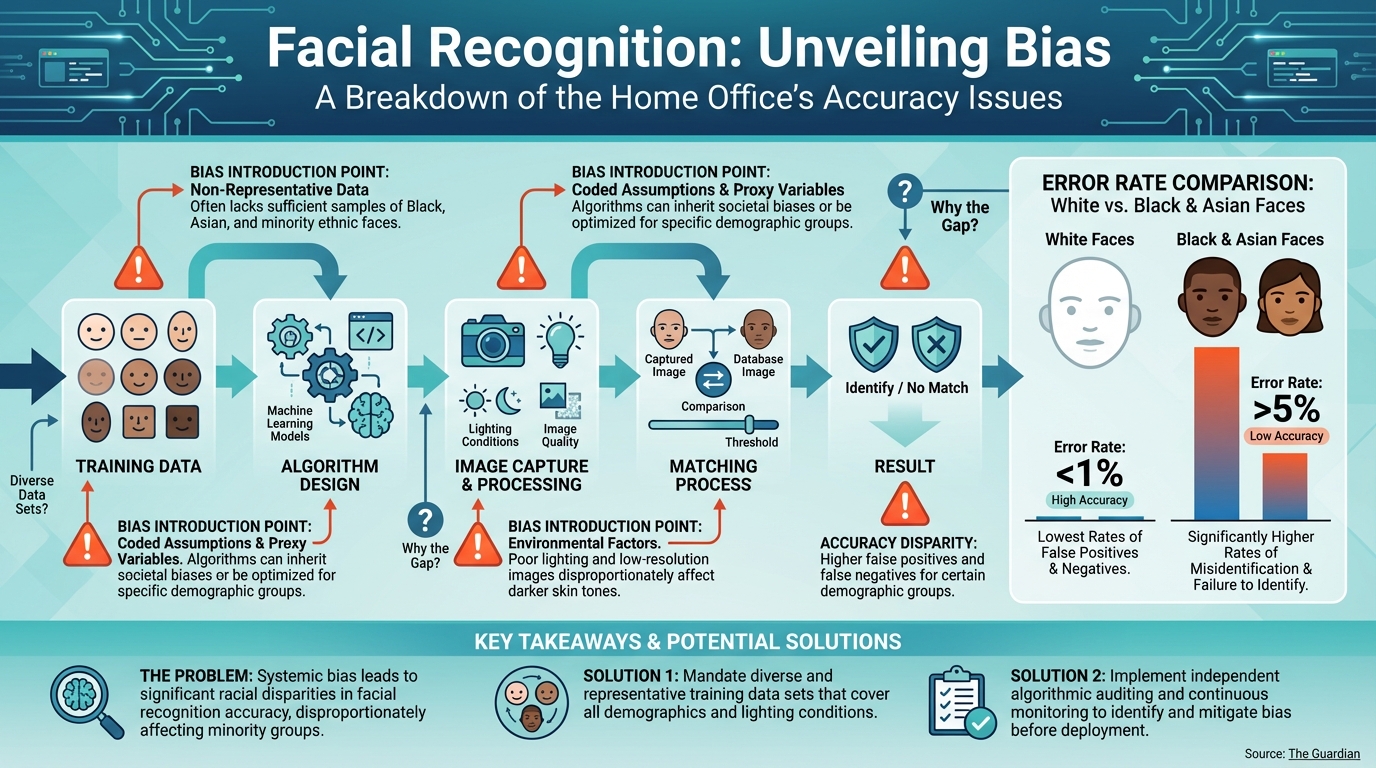
Biased facial recognition isn’t a future threat; it’s actively shaping policing, border control, and surveillance now. The Guardian’s report exposes a critical vulnerability: disproportionate misidentification of individuals from specific ethnic backgrounds. This isn’t a glitch; it’s a question of justice.
The Deep Dive: Algorithmic Bias Unmasked
The rot lies in the training datasets. Skewed datasets, lacking diverse representation, inherently cripple AI performance across demographics. Imagine training an image recognition system solely on photos of golden retrievers; it would fail miserably at identifying Chihuahuas. Facial recognition suffers the same fate. Subtle variations in skin tone, facial structure, and even lighting conditions trigger algorithmic errors. Robust, cross-demographic testing isn’t optional; it’s a prerequisite for ethical deployment.
Expert Opinion: Bias as a Feature, Not a Bug
As a CTO who’s built and audited AI systems, I’ve witnessed firsthand how bias can be inadvertently engineered into these systems. 7 Proven Ways AI Chatbots Are Rewriting Political Persuasion: MIT Tech Review Analysis underscores the broader dangers of unchecked AI influence, a concern that’s amplified in facial recognition.
The Home Office’s acknowledgement isn’t progress; it’s damage control. We need immediate, stringent regulations, not just “ethical guidelines.” Biased AI *already* perpetuates systemic inequalities. This demands accountability.
Technologists bear the responsibility to build equitable systems. This means aggressive investment in diverse datasets, red-team testing that actively seeks out biases, and transparent reporting on limitations. We must acknowledge that these systems are *not* infallible and build safeguards accordingly.
Real-World Scenario: The Stop and Frisk Parallel
Imagine a facial recognition system flagging individuals from a specific ethnic background at a higher rate for “suspicious activity” based on biased training data. This directly translates to a digital version of “stop and frisk,” disproportionately targeting and surveilling specific communities. The potential for abuse and erosion of civil liberties is immense. This isn’t hypothetical; it’s a trajectory we must actively prevent.
The Future: From Bias to Justice
Rectifying facial recognition bias demands a coordinated effort. Researchers need to develop bias-detection algorithms. Policymakers must enact enforceable regulations with teeth. The tech industry has to prioritize ethical development over rapid deployment. Adversarial training and federated learning offer promising technical avenues, but they’re not silver bullets.
Ultimately, technical solutions are insufficient without addressing the underlying social and political inequities that fuel bias. This requires fostering diversity *within* the tech industry and challenging discriminatory practices *within* law enforcement. 11 Strategic Insights for The AI Backlash Is Here: Why Public Patience with Tech Giants Is Running Out correctly identifies the growing public distrust of AI. Ethical considerations must be paramount, or we risk a complete societal rejection of these technologies.
9 Critical Lessons from the Home Office Debacle
- Data Diversity is Non-Negotiable: Garbage in, garbage out. Period.
- Bias is a Design Flaw: It’s not a bug; it’s a failure of the development process.
- Transparency is Mandatory: Open-source algorithms and datasets are essential for accountability.
- Regulation is Overdue: Self-regulation has demonstrably failed.
- Testing Must Be Adversarial: Actively seek out biases; don’t passively wait for them to emerge.
- Collaboration Across Disciplines: Tech, law, and social sciences must converge.
- Ethics Must Be Enforced: Ethical principles are meaningless without consequences.
- Human Oversight is Indispensable: AI is a tool, not a replacement for human judgment.
- Continuous Auditing is Essential: Bias can creep in over time; constant vigilance is required. 7+ Proven Strategies for Tech Pitch for Non-Technical Founders Success in 2025: A Step-by-Step Guide highlights the need for clear communication between technical experts and the public.
FAQ: Debunking Myths About Facial Recognition Bias
Q1: Why is facial recognition inherently biased?
A1: It’s not “inherently” biased, but current systems *are* biased due to skewed training data and flawed algorithms.
Q2: How can we fix this bias?
A2: By using diverse, representative datasets; employing adversarial training; and implementing rigorous, ongoing testing.
Q3: What regulations exist to prevent bias?
A3: Current regulations are weak and inconsistent. Stronger, enforceable laws are urgently needed.
Q4: How accurate is facial recognition *really*?
A4: Accuracy claims are often misleading. Performance varies wildly depending on demographics, lighting, and other factors. For some groups, it’s demonstrably unreliable.
Q5: What are the broader ethical implications?
A5: Mass surveillance, erosion of privacy, and the perpetuation of systemic discrimination are just the tip of the iceberg. 7+ Proven Strategies for Minimum Marketable Product (MMP) Success in 2025: Achieving Product-Market Fit Faster with AI and Empathy reminds us that empathy must be at the core of tech development.
Q6: What’s the role of humans in this process?
A6: Humans must provide oversight, challenge algorithmic outputs, and ensure fairness. AI should augment, not replace, human judgment and accountability. Mastering Real-Time Data Updates with WebSocket APIs can facilitate faster human intervention when AI errors are detected.
The Home Office’s admission is a call to action, not a cause for celebration. We must demand accountability and work towards a truly equitable future.
For further investigation, consult The Guardian’s original reporting and resources from organizations like the Electronic Frontier Foundation (EFF) and the American Civil Liberties Union (ACLU).